Global reports and market data
Documents
Human, All Too Non-Human: Coop AI and the Conversation of Action
The document, "Human, All Too Non-Human: Coop AI and the Conversation of Action," explores the cultural sociological implications of human-computer interaction in digital games, particularly focusing on cooperative AI (Coop AI) as a departure from traditional competitive models.
- Simon argues that single-player games often preserve a "humanist remains" by hiding machine labor behind an illusion of individual human mastery, whereas cooperative AI foregrounds a "conversation of actions" in which players must continually track and adapt to non-human comrades.
- The paper frames cooperative AI as a move toward critical posthumanism, drawing on Haraway, Latour, Hayles, and Baudrillard, and uses Mori's uncanny valley to describe the unsettling yet productive tension it creates.
- Simon contends that cooperative AI opens exploratory space that competitive, Turing-style AI (exemplified by chess and the 1997 Deep Blue–Kasparov match) has largely closed off.
Ghastly Multiplication: Fatal Frame II and the Videogame Uncanny
The document analyzes how Fatal Frame II: Crimson Butterfly uniquely generates the uncanny in a videogame context, moving beyond traditional literary or filmic interpretations.
- The videogame uncanny, per this paper, arises not just from borrowed literary or filmic techniques but from the interplay of operational demands (controls, camera, mechanics) and affective experience, producing a distinctly ludic form of the familiar made unfamiliar.
- Using Fatal Frame II: Crimson Butterfly (Tecmo, 2003, PlayStation 2) as its case study, the authors show how camera-based combat, shifts between third- and first-person perspectives, and restricted movement during camera mode generate uncanny effects.
- The twin avatars Mio and Mayu and the Crimson Sacrifice ritual, in which one twin kills the other, are read as doubles that mirror the player's own uncertain identification with the avatar.
Mapping Time in Video Games
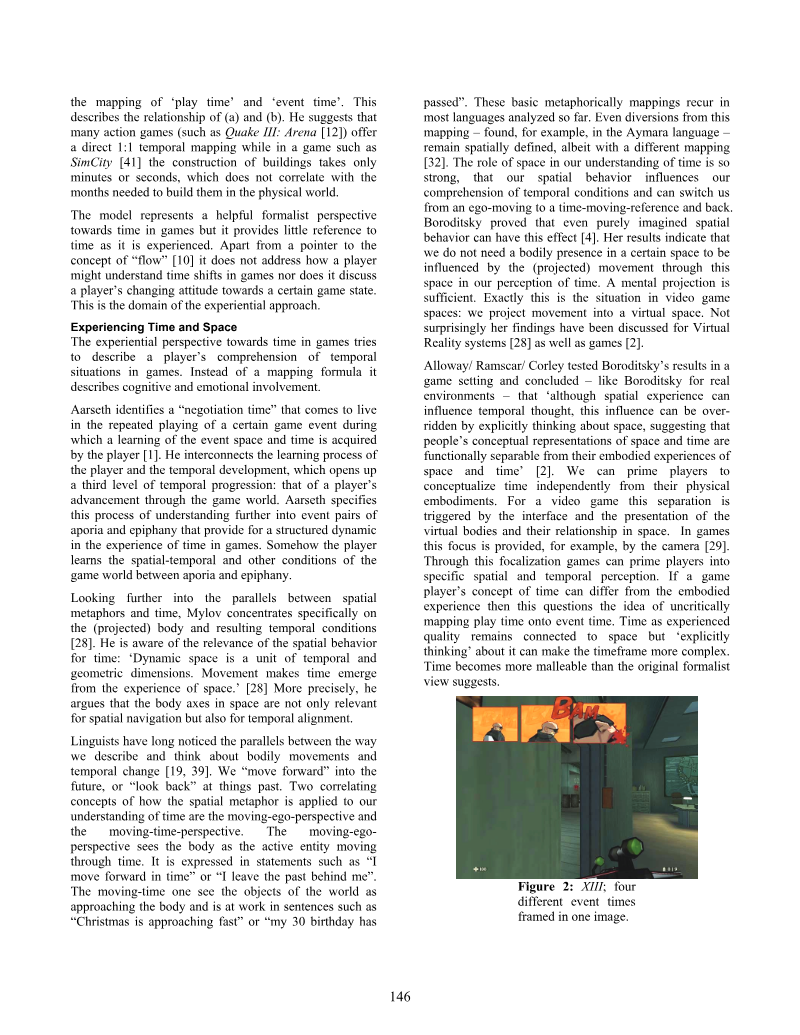
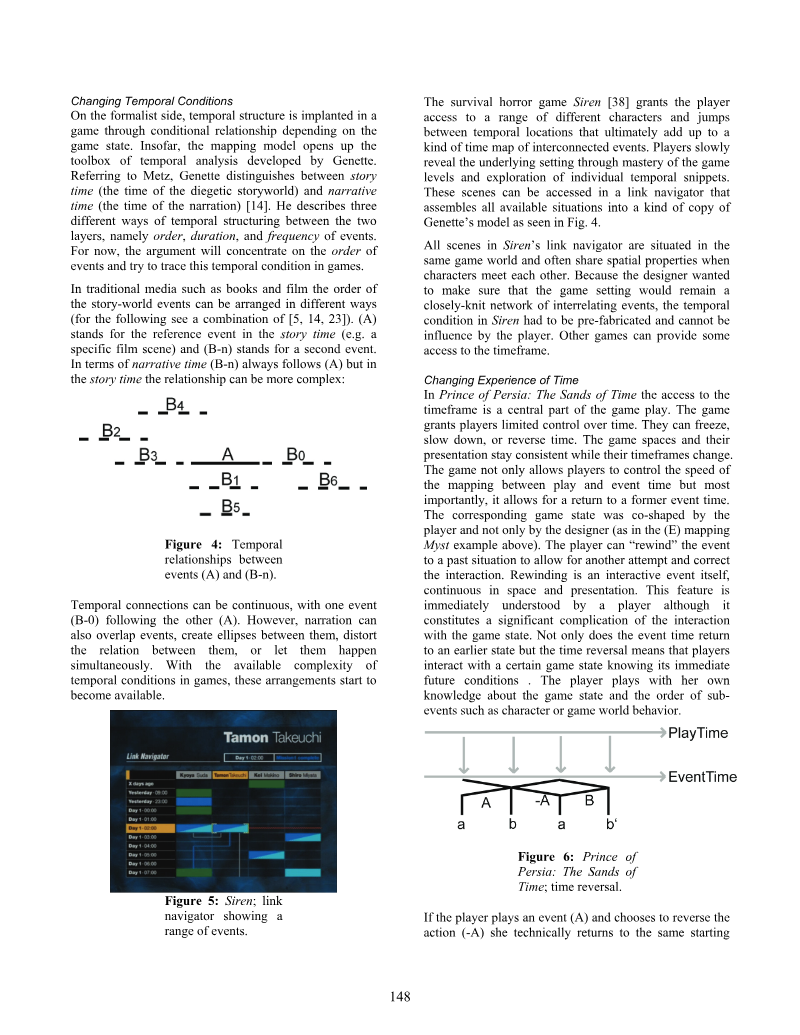
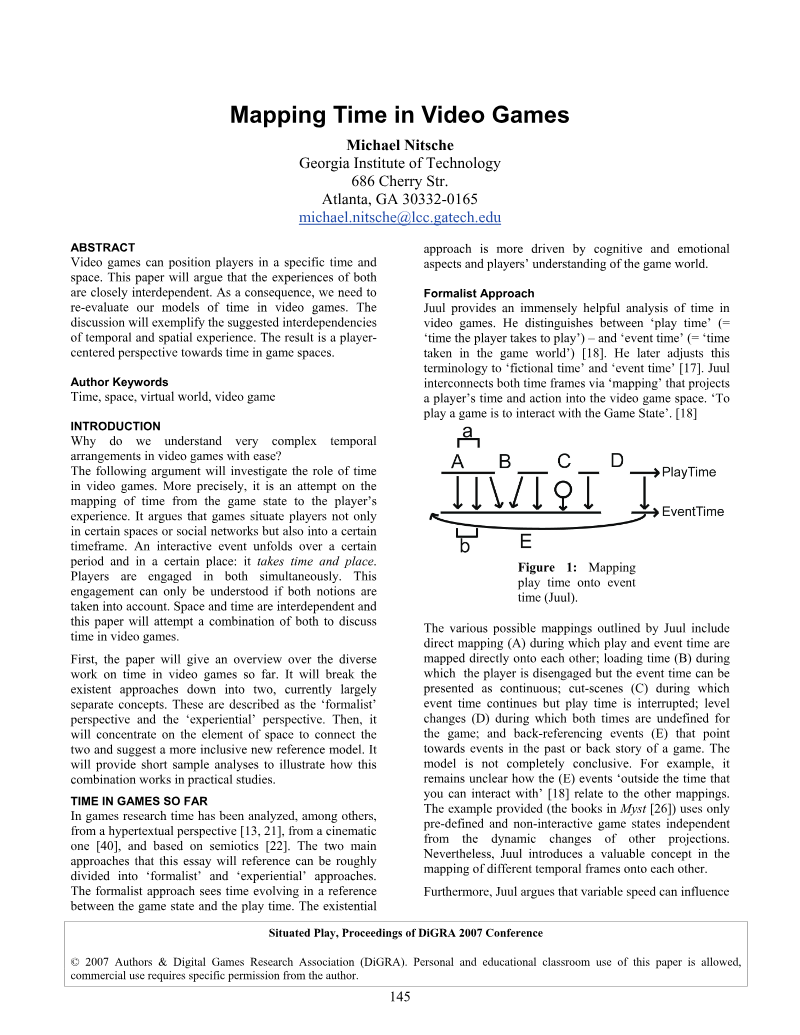
Michael Nitsche's paper "Mapping Time in Video Games" argues that players are situated in both space and time when playing, and that our understanding of temporal structures in games depends on our comprehension of their spatial relationships.
- Michael Nitsche's paper argues that players are situated in both space and time during play, and that understanding temporal structures in games depends on understanding their spatial relationships.
- The paper proposes combining the formalist model (Jesper Juul's mapping of play time onto event time, including direct mapping, loading time, cut-scenes, level changes, and back-referencing) with the experiential model (Espen Aarseth's negotiation time and players' cognitive and emotional engagement with temporal situations).
- Space is identified as the connecting element between the formalist and experiential models, with players projecting movement into virtual spaces so that consistent spatial layout keeps complex temporal arrangements legible.

Understanding Pervasive Games through Gameplay Design Patterns
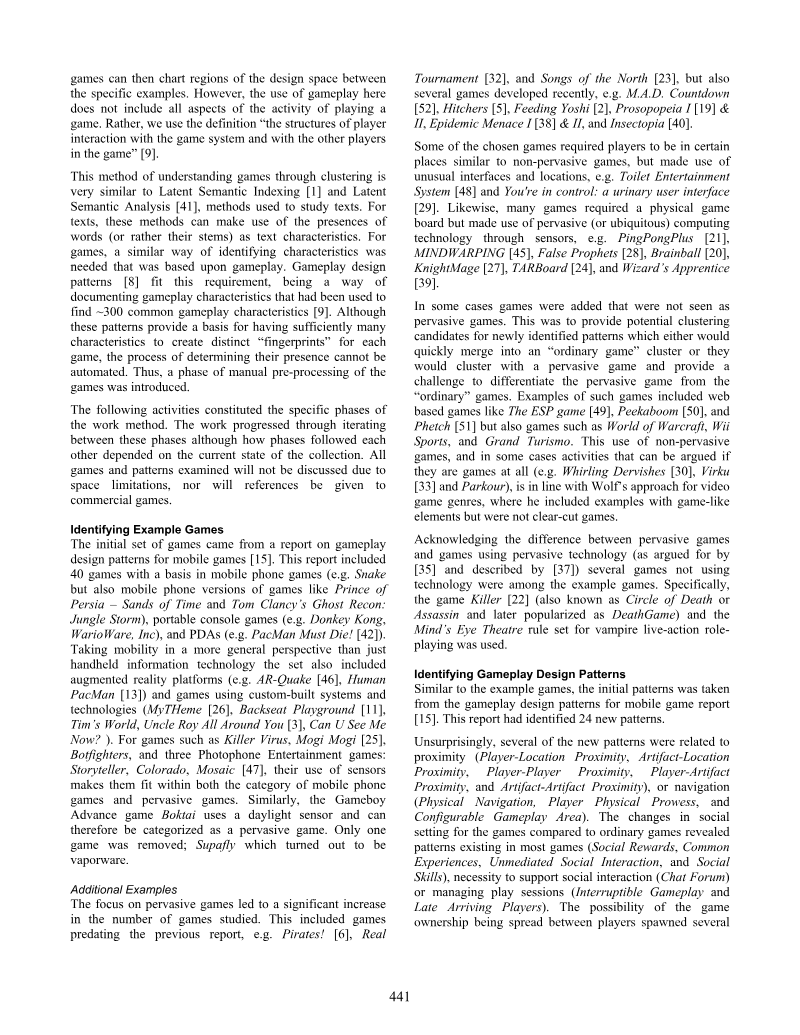
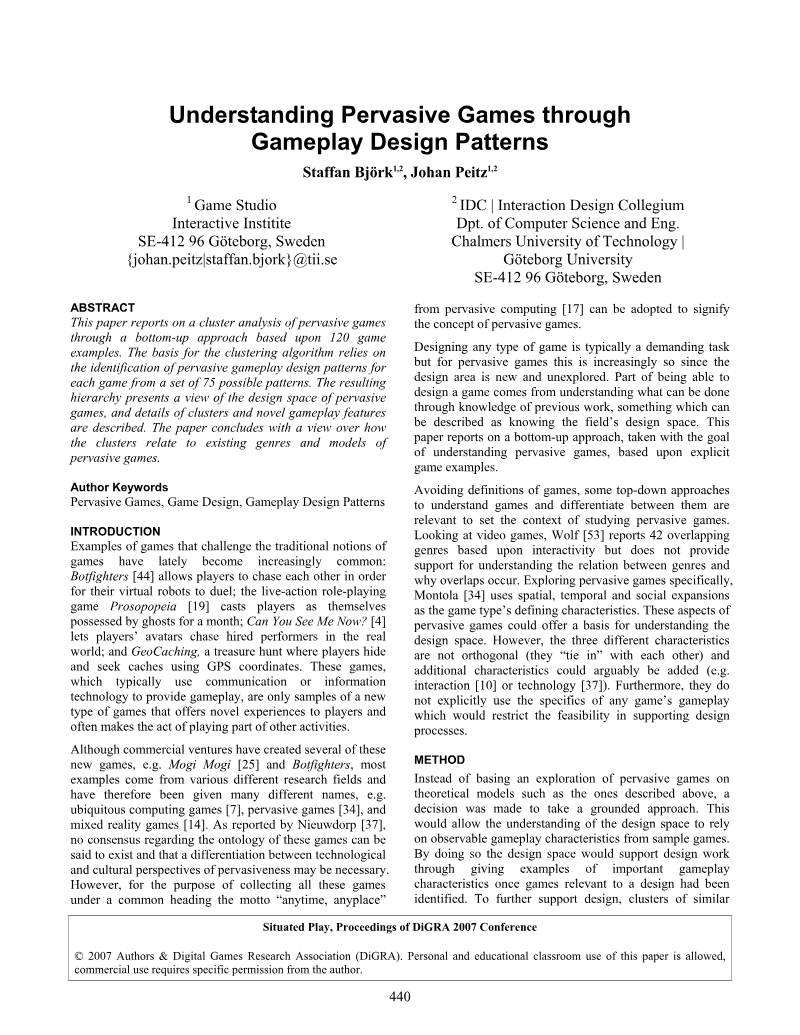
The 2007 study "Understanding Pervasive Games through Gameplay Design Patterns" examines how pervasive games, those that extend play into everyday physical and social spaces, can be characterized and organized through a shared vocabulary of design patterns.
- The study analyzed 120 pervasive game examples against 75 gameplay design patterns, of which 53 were newly developed for pervasive contexts and 24 carried over from an earlier study of mobile games.
- Rather than classifying games by genre, the authors used a bottom-up approach, grouping patterns with a custom clustering program and treating cluster names as hypotheses about each group's core character.
- The resulting cluster hierarchy maps the pervasive game design space, with GPS Games the most distinct grouping, separated mainly by its lack of social-interaction patterns.
Designing a Game to Model Consumer Misbehavior
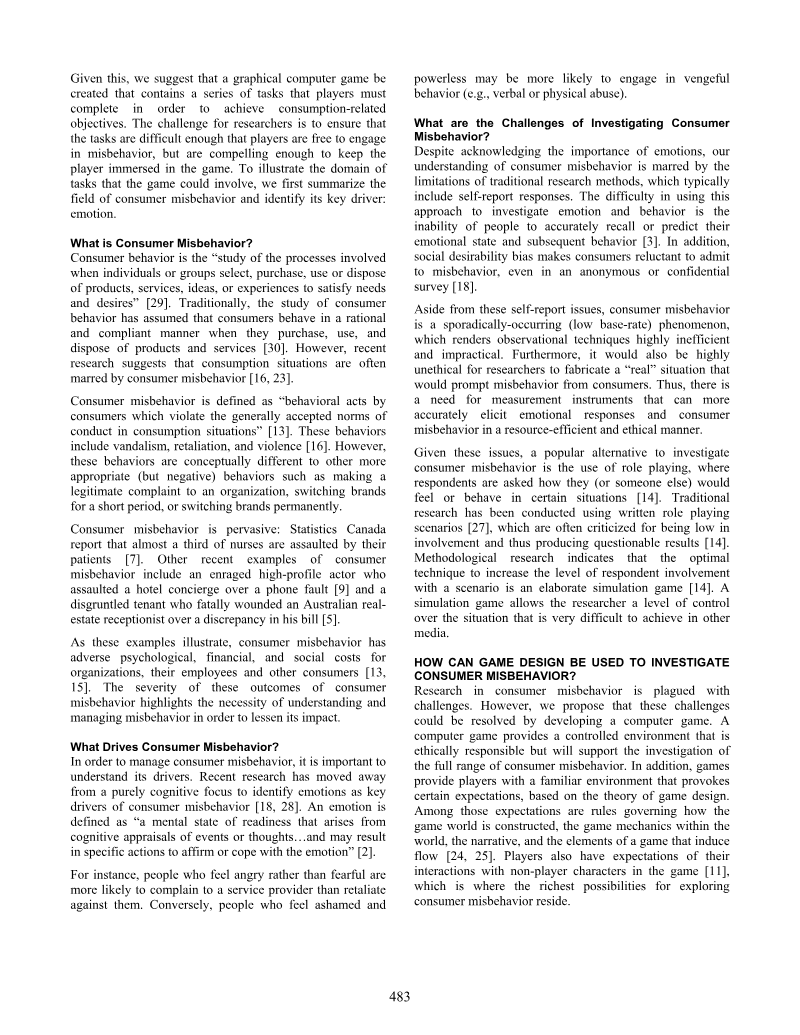
This paper argues that computer games, grounded in game design theory, offer a controlled, ethical, and engaging means of studying consumer misbehavior, a phenomenon driven largely by emotion that is difficult to examine through self-reports, direct observation, or role-play.
- The paper proposes a graphical, single-player game as a controlled, ethical way to study consumer misbehavior, a largely emotion-driven phenomenon that is hard to examine through self-reports, direct observation, or role-play.
- The design relies on real-time constraints, a clear winning state, and deliberately withheld information or feedback to induce stress and frustration that may provoke misbehavior.
- Emotionally responsive, context-specific non-player character dialogue is intended to sustain realism, while strong immersion and player control are meant to keep participants engaged.
Peep-Boxes to Pixels: An Alternative History of Video Game Space
Philip Sharp's "Peep-Boxes to Pixels: An Alternative History of Video Game Space" argues that video game arcades emerged from the convergence of leisure practices, technological innovation, and cultural identity rather than from a single line of technical progress.
- Philip Sharp argues that video game arcades arose from the convergence of leisure practices, technological innovation, and cultural identity rather than a single line of technical progress, with roots in nineteenth-century optical toys such as Dutch peep-boxes and Japanese magic lanterns, plus pinball and pachinko.
- Sharp contends Japan absorbed Western mechanical and optical devices and framed them as commercial leisure spaces, a pattern he sees continuing in modern arcades, while Japan's arcade and pachinko culture endured in contrast to the American shift toward home gaming and family entertainment centers.
- The report situates arcades within a recurring history of moral panic over amusement spaces, citing American pinball bans as an early stigma that anticipated later reactions to video game arcades.
Temporal Frames: A Unifying Framework for the Analysis of Game Temporality
"Temporal Frames" proposes a formal analytical tool for studying how time operates in games, grounded in a relationist view in which temporal properties arise from relationships among events rather than from time as an independent container.
- Games rarely operate within a single temporal frame; the authors identify four recurring frames (real-world time, gameworld time, coordination time, and fictive time) that often coexist or succeed one another, and meaningful analysis depends on identifying each and how they interact.
- The paper critiques the familiar real-time versus turn-based binary as obscuring distinct temporal phenomena produced by frame interactions, and reconceives both as interactions between frames rather than fixed categories.
- Sequential and embedded arrangements of temporal frames generate temporal anomalies such as temporal bubbles, warping, and non-uniform temporality, illustrated with cases from Final Fantasy XII, Animal Crossing, Civilization, and Grand Theft Auto III.
The Lambent Reactive: Exploring the Audiovisual Kinesthetic Playform
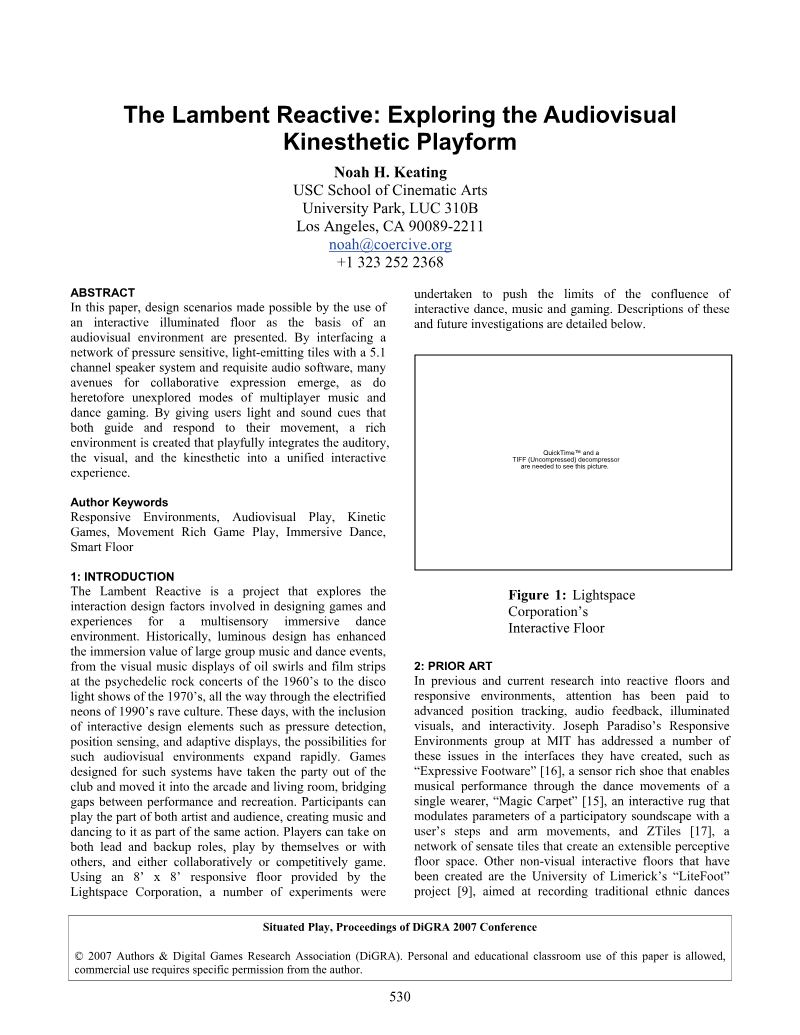
The Lambent Reactive project explores the design of multisensory immersive dance environments by integrating interactive audiovisual and kinesthetic elements.
- The central thesis is that fusing auditory, visual, and kinesthetic feedback in a single interactive space produces a more rewarding and flow-inducing play experience than any single modality alone.
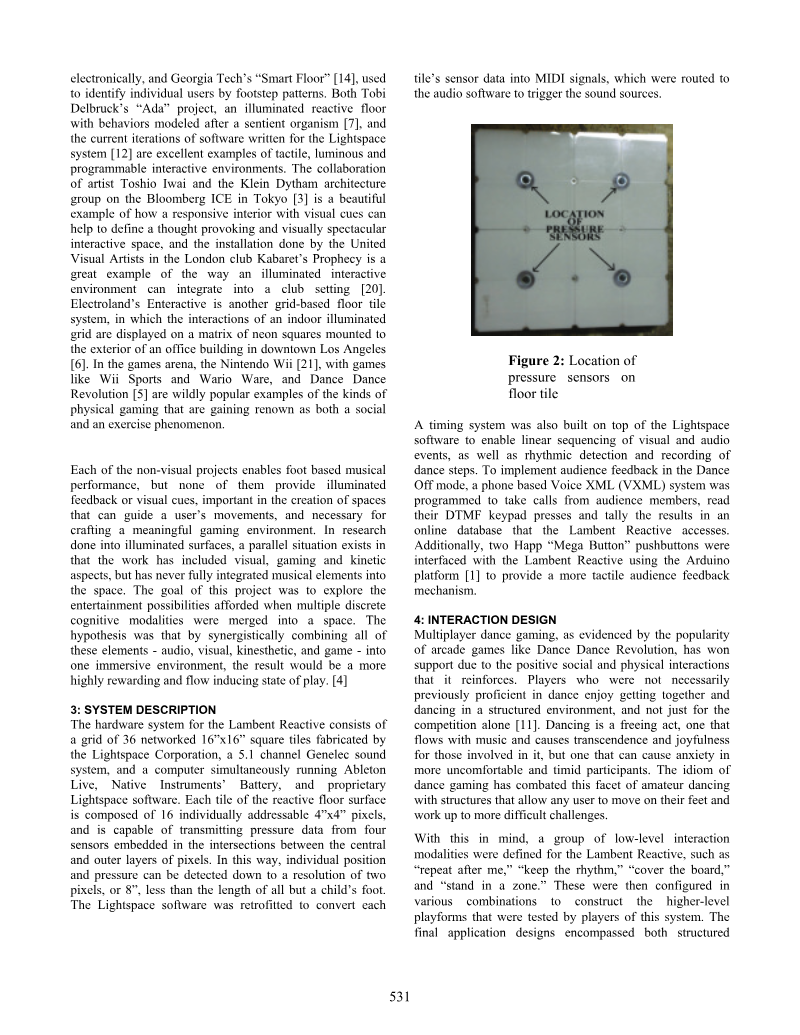
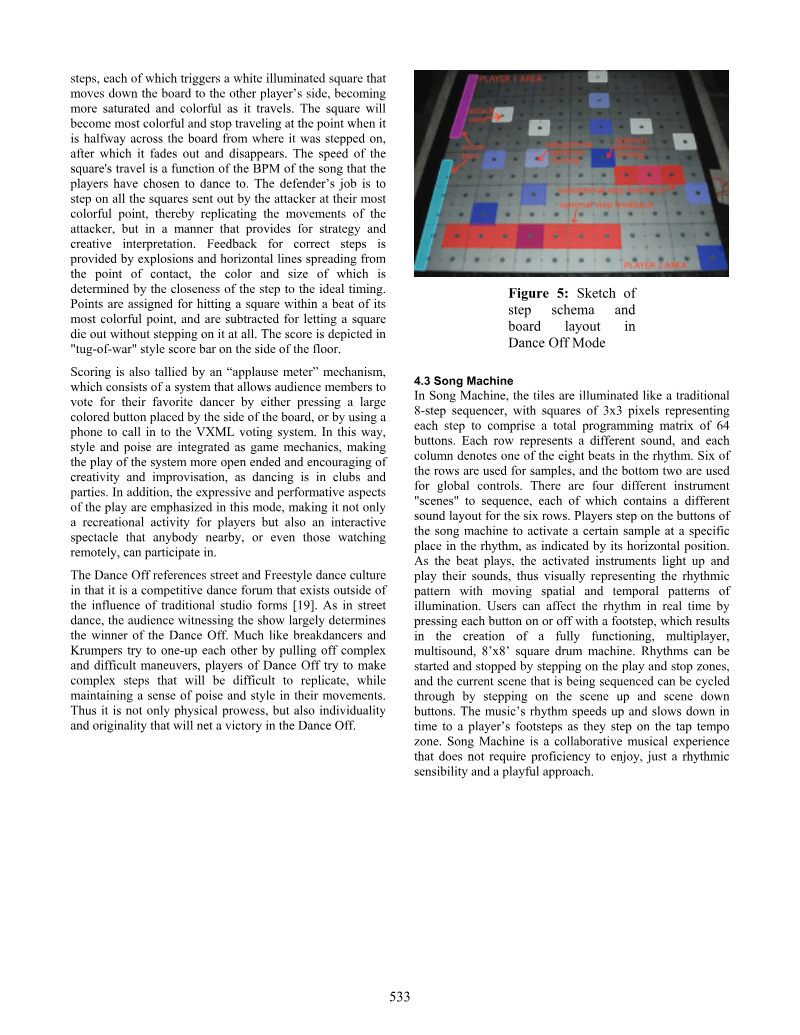
- The Lambent Reactive uses a 36-tile networked floor of pressure-sensitive, individually addressable light-emitting tiles, paired with a 5.1-channel speaker system and music software, with pressure detection down to roughly two pixels (8 inches).
- Pressure data is converted into MIDI signals to trigger sound, tying each footstep's location and force directly to musical output.
The Contextual Game Experience: On the Socio-Cultural Contexts for Meaning in Digital Play
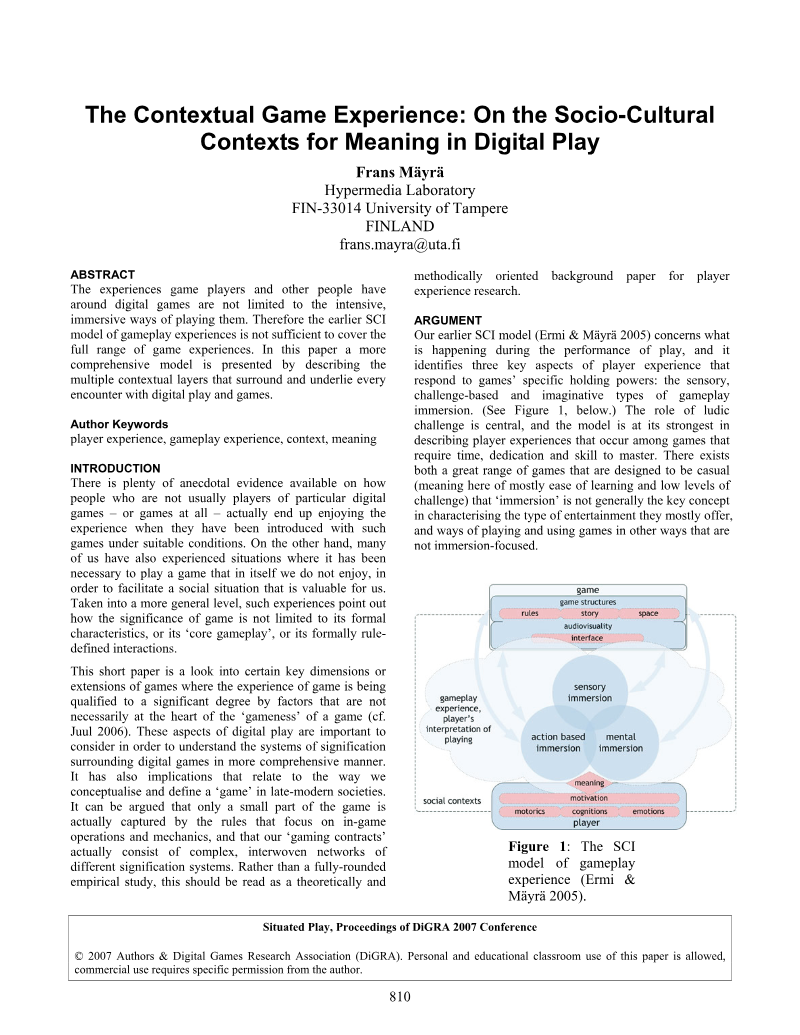
Frans Mäyrä's paper argues that the existing SCI model of gameplay experience, which focuses on immersion during active play, is insufficient for capturing the full range of how people encounter digital games.
- Frans Mäyrä argues that the SCI model of gameplay experience, which centers on immersion during active play, is insufficient for capturing the full range of how people encounter digital games.
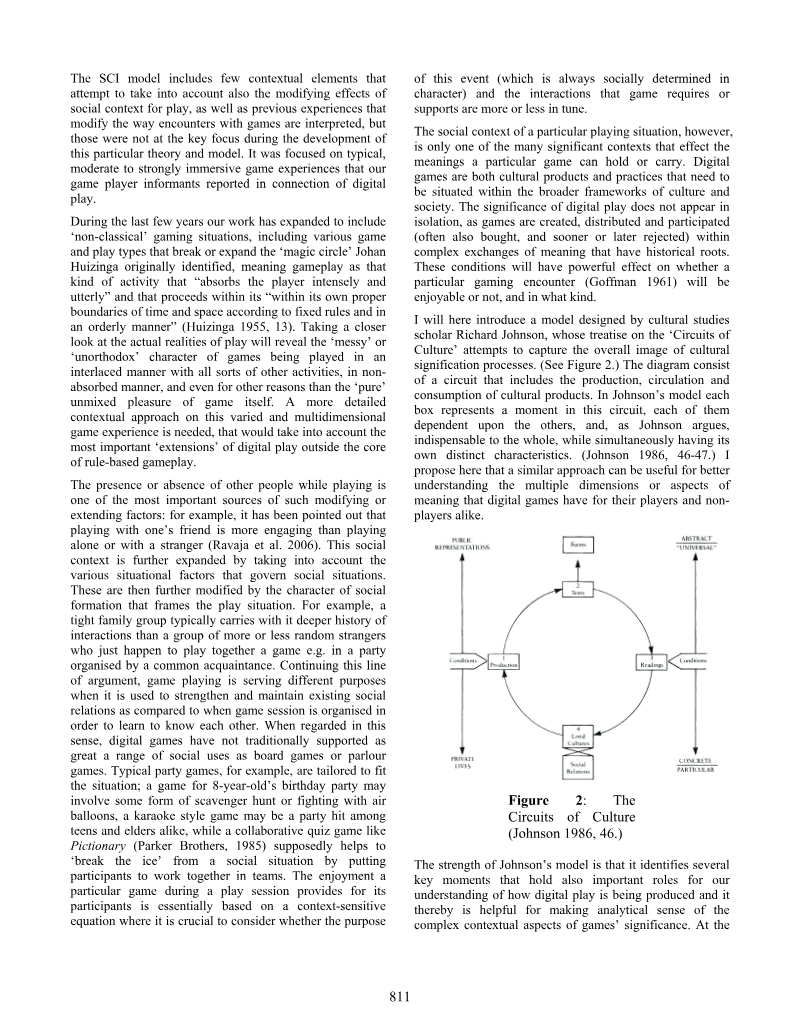
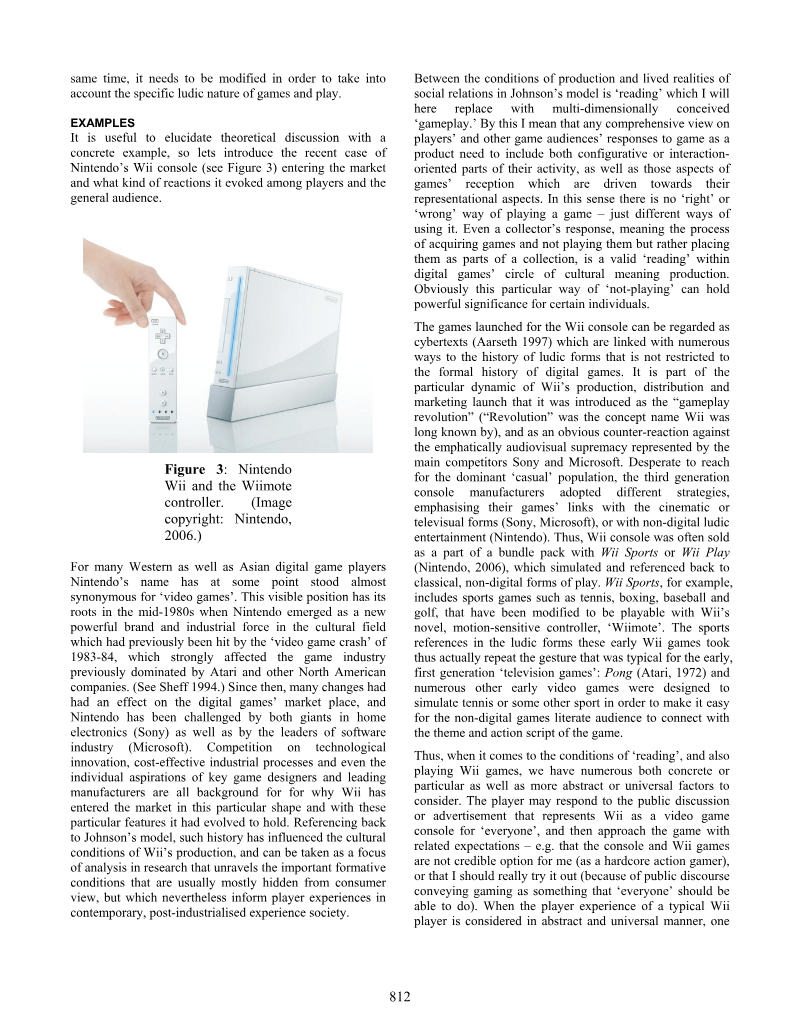
- The proposed contextual game experience model draws on Richard Johnson's "Circuits of Culture" framework from cultural studies to situate play within layered social, cultural, and historical contexts.
- A game's significance, on this view, extends beyond its formal rules and core gameplay to include production conditions, social relations, personal histories, and wider societal values.
People, Places, and Play: A Research Framework for Digital Game Experience in a Socio-Spatial Context
De Kort, IJsselsteijn, and Gajadhar's paper proposes a research framework for understanding digital game experience as shaped by social and spatial context.
- Gaming is argued to be inherently social, and existing models of game experience underweight the social processes that shape enjoyment, performance, and social contact.
- The framework draws on social psychology, including arousal-based and evaluation-apprehension mechanisms, to argue that the presence of others (co-playing, spectating, or the physical setting) meaningfully alters play rather than producing isolation.
- Four sociality characteristics are proposed as key dimensions for analysis: co-location, monitoring, communication, and relationship.

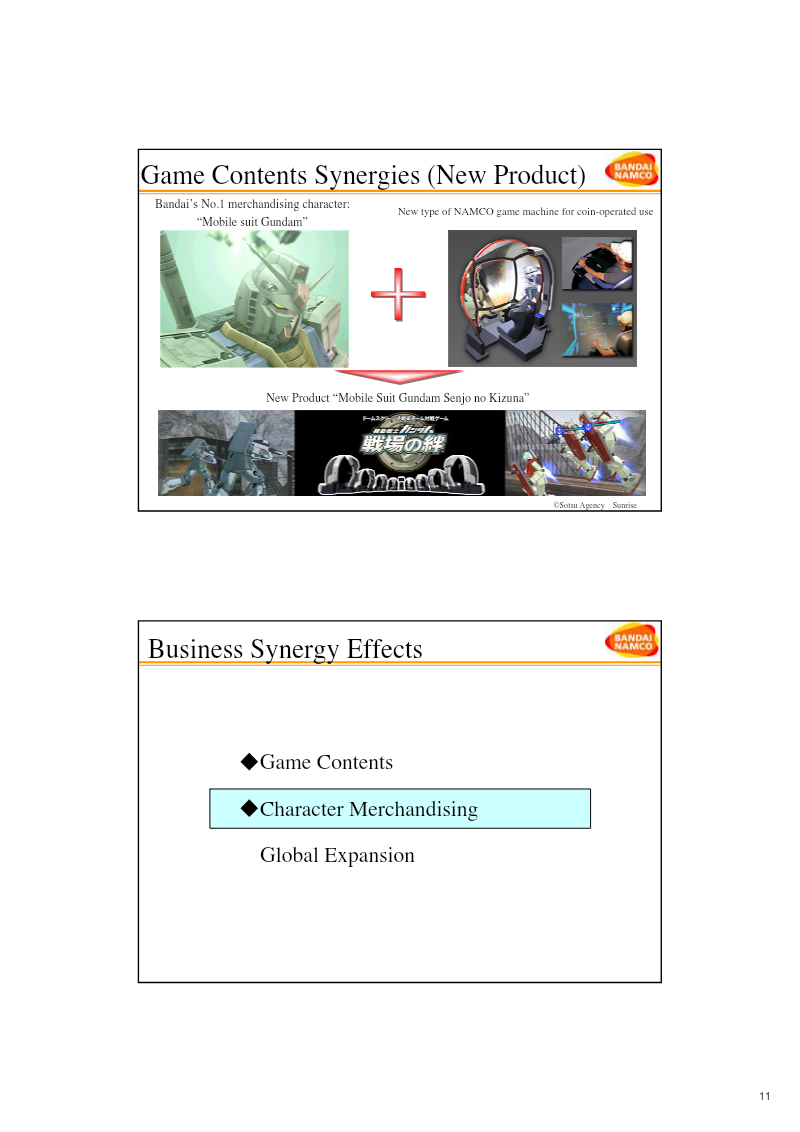
Bandai Namco Group Strategic Presentation Session
This strategic presentation outlines the Bandai Namco Group's vision, reorganization, and growth strategy following the merger of Bandai and Namco, effective September 29, 2005.
- Bandai and Namco are merging to form NAMCO BANDAI Holdings Inc. by April 2006, creating a unified corporate structure organized into six strategic business units.
- The group forecasts total sales growth from 475 billion yen in fiscal year 2006 to 550 billion yen by fiscal year 2008.
- Operating income is projected to increase from 44.2 billion yen to 55 billion yen over the two-year period following the merger.
The Problem of Other Players: In-Game Cooperation as Collective Action
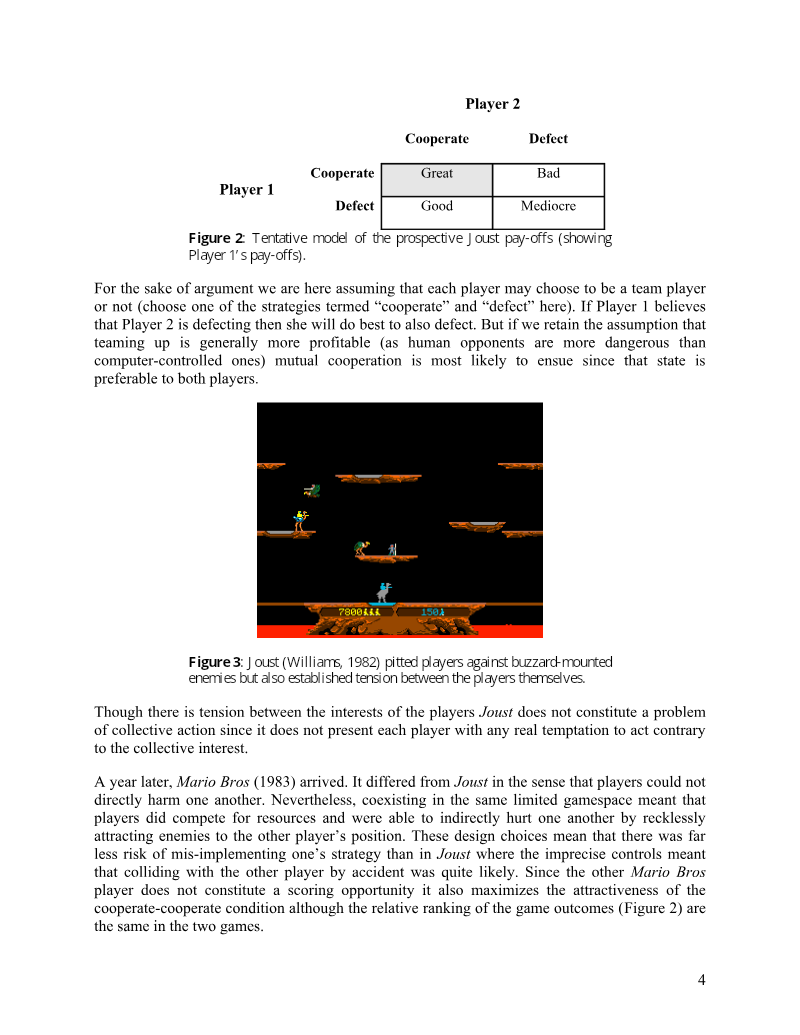
This paper examines how multiplayer video games stage relationships between players and argues that semi-cooperative game designs function as ongoing experiments in collective action.
- The paper's central thesis is that the "problem of other players" in multiplayer games can be analyzed as a structure of collective action using economic game theory and the frameworks of Mancur Olson and Elinor Ostrom, rather than treated merely as an obstacle.
- It proposes a three-part typology of multiplayer games: cooperative games with exactly aligned interests, semi-cooperative games where collective and individual goals partly diverge, and zero-sum competitive games.
- Gauntlet is identified as a pivotal arcade design that introduced a genuine collective action problem, since shared progression depends on cooperation while individual resource collection tempts defection.