Global reports and market data
Documents

Is There a Shift from Content to Tech Startups Among Gaming VCs?
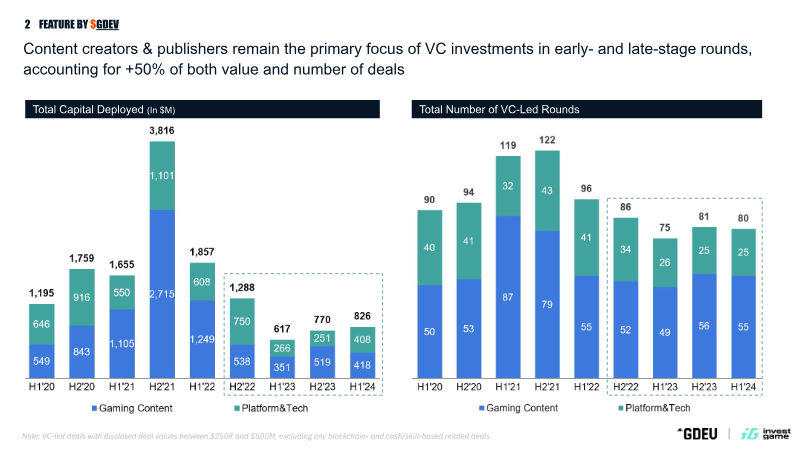
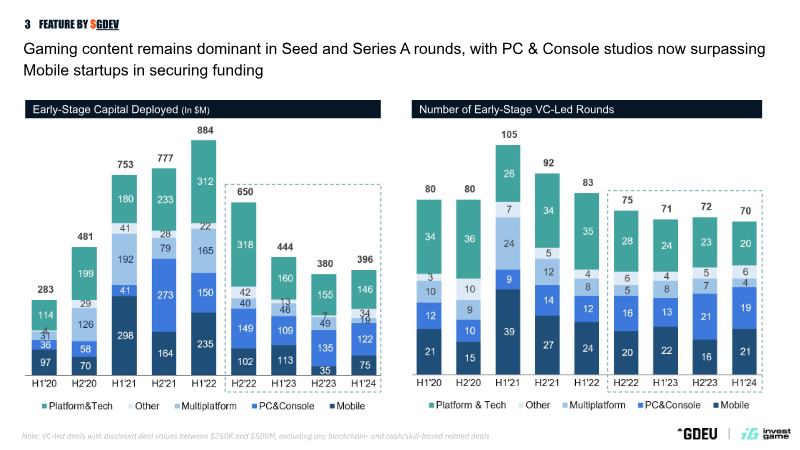
The analysis examines venture capital activity in the gaming sector from 2020 to early 2024, focusing on whether investment priorities are shifting from traditional content creation and publishing toward technology-driven startups.
- Content creators and publishers remain the primary focus of gaming VC, accounting for over half of all capital deployed (approximately $1.76 billion) and the majority of deal volume across all stages.
- Gaming-focused VC funds, including VENTURES, BEHOLD Venture, and Lightspeed Lvp., significantly increased their activity between 2020 and H1 2024, with capital deployed rising from $1.3 billion to over $2.4 billion.
- The number of VC-led funding rounds grew substantially from 67 in early 2020 to 289 by H1 2024, reflecting an overall increase in investment activity.

The Alumni Effect: Studios Founded by Ex-Activision, Blizzard, and King Employees
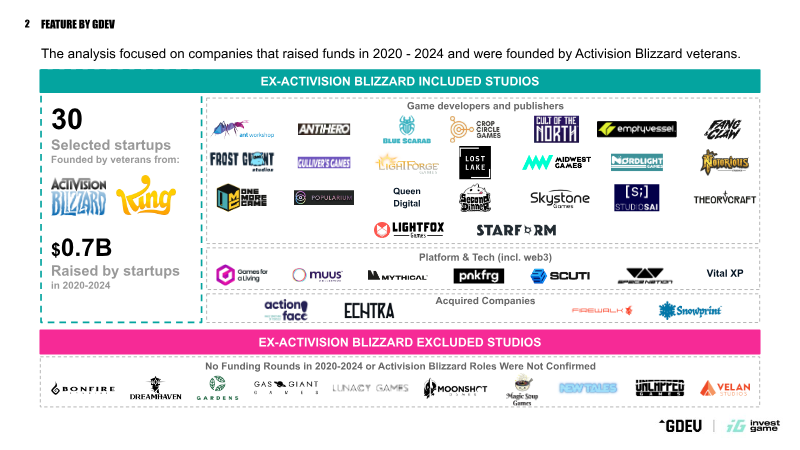
The analysis examines venture capital activity directed toward studios founded by former Activision Blizzard employees between 2020 and 2024.
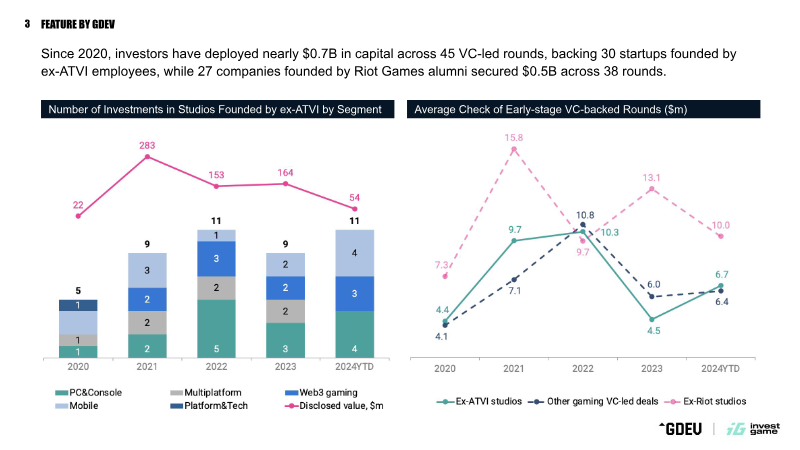
- Between 2020 and 2024, 30 studios founded by former Activision Blizzard employees secured approximately $0.7 billion in venture capital across 45 funding rounds.
- Ex-Activision studios demonstrate a 'first-round momentum' effect, being roughly four times more likely than peer startups to secure a second round of financing within the same calendar year.
- Investor confidence in alumni teams peaked in 2021, when 43% of ex-Activision studios raised a subsequent round compared to only 9% of broader gaming startups.
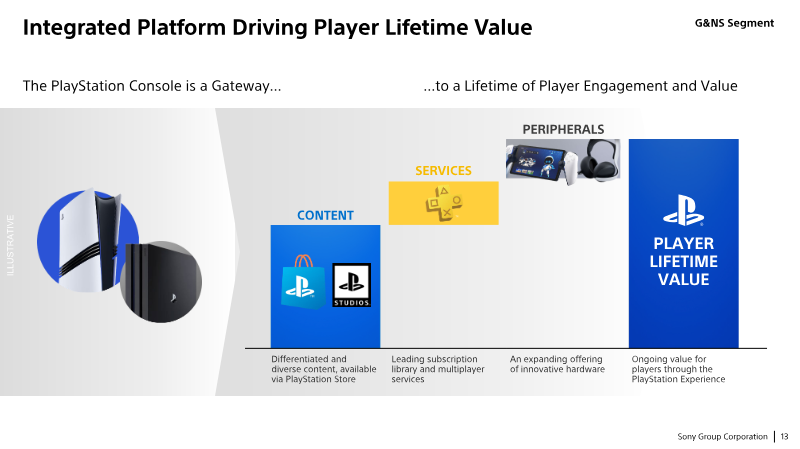
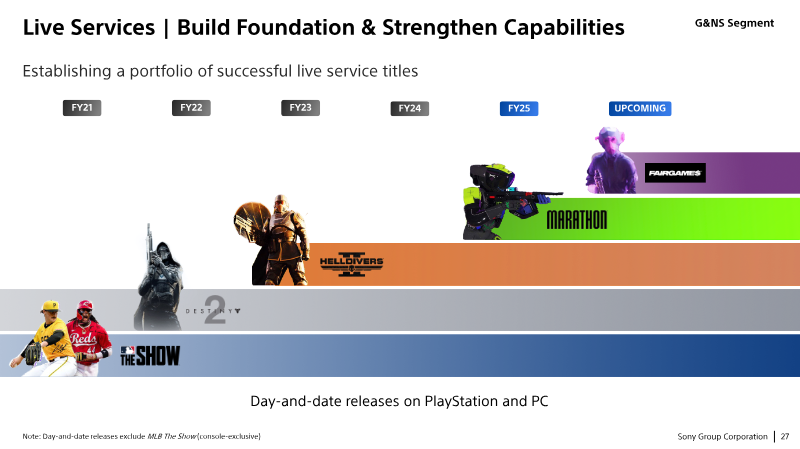
Game & Network Services Segment Presentation
Sony Interactive Entertainment’s Game & Network Services segment demonstrates a clear trajectory of growth and increasing operating leverage.
- Sony’s Game & Network Services segment has achieved a significant financial turnaround, growing from a $4 billion operating loss in 2000 to $13 billion in operating income by 2024.
- Revenue is increasingly driven by services, the PlayStation Store, and peripherals, which now account for 52–54% of the segment's total revenue.
- The PlayStation ecosystem has reached 124 million monthly active users, representing a 14% year-over-year increase, with a life-to-date spend of $846 per console.
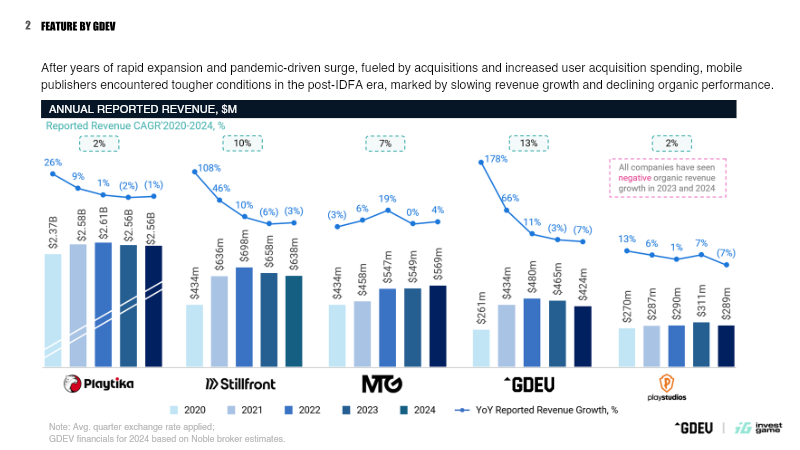

Public Mobile Gaming Publishers: Resilience & Adaptation in a Shifting Landscape
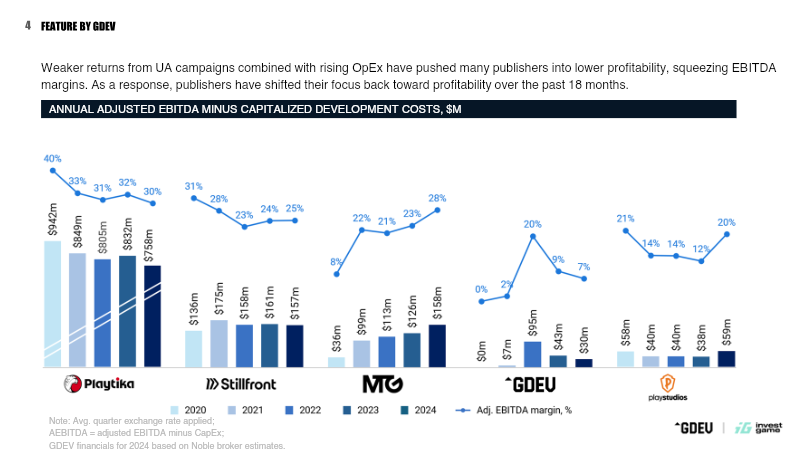
The analysis examines the post-IDFA mobile gaming landscape, focusing on revenue dynamics, user acquisition spending, profitability trends, and market valuation shifts across key publishers.
- Aggregate market capitalization for major mobile gaming publishers has plummeted by more than 50% since January 2022, with most stocks remaining below pre-IDFA valuation peaks.
- User acquisition costs have surged to as high as $40 million per firm, while diminishing returns on these campaigns have compressed EBITDA margins and forced a shift toward cost control.
- MTG outperformed the broader market with a 50%+ share price increase and 9% organic growth in Q4 2024, driven by disciplined M&A and operational efficiency.

Enabling Growth: Cohort User Acquisition Financing
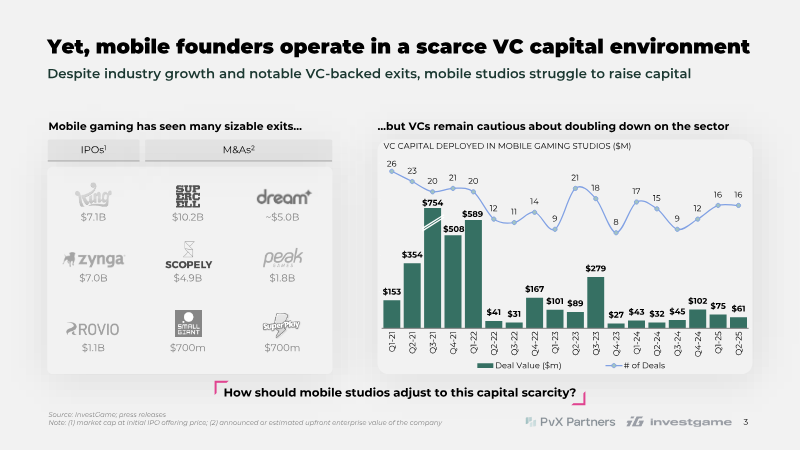
Mobile gaming has rebounded from the downturn of 2022-23, with a projected compound annual growth rate of 5.0% from 2020 to 2025, driven largely by a 16.2% rise in in-app advertising and the continued popularity of casual puzzle titles.
- Mobile gaming is projected to grow at a 5.0% CAGR from 2020 to 2025, supported by a 16.2% increase in in-app advertising and AI-driven ad tech.
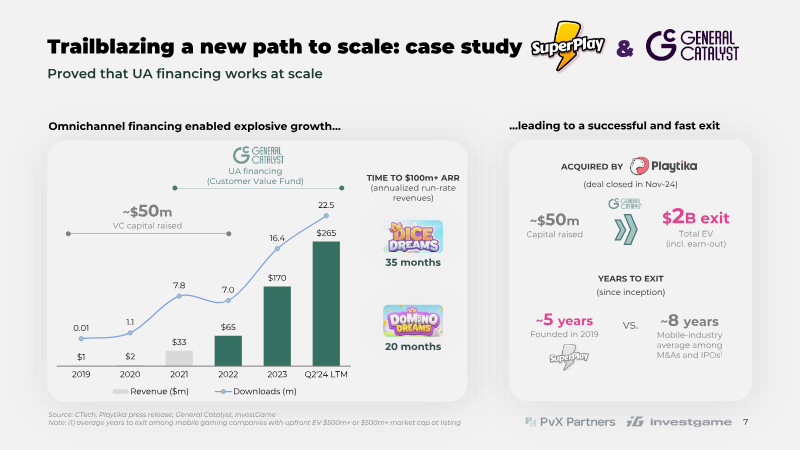
- Cohort-based UA financing allows studios to fund up to 80% of monthly acquisition costs by leveraging future revenues, providing an alternative to scarce venture capital.
- Studios utilizing cohort-based financing have demonstrated the ability to increase monthly marketing spend by 16–38% while maintaining founder control over equity and IP.

The 2025 Benchmark Report: Roblox Platform Trends
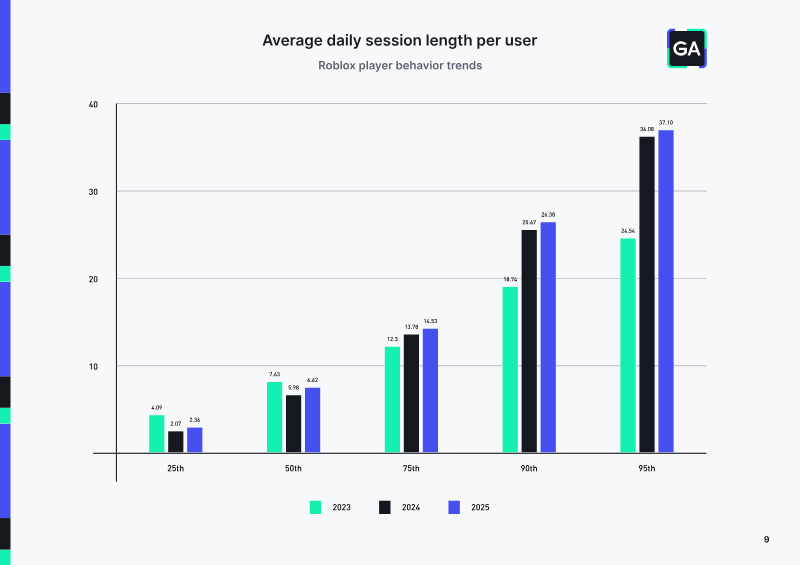
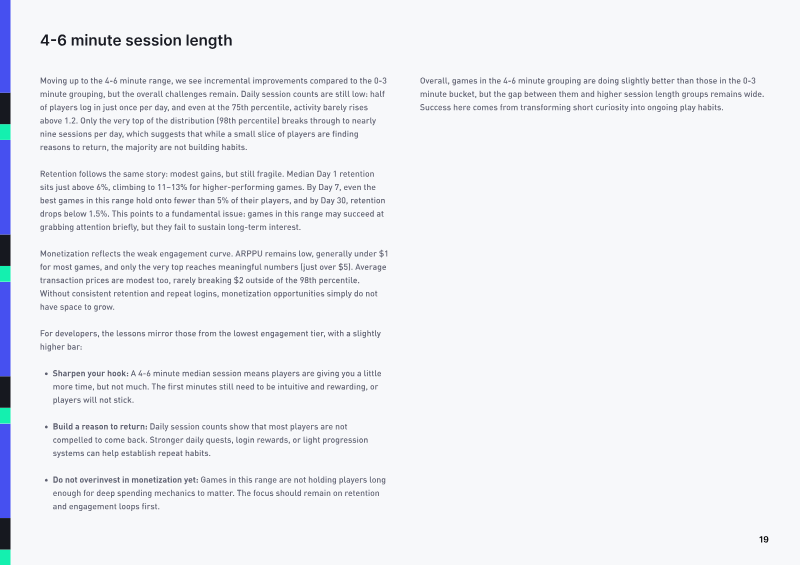
The report establishes that Roblox’s player base is sharply divided between casual users who spend only a few minutes per session and core players who log in multiple times daily, often exceeding 30-minute sessions.
- Games with median session lengths under six minutes suffer from negligible Day-1 retention of approximately 6% and ARPPU below $1, while top-tier titles achieve ARPPU exceeding $6 with average transaction values of $3–$4.
- The top 5% of Roblox games generate over $20 per day from a single player, demonstrating that sustained engagement is the primary driver of high-value monetization.
- Platform discovery algorithms prioritize games with consistent 7-day spend and high engagement, causing low-engagement titles to fall below 5% Day-1 and 2% Day-7 retention.


The Rise of the Financial Kingmakers: Private Equity’s $21B+ Bet on Gaming
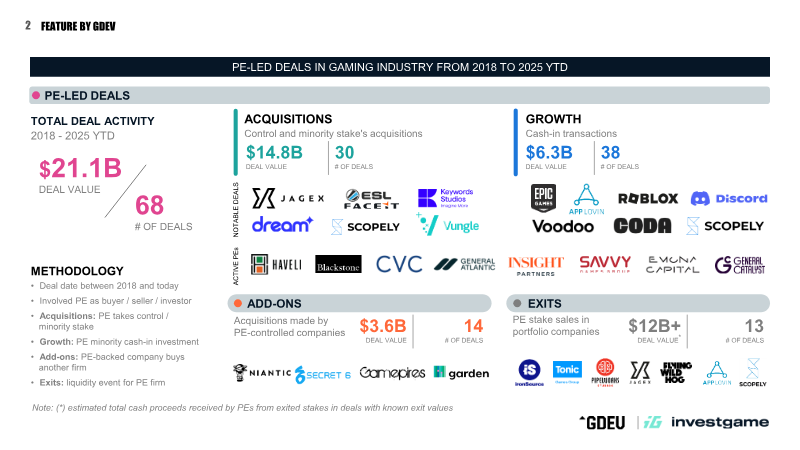
The analysis demonstrates that private equity (PE) has increasingly positioned itself as a decisive force in the gaming sector, channeling more than $21 billion into acquisitions and growth investments from 2018 through the first half of 2025.
- Private equity firms deployed over $21 billion into the gaming sector between 2018 and mid-2025, with annual deal values consistently surpassing $1 billion.
- Control acquisitions represent the primary investment strategy, accounting for approximately 60% of total capital deployed in the sector.
- Content creation studios holding strong IP portfolios are the most targeted assets, securing 42 of the 68 total private equity-led deals identified.



The Take-Two Diaspora: Why Alumni Win Big in Mobile, Not AAA
The analysis examines the investment trajectory of companies founded by former senior executives from Take-Two Interactive and its subsidiaries.
- Former Take-Two senior executives founded 23 startups between 2020 and 2025, securing $1.2 billion in capital across 43 deals.
- Dream Games, a prominent alumni-led studio, achieved a $2.5 billion exit in July 2025, highlighting the high valuation potential of these ventures.
- Alumni-led firms significantly outperform industry benchmarks, with a 60% rate of raising a second funding round within one year compared to the 20% industry average.


Beyond the Game: How Gamification is Becoming Mainstream
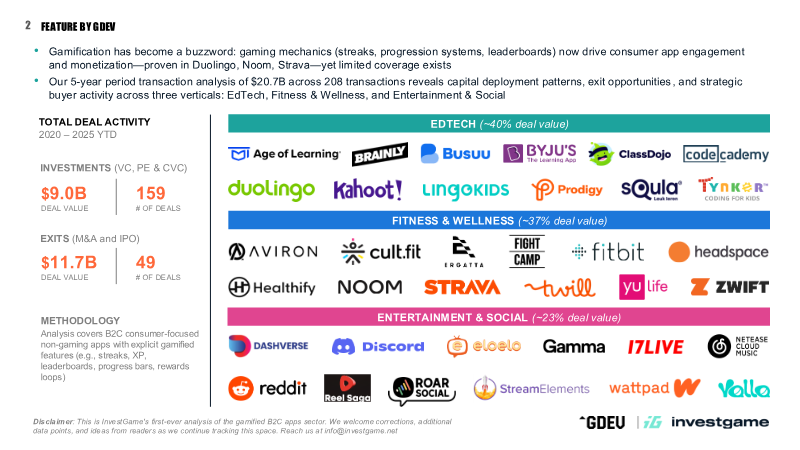
The analysis examines how gamification—applying game-like mechanics such as streaks, leaderboards, and reward loops—to non-gaming consumer apps has shifted the mobile app economy over a five-year period (2020-2025).
- Gamified non-gaming apps have surpassed mobile games in net revenue, generating $21.2 billion in Q2 2025 compared to $19.8 billion for games.
- Gamified apps are driving a 24% year-over-year growth in mobile consumer spending, while traditional mobile gaming revenue has stagnated.
- EdTech, Fitness & Wellness, and Entertainment & Social account for $20.7 billion in transaction value, with EdTech dominating deal volume (43%) and exit activity (45%).



AI Eats the World
Generative AI is positioned as the latest platform shift that will reshape value capture across the global tech ecosystem, with investment surging even as its ultimate impact remains uncertain.
- Hyperscaler capital expenditure is projected to reach $350 billion in 2025, nearly doubling 2024 levels as data-center investment outpaces office construction.
- Silicon supply constraints at Nvidia and TSMC, combined with power and permitting limitations, represent the primary bottlenecks threatening to throttle AI growth.
- Despite 800 million weekly active users, the paying-user base for AI models remains at approximately 5%, highlighting a significant gap in monetization.


Investing and Financial Management App Market and Advertising Trends 2025
Investment-management and crypto trading applications have accelerated growth in 2025, with global downloads rising 12% to about five billion.
- Global downloads for investment and crypto trading apps rose 12% in 2025, reaching approximately five billion total downloads.
- User demographics are heavily male-skewed, with crypto apps reaching over 90% male users and emerging markets like India and Vietnam reporting only 13–17% female participation.
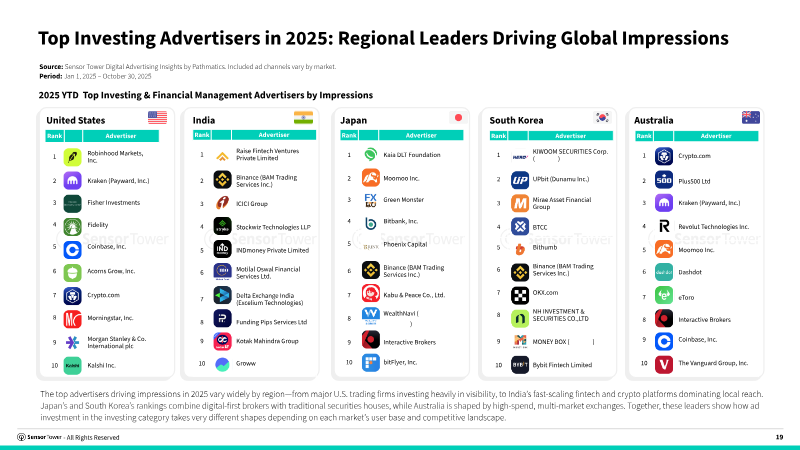
- Market preferences are geographically fragmented: U.S. and Japanese users favor established brokerages, while consumers in India and Southeast Asia prioritize local, mobile-centric platforms.


1H 2025 Amazon Retail Media: An Inside Look at How Brands Are Showing Up
Amazon Retail Media dominated the first half of 2025, capturing $618 million in ad spend—more than double Walmart’s $236 million and nearly six times Chewy’s $105 million—while attracting 9,542 unique advertisers, a figure nine times larger than Walmart’s 1,076.
- Amazon Retail Media dominated the market in 1H 2025 with $618 million in ad spend, significantly outpacing Walmart ($236 million) and Chewy ($105 million).
- Amazon’s advertiser base is nine times larger than Walmart’s, hosting 9,542 unique advertisers compared to Walmart’s 1,076.
- Samsung, Unilever, and L’Oréal were the top spenders in 1H 2025, contributing $7.1 million, $5.7 million, and $5.3 million respectively.