1 free read left. Create a free account for unlimited reading + AI research.
Create free accountReport HPvX Partners
1 free read left. Create a free account for unlimited reading + AI research.
Create free accountReportHPvX Partners
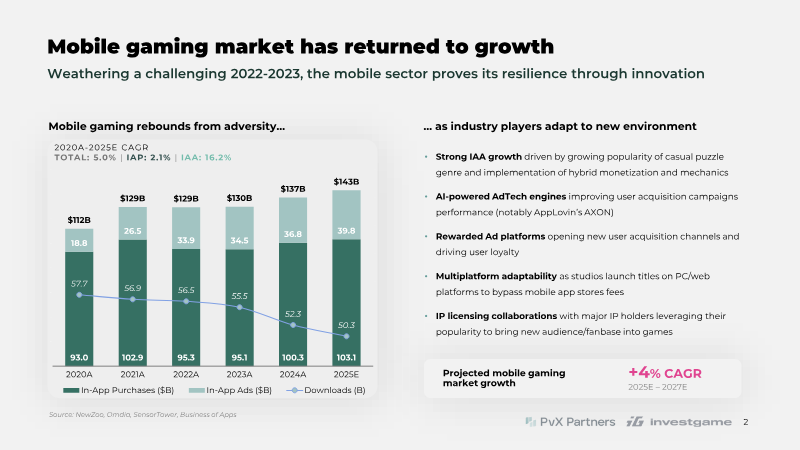
The sector rebounded from the 2022–23 downturn. In-app advertising rose 16.2%, and casual puzzle titles remain popular.
Mobile gaming has rebounded from the downturn of 2022-23, with a projected compound annual growth rate of 5.0% from 2020 to 2025, driven largely by a 16.2% rise in in-app advertising and the continued popularity of casual puzzle titles. The sector’s resilience is underpinned by AI-powered ad tech, rewarded advertising platforms, multiplatform releases that bypass app-store fees, and strategic IP licensing collaborations. Despite this growth, venture capital remains cautious; VC deployments in mobile studios have plateaued while high-profile exits such as King, Zynga, and Playtika illustrate that capital is still scarce. Mature studios reinvest roughly one-third of revenue into user acquisition (UA), yet only a minority secure the $30 million+ funding needed to sustain such spend, and smaller studios often allocate 70% or more of net revenue to marketing.
PvX Partners’ cohort-based UA financing addresses this gap by providing credit secured against future cohort revenues. The model offers up to 80% of monthly customer acquisition costs, recovers 80% of net revenues until repayment, and imposes a modest interest rate tied to Net Return on Ad Spend (ROAS). Case studies show that studios receiving this financing can increase monthly spend by 16–38% while boosting cash balances, achieving accelerated growth and faster exits—examples include Playtika’s acquisition of a $2 billion-valued studio within 35 months.
Overall, the analysis suggests that cohort-based UA financing can unlock scalable growth for mobile studios that lack traditional VC backing, potentially expanding the market’s total UA spend from $143 billion to an additional $3.2 billion by 2027, while maintaining equity and IP control for founders.

Naavik · 2025
Deconstructor of Fun · 2026
Two & a Half Gamers · 2026
Two & a Half Gamers · 2026
Deconstructor of Fun · 2026
Tenjin · 2026
Deconstructor of Fun · 2025
Two & a Half Gamers · 2025
Two & a Half Gamers · 2025
Two & a Half Gamers · 2024
PocketGamer.biz · 2022
PocketGamer.biz · 2016