1 free read left. Create a free account for unlimited reading + AI research.
Create free accountReport Benedict Evans
1 free read left. Create a free account for unlimited reading + AI research.
Create free accountReportBenedict Evans
This is nearly double 2024 levels. Data-center investment now outpaces office construction.
Generative AI is positioned as the latest platform shift that will reshape value capture across the global tech ecosystem, with investment surging even as its ultimate impact remains uncertain. Over the past decade, each new technology—mainframes, PCs, the web, smartphones—has displaced early leaders and created fresh revenue streams; generative AI is expected to follow that pattern, driving capital expenditures toward data-centre expansion and new SaaS offerings.
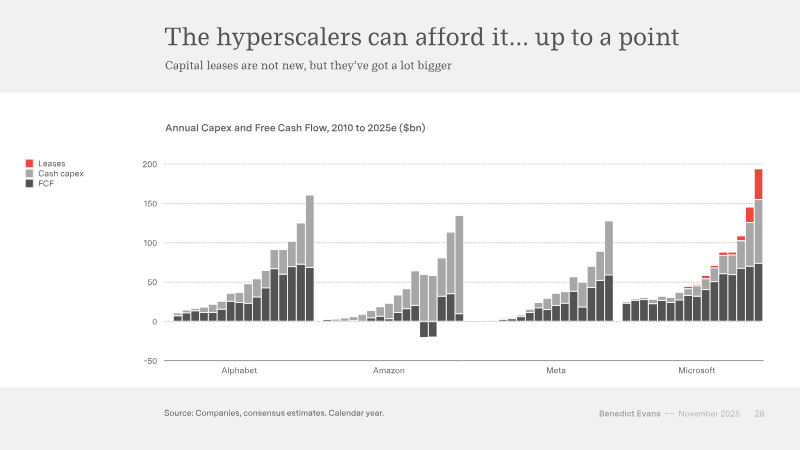
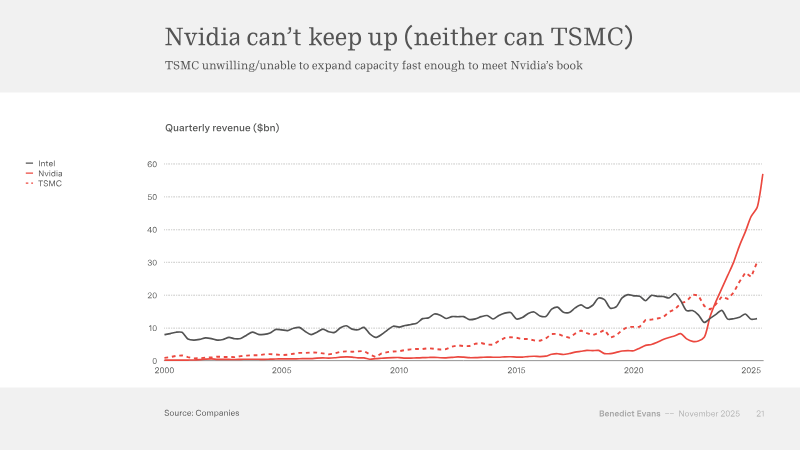
Capital outlays are accelerating at a rate comparable to mature telecom spending, with 2025 capex for the four largest hyperscalers projected at roughly $350 bn, nearly double 2024 levels. U.S. construction data show data-centre investment now eclipsing office build-out, while power and permitting constraints become the primary bottlenecks. Silicon supply lags behind demand, as Nvidia and TSMC struggle to scale, signalling a looming chip-capacity crunch that could throttle further growth.
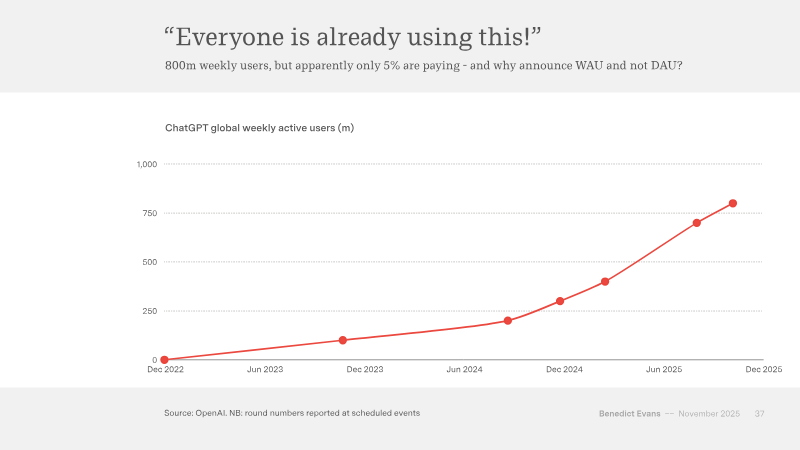
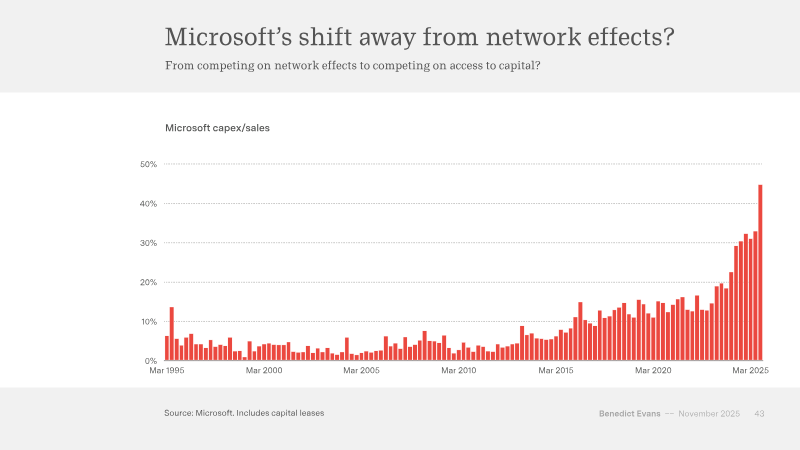
The AI model market remains fragmented, with marginal performance differences among leading systems and a paying-user base of only about 5% despite roughly 800 million weekly active users. Value capture is shifting from network effects to capital access, with incumbents pursuing bundled and unbundled product strategies while a wave of startups seeks to disaggregate existing services.
Early successful use-cases follow an “Absorb → Automate → Innovate/Disrupt” pattern, focusing on high-volume tasks such as coding and marketing copy. Full production roll-outs lag behind pilots, suggesting that future value will arise from unbundling entrenched services rather than merely automating the obvious.
Automation does not eliminate errors; human oversight remains essential, and the Jevons paradox indicates that productivity gains can increase total work. AI-driven recommendation systems already lift conversion rates by 5–14% while cutting content-creation costs, yet the web’s traffic model is shifting as AI summaries replace traditional search results. The overall conclusion is that while generative AI expands creative output and efficiency, human judgment and new business models will be required to manage error, capture value, and adapt to evolving consumer behavior.

Extra Credits · 2025

Two & a Half Gamers · 2025

Extra Credits · 2025

Stream Hatchet · 2025

Mobile Dev Memo · 2026

GameDiscoverCo · 2026

PocketGamer.biz · 2026

Mobile Dev Memo · 2026

Extra Credits · 2026

Thomas Brush · 2026

PocketGamer.biz · 2026

GameDiscoverCo · 2026