Global reports and market data
Documents

Getting Players to Care: Using Narrative to Drive Retention
Narrative-driven design serves as a primary engine for player retention in mobile simulation games, particularly when plot progression is deeply integrated into the core gameplay loop.
- Integrating narrative progression into core gameplay loops, specifically through mandatory story gates and character arcs, achieves an 87 percent tutorial completion rate.
- Consistent weekly narrative updates are critical for retention, sustaining a 71 percent one-day retention rate and a 33 percent monthly retention rate.
- Narrative content functions as a monetization driver, with 63 percent of users engaging with premium quest chains.
Absolutely No Pressure: Continuing a Successful Game Series with Civilization VI
The development of Civilization VI represents a deliberate evolution of the franchise, driven by a rigorous critique of the limitations inherent in its predecessor.
- Firaxis addressed the 'rote' decision-making in Civilization V by introducing 'unstacked' cities in Civilization VI, which forces players to place specialized districts on specific map tiles to gain bonuses.
- To resolve the rigid, linear progression of Civilization V's social policies, the team implemented a 'Civics Tree' that functions like a technology tree, allowing players to unlock policy bundles through cultural progress.
- The development team utilized community feedback from forums and beta testers to identify balance issues, such as the combat system in Civilization V where weak units could disproportionately damage stronger ones.
Game Studies at Scale: Towards Facilitating Exploration of Game Corpora
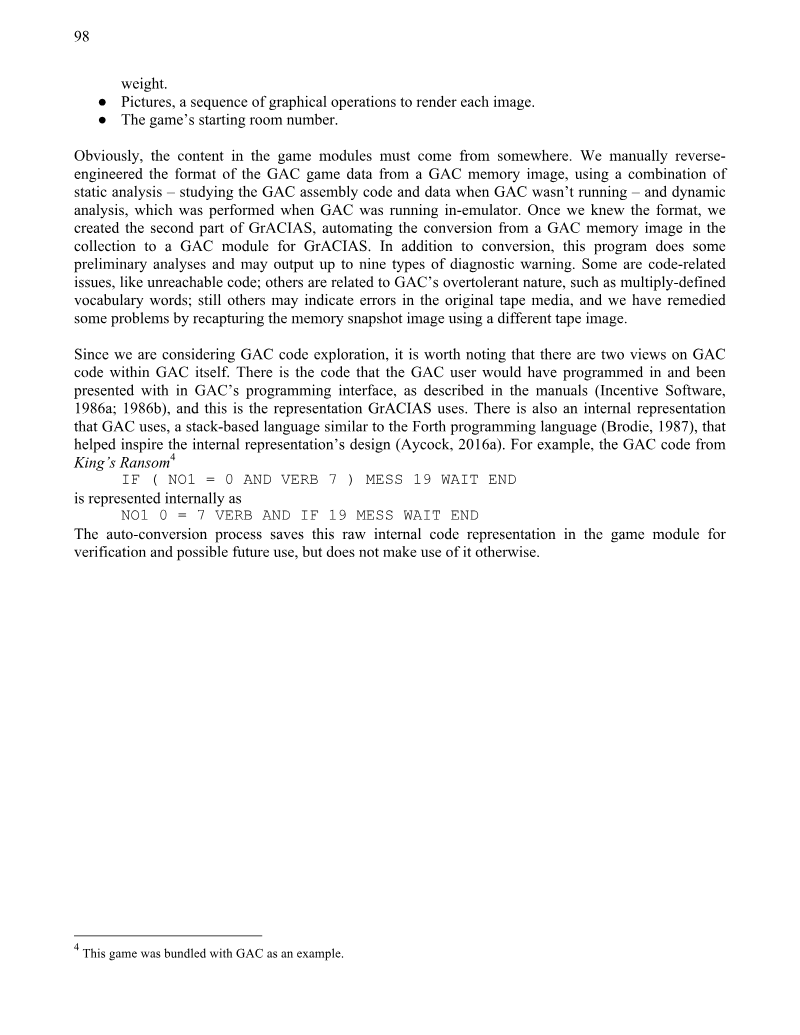
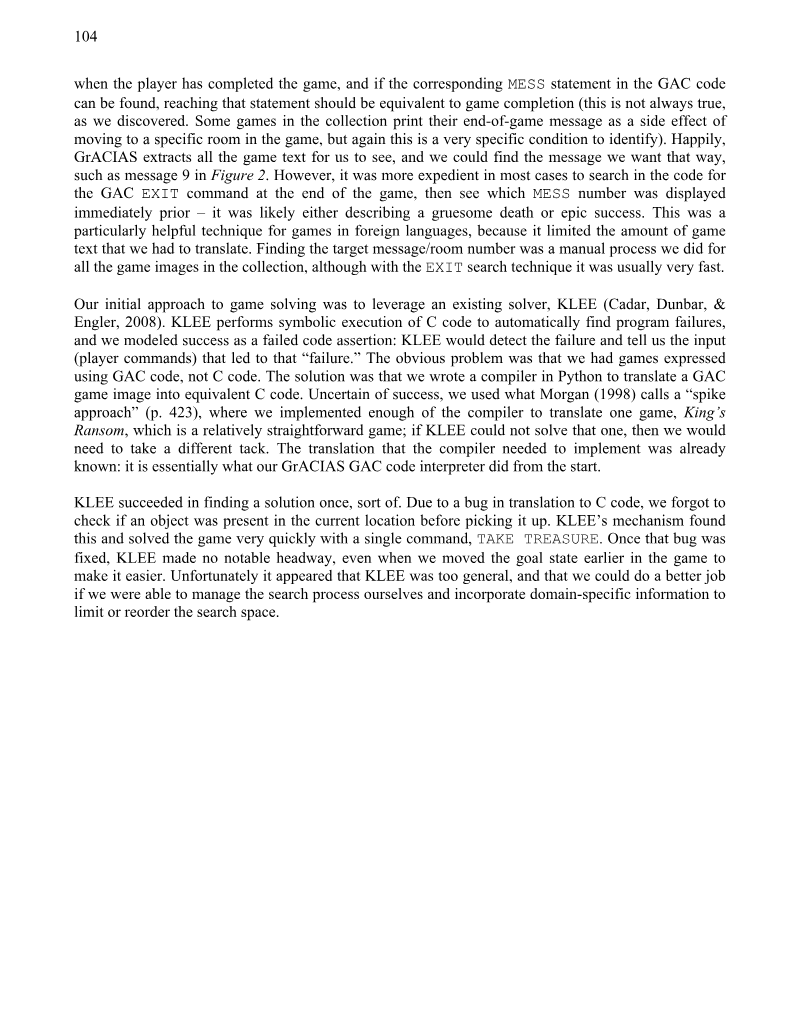
John Aycock, of the Department of Computer Science at the University of Calgary, presents GrACIAS (Graphic Adventure Creator Internal Analysis System), a tool for analyzing games at the level of their code as well as their gameplay.
- The author argues that gameplay alone gives only a partial view of a game, since not all content is reachable from the start and some games cannot be completed in their shipped state.
- The corpus consists of 130 games with 152 game images in total, which the author states is higher than the over 117 titles Wikipedia gives for GAC.
- The system has correctly automatically solved 62 game images, verified by trying the solutions in-emulator with the real GAC and the original game images, including non-English ones.
Apophatic Gaming: The Perpetual Journey to ‘Catch ’em All’
The Journal of the Canadian Game Studies Association article by Benjamin Jozef Banasik, from The University of Sydney, examines whether certain video games foster apophatic practices.
- The author argues that Elite placed the player within the created universe with a single life, which differentiates it from simulators such as The Sims, RollerCoaster Tycoon or Spore.
- The article cites an estimate that visiting every planet in No Man's Sky, without travel or resource time, would take approximately 585 billion years to visit every planet for a single second.
- The author states that Pokémon's Japanese subtitle 'getto suru' literally means 'getting', and argues this suggests the aim is to capture and discover rather than to collect them all.
Simulating the Ages of Man: Periodization in Civilization V and Europa Universalis IV
Greg Koebel, of the University of Regina, examines the historical arguments embedded in two historical strategy games, Civilization V and Europa Universalis IV, focusing on how each divides historical time into periods.
- Civilization V treats progress as continuous across eras, with new ages unlocking new mechanics while the underlying game structure stays the same.
- Paradox produces separate games for separate eras rather than a single universal model, with each game covering its own period.
- Europa Universalis IV runs from 1444 to 1821, and the author states its chronology closely follows Wallerstein's dating of the modern world-system.

Papaya Mobile building its user acquisition empire
Papaya Mobile operates as a long-standing performance marketing specialist focused on mobile user acquisition, evolving over a decade from a game developer into a cross-promotional platform, an ad network, and finally a social media-focused agency.
- Papaya Mobile acts as a major reseller for global advertising platforms including Facebook, Google, Pinterest, LinkedIn, and Snapchat to facilitate cross-border user acquisition.
- The company has transitioned from a game developer into a specialized agency that bridges Chinese mobile applications with international markets, with a current strategic focus on the European games sector.
- Marketing strategy has shifted from prioritizing simple install volume to focusing on post-install events and long-term user value (LTV) to drive monetization efficiency.

Influencer marketing with Zorka.Mobi
Influencer marketing serves as a critical driver for mobile game user acquisition, bridging the gap between game developers and relevant audiences through native video content.
- Influencer marketing drives mobile game user acquisition by utilizing native video content to reach specific demographics across platforms like YouTube, Twitter, and Facebook.
- Campaign effectiveness is optimized through a data-driven methodology that uses proprietary tools to analyze historical influencer performance and predict outcomes.
- Agencies typically initiate campaigns with a test phase involving three to ten influencers to gather data for refining larger-scale, subsequent launches.

Developing accessible virtual reality games for new players
Developing accessible virtual reality experiences requires prioritizing intuitive design to accommodate users who may have no prior gaming experience.
- Prioritize intuitive design by replacing complex button inputs with natural physical movements to bridge the gap between real-world actions and virtual interactions.
- Implement a non-demanding acclimation period at the start of the experience to allow new users to adjust to the sensory novelty of virtual reality without becoming overwhelmed.
- Utilize real-world metaphors, such as using a deck of cards to represent data selection, to simplify complex user interfaces for players without gaming experience.

Why V2 Games is investing in blockchain companies through the Future Fund
V2 Games has launched the Future Fund, a $10 million investment vehicle dedicated to supporting game studios and projects that represent the next evolution of the gaming industry.
- V2 Games has launched the $10 million Future Fund to invest in game studios and projects, with a primary strategic focus on integrating blockchain technology.
- The fund views blockchain as a fundamental infrastructure upgrade that replaces centralized databases with decentralized ledgers to enhance security and transaction transparency.
- A core investment thesis is the creation of non-fungible in-game assets, which provide players with verifiable proof of ownership that distinguishes items from mass-produced assets in traditional gaming.

Sound Design Action for My Indie Game Again!
Sound design and music composition serve as critical components in defining the player experience and atmosphere of an indie game.
- Indie developers can produce professional-grade audio using accessible software like Cubase for music composition and Audacity for sound effect recording.
- Effective sound design relies on a consistent workflow of recording, editing, filtering, and volume adjustment rather than requiring expert-level training.
- Sound effects can be created by capturing organic noises and manipulating them through layering and reversal techniques to simulate complex impacts like explosions.
Ten Principles for Good Level Design
Effective level design functions as a holistic delivery system that integrates narrative, mechanics, and mission structure to create immersive, replayable experiences.
- Designers should prioritize emotional resonance over simple player empowerment by working backward from a desired emotional impact to ensure every spatial choice and mechanic serves a specific purpose.
- Levels should function as a holistic delivery system that integrates narrative, mechanics, and mission structure to foster emergent gameplay and player agency.
- To maintain engagement and avoid predictable pacing, developers should use subversion by revisiting familiar locations with altered contexts to disrupt player expectations.

7 Game Development Facts - Let's Face It!
Independent game development is a demanding discipline characterized by significant market saturation and high barriers to commercial success.
- Market saturation in the independent game sector is high, meaning developers cannot rely on organic discovery and must implement deliberate, strategic marketing to achieve visibility.
- Consumers are indifferent to the technical methodology or personal struggles behind a game's production, prioritizing only the final product's quality and playability.
- Success requires transitioning from a romanticized view of development to a pragmatic business approach that treats the game as a commercial product rather than a personal project.
Writers
Games and companies
Games