Game Development reports and market data
Documents

Let's Review Your Games — Ep. 008
Successful indie game development hinges on the ability to communicate a clear, compelling hook to potential players through both marketing materials and core gameplay design.
- A successful indie game requires a clear, compelling hook that is immediately communicated through both marketing materials and core gameplay design.
- Steam pages must categorize the game experience using concise, descriptive language to ensure players immediately understand the title's identity.
- Trailers must prioritize high-energy gameplay within the first five seconds to effectively capture potential player attention.
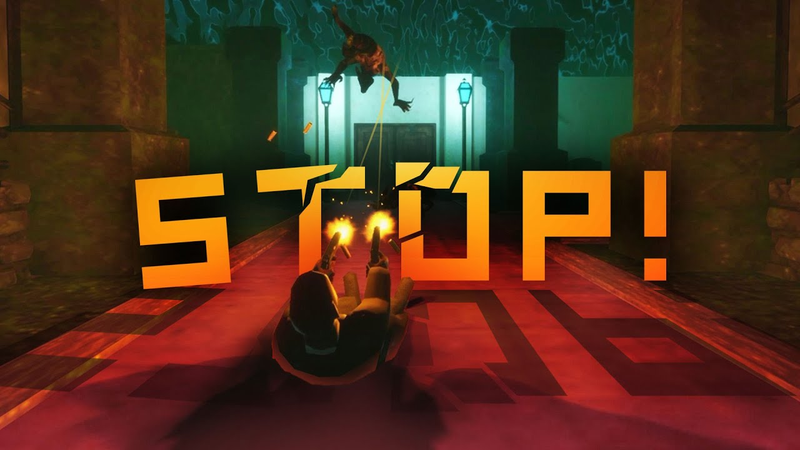
Watch THIS If You Want To Make Games (And FINISH Them!)
Successful independent game development requires a shift away from the common industry tendency to pursue high-risk, multi-year projects without market validation.
- Treat game development as a traditional business by scaling from small, proven concepts rather than pursuing high-risk, multi-year projects without market validation.
- Prioritize rapid prototyping and iterative testing to identify market potential before committing to full-scale production.
- Avoid over-investing in projects by ensuring a concept is validated and has a clear path to completion before beginning development.
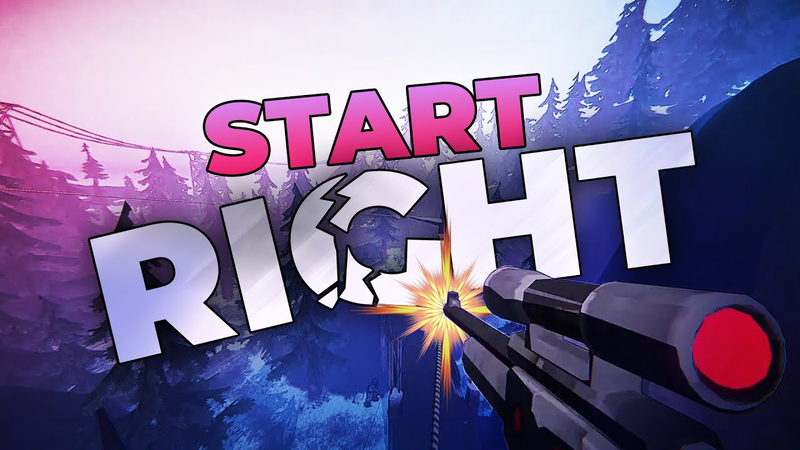
How To Start Making Games (The RIGHT Way)
Successful independent game development relies on the implementation of artificial constraints and a clear understanding of personal objectives rather than chasing industry trends or open-ended development cycles.
- Prevent project bloat and ensure financial viability by implementing strict, self-imposed constraints on budget, time, and development scope.
- Define a clear 'finish line' early in the development cycle to maintain creative momentum and avoid the multi-year cycles that frequently lead to commercial failure.
- Prioritize the developer’s specific creative strengths, such as narrative-driven storytelling, rather than chasing market trends or implementing complex, popular features like procedural generation.
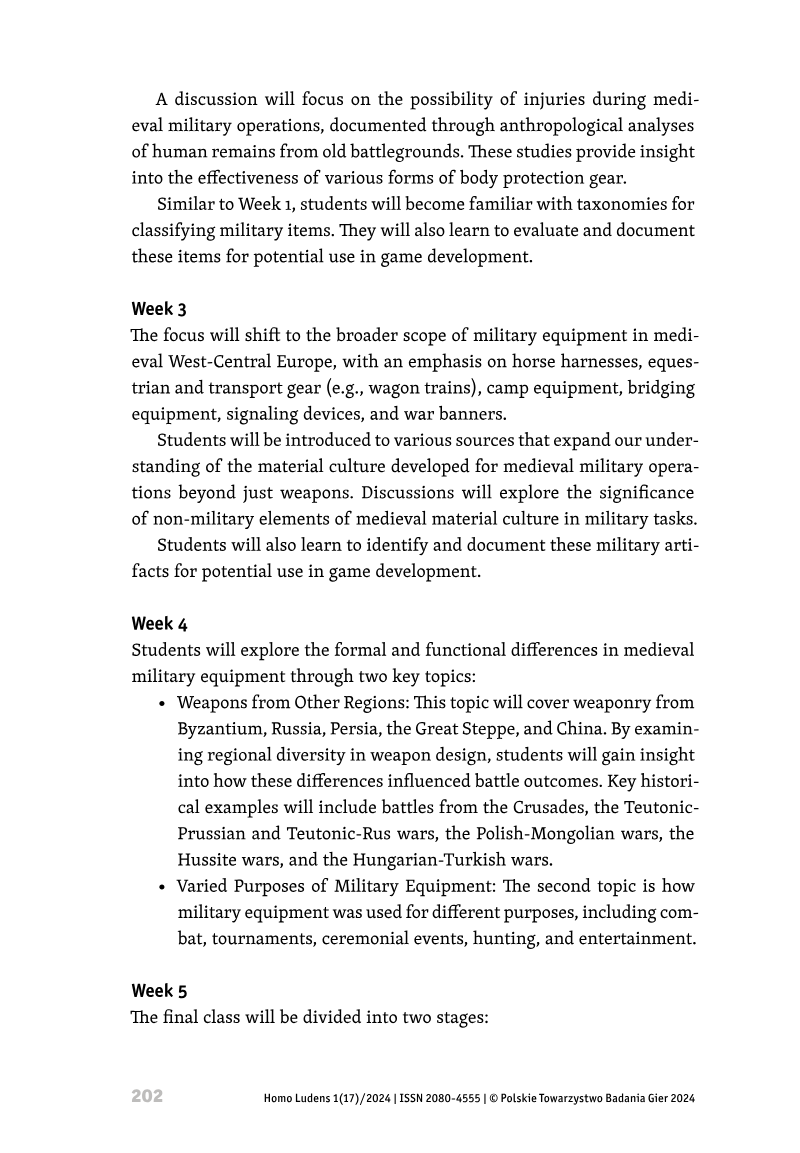
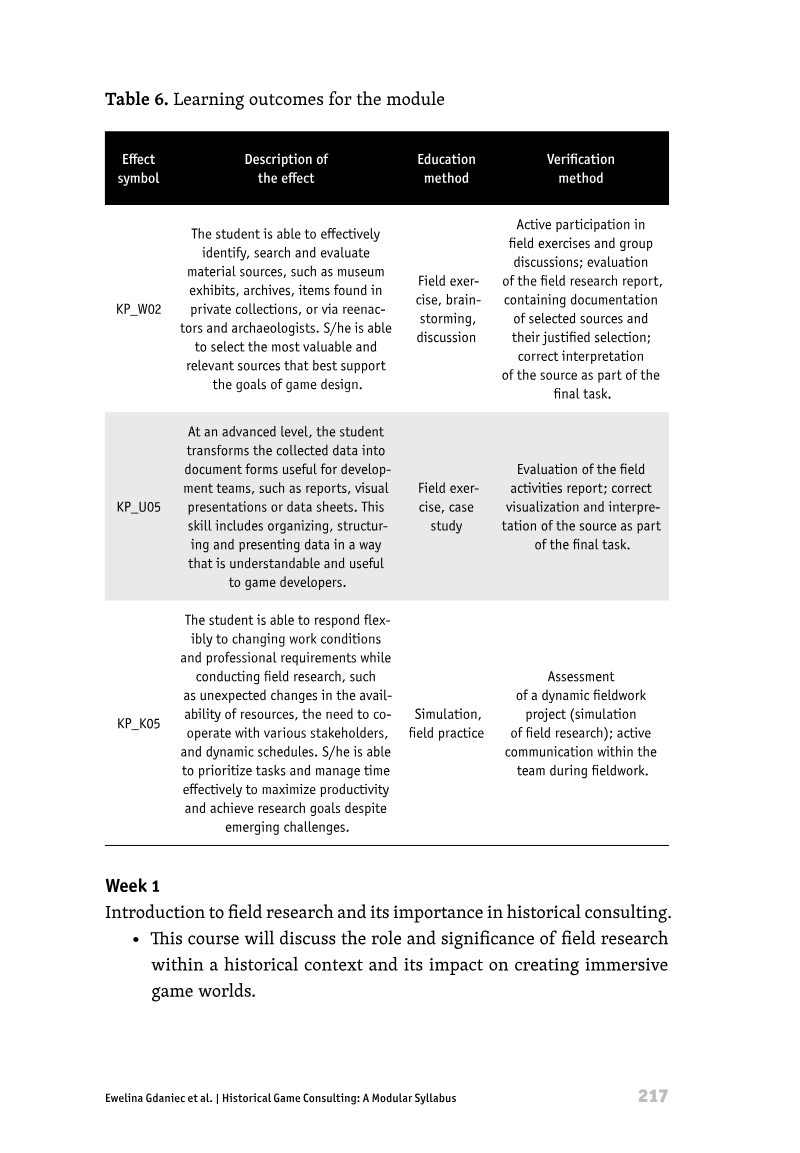
Historical Game Consulting: A Modular Syllabus
This document outlines a modular syllabus designed to train history students in historical game consulting, funded by a CRPK grant.
- The syllabus targets historians who want to supply accurate, usable historical knowledge to game development teams, filling a gap where few educational materials exist at the intersection of historical scholarship and game production.
- Its central argument is that historical accuracy is a prerequisite for authentic game worlds, and that unique primary sources and expert consultation add substantial value to development.
- The authors deliberately exclude game design instruction, focusing instead on research skills, source analysis, and professional communication, since game design is already covered by existing resources.
Historical Game Consulting: A Modular Syllabus
The document outlines a comprehensive modular syllabus designed to train history students as historical consultants for the game industry, addressing a growing demand for historical authenticity in game development.
- Historians already hold the subject knowledge game developers need; the syllabus targets the translation gap, teaching historians to convert research into forms usable by production teams rather than teaching general game design.
- The syllabus is a modular, instructional work (published in Homo Ludens in 2024 by Mochocki and Kot) with autonomous multi-week blocks that can be recombined into different programs, and it presents no quantitative or empirical findings.
- Modules pair source research with practical deliverables such as architectural drawings, iconographic records, technical data, paint schemes, and photographs, and assessments judge student work on accuracy, historical context, and suitability for game use.
Historical Consultants in the CEE Video Game Industry: Part 2: Competence Building
The "Historical Consultants in the CEE Video Game Industry: Part 2: Competence Building" paper examines the essential competencies and training requirements for historical consultants working within the Central and Eastern European (CEE) video game industry.
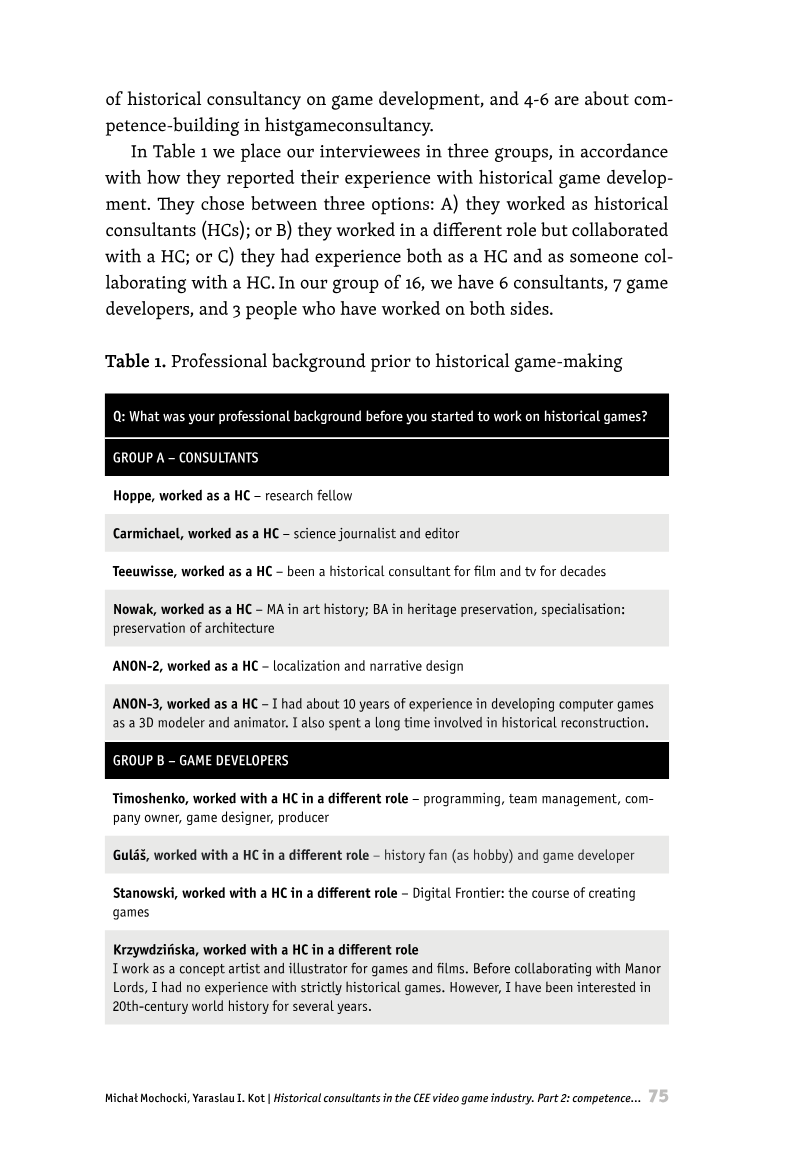
- Historical consultancy in the game industry has no formal training pathway, and this study, based on an online survey of 16 respondents (six consultants, seven developers, three who worked in both roles) in Central and Eastern Europe, examines how the field should be prepared.
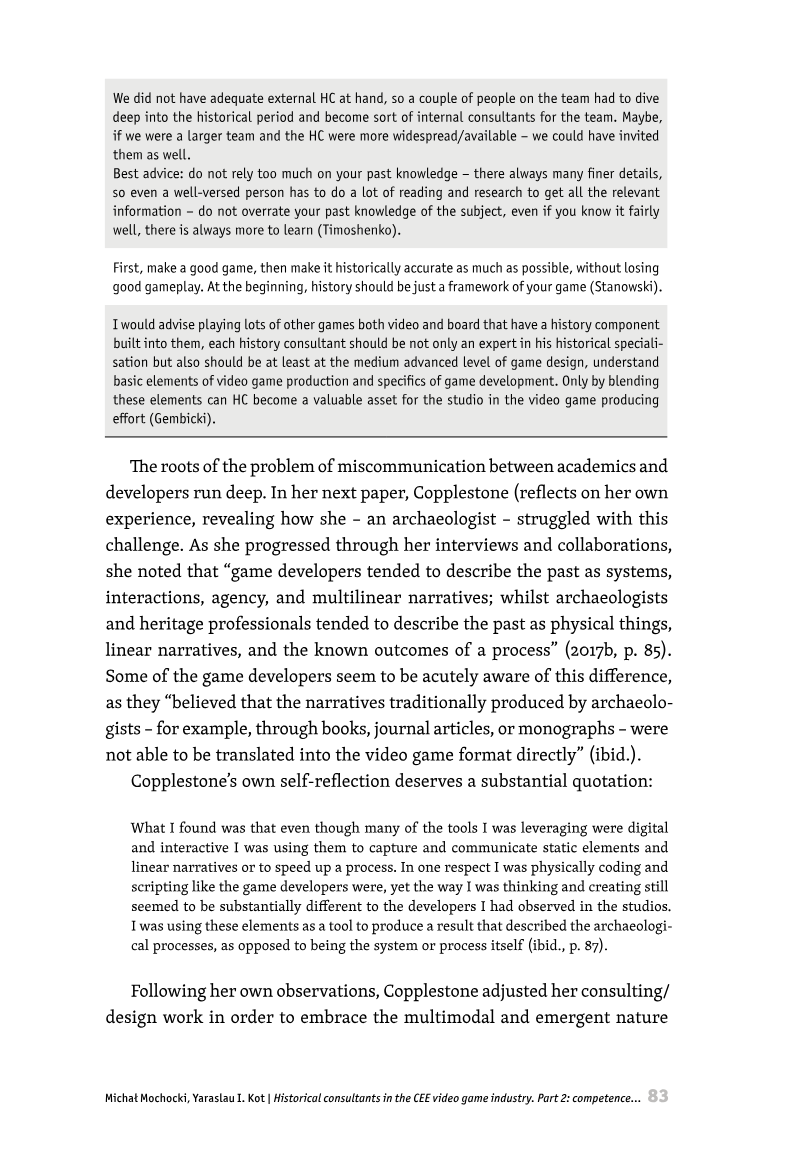
- The central concern is the communication divide between historians and developers, and the most consistent advice is for consultants to learn to "speak game".
- Consultants must understand development workflows and documentation and be willing to trade strict historical accuracy for playability when the two conflict.
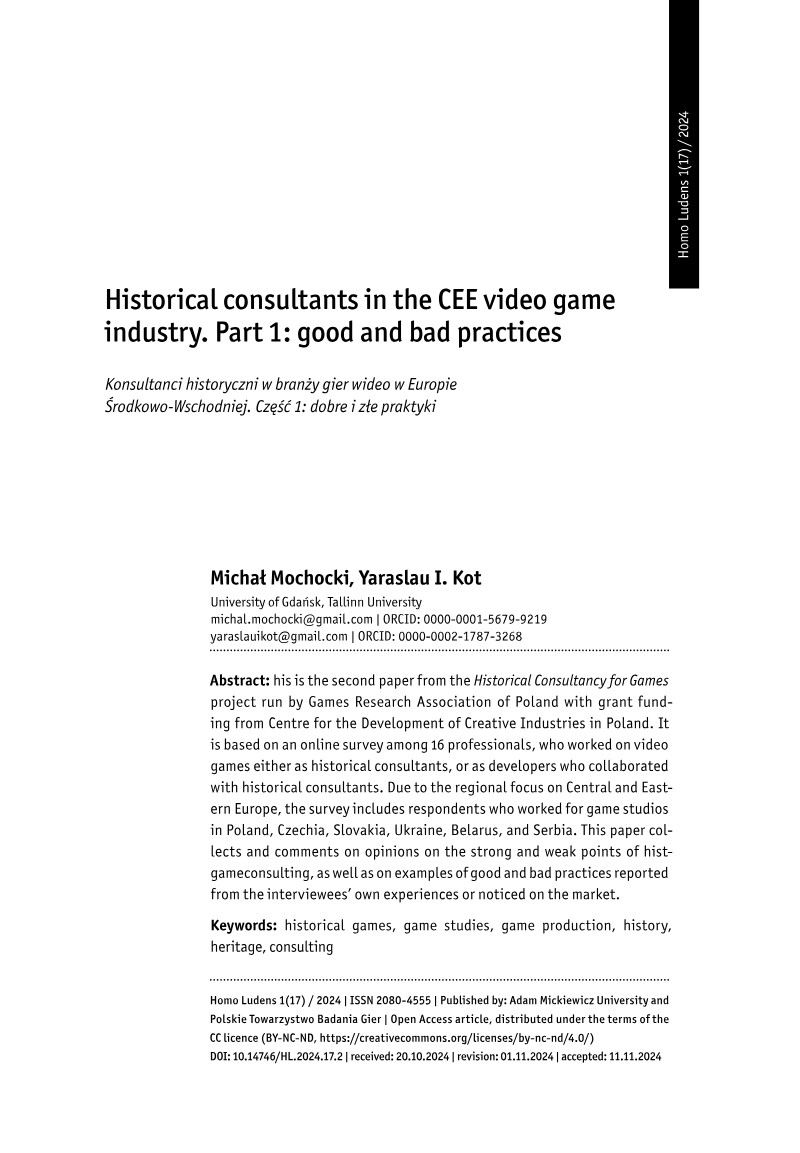
Historical Consultants in the CEE Video Game Industry: Part 1
This study, published in Homo Ludens by Mochocki and Kot in 2024, examines how historical consultants shape video game development in Central and Eastern Europe.
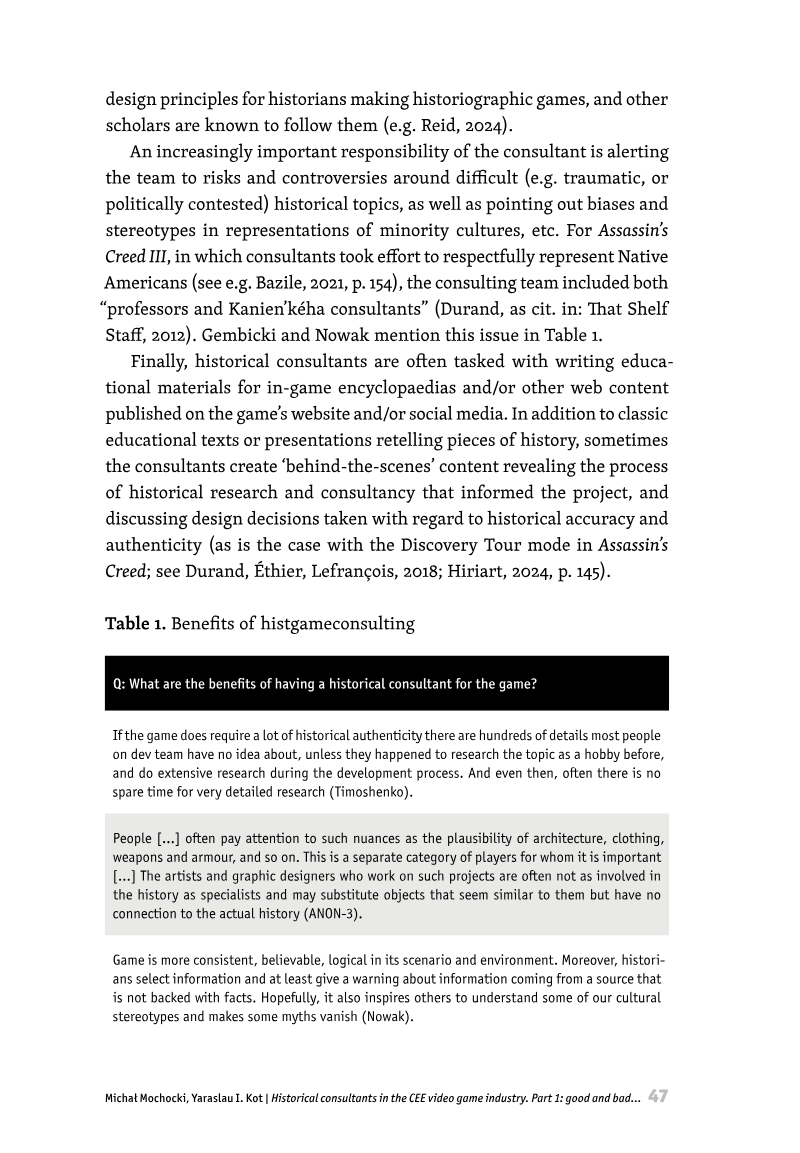
- Historical consultancy in Central and Eastern European game development has matured into a distinct professional specialisation, and its value depends on clearly defined roles, early and continuous collaboration, and a deliberate balance between historical authenticity and gameplay.
- The study is based on an online survey of 16 professionals working as historical consultants or alongside them at studios in Poland, Czechia, Slovakia, Ukraine, Belarus, and Serbia, and it was published in Homo Ludens by Mochocki and Kot in 2024.
- Consultants are typically academics or enthusiasts hired temporarily per project, and their core duties include supplying reference material, teaching research methods to teams, and validating scripts, visuals, and mechanics for accuracy, often alongside productive writing or design work.
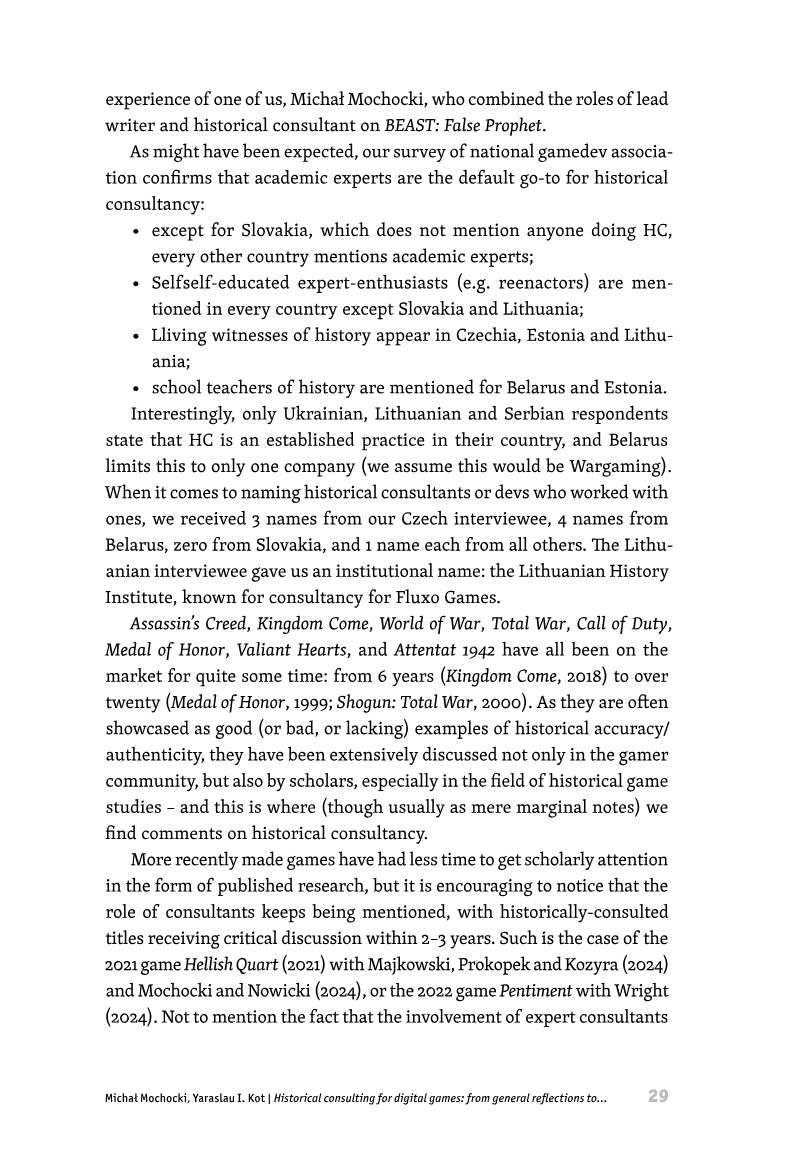
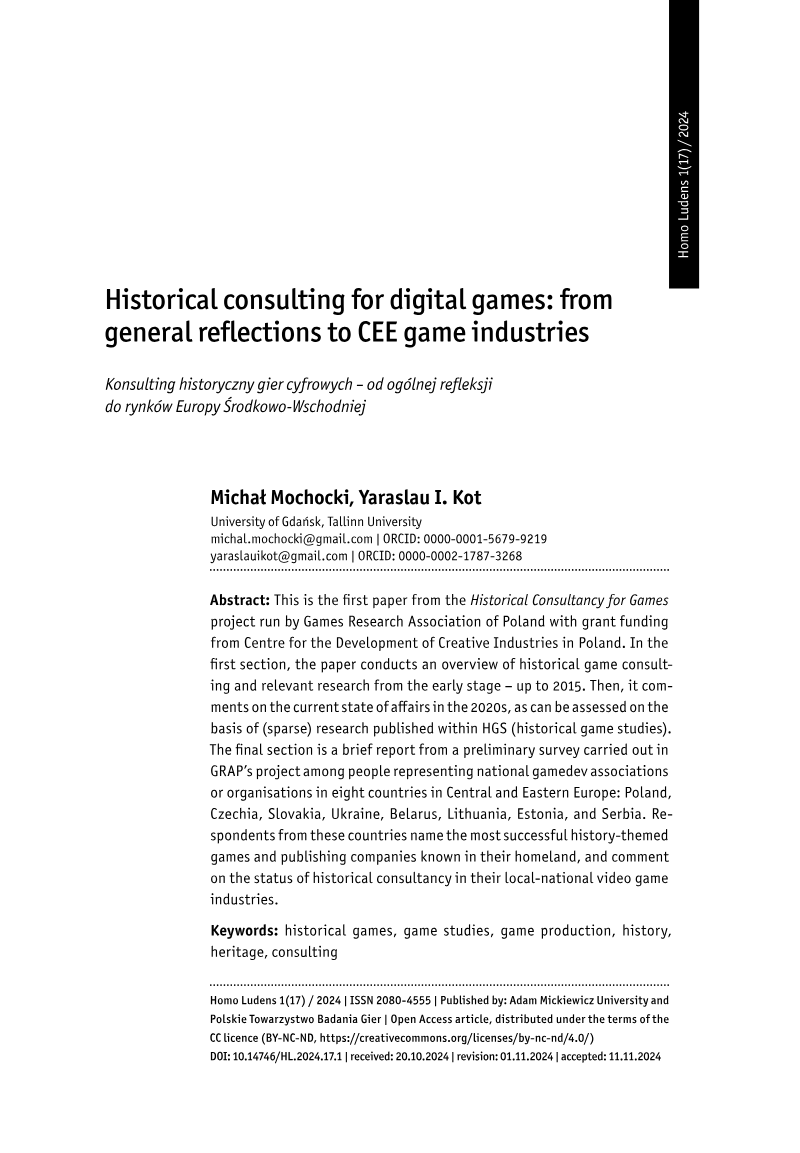
Historical Consulting for Digital Games: From General Reflections to CEE Game Industries
Historical consulting for digital games, the practice of engaging historians and other subject experts to inform game development, has moved from an informal and often decorative role toward a more established professional field.
- Historical consulting for digital games has evolved from an informal, often decorative role, especially in the 2010s when it was frequently used for marketing value, into a more established professional field by the 2020s, with consultants more visible in credits and academic-industry partnerships growing.
- Prominent examples such as Ubisoft's Assassin's Creed series and Warhorse Studios' Kingdom Come: Deliverance show expert involvement becoming a central selling point, though the overall job market for historical consultants remains modest.
- Case studies of Warhorse Studios, Wargaming, Creative Assembly, Ubisoft Montpellier, and Charles Games found that academic historians are the most common consultants, while Wargaming favors military-technical specialists.
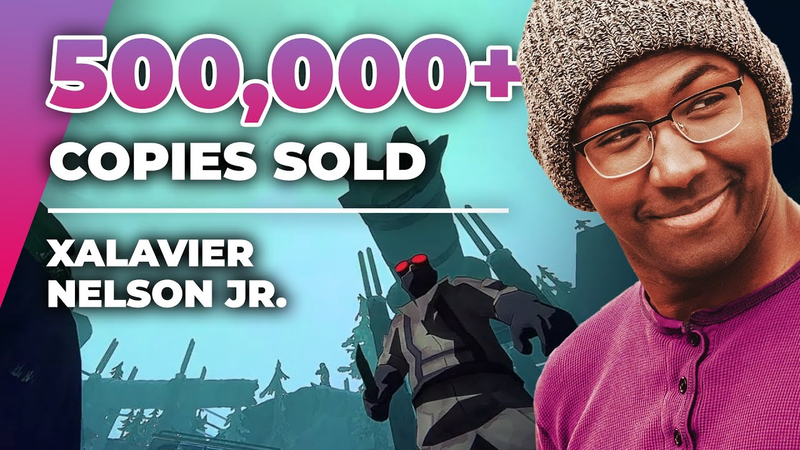
How He Sold 500,000+ Copies Of His Games (Xalavier Nelson Jr.) — Full Time Game Dev Podcast Ep. 033
The modern independent game industry is currently hindered by a pervasive culture of hyper-bloat, where developers and publishers unnecessarily inflate project scopes and budgets in a misguided pursuit of scale.
- Independent studios should reject the industry-wide trend of hyper-bloat, which unnecessarily inflates project scopes and budgets to the detriment of operational efficiency.
- Treating game development as a series of high-stakes, multi-year gambles creates extreme financial vulnerability that threatens both creative autonomy and long-term business viability.
- Adopting artificial constraints on development timelines and budgets transforms game production from an all-or-nothing gamble into a sustainable, professional business model.

Let's Review Your Games — Ep. 007
The primary objective of game development and marketing is the establishment of a clear, high-concept hook that differentiates a title within the crowded Steam marketplace.
- Steam store page success relies heavily on a compelling, high-concept hook in the description and thumbnail, such as framing a character as an 'emo robot' to create immediate emotional intrigue.
- Game UI and menus must match the game's overall visual identity; inconsistent design choices make a product appear cheap and diminish its perceived value.
- Overuse of post-processing effects can negatively impact the player experience by causing visual discomfort, particularly when viewed in full-screen mode.

Let's Review Your Games — Ep. 006
The primary objective of modern game development is to secure immediate player engagement through a clearly defined, high-impact hook.
- Secure immediate player engagement by establishing a high-impact hook within the first five seconds of promotional materials and the opening minutes of gameplay.
- Apply the 'Big Butt Principle' to differentiate titles by pairing a familiar genre with a single, contrasting, and unique mechanic.
- Avoid slow-burn pacing and ambiguous objectives, as modern audiences and streamers prioritize immediate clarity and emotional grounding to prevent disengagement.

Considering Theory-Based Gamification in the Co-Design and Development of a VR Intervention
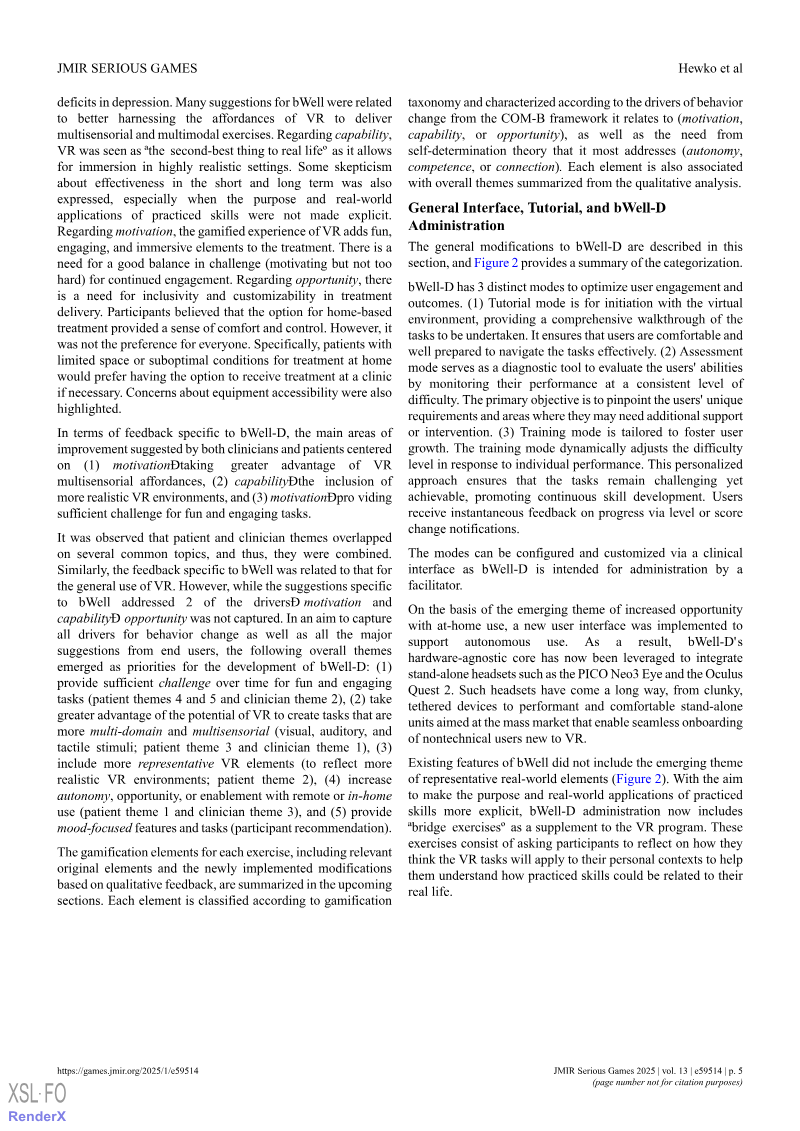
This study, by Hewko and colleagues at the National Research Council Canada and the University of British Columbia, describes the co-design and development of bWell-D, an immersive virtual reality cognitive remediation prototype for major depressive disorder.
- Feedback from end users centered on adding artificial challenge, personalization and customization options, and artificial assistance, with capability as the behavior change driver.
- Of the 28 features categorized against the COM-B model, 19 (68%) focused on capability.
- Of the implemented changes, only one did not address the three self-determination needs, a score streak indicator in the mole scene that offers extrinsic motivation.
Writers
Games and companies
Games