Game Development reports and market data
Documents
ARGs - I: What Are Alternate Reality Games? - Extra Credits
Alternate reality games (ARGs) represent a unique genre that intentionally blurs the boundaries between fiction and reality.
- Alternate Reality Games (ARGs) function by intentionally blurring the line between fiction and reality, operating under the premise that the game world is an extension of the player's everyday life.
- ARGs rely on collective intelligence and decentralized collaboration, allowing designers to implement complex, esoteric puzzles that would be impractical in traditional gaming environments.
- Successful campaigns like 'I Love Bees' (Halo) and Nine Inch Nails' 'Year Zero' demonstrate that ARGs can mobilize global, cohesive player units to solve real-world tasks, such as answering specific payphones at precise times.

Crowdfunding - How Kickstarter Helps Games Innovate - Extra Credits
Crowdfunding has emerged as a transformative alternative to traditional game development funding, enabling developers to bypass publishers and investors to bring niche or experimental projects to market.
- Crowdfunding platforms like Kickstarter and Rocket Hub allow developers to bypass traditional publishers and venture investors, shifting the power dynamic toward direct consumer funding.
- This funding model enables studios to prioritize creative quality and niche appeal over the mass-market profit-maximization strategies typically required by traditional financial backers.
- Traditional publishing agreements often force developers to sacrifice intellectual property rights and adhere to rigid milestones that risk project cancellation.
Kinect Disconnect - How NOT to Do Motion Control - Extra Credits
The Kinect represents a significant challenge in game design, functioning as an "uncanny valley" of input devices.
- Traditional controllers succeed through 'kinesthetic projection,' where the device becomes an extension of the self, whereas the Kinect’s full-body movement forces players to remain hyper-aware of their own physical actions.
- The Kinect triggers cognitive dissonance because the brain identifies the movement as human but detects subtle inaccuracies, such as the lack of haptic feedback and physical resistance.
- Developers must adopt a 'controls-first' design philosophy for motion hardware, ensuring the physical act itself is inherently satisfying before layering on narrative or broader game systems.
Mass Effect 3 DLC - Can Day 1 DLC be a Good Thing? - Extra Credits
The practice of releasing downloadable content (DLC) on a game’s launch day is often viewed as a predatory business tactic, yet it serves a functional role in the modern console development cycle.
- The console certification process creates a mandatory six-to-eight-week gap between the completion of a game and its retail release, which developers use to produce day-one DLC.
- Day-one DLC serves as a functional economic model to keep development teams employed during the post-gold, pre-launch window when the base game is already finished.
- Publishers rely on day-one DLC because consumer interest in a new title drops precipitously shortly after the initial release, creating a narrow window for monetization.
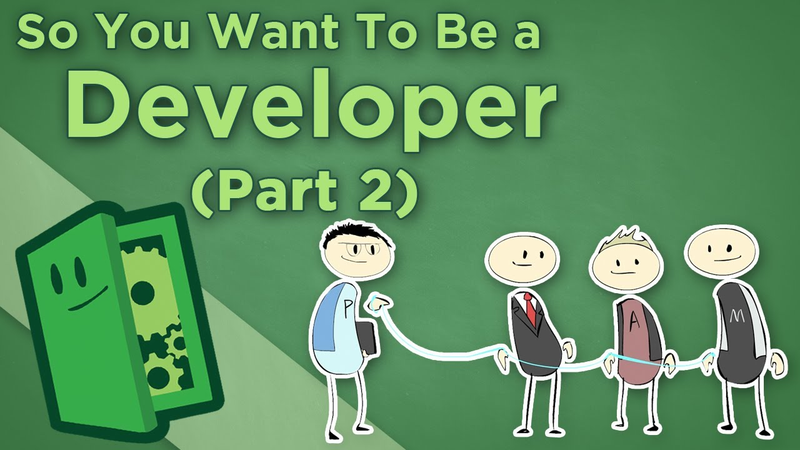
So You Want to Be a Developer - II: Understand Your Coworkers and Your Users - Extra Credits
Professional software development requires a transition from the solitary hacker archetype to a collaborative team member.
- Professional software development requires transitioning from a solitary hacker mindset to a collaborative team member who can effectively coordinate with artists, managers, and marketers.
- Technical proficiency is insufficient for success; developers must treat communication as a core skill by practicing active listening and respecting the expertise of non-technical colleagues.
- Developers must maintain deep technical knowledge of low-level languages like C and assembly, as well as hardware, networking, and operating systems, to troubleshoot performance issues beneath high-level abstractions.

So You Want to Be a Developer - I: How to Think Algorithmically - Extra Credits
Software development is fundamentally defined as a process of problem-solving rather than merely writing code.
- Software development is primarily a problem-solving discipline focused on decomposing complex systems rather than the act of writing code.
- Algorithmic and abstract thinking are more valuable to a developer's long-term success than the memorization of specific programming syntax or software tools.
- Expertise is defined by the breadth of a developer's 'tool belt' and the ability to select the most efficient technique for a specific problem.

Mailbag 4 - Questions About the Game Industry - Extra Credits
This discussion addresses a variety of inquiries regarding the game industry, ranging from professional development and design resources to market trends and corporate analysis.
- Professional success in the game industry is driven by tangible output and functional prototypes rather than abstract concepts or academic degrees in fields like psychology or economics.
- Aspiring designers should prioritize practical skill development and portfolio building, supplemented by foundational texts such as Jesse Shell’s 'The Art of Game Design: A Book of Lenses' and Don Norman’s 'The Design of Everyday Things'.
- Digital distribution platforms like EA’s Origin are essential business model pivots necessitated by the ongoing decline of physical game sales.

Mailbag 3 - Questions About the Game Industry - Extra Credits
This analysis addresses common inquiries regarding the game industry, focusing on professional development, studio management, and market dynamics.
- Practical experience and project completion are the most effective credentials for career advancement, outweighing traditional management degrees for aspiring producers.
- Aspiring producers should prioritize studies in psychology or business over management-specific degrees to better navigate the interpersonal and operational challenges of game development.
- Launching an independent studio is a low-barrier process that requires only a core team, the formation of a legal entity like an LLC, and active promotion through public platforms and competitions.

SOPA & PIPA - 2011 Legislation that Threatens Digital Freedoms - Extra Credits
The Stop Online Piracy Act (SOPA) and the PROTECT IP Act (PIPA) represent significant legislative threats to digital freedom and internet infrastructure.
- SOPA and PIPA threaten the integrity of the Domain Name System (DNS) by proposing government-mandated interference that experts from the Department of Homeland Security and Sandia National Laboratories warn would undermine global cybersecurity.
- The legislation grants internet service providers (ISPs) blanket immunity for voluntary content blocking, creating a conflict of interest for ISPs that simultaneously own large copyrighted media portfolios.
- The bills utilize overly broad language that risks suppressing legitimate online activity and eroding net neutrality standards.
Playtesting - How to Get Good Feedback on Your Game - Extra Credits
Playtesting serves as a critical component of the iterative game design process, functioning as a primary mechanism for gathering objective user feedback to refine quality.
- Designers must detach emotionally from their work to treat critical feedback as an objective tool for identifying flaws and validating core mechanics.
- Effective playtesting requires observing player behavior and frustration points in silence, as verbal interaction from the designer often biases the participant's experience.
- When analyzing feedback, developers should prioritize identifying the root cause of player dissatisfaction rather than adopting the specific solutions proposed by the testers.
Technobabble - Bad Writing Makes Bad Sci-Fi - Extra Credits
Effective science fiction writing requires a commitment to either rigorous internal logic or a clear embrace of fantasy, rather than the use of superficial jargon.
- Technobabble—the misuse of scientific terminology to mask narrative gaps—undermines audience immersion and violates fundamental design principles.
- Effective science fiction requires a commitment to either rigorous internal logic or a clear embrace of fantasy, rather than using superficial jargon to simulate credibility.
- Creators should either perform the necessary research to ground their universes in accurate scientific principles or abandon the pretense of realism to focus on the narrative freedom of fantasy.

The Uncanny Valley - Why More Realistic Characters Look Less Human - Extra Credits
The Uncanny Valley theory describes the psychological phenomenon where human-like depictions become increasingly unsettling as they approach, but fail to achieve, perfect realism.
- The Uncanny Valley theory, introduced by roboticist Masahiro Mori, posits that human-like depictions become increasingly unsettling as they approach, but fail to achieve, perfect realism.
- Human brains possess a high-resolution understanding of natural movement and appearance, causing viewers to perceive minor technical discrepancies in near-human simulations as revolting or unnatural.
- Photorealistic game development carries high financial risk and technical requirements, as even minor flaws like geometry clipping or stiff animation can shatter the illusion of humanity.
Writers
Games and companies
Games