Game Development reports and market data
Documents
A Hybrid Approach to Procedural Generation of Roguelike Video Game Levels
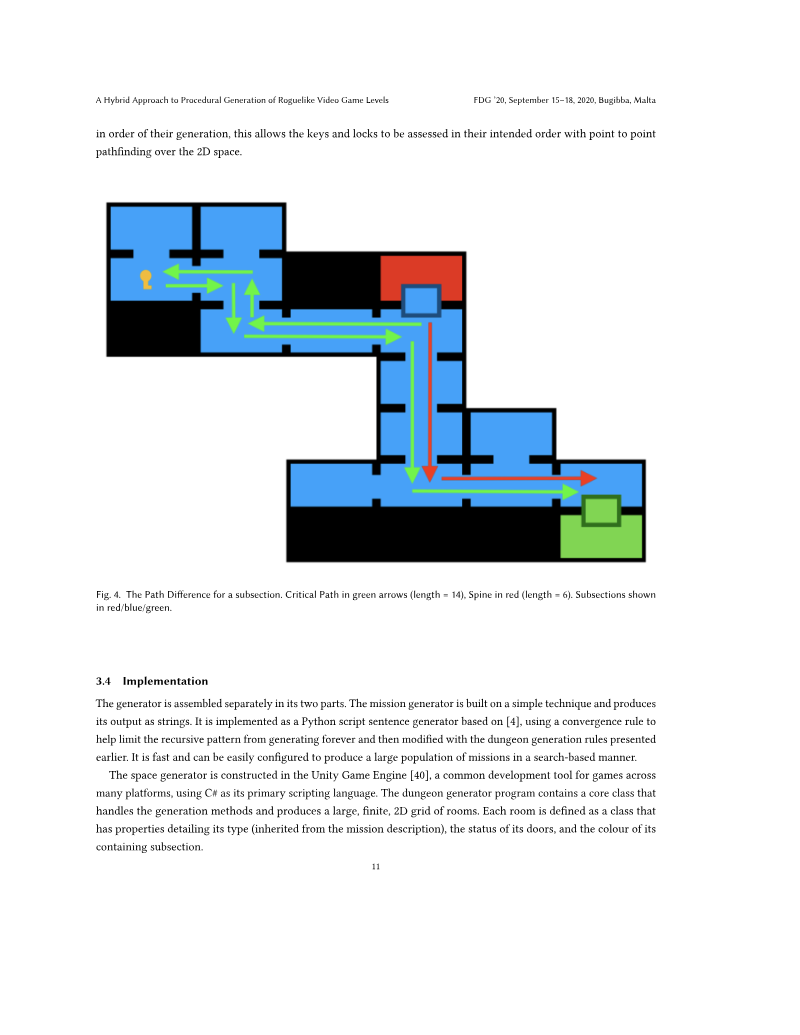
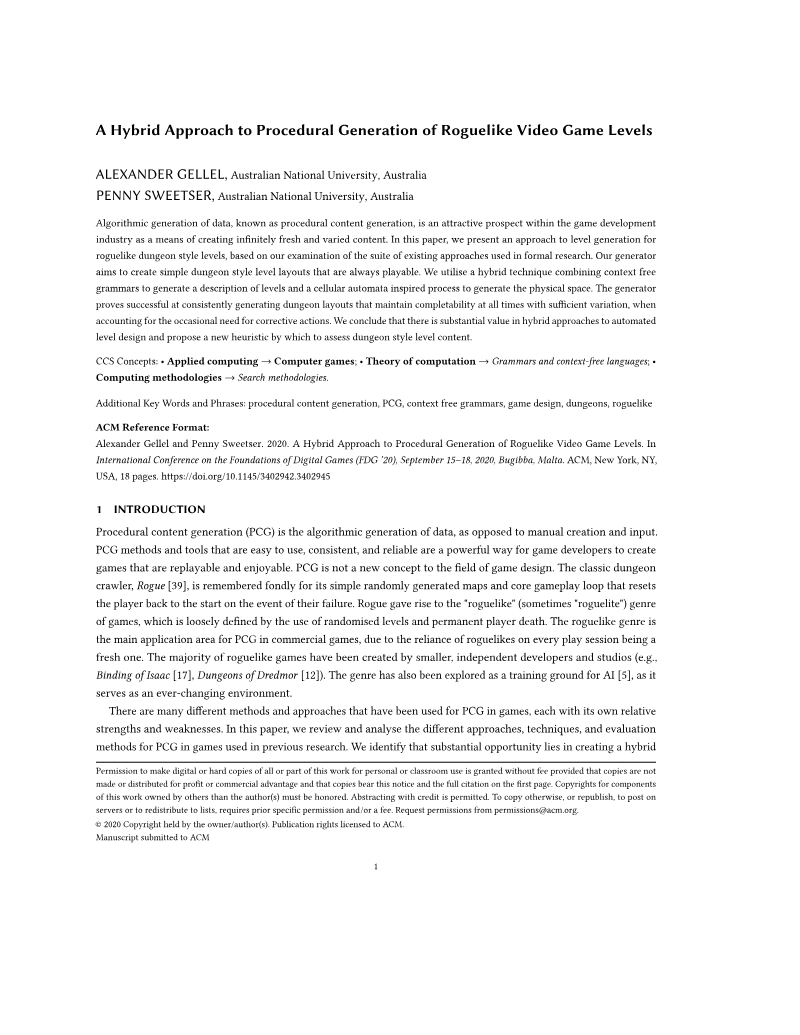
Alexander Gellel and Penny Sweetser, of the Australian National University, present a prototype level generator for roguelike dungeon-style levels, described in a paper for the 2020 International Conference on the Foundations of Digital Games.
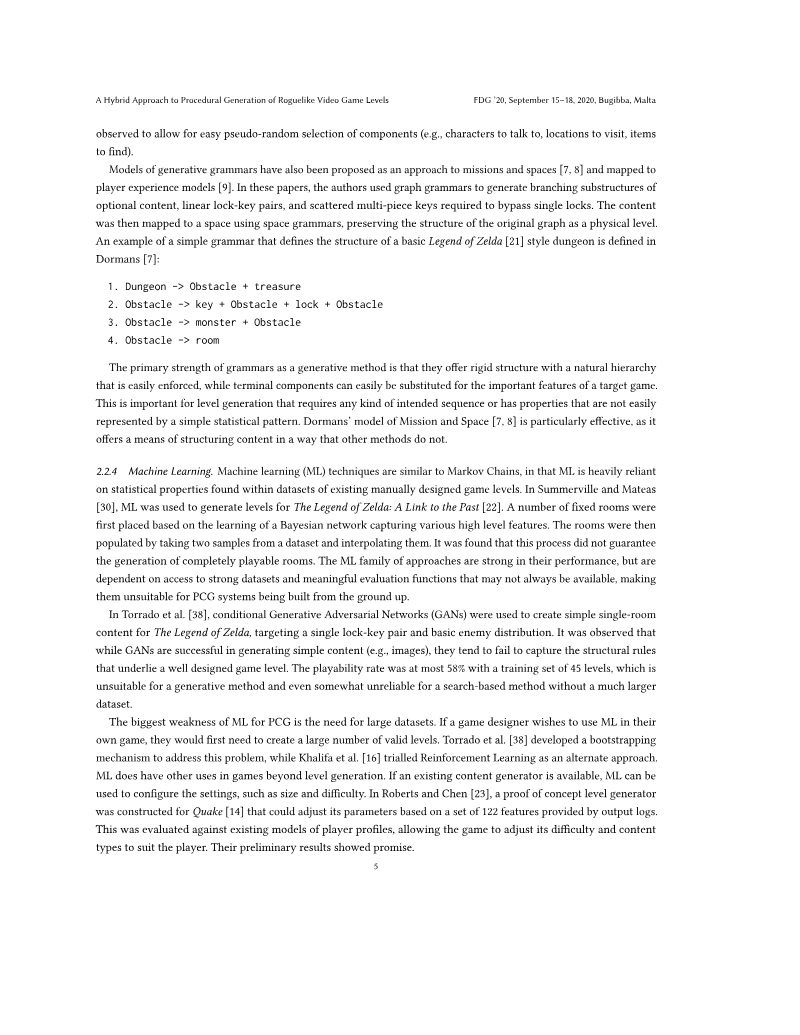
- The baseline Random Neighbour Search generated completable levels only 53.2% of the time in the authors' tests, while both Subsection Search variants reached 100% completability.
- The authors combined context free grammars for mission structure with a cellular automata-inspired process for physical space, arguing the two complement each other's weaknesses.
- The authors' grammar-based generator generated 100% of lock-key pairs appropriately in automated evaluation across numerous sample sets.
Procedural Generation Using Quantum Computation
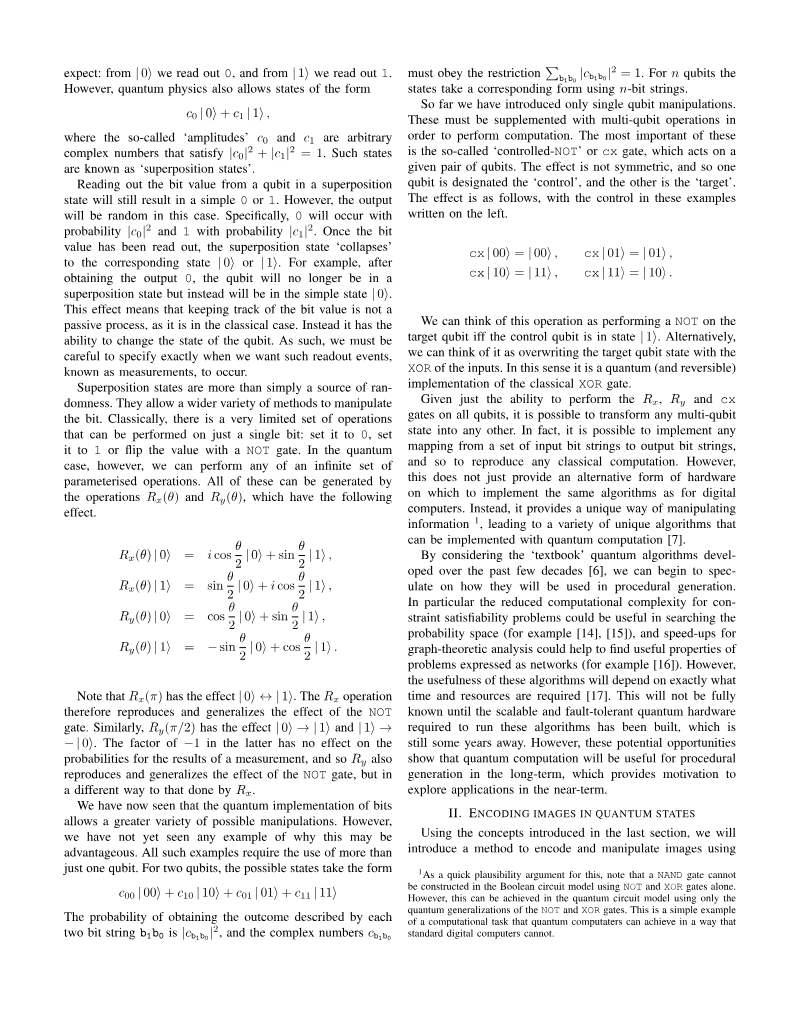
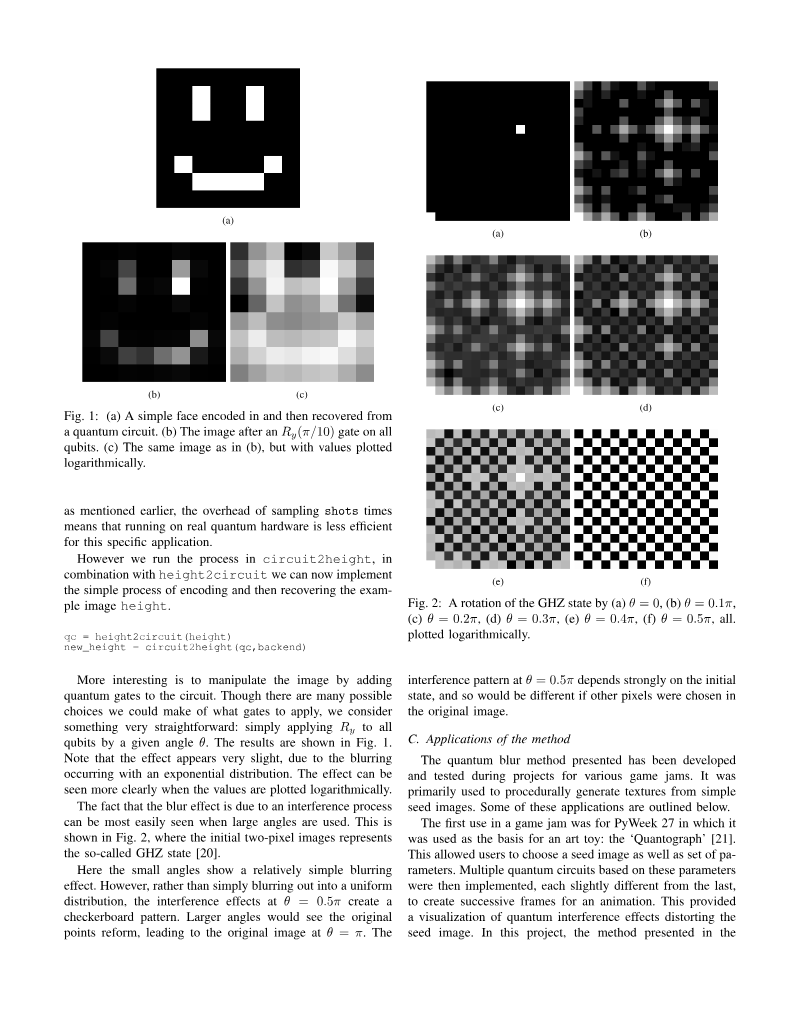
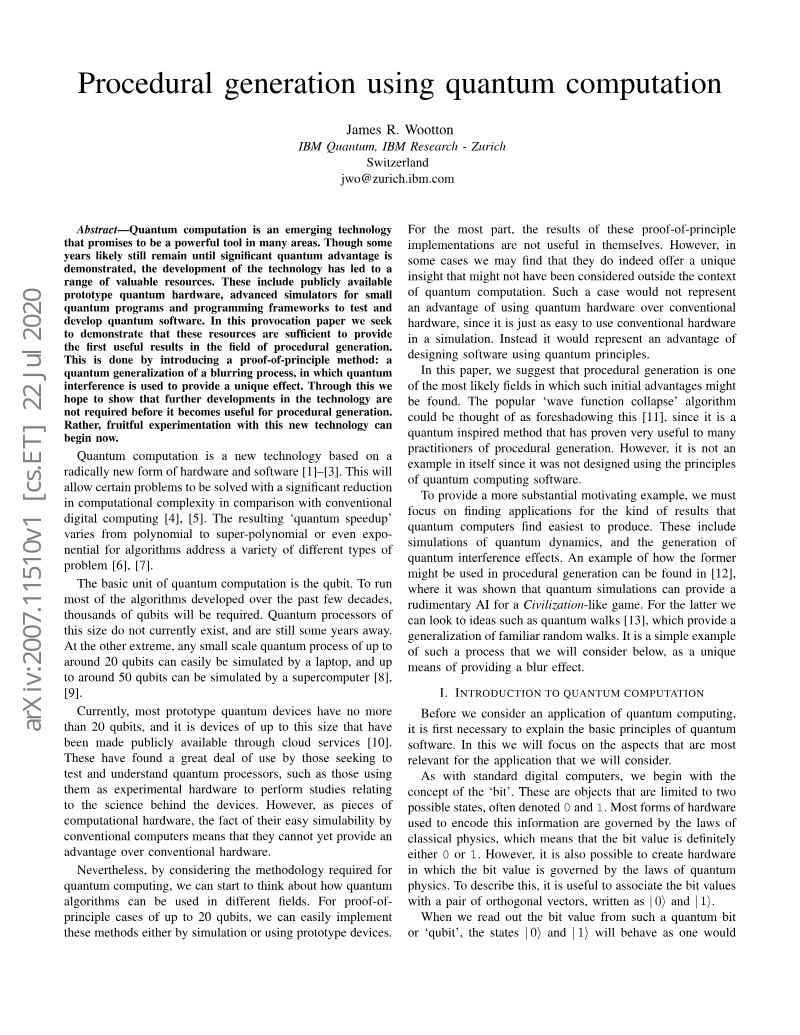
Wootton (IBM Quantum, IBM Research - Zurich) presents a proof-of-principle method for procedural generation that uses quantum computation.
- The quantum blur method encodes grayscale images as quantum state amplitudes, with the probability of each bit string proportional to the brightness of the corresponding pixel.
- The author reports that a Ludum Dare 44 game used one quantum process run to generate hundreds of textures, taking under 10 seconds on a laptop.
- The author states that the quantum method cannot beat the complexity of the standard box blur.
Sequential Segment-based Level Generation and Blending using Variational Autoencoders
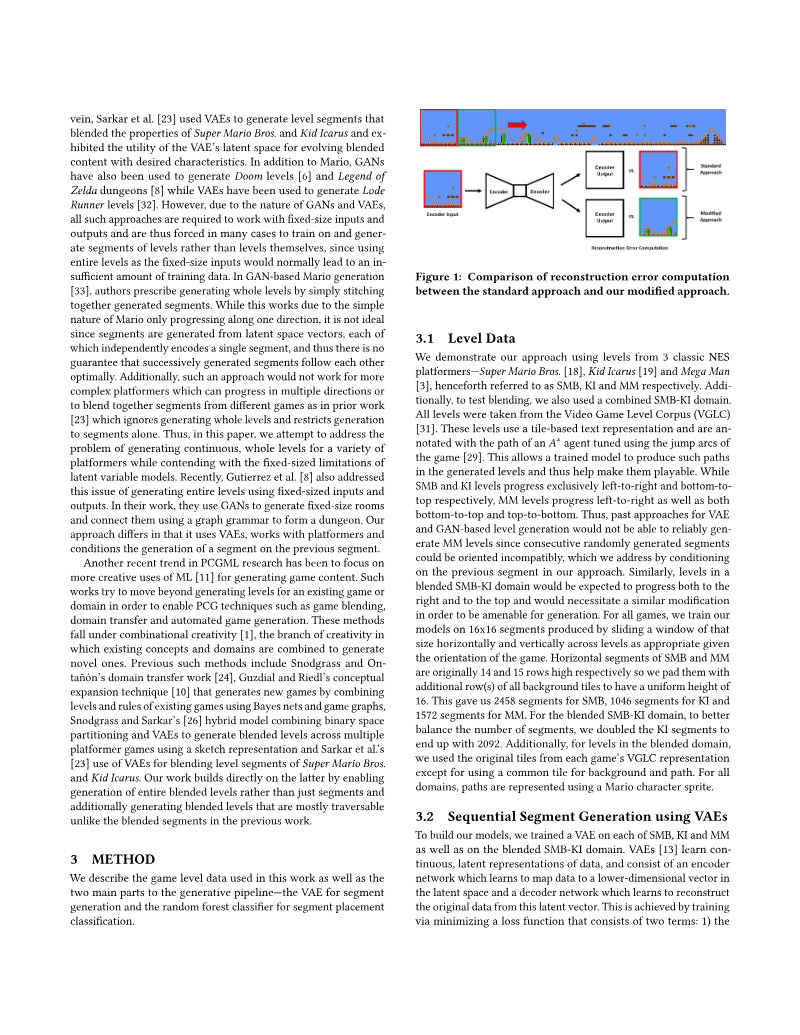
This paper by Anurag Sarkar and Seth Cooper of Northeastern University presents a method for generating continuous, multi-directional platformer levels using Variational Autoencoders (VAEs) combined with a random forest classifier for segment placement.
- Training the VAE to reconstruct the segment that follows the encoded input, rather than the input itself, lets generated segments logically follow one another.
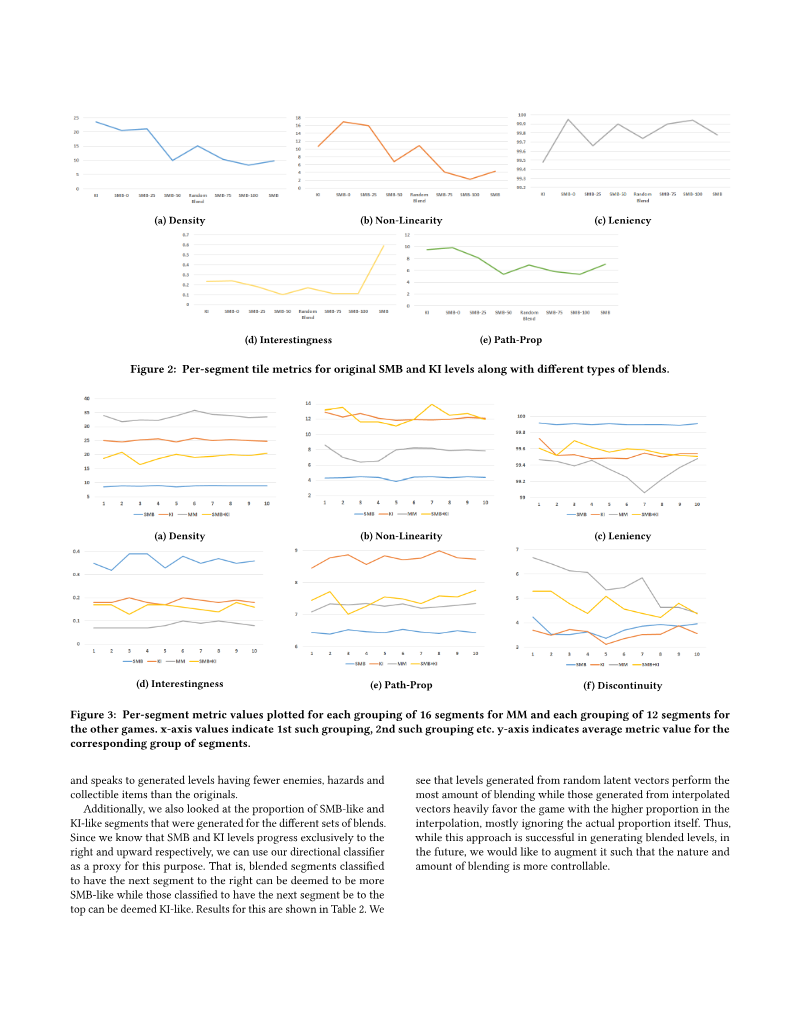
- Sequential generation yielded lower Discontinuity than independent generation in every domain, with SMB at 3.86 versus 5.91 for independent generation.
- For Mega Man, average Discontinuity was 6.54 ± 2.63 for sequential generation compared with 11.18 ± 1.69 for independent generation.
Tabletop Roleplaying Games as Procedural Content Generators
The paper by Guzdial, Acharya, Kreminski, Cook, Eladhari, Liapis and Sullivan, affiliated with universities in Canada, the United States, the United Kingdom, Sweden and Malta, argues that tabletop roleplaying game (TTRPG) design can be viewed as procedural content generator (PCG) design.
- The authors contend that TTRPG design can be viewed as equivalent to designing a procedural content generator, with players and authored mechanics as inputs and play experiences as outputs.
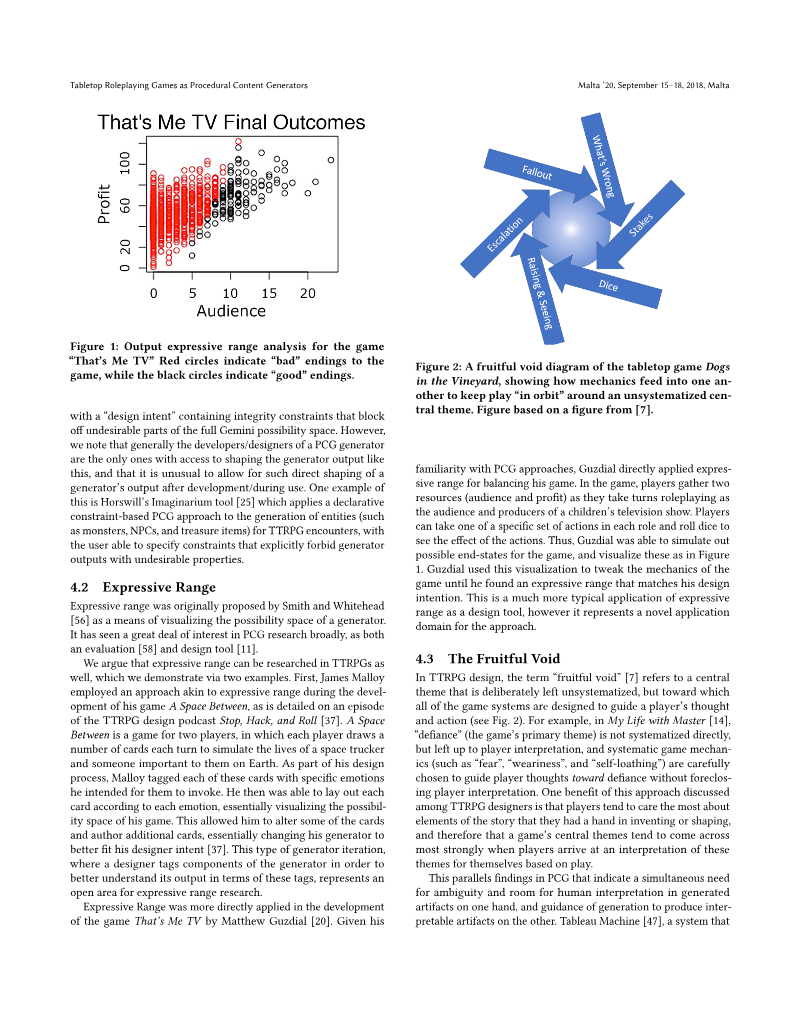
- Guzdial used expressive range visualization to tweak the mechanics of his game That's Me TV until its output matched his design intent.
- The paper states that the Powered by the Apocalypse system resolves most actions by rolling two six-sided dice, where a roll of 7 to 9 indicates a partial success.
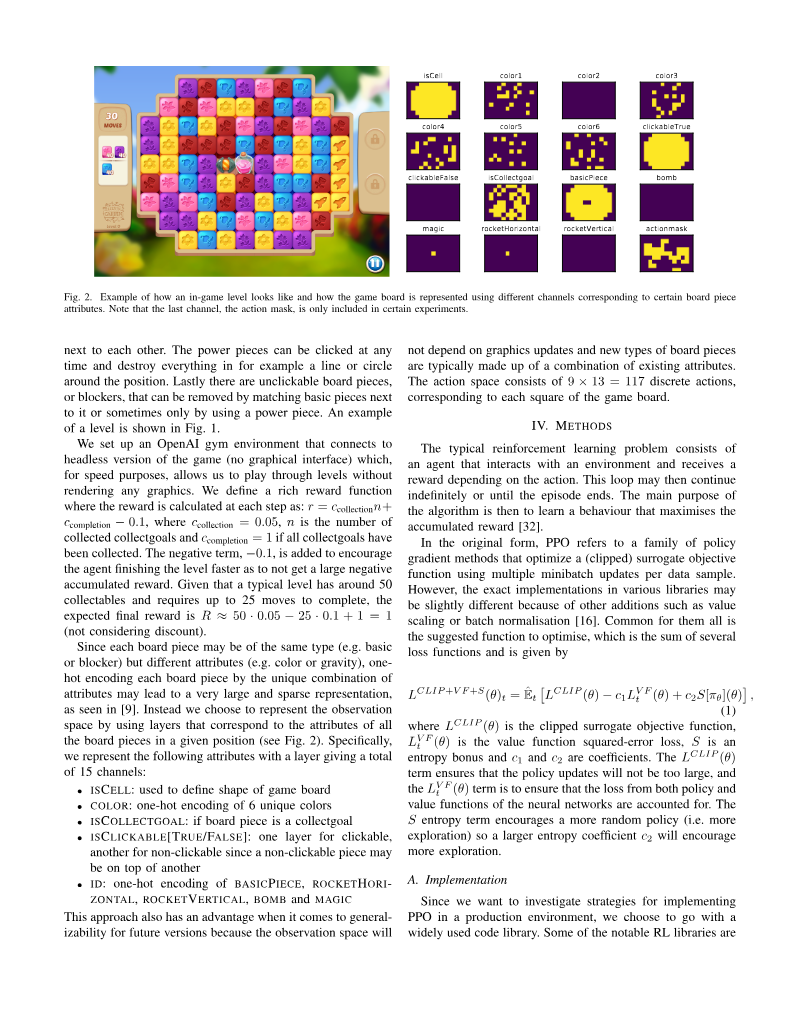
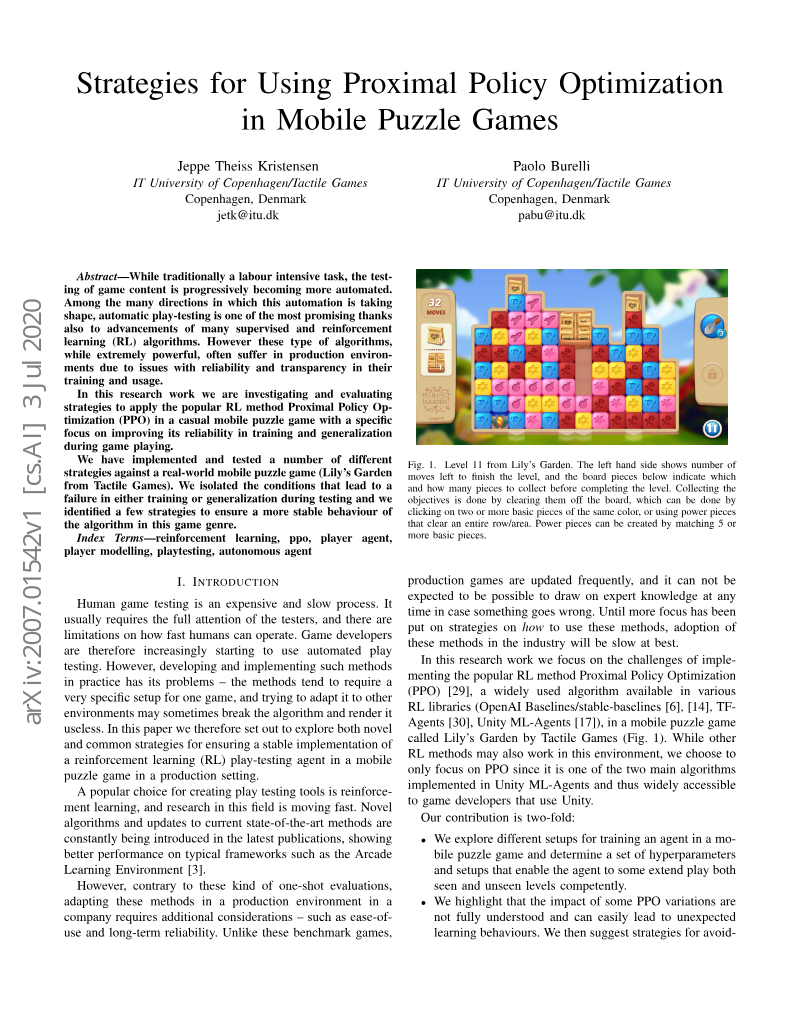
Strategies for Using Proximal Policy Optimization in Mobile Puzzle Games
This arXiv paper (July 2020) by Jeppe Theiss Kristensen and Paolo Burelli, from the IT University of Copenhagen and Tactile Games, examines how to apply Proximal Policy Optimization (PPO) to build a reliable play-testing agent for Lily's Garden, a free-to-play casual mobile puzzle game with more than 1500 levels.
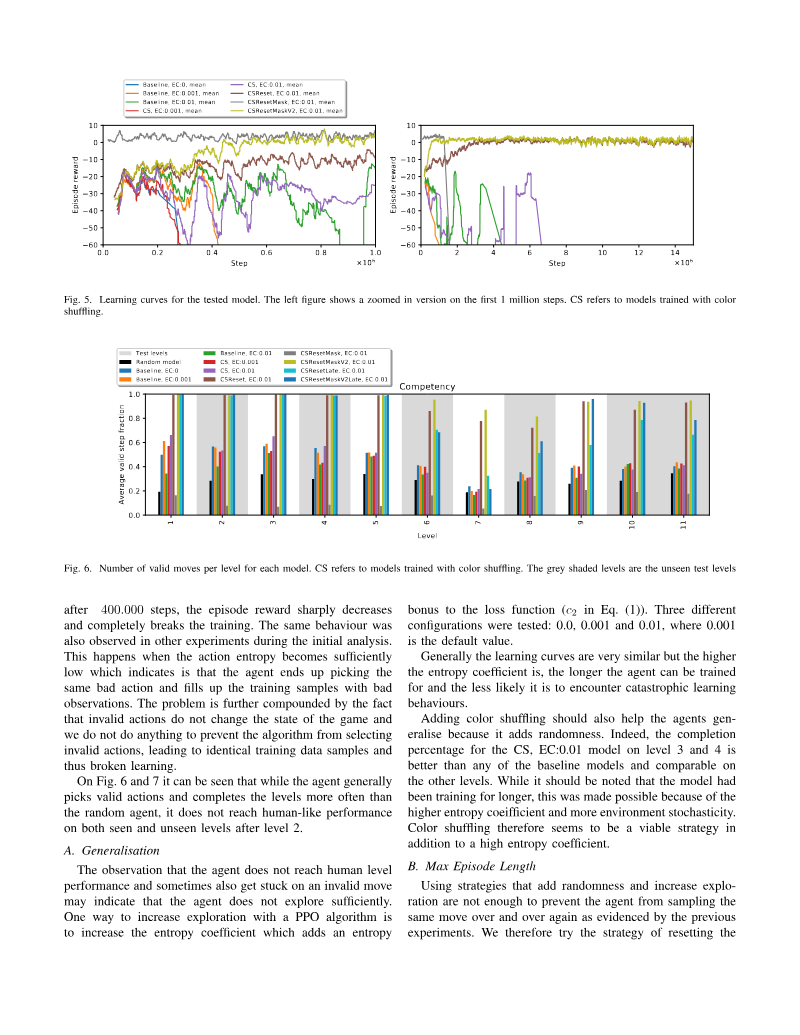
- The authors identify resetting the environment after a fixed number of steps as the most effective training strategy, which they say ensured more stable learning.
- A hard action mask added to the logits caused training to fail, with the training completely breaking after around 1.5 million steps.
- The soft action mask, included as an observation channel, produced stable training that learned faster than the reset-only model, reaching the same plateau after 0.5M steps versus 4M steps.

Data-Driven Game Development: Ethical Considerations
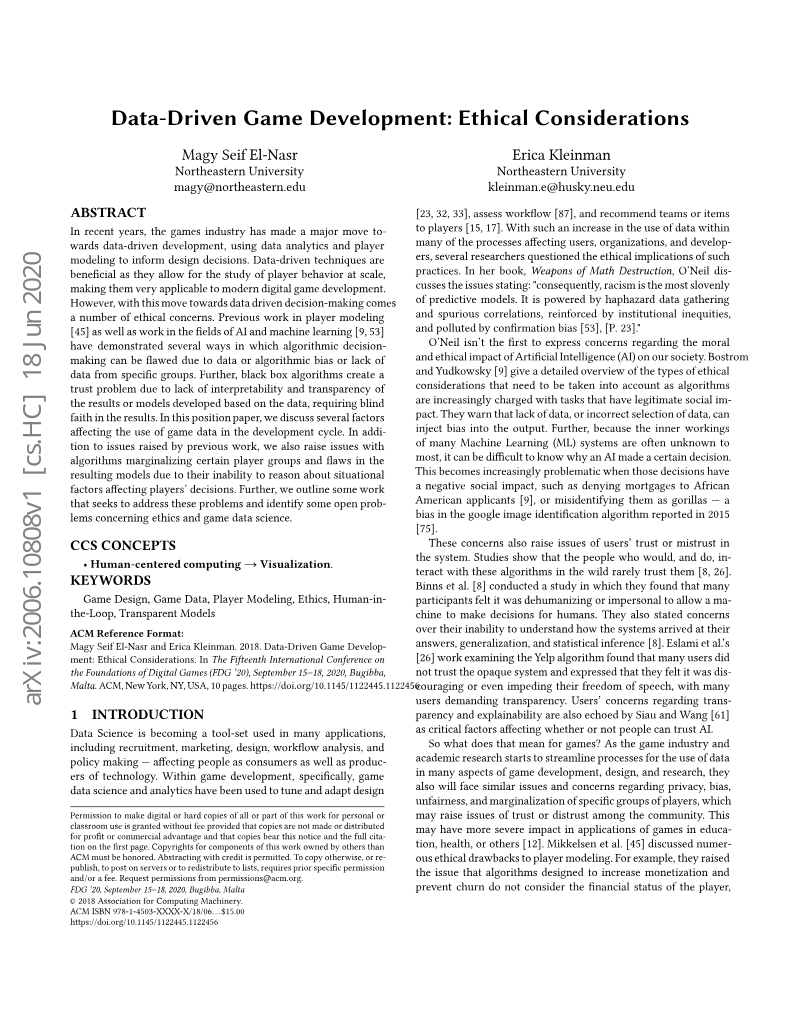
The paper is a position paper by Magy Seif El-Nasr and Erica Kleinman of Northeastern University, presented at the FDG '20 conference, that examines ethical concerns in using game data and player modeling in game development.
- Citing Mikkelsen et al., the authors note that algorithms designed to increase monetization and prevent churn do not consider a player's financial status, which risks trapping players in a predatory cycle.
- A large-scale study by Zendle and Cairns found correlations between problematic gambling behaviors and lootbox purchasing with real money, though it did not infer causation.
- The authors argue that because the trajectories of successful players are the most common in an educational game, aggregation or vanilla machine learning techniques could marginalize players who need the most design adjustments or help.
Multi-Objective Level Generator Generation with Marahel
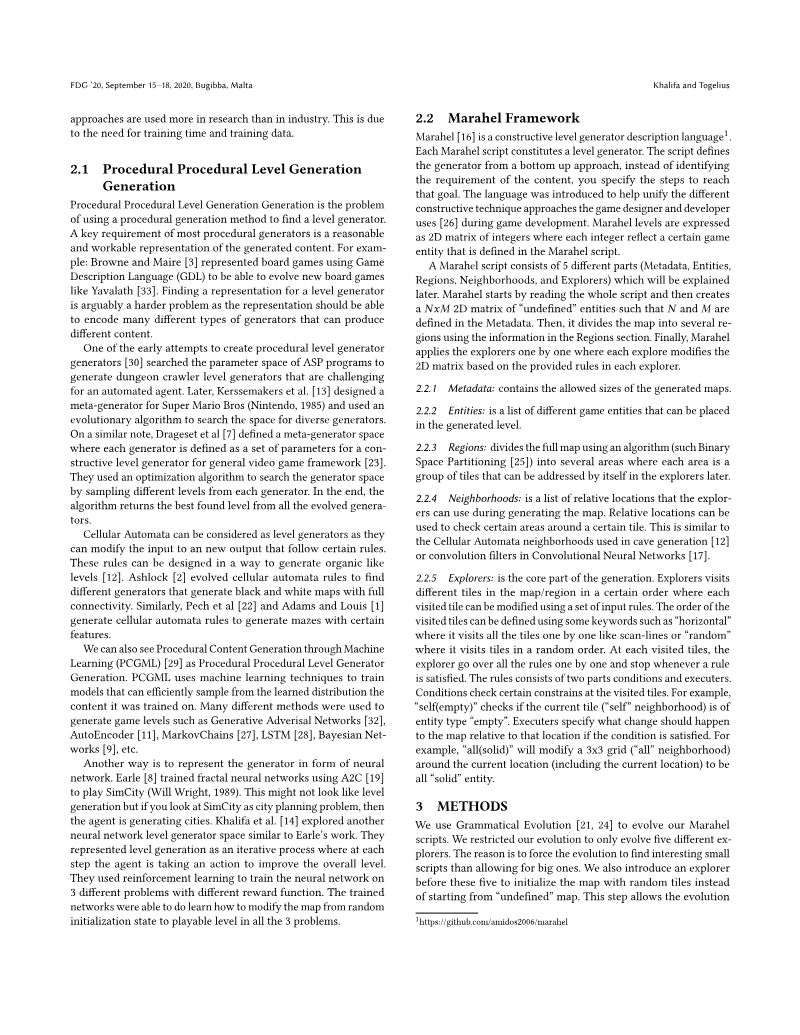
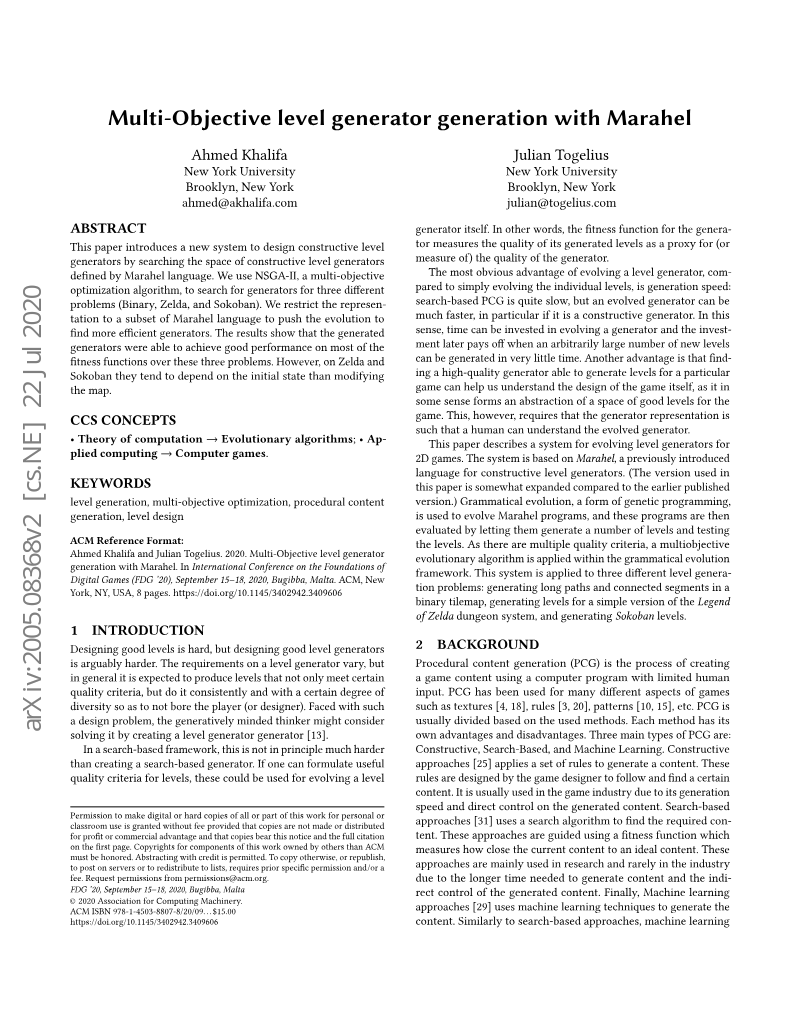
This FDG 2020 paper by Ahmed Khalifa and Julian Togelius introduces a system that evolves constructive level generators written in the Marahel language, using grammatical evolution and the NSGA-II multi-objective algorithm.
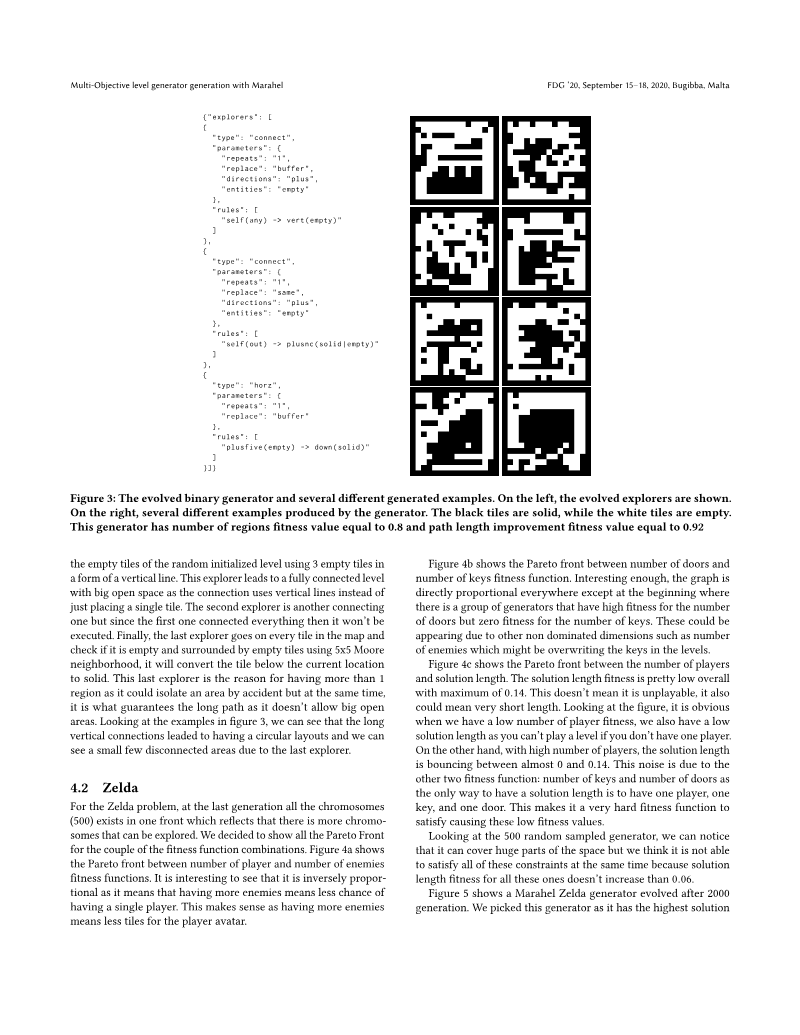
- The authors state that the Binary problem ended with 10 Pareto fronts, the first containing 36 of the 500 chromosomes, while Zelda and Sokoban ended with all 500 chromosomes in a single front.
- The authors report that the Binary path-length fitness was hard to satisfy together with connectivity, with random sampled generators reaching a maximum of 0.6 on long path length with connectivity.
- The authors argue that the Zelda generator they highlight acts as an eraser that removes extra objects from the random initialization, while the Sokoban generator resamples the level from a different distribution.
Mech-Elites: Illuminating the Mechanic Space of GVG-AI
Mech-Elites is a 2020 FDG paper by M Charity, Michael Cerny Green, Ahmed Khalifa and Julian Togelius, from New York University (with OriGen.AI for Green).
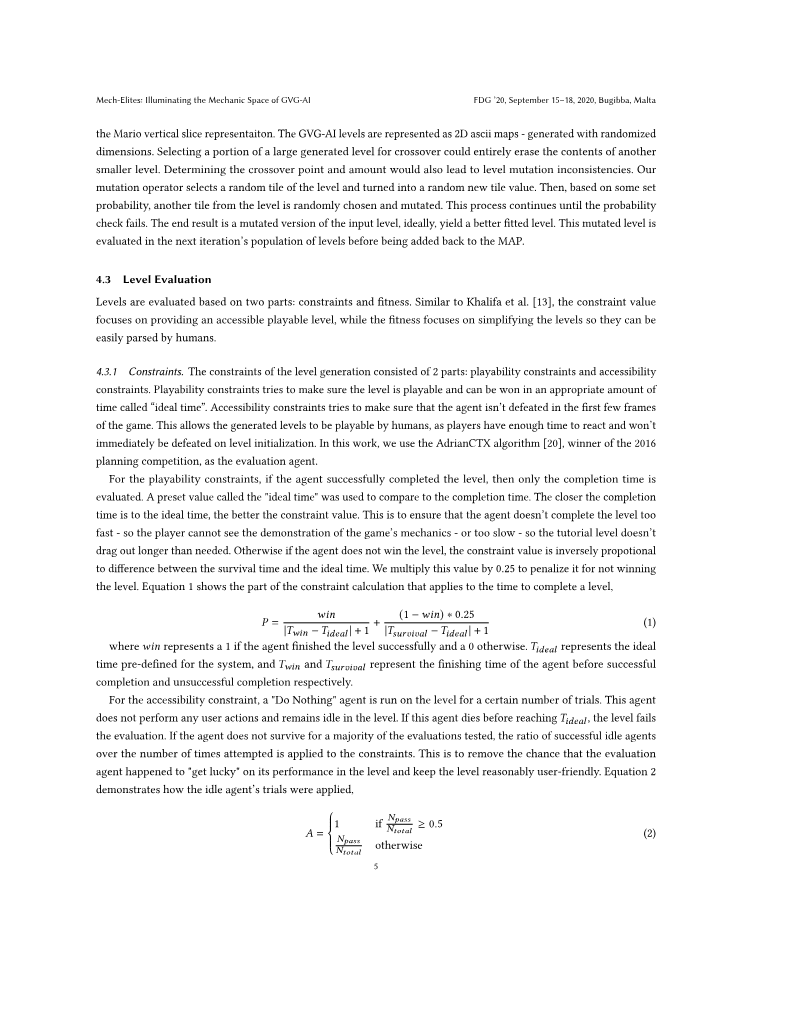
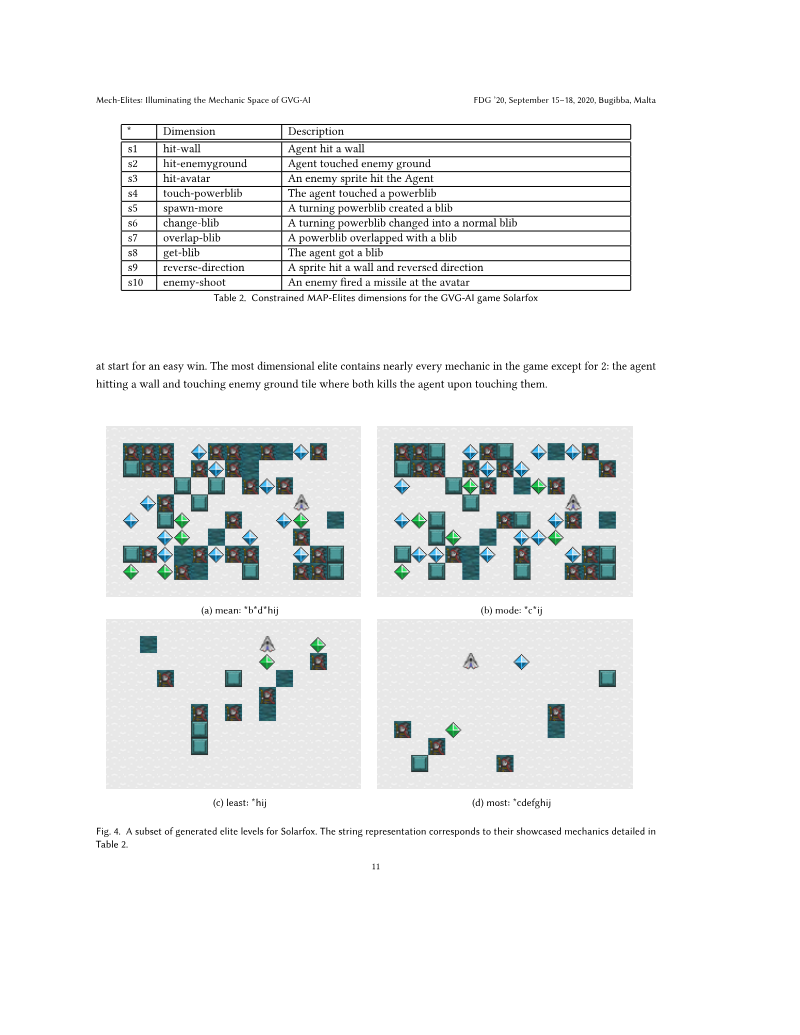
- Mech-Elites applies Constrained MAP-Elites within the GVG-AI framework to generate simple, playable tile-based levels containing specific sets of game mechanics across four games.
- Game mechanics were extracted automatically from each game's VGDL description rather than supplied by a designer, using the AtDelfi system.
- After 500 iterations, 55 of 256 possible Zelda cells were populated, with 25 cells containing an elite map.

Game Dev Archeology: Unearthing and Preserving Japanese Game History
Preserving the history of Japanese video games requires a rigorous, archaeological approach that transcends simple emulation.
- Preserving Japanese game history requires an archaeological approach that combines developer interviews, archival scans, and the recovery of lost source code rather than relying solely on emulation.
- Success in this field depends on persistent, on-site relationship-building within the Japanese industry to navigate corporate sensitivities and gain access to internal archives.
- Field research has yielded concrete results, such as the recovery of the unreleased title 'Samurai Shodown 5 Perfect' from a forgotten hard drive and the clarification of technical specifications for early SNK hardware.
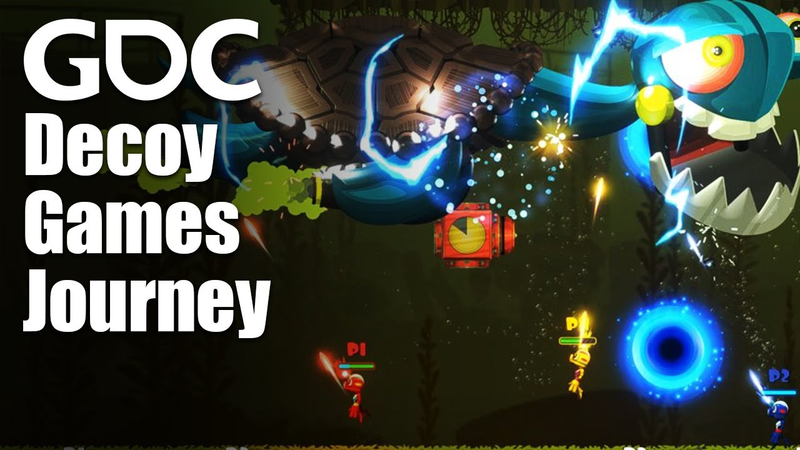
The Decoy Games Journey: From Gaming Brothers to Console Devs
The transition from hobbyist game development to professional console publishing requires a disciplined, business-first mindset that prioritizes long-term sustainability over rapid growth.
- Maintaining full-time employment while self-funding development preserves creative autonomy and eliminates the risks associated with external financing.
- Securing an internal champion within a console organization is a critical requirement for navigating the complex certification and approval processes.
- Success in console publishing relies on treating game development as a formal business enterprise, utilizing structured business plans and rigorous, unbiased playtesting.

I need help. (Channel Update 2020)
Following the commercial release of the game Neversong, the channel is pivoting toward a more structured and professional approach to indie game development education.
- Following the release of Neversong, the channel is transitioning from sporadic content to a structured, weekly production schedule focused on professional indie game development education.
- The new content strategy is built on three pillars: comprehensive tutorials for aspiring developers, analytical mini-documentaries deconstructing game design, and community-driven game jams.
- The channel aims to establish itself as a premier resource by focusing on the practical realities of marketing, platform success on Steam, and building a sustainable career.

Jumpstarting Your Creativity: From Hobbyist to Professional
The transition from hobbyist to professional game developer is often hindered by a cycle of starting ambitious projects, encountering technical hurdles, and losing motivation before reaching completion.
- Prioritizing the completion of small-scale projects over ambitious, complex ideas is the most effective way to break the cycle of unfinished work and stalled professional growth.
- Finishing projects is the critical metric for development, as evidenced by a shift from zero output to the release of eight projects over a two-year period through disciplined completion.
- Developers should implement strict time constraints, such as two-day or two-month windows, to force the completion of projects and prevent scope creep.
Writers
Games and companies
Games