Game Culture reports and market data
Documents
Buttons, Simplicity, and Natural Interfaces
The push button has served as the primary interface for video games since the industry's inception, primarily due to its low cost and simplicity as an electrical switch.
- Traditional button-based interfaces create a cognitive disconnect by forcing players to memorize arbitrary mappings that lack logical connections to in-game actions.
- The industry is shifting toward natural interfaces that utilize software-intensive technologies like speech recognition, gesture tracking, and pressure sensing to mirror real-world human movement.
- Natural interfaces replace binary mechanical inputs with context-aware systems, using computer vision and accelerometers to translate physical actions like swinging or running directly into gameplay.
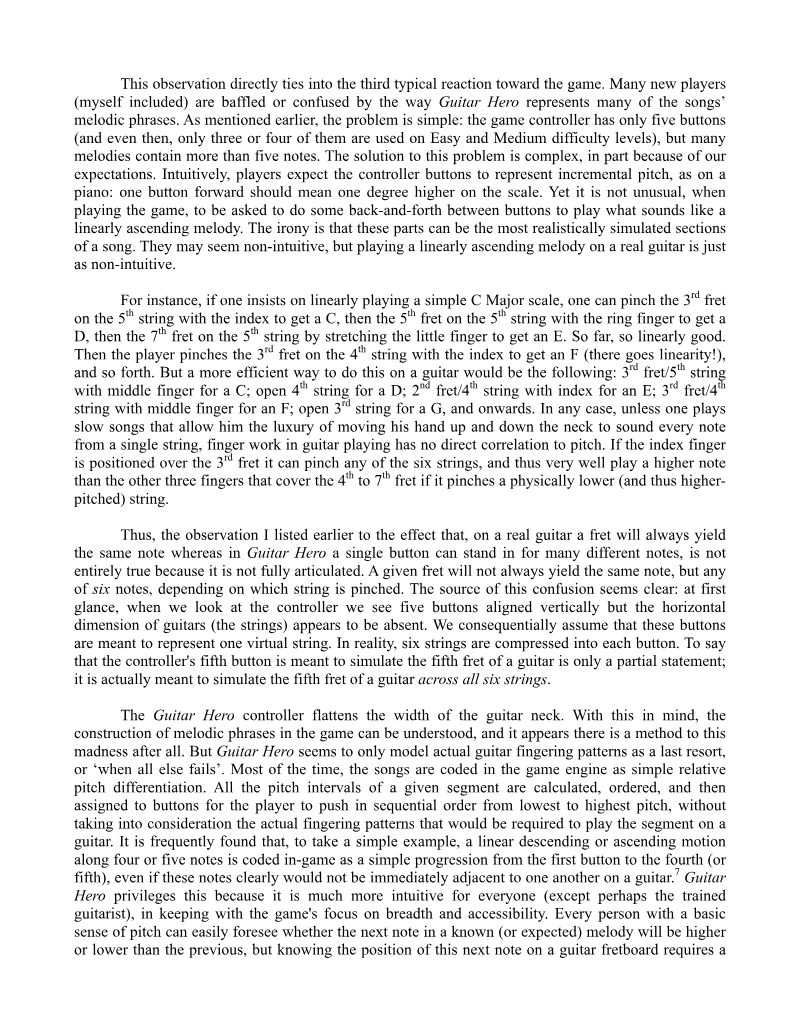
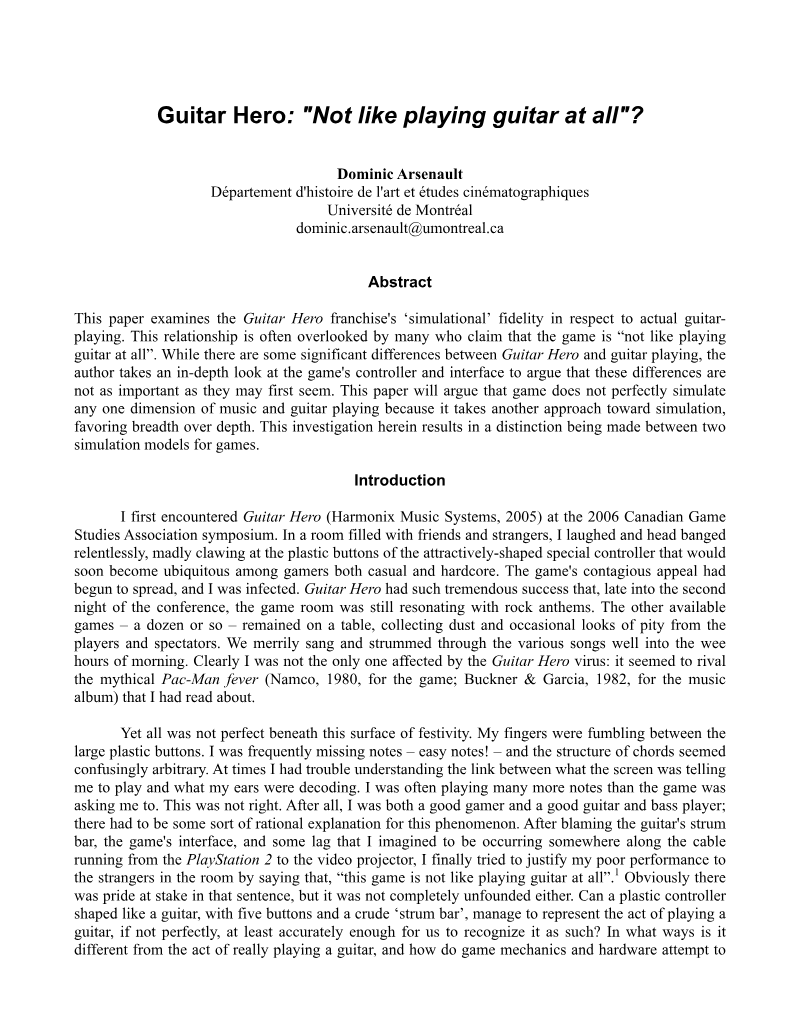
Guitar Hero: "Not Like Playing Guitar at All"?
The Guitar Hero franchise is often criticized for its lack of simulational fidelity compared to playing a real guitar.
- Guitar Hero functions as a valid simulation by prioritizing breadth of musical experience over the deep technical accuracy required for real instrument mastery.
- The game’s interface uses a five-button controller to represent melodic and harmonic structures as a system of differential pitch intervals, making music accessible to non-musicians.
- Simulation in gaming can be achieved through two distinct strategies: modeling a wide range of experience facets or focusing on a few parameters with high precision.
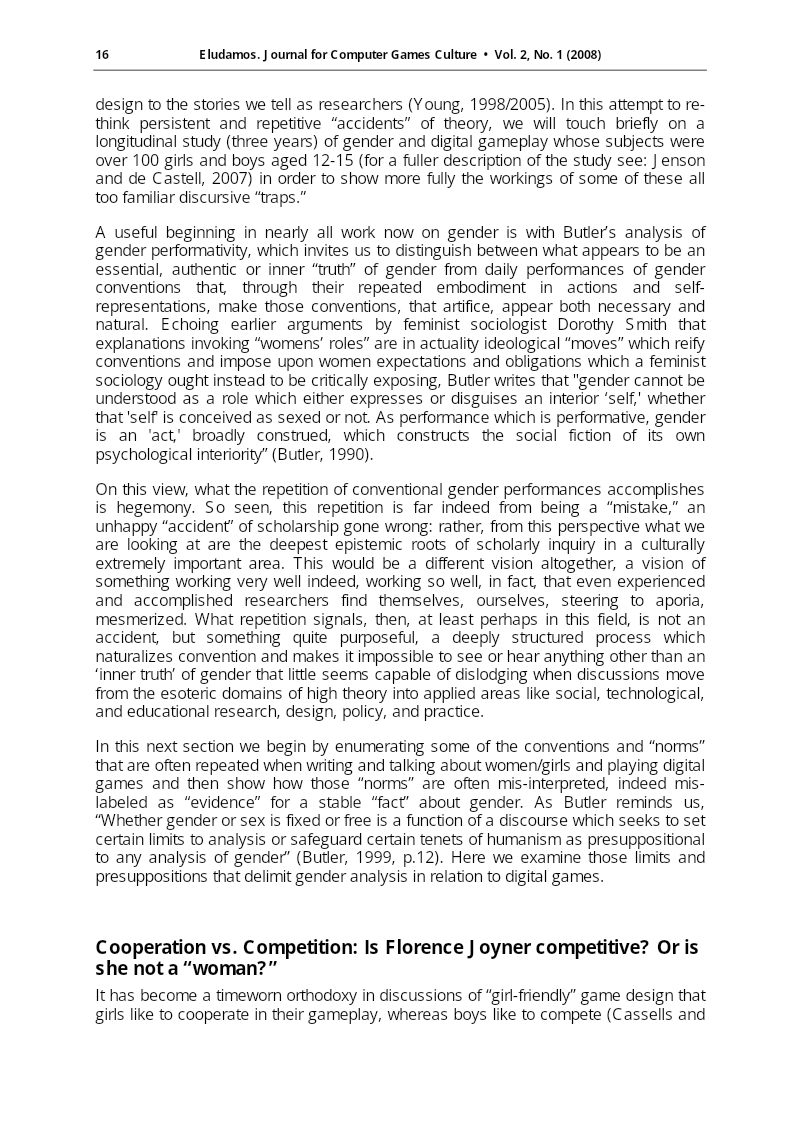
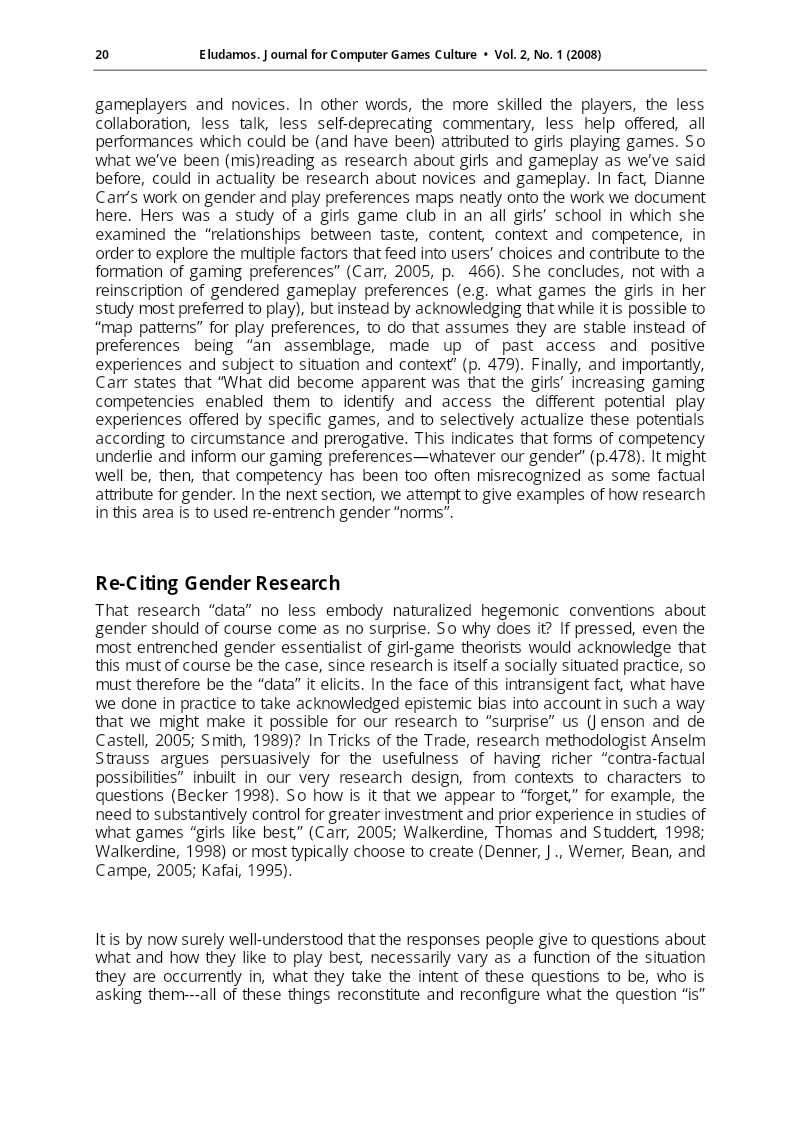
Theorizing Gender and Digital Gameplay: Oversights, Accidents and Surprises
Jenson and de Castell's chapter examines why research on gender and digital gameplay has repeatedly produced the same conclusions, and argues that these conclusions are often artifacts of researchers' assumptions rather than stable features of players.
- The chapter argues that recurring findings in gender-and-games research, such as girls preferring cooperation and boys preferring competition, are artifacts of researchers' assumptions and socially constructed categories rather than stable features of players.
- Drawing on Butler's theory of gender performativity, the authors contend that repeated framings in the field limit analysis and reinforce stereotypes, and they call for critical theorization of core concepts such as competition.
- In a longitudinal study of more than 100 children aged 12 to 15, many girls enjoyed competitive play, and what was labeled 'benevolent competition' appeared to reflect a shift from novice to expert roles rather than a distinct gendered trait.
How I Learned to Love the Bomb: Defcon and the Ethics of Computer Games
This analysis explores the ethics of computer games by applying the framework of Information Ethics, specifically utilizing Luciano Floridi’s Method of Abstraction.
- Computer games function as complex informational environments, or 'infospheres,' that require players to act as active moral agents rather than passive users of mechanical systems.
- The 'Method of Abstraction' framework categorizes game interaction into a procedural gradient (rule-based mechanics) and a semantic gradient (cultural and aesthetic meaning).
- Ethical concerns like desensitization to violence often arise from an over-focus on the procedural layer, ignoring how players use their own cultural knowledge to interpret the semantic layer.
Who Wants to Terminate the Game?: The Role of Vested Interests and Metaplayers in the ATOLLGAME Experience
ATOLLGAME functions as a computer-assisted role-playing simulation designed to navigate the complex intersection of hydrogeological modeling and socio-political conflict on the Tarawa atoll in Kiribati.
- ATOLLGAME demonstrates that participatory role-playing simulations can successfully transition stakeholders from bipolar conflict toward collaborative, technical, and social water management strategies.
- The long-term viability of community-led resource management is frequently undermined by 'meta-players'—external political and financial entities that prioritize rigid, top-down institutional agendas.
- Systemic project stagnation and the alienation of local populations occur when institutional goals override the consensus-based road maps developed through participatory gaming.
Cheating by Video Game Participants
This analysis explores the multifaceted nature of cheating within video games, examining the motivations behind such behaviors and the evolving moral and legal implications of virtual misconduct.
- Online cheating necessitates robust prevention strategies because it causes genuine financial and social harm, unlike single-player rule-breaking which is often viewed as benign alternative play.
- The rise of virtual economies has elevated certain in-game actions to the level of real-world criminal activity, such as theft, due to the tangible financial value of virtual items.
- Cheating is defined as a violation of the implicit or explicit rules of a game that undermines the 'magic circle,' the conceptual boundary that defines the shared experience of play.
ARTcade: A Canadian Game Studies Association Symposium Vignette
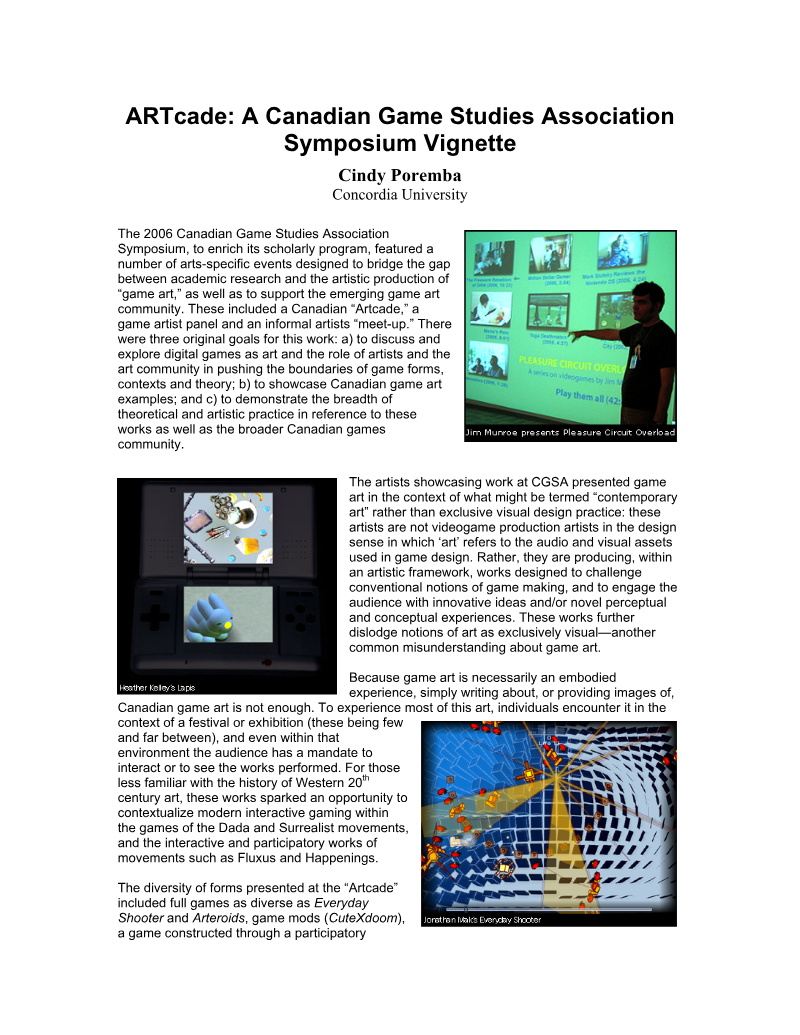
The 2006 Canadian Game Studies Association Symposium introduced a series of arts-focused events, collectively titled Artcade, to bridge the divide between academic game research and independent artistic production.
- The 2006 Canadian Game Studies Association Symposium launched 'Artcade' to integrate independent artistic game production with academic research, moving beyond traditional views of game art as mere assets.
- The initiative aimed to contextualize interactive digital works within 20th-century art movements, specifically citing Dadaism, Surrealism, and Fluxus.
- Featured works included diverse formats such as full games, mods, hardware prototypes, live performances, and machinima, with specific examples including 'Everyday Shooter' and 'CuteXdoom'.
Mapping Gendered Play
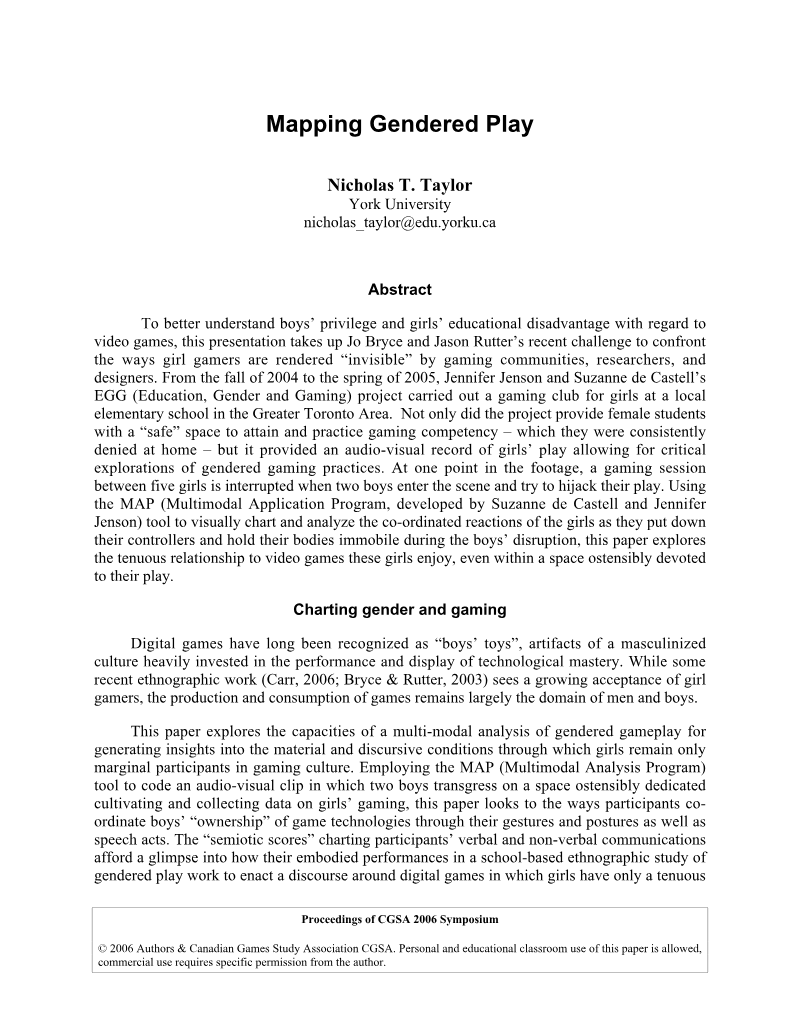
The Education, Gender and Gaming project investigates the social construction of video games as masculine domains, challenging the assumption that gendered disparities in play stem from innate differences in interest.
- Gendered disparities in gaming are driven by social performance and environmental conditioning rather than innate biological differences in interest.
- Gaming environments are actively constructed as masculine domains through material and discursive conditions that reinforce male ownership of technology.
- The physical and social intrusion of boys into gaming spaces frequently forces girls to shift from active engagement to passive spectatorship or increased anxiety.
Never Playing Alone: The Social Contextures of Digital Gaming
Digital gaming functions as an inherently social phenomenon, fundamentally challenging the persistent myth of the isolated player seeking solitary vicarious thrills.
- Digital gaming is an inherently social phenomenon that functions through complex social dependencies, debunking the myth of the isolated player.
- All digital play should be analyzed through a multiplayer lens, as even solo gaming experiences are embedded within broader material and interpersonal environments.
- The gaming experience is significantly influenced by the presence of others, including non-playing spectators, who impact a player's ability to maintain virtual immersion.
Continuity and Discontinuity: An Experiment in Comparing Narratives Across Media
Mythopoetic narratives, such as those found in The Lord of the Rings and Star Wars, undergo significant structural transformations when adapted from literature and film into digital games.
- Digital games transform mythic narratives by replacing the abstraction and mystery of traditional media with high-definition, rule-based systems.
- The transition from passive observation to active participation requires players to inhabit a simulated environment rather than simply viewing a story.
- Game engines function as 'Secondary Realities' that prioritize spatial storytelling and player agency over the narrative ambiguity found in literature or film.
I'm a Warrior, I'm a Monster: Shifting/Shaping Identity through Video Game Play
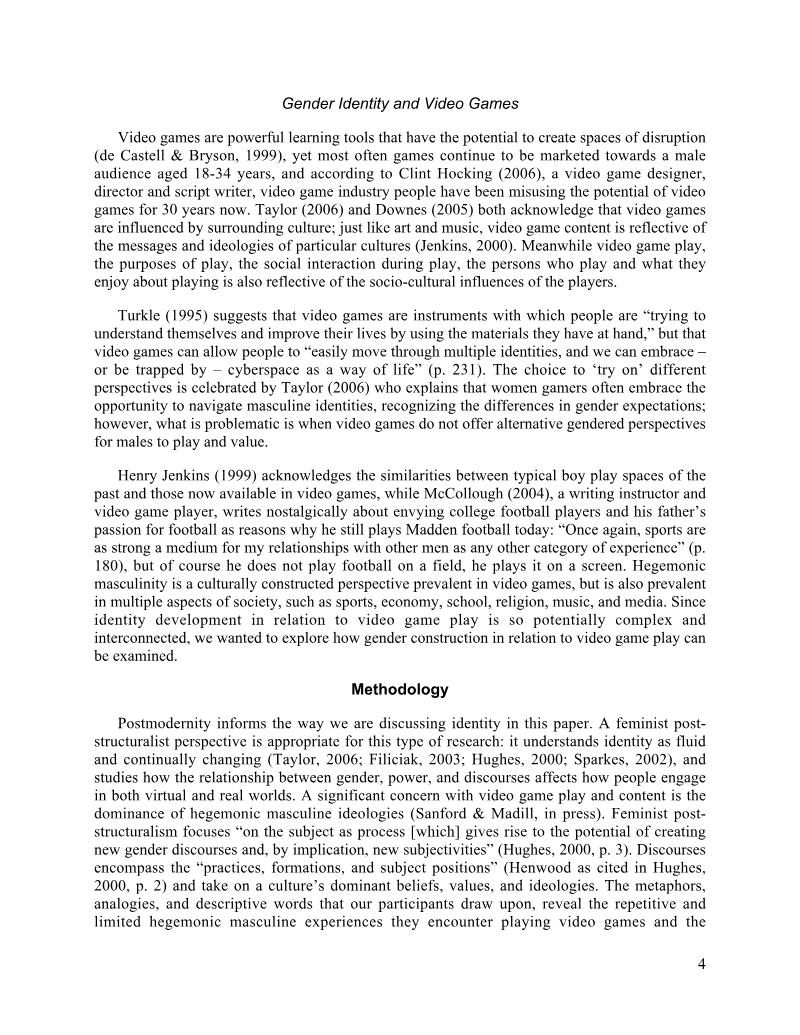
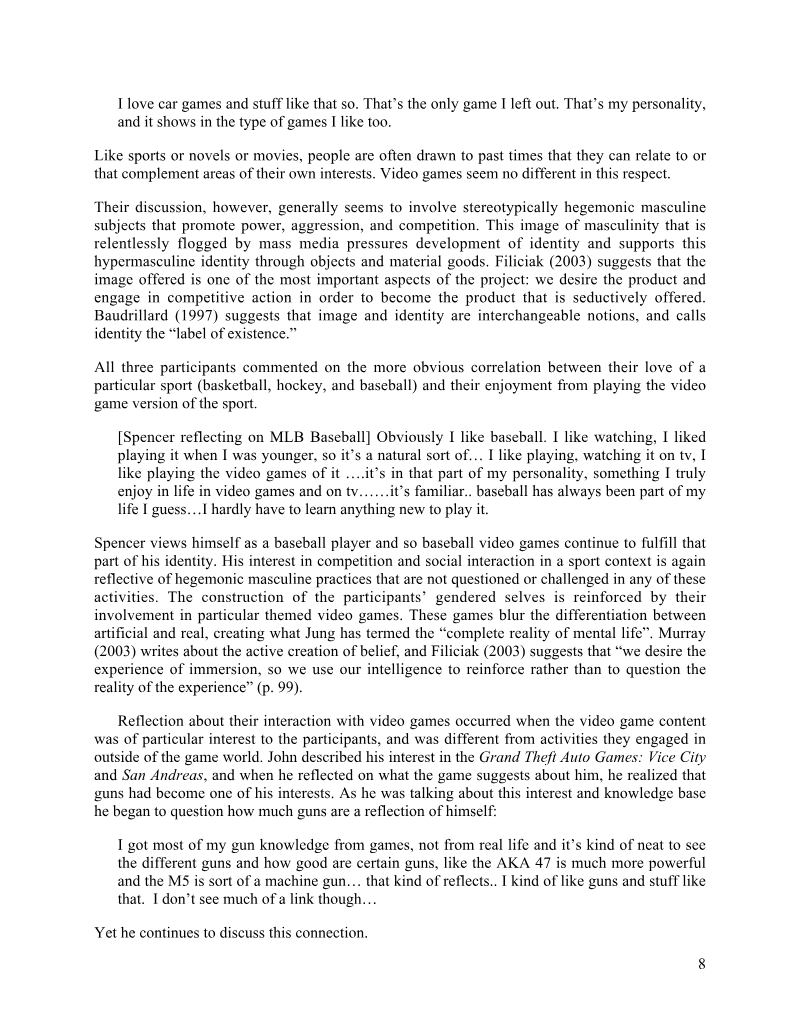
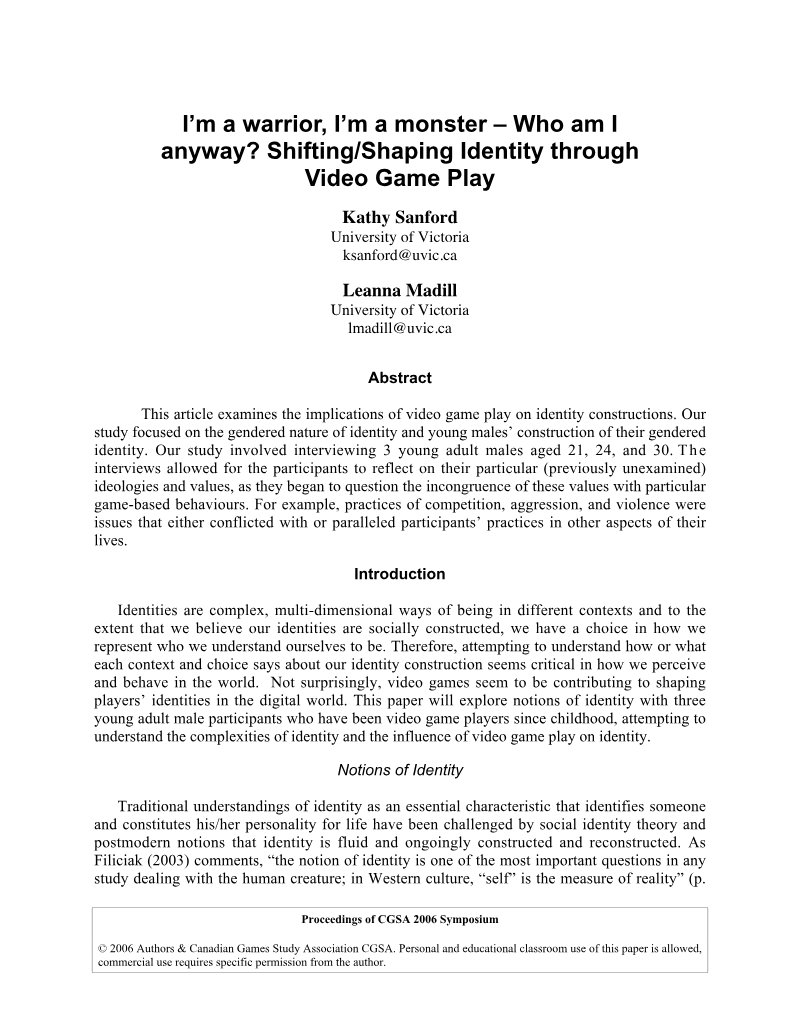
Video games function as dynamic, fluid environments where young adult males actively negotiate and construct their personal identities.
- Video games serve as active environments for identity construction where players negotiate the tension between their personal moral frameworks and the aggressive behaviors incentivized by gaming culture.
- Gaming spaces frequently function as platforms for projecting and reinforcing hegemonic masculine ideals, such as the pursuit of power, leadership, and professional dominance.
- Players experience internal conflict when their personal ideologies clash with the violent or exclusionary nature of the gaming environments they inhabit.
Machinima: Video Game as an Art Form?
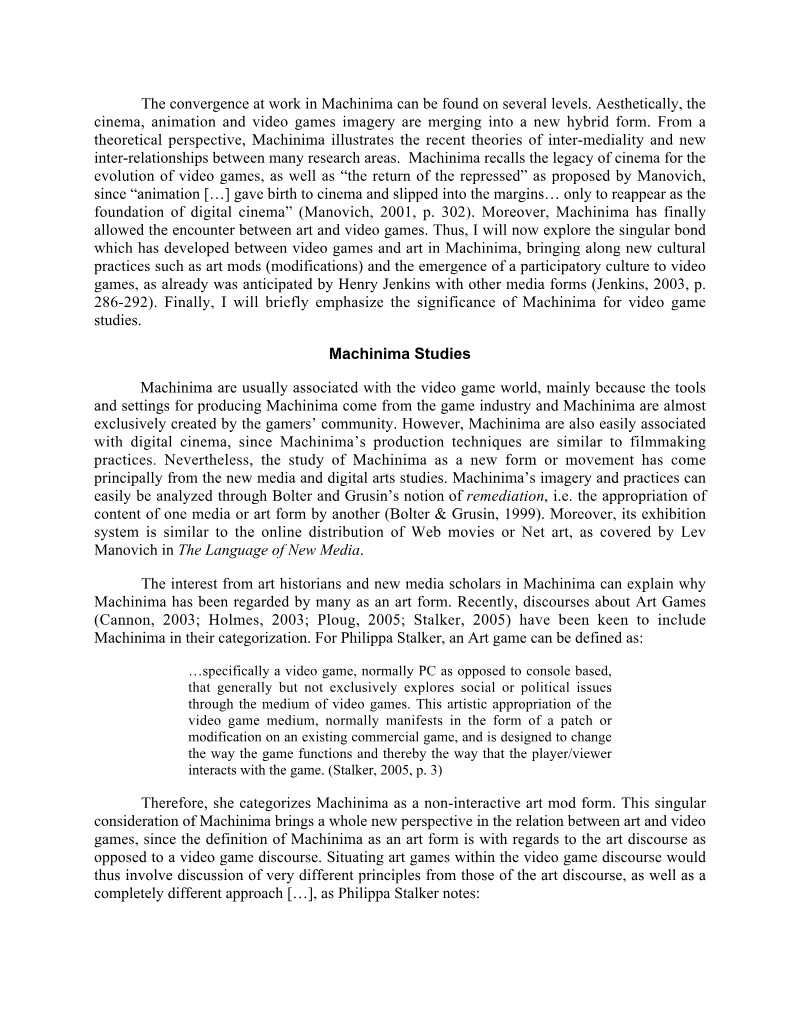
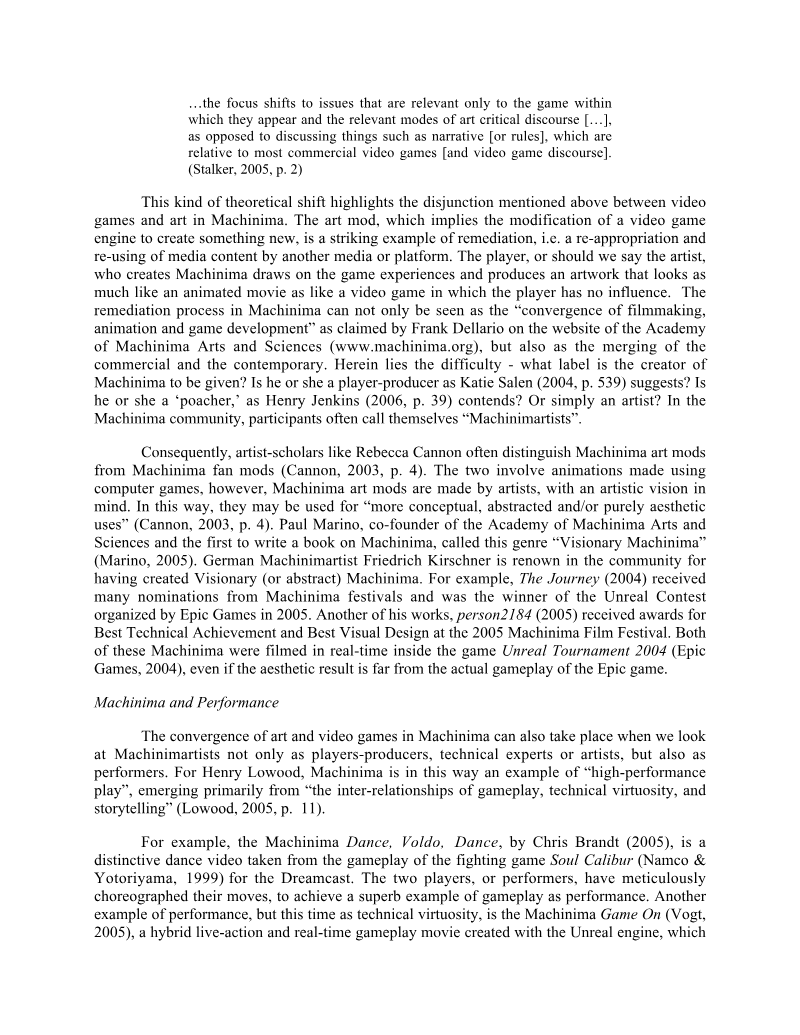
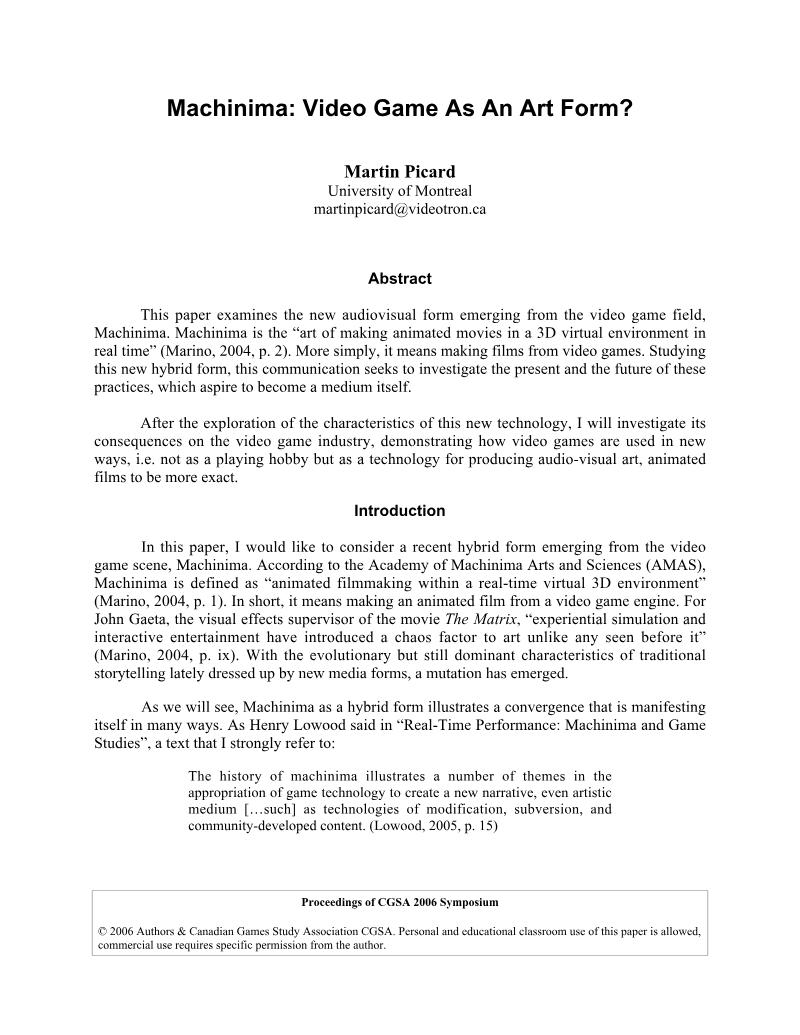
Machinima, defined as the practice of creating animated films within real-time 3D game environments, represents a significant hybrid medium that bridges the gap between video games, digital cinema, and animation.
- Machinima transforms video games from interactive entertainment into digital art platforms by repurposing real-time 3D game engines for cinematic and narrative expression.
- The practice blurs the distinction between consumer and producer, enabling players to act as 'Machinimartists' who utilize commercial technology for creative rather than ludic purposes.
- Machinima has evolved from its origins in first-person shooter gameplay showcases into a sophisticated form of participatory culture centered on public performance and spectatorship.
Writers
Games and companies
Games