China reports and market data
Documents
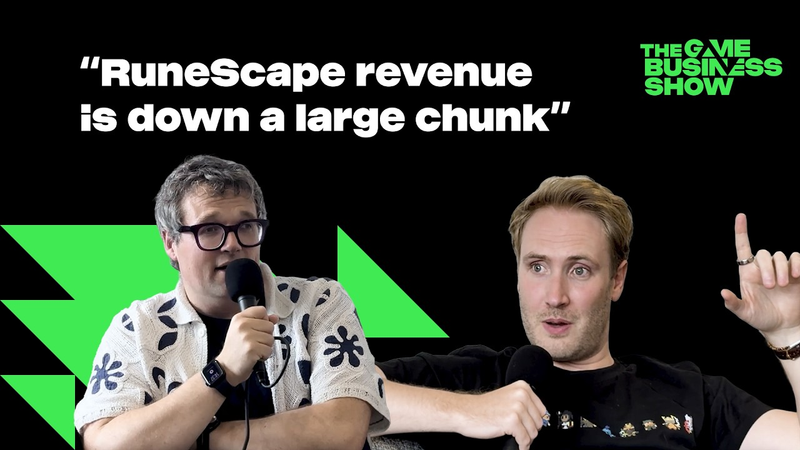
RuneScape CEO: We want to be bigger than World of Warcraft
Jagex is undergoing a strategic transformation to solidify its position as a premier global gaming entity by centering all operations exclusively on the RuneScape franchise.
- Jagex has launched the 'RS25' strategy, a £200 million investment initiative aimed at modernizing the RuneScape franchise and establishing it as the world’s leading MMO brand within five years.
- The company is pivoting to a single-franchise focus by divesting non-core assets to prioritize the long-term health and growth of RuneScape.
- Jagex intends to leverage its historical player base of 300 million users to drive expansion into Asian markets and launch the new title 'Dragon Isles' on console platforms.

In the Hot Seat: Three ways Western developers are leaving a fortune on the table in China
Western game developers often struggle to penetrate the Chinese market due to a fundamental misunderstanding of its unique operational landscape, which frequently results in significant lost revenue.
- China represents approximately 20% of global player spending and 38% of total market growth, yet many Western studios fail to enter the market due to a lack of dedicated local resources.
- Successful entry into the Chinese mobile market requires a dedicated team of three to five people to manage the significant technical support and localization work necessary for local partnerships.
- Unlike the Western model of soft-launching to improve metrics, the Chinese market utilizes a 'wishlist' system where games build massive pre-launch interest over six months to trigger millions of day-one downloads.

Epic and Google drop settlement and Pokémon Go revenue skyrockets | Week in Mobile Games podcast
The mobile gaming landscape is currently defined by significant legal volatility and shifting consumer spending patterns.
- Epic Games and Google have withdrawn their attempt to settle their US antitrust lawsuit, leaving the court's ruling that Google maintains an illegal monopoly over Android apps in place.
- Pokémon Go experienced one of its most lucrative days in history on July 11, 2026, driven by a free-to-play Go Fest event that encouraged high spending on raid tickets and limited-time bundles.
- A California-led coalition is attempting to block the Paramount-Warner Bros. merger, citing concerns that the combined entity would control 27% of US theatrical film distribution, 30% of blockbuster releases, and 27% of the basic cable market.
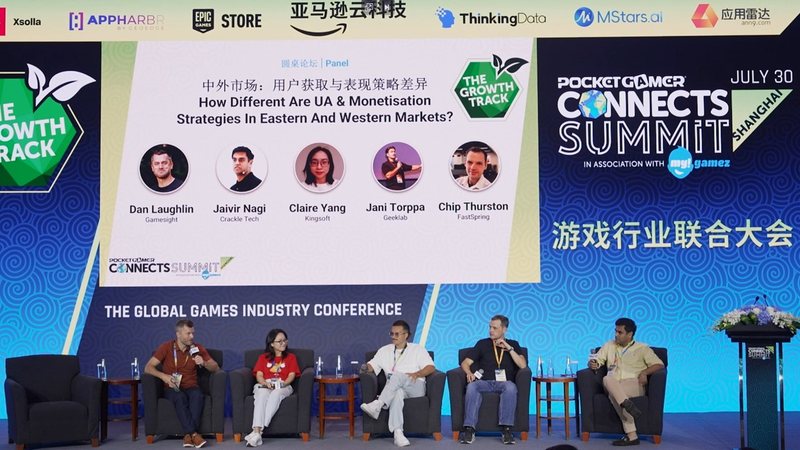
How Different Are UA & Monetisation Strategies In Eastern And Western Markets?
User acquisition and monetization strategies diverge significantly between Eastern and Western markets, driven by distinct platform ecosystems and consumer behaviors.
- The mobile gaming industry is currently dominated by legacy titles, with new game launches struggling to break into the top 10 charts on the App Store and Google Play due to high development costs and market saturation.
- Western user acquisition is heavily concentrated on Meta, Google, and TikTok, creating a 'single basket' risk where publishers struggle to scale or attribute performance due to IDFA and privacy-related data limitations.
- Direct-to-consumer (DTC) web stores are becoming a critical strategy for publishers to increase profitability by bypassing platform fees, despite ongoing legal uncertainty surrounding Apple and Epic Games' court battles.

In the Hot Seat: Stefan Lampinen on how Chinese publishers are outpacing the West
Stefan Lampinen, founder of Game Advisor Ltd and a veteran of the global gaming industry, provides a strategic analysis of the evolving dynamics between Western and Chinese game markets.
- European markets should not be treated as a single entity; successful expansion requires a granular approach that accounts for distinct legal, cultural, and regional differences, such as the specific nuances between cities like Berlin, Munich, and Cologne.
- Chinese publishers like Tencent and NetEase are demonstrating high levels of sophistication by conducting deep-dive research into specific European micro-markets, including identifying individual studios in cities with populations over 100,000.
- Entering the European market requires rigorous preparation and strategic planning rather than rushed execution, as historical data shows that many large companies have failed due to a lack of localized positioning and messaging.
Xbox Tells Sony to Say Less, Digital Ownership & SITTING in Minecraft! | Games For Breakfast
The gaming industry is currently navigating a period of profound instability characterized by widespread workforce reductions, shifting hardware regulations, and contentious debates over digital ownership.
- Microsoft has initiated significant layoffs affecting approximately 12,000 to 14,000 employees, representing roughly 20% of the Xbox workforce.
- As part of its restructuring, Microsoft is transitioning Compulsion Games and Double Fine Productions into independent studios, allowing them to retain their IP catalogs and operational runway.
- Fandom has laid off its entire commerce team and its Vice President of Games and Entertainment, Chris Grant, according to reports from Aftermath.

In the Hot Seat: Mattel163 COO Devin Nambiar on Uno and life after the NetEase deal
Mattel163, a mobile game publisher, recently transitioned from a joint venture between Mattel and NetEase to a wholly-owned internal development and publishing division of Mattel.
- Mattel acquired NetEase's 50% stake in their joint venture, Mattel163, in February 2024 for $318 million, transitioning the studio into its internal game development and publishing division.
- Mattel163 has achieved over $1 billion in lifetime revenue, nearly $250 million in annual recurring revenue (ARR), and 20 million monthly active users (MAUs) across its four live titles.
- Successful cross-border game expansion requires significant product tailoring, as evidenced by the failure of major titles like Honor of Kings and Monster Strike when launched globally without sufficient culturalization.

WeChat Mini-Games insights and the Love & Deepspace Valko controversy | Week in Mobile Games podcast
The Chinese mobile gaming landscape is undergoing a rapid transformation, characterized by the explosive growth of WeChat Mini-Games.
- WeChat Mini-Games are evolving into global franchises, with titles like 'Nobody's Adventure Chop-Chop' reaching 35 million monthly active users and $10 million in daily global revenue, while 'Legend of Mushroom' has generated $270 million globally.
- Infold Games canceled the introduction of a sixth love interest for the game 'Love and Deepspace' following fan backlash over the character's perceived ties to an 'evil corporation' and the use of the number 731, which is associated with a sensitive historical war crime unit in China.
- The shift toward a discless console future is accelerating, with industry analysts predicting that the next generation of hardware, such as the potential PlayStation 6, will likely be fully digital to reduce manufacturing costs and align with current digital-first sales trends.
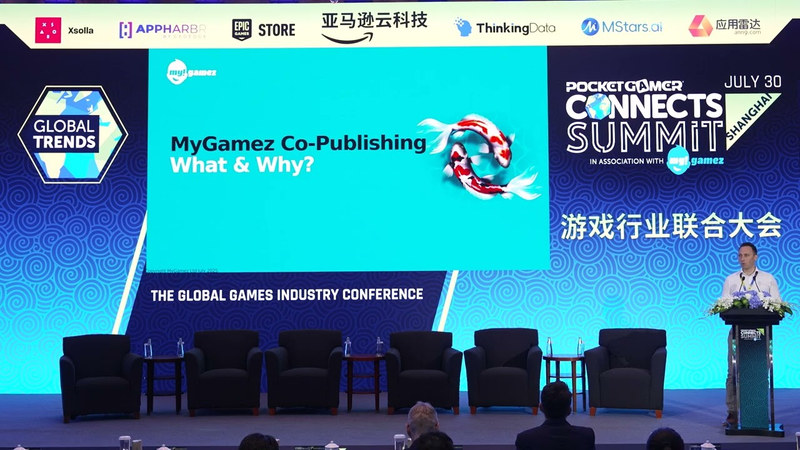
Why co-publishing might be your best option for entering the Chinese market
China represents a significant growth opportunity for global game developers, accounting for approximately 30% of worldwide gaming revenue.
- China represents approximately 30% of global gaming revenue, yet the market remains largely untapped by overseas developers.
- The co-publishing model allows developers to retain control over their IP and game operations, mitigating the risks associated with handing over source code to third-party publishers.
- Successful entry into the Chinese market requires a long-term commitment, with partnerships ideally spanning 5 to 20 years rather than short-term cycles.
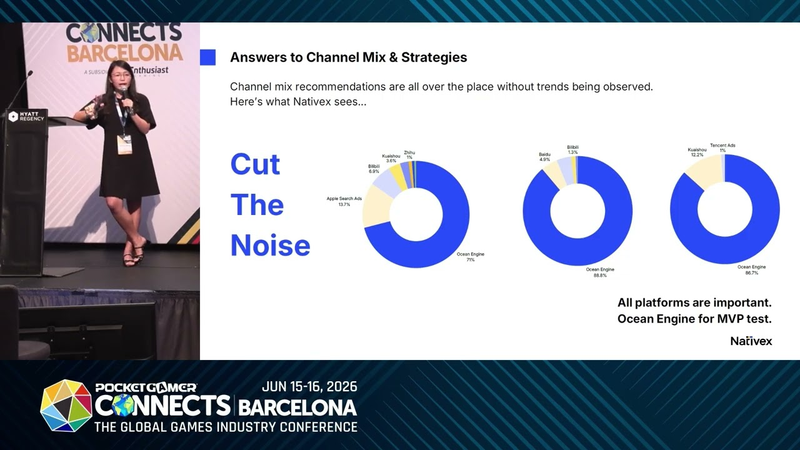
Session: Demystifying China UA: Reverse-Engineering AI Advice (Fact vs. Fiction) - Yolanda Huang.
The presentation evaluates the reliability of large language models (LLMs) in providing strategic guidance for user acquisition (UA) in the Chinese gaming market.
- Mainstream AI tools currently provide inconsistent, contradictory, and often inaccurate advice regarding China market entry, failing to serve as a reliable source of truth for UA strategies.
- Contrary to common industry misconceptions, a full ISBN license is not required for initial market testing; a software copyright license allows foreign entities to conduct paid media and influencer marketing tests.
- Ocean Engine, the ad platform powered by ByteDance, is the primary and most scalable channel for testing mobile game performance in the Chinese market.
Retailer warns of GTA console stock shock. Plus, why is Russian propaganda still on Steam?
The global gaming industry is currently navigating a period of significant structural transition, characterized by supply chain volatility and a fundamental shift in investment philosophy.
- Retailers anticipate severe hardware shortages during the launch of Grand Theft Auto 6, reflecting a broader industry shift toward digital-only distribution and premium pricing models.
- State actors including Russia, China, and Saudi Arabia are increasingly using gaming ecosystems as geopolitical tools to exert soft power and influence international narratives.
- Russia is actively utilizing the limited moderation policies on platforms like Steam to disseminate state-backed propaganda to vulnerable user demographics.
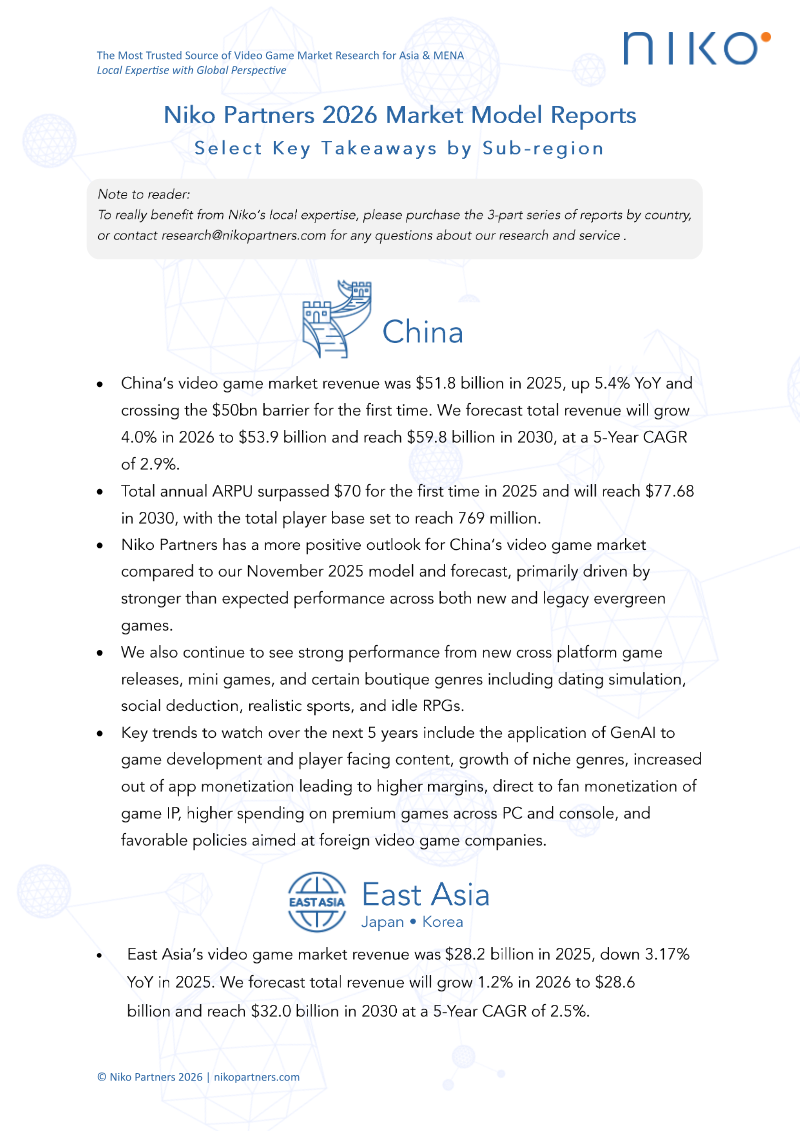
Market Model Reports: Asia & MENA
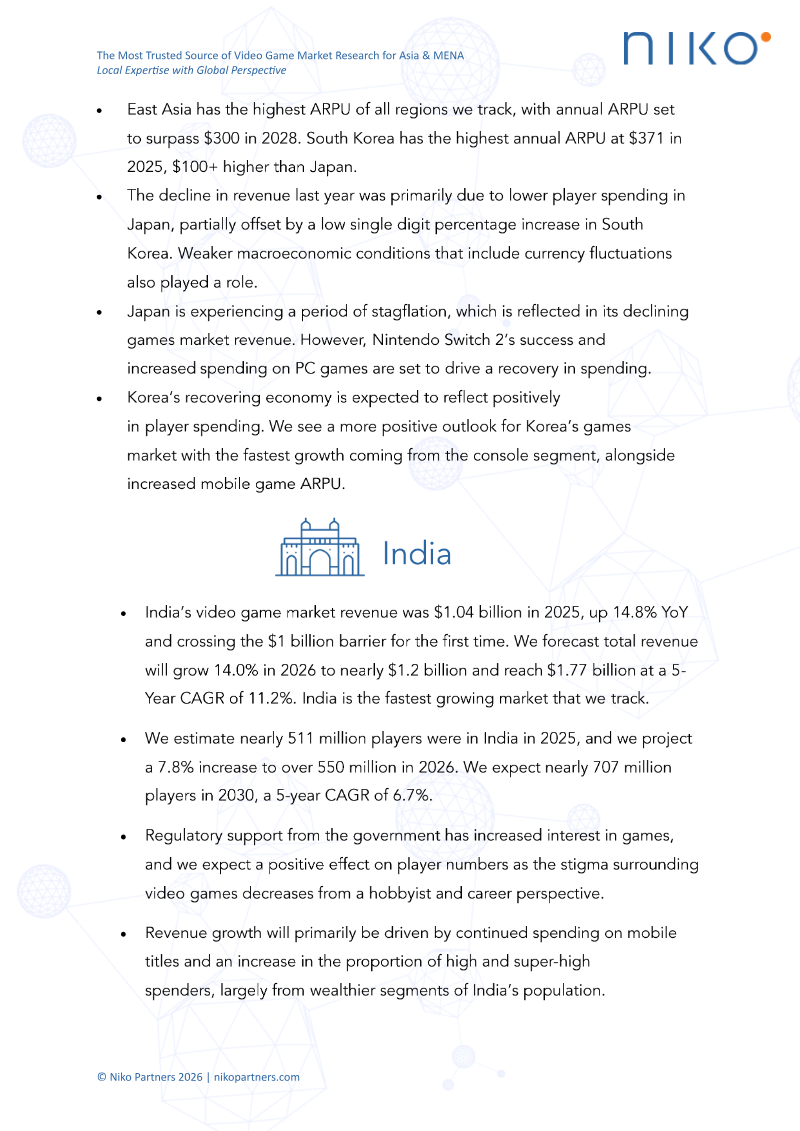
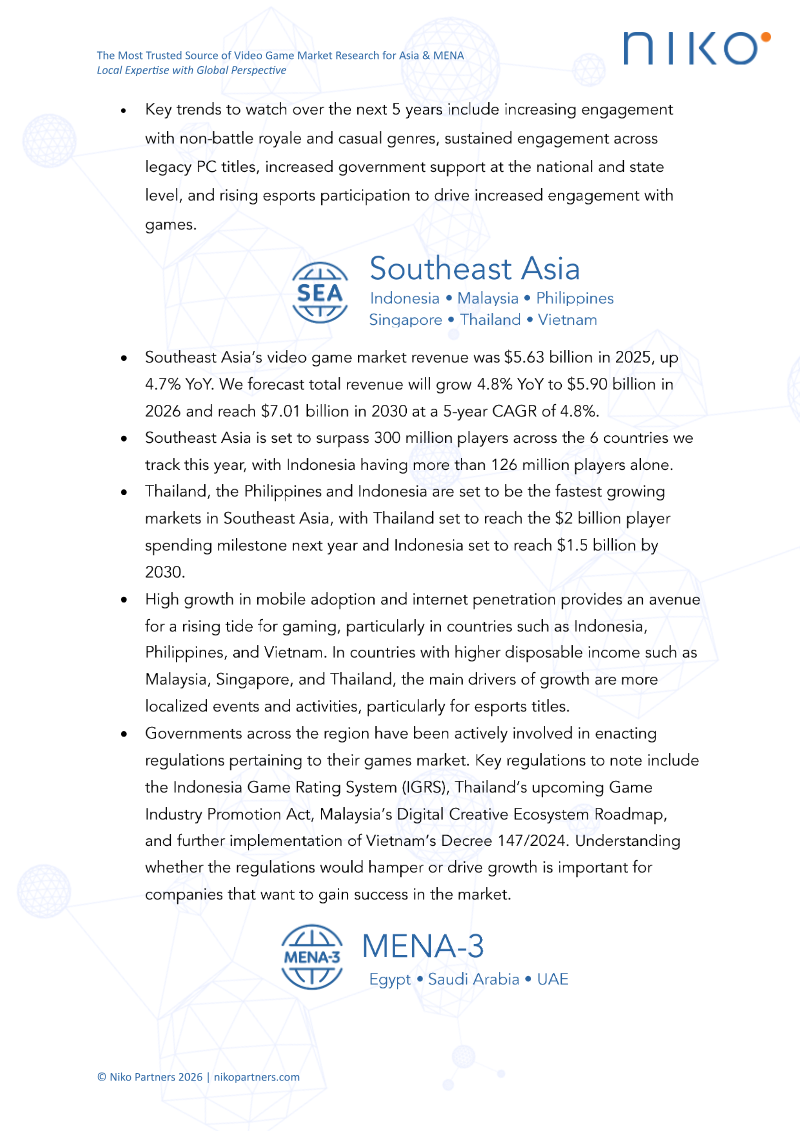
The 2026 Market Model Reports provide a comprehensive analysis of video game industry performance and growth projections across Asia and the Middle East and North Africa (MENA).
- China’s video game market reached $51.8 billion in 2025 and is projected to grow at a 2.9% CAGR to reach $59.8 billion by 2030.
- India is the fastest-growing market tracked, with 2025 revenue of $1.04 billion and a projected 11.2% CAGR through 2030, supported by a player base expected to reach 707 million.
- East Asia remains the region with the highest ARPU, though 2025 revenue declined 3.17% to $28.2 billion due to Japanese market stagnation and macroeconomic conditions.