
Report60 pages
Gamedev Salary Pulse 2026: North America, Western Europe, Nordics, Central and Eastern Europe
The game development industry is currently navigating a period of profound structural instability, characterized by widespread workforce reductions and a pervasive sense of professional anxiety. Despite the rapid integration of artificial intelligence, the primary driver of current career displacement remains studio restructuring rather than technological replacement. While the majority of the workforce remains employed in hybrid or remote roles, a significant portion of professionals are actively reassessing their career trajectories. This climate of cautious realism is reflected in market sentiment, where nearly 40 percent of industry participants anticipate further decline, leading to increased emotional fatigue and a shift in priorities toward time-based benefits, such as the four-day workweek, over traditional office perks.
Geographically, the industry maintains a clear hierarchy in compensation, with North America consistently commanding the highest salary tiers across all seniority levels. In contrast, Central and Eastern Europe continue to function as the most cost-effective hubs for talent acquisition. This regional disparity underscores a broader trend of geographic diversification, as studios balance the need for specialized expertise with the economic realities of global operations. Although the workforce remains mobile, the prevalence of remote work has effectively anchored many professionals, creating a distinct divide where on-site employees demonstrate a significantly higher propensity for international relocation compared to their remote counterparts.
The current landscape is defined by a maturing workforce dominated by mid-to-senior level professionals, accompanied by a concerning decline in new entrants. This demographic shift, coupled with the ongoing volatility in employment, has necessitated more flexible recruitment strategies. Studios are increasingly moving away from traditional hiring models, favoring diverse solutions that range from subscription-based flat-fee packages to comprehensive recruitment process outsourcing. As the industry continues to evolve, these data-driven benchmarks serve as a critical framework for both studios and professionals attempting to navigate the complexities of global compensation and shifting labor market dynamics.
- Nearly 40 percent of game industry professionals anticipate further market decline, driving a shift in worker priorities toward time-based benefits like the four-day workweek over traditional office perks.
- Workforce reductions and studio restructuring remain the primary drivers of career displacement, significantly outpacing job losses attributed to artificial intelligence integration.
- North America maintains the highest global salary tiers for all seniority levels, while Central and Eastern Europe remain the most cost-effective regions for talent acquisition.
- The industry is experiencing a demographic shift characterized by a maturing workforce of mid-to-senior level professionals and a concerning decline in new entrants.
- Remote work has anchored the workforce, resulting in a clear divide where on-site employees are significantly more likely to relocate internationally than their remote counterparts.
+3
8BitMar 2026
Report83 pages
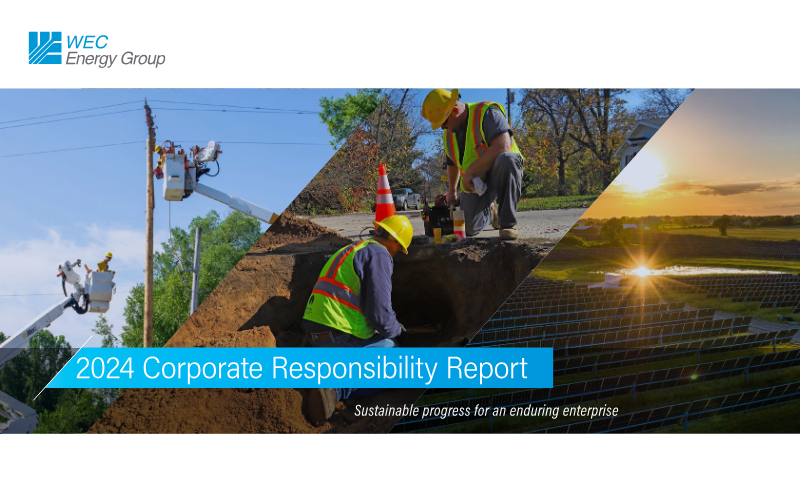
2024 Corporate Responsibility Report: Sustainable Progress for an Enduring Enterprise
Atec 2024 Corporate Responsibility Report 2024 Corporate Responsibility Report Sustainable progress for an enduring enterprise Sustain s for an enduring enterprise 2024 Corporate Responsibility Report Message from leadership 4 Social 39 Governance 69 Our company 5 Empowered employees 40 Governance framework 70 Building and sustaining Safety and health 46 Cybersecurit...
- Atec, with a $29.9 billion market cap and $47.4 billion in assets as of Dec. 31, 2024, has a long history of quality earnings with a compound annual growth rate of ~6.7% from 2015-2024, and projects long-term EPS growth of 6.5%-7%.
- The company plans a $28.0 billion capital investment from 2025-2029, primarily focused on electric generation ($13.2 billion) and electric distribution ($5.3 billion), to invest in renewable/low-carbon energy and modernize infrastructure.
- Atec actively remediated environmental sites in 2024, including completing sediment remediation at the Milwaukee Solvay Car Ferry Slip and continuing work on several former manufactured gas plant (MGP) sites.
- Combustion product production decreased from 508,200 metric tons in 2022 to 476,000 in 2024, while beneficial use remained high at 99% in both 2023 and 2024, exceeding production in 2024 by utilizing surplus from prior years.
- Atec's WEC Energy Group achieved first place in the 2024 E Source Large Business Customer Satisfaction Study, and Wisconsin Public Service was named a 'Customer Champion' and 'Most Trusted Brand' in Escalent’s 2024 study.
Atec

Report93 pages
Responsibility Report 2020: Partners for Greater Purpose
Leading in a Changing World R 2 ABOUT THIS REPORT 21 ENVIRONMENT 3 Letters from Ecolab’s Chief Executive Officer 22 Environmental Management and Chief Sustainability Officer 23 Energy and Emissions 5 Combatting the Covid-19 Pandemic 31 Water 6 About Ecolab 37 Materials Use and Waste 8 OUR APPROACH 40 Ch...
- Ecolab has set ambitious 2030 Impact Goals, aiming to save 300 billion gallons of water (69% progress), avoid 6 million metric tonnes of CO2e (58% progress), provide safe food to 2 billion people (65% progress), and clean 90 billion hands (73% progress).
- Ecolab's sustainability strategy is core to its business, focusing on innovative solutions to minimize environmental and social impact, particularly addressing water scarcity and climate change.
- Ecolab developed the Smart Water Navigator, a publicly available online tool in partnership with S&P Global Trucost and Microsoft, to help businesses improve water resilience through a four-step process: Identify, Target, Implement, and Track.
- Ecolab's governance structure for sustainability includes the Safety, Health and Environment (SHE) Committee of the Board, which has the highest responsibility for sustainability matters, including climate and water issues, reporting to the full Board.
- Ecolab's facilities demonstrate strong management systems, with 56% achieving ISO 14001 certification, 31% OHSAS 18001 or ISO 45001 certified, and 74% of manufacturing sites having ISO 9001 certification.
Ecolab

Report86 pages
2020 Report on Corporate Responsibility
2020 Report on Corporate Responsibility Our frameworks: Our corporate responsibility report is prepared in accordance with the Global Reporting Initiative’s (GRI) Core Standards, and the Greenhouse Gas Protocol (GHG Protocol). We also provide reporting indices for the Task Force on Climate-related Financial Disclosures (TCFD), and the Sustainability Accounting Standards Board (SASB) Oil & Gas Services Industry Standard - Extractives & Minerals Processing Sector.
- Baker Hughes reduced its Scope 1 & 2 greenhouse gas emissions by 15% in 2020 compared to 2019, with Scope 1 emissions decreasing from 497,144 CO2e in 2019 to 432,316 CO2e in 2020, and Scope 2 market-based emissions decreasing from 303,647 CO2e to 252,069 CO2e.
- The company significantly increased its electricity from renewables and zero-carbon sources, reaching 22% of total electricity (163,075 MWH) in 2020, up from 15% (104,457 MWH) in 2019 and 3% (17,762 MW) in 2018.
- Baker Hughes increased female representation in its workforce from 17% in 2019 to 18% in 2020, with stronger hiring rates for women (27% in 2020 vs. 22% in 2019).
- Total combined contributions to communities, including financial and in-kind donations, increased substantially from $26 million in 2019 to $119 million in 2020, with company in-kind contributions rising from $24 million to $115 million.
- Water use decreased from 7,882 million liters in 2019 to 5,798 million liters in 2020, and the volume of significant spills decreased from 1,598 barrels in 2019 to 738 barrels in 2020.
Baker Hughes

Report47 pages
IBM 2020 Corporate Responsibility Report
While the events of 2020 have tested and tried the world’s resolve in entirely new ways, they also revealed humanity’s determination to adapt and emerge stronger. It was a profound reminder that, when pressed for more, individuals and organizations will rise to reinvent themselves and apply ingenuity to the most challenging of societal problems.
- IBM transitioned 95% of its employees to remote work in March 2020 and is shaping the future of work for a post-COVID era, focusing on employee well-being and flexible innovation.
- IBM aims to achieve net-zero greenhouse gas (GHG) emissions by 2030 through energy conservation, efficiency, and renewable electricity, without using financial certificates or nature-based carbon offsets.
- IBM's SkillsBuild program has enrolled 215,000 people worldwide, completing 341,000 learning hours in technical and workplace skills, with over 4,000 learners in India finding full-time employment.
- IBM spent $2.1 billion directly with first-tier diverse suppliers in 2020, with the largest portion ($1.53 billion) in the United States.
- IBM plans to eliminate nonessential, single-use plastics from cafeteria operations by 2025 and from IBM logo hardware packaging by year-end 2024, aiming for 100% reusable, recyclable, or compostable essential plastic packaging.
+1
IBM

Report79 pages
2020 Corporate Responsibility Report
OVERVIEW 3 PEOPLE & COMMUNITIES 32 A Letter from our Chairman & CEO and CSO 3 Employee Health & Safety 33 About This Report Our Company 4 Employee Engagement & Development 35 Keurig Dr Pepper (KDP) has reported on Key Highlights 5 Diversity & Inclusion ...
- All K-Cup pods produced by Keurig Dr Pepper (KDP) are now recyclable, made from #5 polypropylene plastic.
- KDP achieved 90% recyclable or compostable packaging across its total portfolio in 2020, up from 86% in 2018, and increased post-consumer recycled (PCR) content to 22% in 2020 from 20% in 2018.
- KDP aims to replenish 100% of the water used for beverages in its highest water-risk operating communities by 2025, with a 20% improvement in water use efficiency targeted by the same year.
- KDP achieved its 100% responsibly sourced coffee commitment and has engaged over 1 million people in its supply chain since 2014 to improve their lives, with over $64 million in social impact investments since 2003.
- KDP's plastic packaging that is recyclable or compostable increased from 64% in 2019 to 74% in 2020, and PCR content in plastic packaging rose from 0.4% in 2019 to 2% in 2020.
+1
Keurig Dr Pepper
Report47 pages
2024 Corporate Responsibility Report
+ Publication Date: July 30, 2025 Publication Date: July 30, 2025 2 Introduction The Care The People The Planet 32 Governance, Policies & We Advance We Support We Share Systems Infrastructure 5 Who We Are 39 Appendix Overview 41 Sustainability Accounting 7 IDEXX Corporate ...
- IDEXX is a global leader in pet healthcare innovation, providing diagnostic and software products and services in veterinary medicine, employing approximately 11,000 people and serving customers in over 175 countries.
- In 2024, IDEXX's overall Greenhouse Gas (GHG) emissions increased by 10.5%, primarily due to increased energy consumption at the newly operational Horizon Center in Scarborough, Maine, though the company remains on track to meet its 2030 GHG emissions reduction goal of 37.8% for Scope 1 & 2.
- IDEXX donated over 21,000 SNAP™ tests in 2024 for disaster response, education, and community outreach, contributing to enabling access to care for over 79,000 animals in underserved communities.
- Employees logged over 86,000 hours of learning and development in 2024, including 23,200 hours in leadership and AI, and 50,200 hours in skill-based training.
- IDEXX reduced its freight forwarders from 18 to three in 2024 to ship products more sustainably, prioritizing ocean shipping over air when possible.
+1
IDEXX
Report19 pages
Cyprus Game Industry: Senior+ Employment Landscape 2025
The study examines the senior‑level employment landscape in Cyprus’s game industry for 2025, drawing on an anonymous survey of 113 professionals and a comparative analysis with European peers. Findings reveal that senior‑plus talent in Cyprus exhibits low job mobility, with 71 % reporting no change in the past year and only 20 % moving voluntarily. When moves occur, they are largely strategic, aimed at improving compensation or scope rather than reacting to instability. Senior professionals prioritize financial reliability, clear role definitions, and predictable work environments over brand visibility or rapid career acceleration. Lifestyle factors—including climate, taxation, and family considerations—reinforce long‑term retention and reduce relocation willingness.
Job security perceptions are higher in Cyprus (average 2.68 on a 5‑point scale) than across Europe, yet the expected risk of job loss in the next year is also higher for many roles. Burnout and limited professional development opportunities emerge as key structural risks, with 66 % reporting burnout and only 53 % receiving employer‑funded training. Overtime is common, with 27 % working one to two times a month and 45 % accepting it as part of leadership duties, contributing to long‑term fatigue.
Salary data show Cyprus median salaries for senior roles (e.g., €98 k for top management) below European averages, while desired salaries are substantially higher (e.g., €135 k for top management). Relocation openness is moderate, with 36 % not open and 32 % very open; visa support, health insurance, and relocation bonuses are the most valued benefits.
Overall, the market is mature but faces challenges in retaining talent through sustained engagement and development rather than short‑term compensation incentives. The primary risk for employers is gradual burnout and skill stagnation hidden behind long tenure, rather than sudden turnover.
- Senior-level talent in Cyprus exhibits low job mobility, with 71% of professionals reporting no change in employment over the past year.
- A significant retention risk exists in the form of burnout, which affects 66% of senior professionals, compounded by the fact that only 53% receive employer-funded training.
- Median salaries for top management in Cyprus are approximately €98k, falling significantly short of the €135k desired by professionals in these roles.
- Overtime is a systemic issue, with 45% of leaders accepting it as a standard duty and 27% of the broader senior workforce working overtime at least once or twice a month.
- While 36% of senior professionals are not open to relocation, 32% are very open, with visa support, health insurance, and relocation bonuses identified as the most critical incentives.
+1
Values ValueMar 2026
Report1 pages
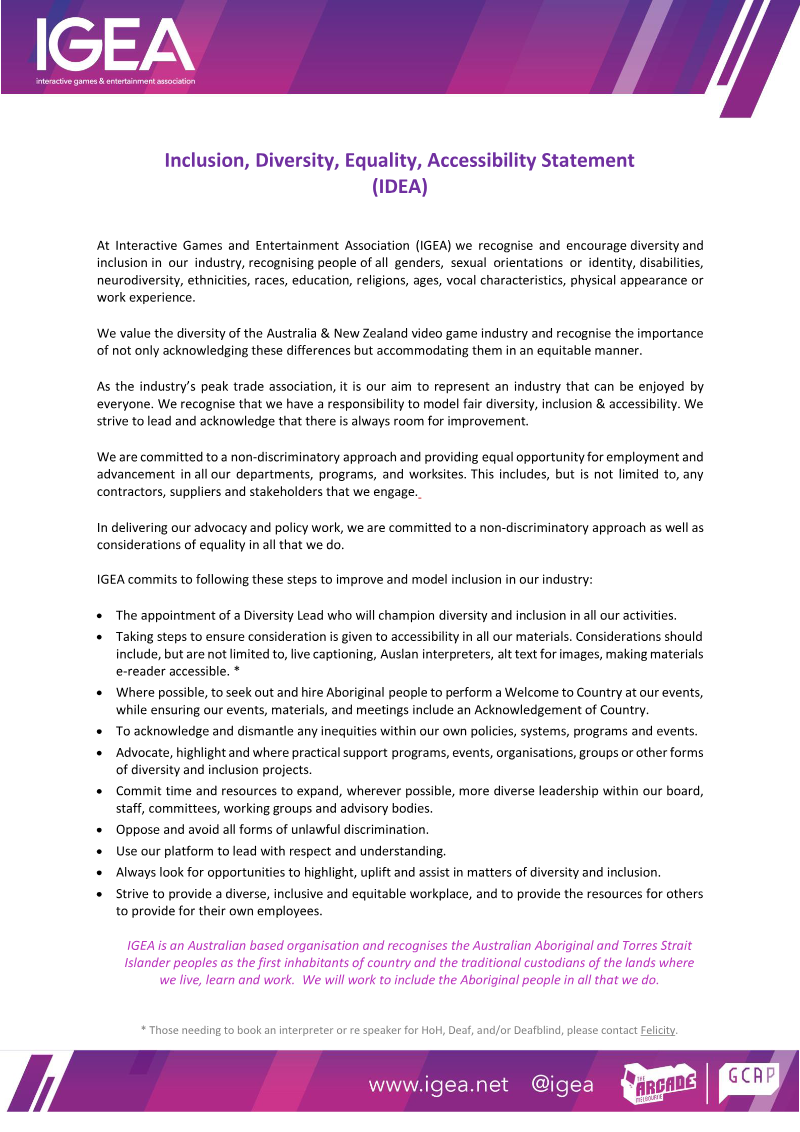
Inclusion, Diversity, Equality, Accessibility Statement: Australia & New Zealand
The statement articulates a commitment by the Interactive Games and Entertainment Association (IGEA) to foster inclusion, diversity, equality, and accessibility across the video‑game sector in Australia and New Zealand. It positions the association as the peak trade body responsible for modeling equitable practices and ensuring that the industry can be enjoyed by all participants, regardless of gender, sexual orientation, disability, neurodiversity, ethnicity, religion, age, or other personal characteristics.
Key actions outlined include appointing a dedicated Diversity Lead, embedding accessibility features such as live captioning, Auslan interpretation, and alt‑text in all communications, and actively seeking Aboriginal participation for Welcome to Country ceremonies and Acknowledgement of Country protocols. The association pledges to audit and dismantle inequities within its own policies, expand diverse representation on its board and committees, and oppose any unlawful discrimination. It also commits to using its platform to promote and support external diversity initiatives, providing resources that enable other employers to create inclusive workplaces.
The scope covers the entire Australian and New Zealand video‑game industry, encompassing IGEA’s staff, contractors, suppliers, and broader stakeholder network. While no empirical data or survey methodology is presented, the statement functions as a policy framework that sets measurable expectations for internal governance and external advocacy, signalling a strategic shift toward a more inclusive industry culture.
- The Interactive Games and Entertainment Association (IGEA) has established a formal policy framework to mandate inclusion, diversity, equality, and accessibility standards across the Australian and New Zealand video game industry.
- IGEA is restructuring its internal governance by appointing a dedicated Diversity Lead and committing to audit and dismantle existing inequities within its own policies.
- The association is expanding diverse representation across its board and committees to ensure broader demographic inclusion in industry leadership.
- Operational accessibility standards are being implemented for all IGEA communications, including the mandatory use of live captioning, Auslan interpretation, and alt-text.
- The policy mandates the integration of Aboriginal cultural protocols, specifically requiring Welcome to Country ceremonies and Acknowledgement of Country, across industry engagements.
Interactive Games & Entertainment AssociationFeb 2026
Report3 pages
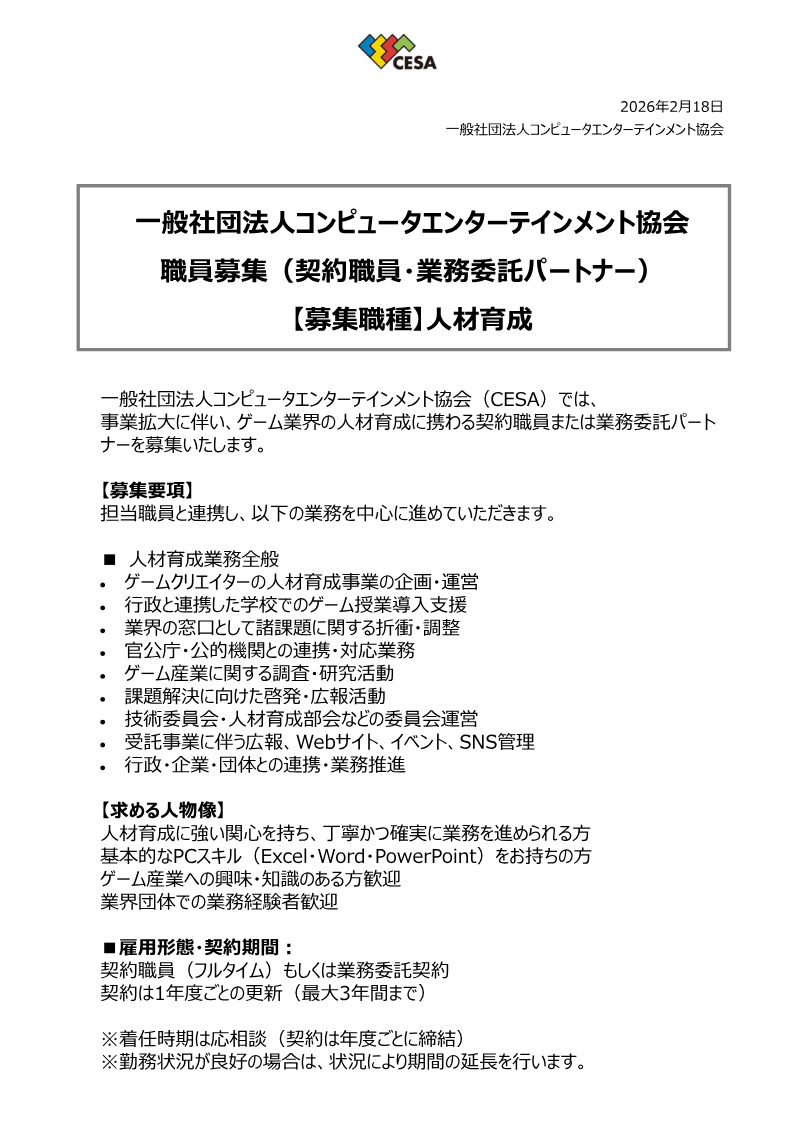
職員募集(契約職員・業務委託パートナー):人材育成
The Computer Entertainment Society (CESA) announces a recruitment drive for contract personnel and outsourced partners to support its expanding human‑resource development initiatives within Japan’s video‑game sector. The role centers on planning and operating creator training programs, facilitating the introduction of game‑based curricula in schools in collaboration with government bodies, and acting as a liaison for industry‑wide issues. Additional responsibilities include coordinating with public agencies, conducting research on the gaming industry, managing outreach and publicity, overseeing committee activities, and handling web, event, and social‑media communications tied to commissioned projects.
Candidates are expected to possess at least five years of professional experience, demonstrable negotiation and coordination skills, and a strong interest in gaming. Preferred backgrounds include prior interaction with governmental entities, experience driving contract‑based projects, and familiarity with educational or certification activities related to games. Basic PC proficiency in spreadsheet, word‑processing, and presentation software is required, while prior employment in game companies or teaching roles is advantageous.
Employment is offered either as a full‑time contract employee with a standard 9:00‑17:30 schedule in Shinjuku, Tokyo, or as an outsourced partnership negotiated according to individual expertise. Contract terms are annual, renewable up to three years, with an hourly wage starting at ¥1,800, subject to experience. Benefits encompass health, pension, unemployment, and workers’ compensation insurance, a complete two‑day weekend, and a smoke‑free office environment. Applications are to be submitted via the CESA inquiry form, followed by a two‑stage interview process conducted online and in person.
- The Computer Entertainment Society (CESA) is hiring contract personnel and outsourced partners to lead human-resource development and creator training programs within the Japanese video-game industry.
- Core responsibilities include facilitating game-based curricula in schools, managing government relations, conducting industry research, and overseeing communications for commissioned projects.
- Candidates must have at least five years of professional experience, with preference given to those with backgrounds in government liaison work, project management, or educational certification.
- Contract employees are based in Shinjuku, Tokyo, with a standard 9:00–17:30 schedule and an hourly wage starting at ¥1,800.
- Employment terms are annual and renewable for up to three years, with full benefits including health, pension, unemployment, and workers' compensation insurance.
+2
CESA – Computer Entertainment Supplier's AssociationFeb 2026

Report11 pages
Flemish Games Sector: 2025 Industry Report
The Flemish games sector demonstrates consistent growth and structural stability as of 2025. The industry, encompassing game development, publishing, support services, and incubators, has expanded its corporate footprint significantly, rising from 60 active entities in 2020 to 128 in 2025. This growth trajectory reflects a robust ecosystem that has more than doubled its number of participants over a five-year period. Geographically, the industry remains concentrated in East Flanders, which hosts 42 companies, followed by Antwerp with 33, West Flanders with 24, Flemish Brabant with 19, and Limburg with 10.
The sector is characterized by a predominantly micro-enterprise structure, with 112 companies employing between one and ten staff members. Small businesses account for 15 entities, while only one mid-sized firm exists, and no large-scale organizations with over 250 employees are currently present. Despite this small-scale composition, the workforce has seen a steady upward trend, reaching 728 full-time equivalents in 2025. This represents a recovery and expansion from the 627 full-time equivalents recorded in 2020, highlighting the sector's increasing capacity to sustain professional employment.
Financial performance mirrors this operational expansion, with total annual turnover reaching 76.5 million euros in 2025. This figure marks a steady climb from 58.7 million euros in 2020, indicating a resilient market that has successfully navigated economic fluctuations. By maintaining a steady increase in both company count and revenue, the Flemish games industry continues to solidify its position as a growing contributor to the regional economy, supported by a dense network of small, specialized development and service-oriented studios.
- The Flemish games sector has more than doubled its corporate footprint since 2020, growing from 60 to 128 active entities by 2025.
- Annual industry turnover reached 76.5 million euros in 2025, reflecting a steady increase from 58.7 million euros in 2020.
- The sector is composed almost entirely of micro-enterprises, with 112 of the 128 companies employing between one and ten staff members.
- Total professional employment in the sector has grown to 728 full-time equivalents in 2025, up from 627 in 2020.
- Industry activity is geographically concentrated, with East Flanders hosting the largest share of companies (42), followed by Antwerp (33) and West Flanders (24).
FLEGA – Flemish Games AssociationJan 2026

Report46 pages
Esports 2023: Challenges and Opportunities in the UK
The report argues that the United Kingdom’s esports sector has evolved from a fragmented niche into a rapidly professionalised ecosystem, yet it still requires coordinated investment and policy to sustain growth. Key findings show an audience of roughly 55 million adults, with 82.7 % aged 18‑34 and a male dominance of 83 %. While shooters such as Call of Duty, CS:GO and Fortnite command the largest viewership, only 3.8 % of gamers follow competitive play, revealing a small “iceberg” of engaged fans. This gap highlights opportunities for talent development and global brand expansion, especially as the UK lags behind U.S. and Asian markets in producing top‑tier professionals.
Economic data underscore the sector’s momentum: gross value added reaches £111 million and sponsorship revenue exceeds $1.38 billion, with UK events and teams capturing a $1.5 billion share of the global market. Major brands—Intel, Red Bull, Saudi PIF—and tournament operators such as ESL, FACEIT and Gfinity are driving investment, while infrastructure projects by XLHQ, Royal Ravens and Cloud9 create dedicated studios and community hubs. Educational initiatives, including a BTEC programme with Pearson and university leagues like NUEL, demonstrate that esports can boost computing engagement and skill development among 10 000 pupils.
Despite these gains, challenges persist. Mainstream media coverage remains limited, and government support is uneven, constraining broader recognition of esports as a legitimate sport. Diversity and inclusion remain under‑addressed, with female participation at 17 % and a need for stronger links between education, industry and policy to create sustainable career pathways. Emerging monetisation models—Web3, NFTs, metaverse experiences—offer new revenue streams but require regulatory clarity and infrastructure investment. Coordinated action across stakeholders is essential to unlock the UK’s full economic and cultural potential in esports.
- The UK esports sector generates £111 million in gross value added, with UK-based teams and events capturing a $1.5 billion share of the global market.
- While the UK has a potential audience of 55 million adults, only 3.8% of gamers follow competitive play, indicating a significant opportunity for fan base expansion.
- The demographic profile of the UK esports audience is highly concentrated, with 82.7% aged 18–34 and 83% male, highlighting a need for improved diversity and inclusion efforts.
- Major investment is being driven by global brands like Intel, Red Bull, and the Saudi PIF, alongside infrastructure developments from organizations such as XLHQ, Royal Ravens, and Cloud9.
- Educational initiatives, including a Pearson BTEC programme and the NUEL university league, are currently engaging 10,000 pupils in computing and skill development.
+1
British EsportsDec 2025

Report13 pages
Annual Review: 2025
The document outlines Ukie’s first year of its five‑year “Supercharged” strategy, aimed at accelerating the UK video games and interactive entertainment sector. The thesis is that a coordinated policy, industry‑wide campaigns, talent development and trade support can secure the UK’s position as a global leader in games. Key findings show that consumer spending reached £7.6 billion in 2024, a record high, and that Ukie’s advocacy generated three major policy wins: recognition of games as a growth sector, a tailored growth package and £30 million for the UK Games Fund. The organisation also secured £75 million in business wins through global trade activity at GDC and Gamescom, and delivered 19 consultations to government bodies. In talent development, Ukie supported 30 companies via its Growth Programme and ran the largest student game jam with over 200 participants, while Digital Schoolhouse won a national BETT award for best opportunities and experience. The scope covers the UK, with outreach to Scotland, Wales, Northern Ireland and international partners such as Tencent. Methodology includes evidence‑based lobbying, a national pulse survey network, and partnership with academic institutions for skills research. The report concludes that the next year will focus on deepening policy influence, expanding trade missions, and fostering emerging mobile, UGC and external‑engine opportunities to sustain industry growth.
- UK consumer spending on video games and interactive entertainment reached a record high of £7.6 billion in 2024.
- Ukie’s advocacy efforts secured £30 million in funding for the UK Games Fund and official recognition of the sector as a key driver of economic growth.
- Global trade activities at GDC and Gamescom generated £75 million in business wins for the UK games industry.
- The organization delivered 19 formal consultations to government bodies to influence policy and secure a tailored growth package for the sector.
- Talent development initiatives included supporting 30 companies through the Growth Programme and hosting a student game jam with over 200 participants.
+2
UkieDec 2025

Report39 pages
Business Case for an Enhanced Video Games Expenditure Credit: UK
The analysis argues that a targeted increase in the Video Games Expenditure Credit (VGEC) would markedly strengthen the United Kingdom’s competitive position within the global video‑games sector. By raising the nominal rate to 53 % for projects up to £10 million and to 39 % for larger productions, the model predicts an additional £530 million in gross value added (GVA) and roughly 6,000 new full‑time jobs over five years. The return on investment is projected at £2.12 of GVA and tax revenue for every £1 spent, positioning the UK as one of the most attractive jurisdictions for game development.
Key findings highlight a worldwide contraction in employment, with 30 000 layoffs expected between 2023 and 2024, prompting a shift toward freelance and subcontracted talent. Venture‑capital funding has fallen sharply from $9 billion in 2020 to just over $3 billion by early 2024, while indie sales on platforms such as Steam now account for nearly 70 % of full‑game revenue. These trends underscore the need for flexible, cost‑efficient production models and a supportive fiscal environment.
Comparative analysis shows that the current UK VGEC effective rate of 14 % is lower than those in France (20.2 %) and Canada’s Quebec (18.2 %). The proposed tiered scheme would raise the UK rate to 20.6 %, matching or surpassing many international competitors and potentially adding an extra 5,000 full‑time equivalents over five years. Across all scenarios, the cost‑benefit profile remains favorable, with GVA returns of £1.3–£1.4 per £1 invested and tax returns of £0.4–£0.5 per £1.
In sum, the enhanced VGEC package delivers a superior economic return by stimulating export‑driven intellectual property creation and supporting both small studios and multinational operations. The model demonstrates that a carefully calibrated incentive structure can offset macro‑economic pressures, sustain employment growth, and secure the UK’s position as a global leader in video‑game development.
- Increasing the Video Games Expenditure Credit (VGEC) to a tiered rate of 53% for projects under £10 million and 39% for larger productions is projected to generate £530 million in additional gross value added (GVA) and 6,000 new full-time jobs over five years.
- The proposed fiscal enhancement would raise the UK’s effective VGEC rate to 20.6%, surpassing current rates in France (20.2%) and Quebec (18.2%) to improve international competitiveness.
- Every £1 of government investment in the enhanced VGEC is projected to yield a return of £2.12 in combined GVA and tax revenue.
- The global video game industry faces significant contraction, with 30,000 layoffs expected between 2023 and 2024 and venture capital funding dropping from $9 billion in 2020 to roughly $3 billion by early 2024.
- Indie game sales on platforms like Steam now represent nearly 70% of total full-game revenue, highlighting a market shift toward smaller, cost-efficient production models.
+1
UkieDec 2025

Report4 pages
CESA Game Industry Report 2025
The 2025 CESA Game Industry Report presents a comprehensive assessment of the current state of the video‑game sector, emphasizing three strategic themes: the impact of artificial‑intelligence technologies on development, the latest dynamics of the global market, and emerging regulatory issues. By expanding data coverage to include China, Australia, major Western economies, India and the MENA region, the analysis offers a multidimensional view of both domestic and international trends.
Global game‑content revenue reached 31.042 trillion yen in 2024, marking a 5.0 % year‑on‑year increase. Mobile games accounted for 18.433 trillion yen, roughly 60 % of total sales, and grew 6.0 % versus the prior year. PC titles posted the strongest platform growth over the past four years, expanding 59.7 % and overtaking console share, while console revenue showed modest contraction. In Japan, the total gaming population stood at 5.475 million in 2024, a slight decline from 5.553 million; mobile users fell 1.8 %, PC users rose 0.5 %, and console users decreased 0.7 %, with expectations of a rebound following the anticipated Switch 2 launch.
Employment estimates indicate approximately 200 000 individuals work across the Japanese gaming ecosystem. Core developers, publishers and hardware manufacturers employ between 58 000 and 83 000 people, while ancillary sectors—such as visual production, middleware, peripherals, retail and media—constitute the remainder of the workforce.
The findings derive from CESA’s own surveys, expert interviews and user studies conducted in China and Australia, supplemented by industry‑wide data sources and event reports (Tokyo Game Show, Japan Game Awards, CEDEC). The methodology blends desk research with primary fieldwork to deliver a layered, data‑rich portrait of the industry’s structure, growth drivers and regulatory landscape.
- Global game content revenue reached 31.042 trillion yen in 2024, representing a 5.0% year-on-year increase.
- Mobile gaming remains the dominant sector, generating 18.433 trillion yen—roughly 60% of total global sales—with a 6.0% annual growth rate.
- PC gaming has experienced significant momentum, expanding 59.7% over the last four years to overtake console market share.
- Console revenue saw a modest contraction in 2024, though the Japanese market anticipates a rebound following the expected launch of the Switch 2.
- The Japanese gaming population experienced a slight decline to 5.475 million users in 2024, driven by a 1.8% drop in mobile users and a 0.7% decrease in console users.
+1
CESA – Computer Entertainment Supplier's AssociationDec 2025

Report12 pages
Sector Report: Flanders & Brussels 2024
The report presents a comprehensive snapshot of the videogame sector in Flanders and Brussels for 2024, focusing on company activity, employment, and financial performance. It documents a total of 160 companies operating across development, publishing, services, portals, and accelerator/incubator roles, with a notable concentration in Antwerp (23 firms) and Brussels (21). Company size distribution is heavily skewed toward micro enterprises, accounting for 112 out of 160 firms; only 15 are small (11–49 employees), one midsized, and none large.
Employment figures show a steady rise in full‑time equivalents (FTEs) from 600 in 2020 to 857 by 2024, reflecting a growth of roughly 43% over five years. The sector’s turnover has also expanded, reaching €75.9 million in 2024 compared to €64.6 million in 2023, marking a 17% increase year‑on‑year and an overall rise of about 18% since 2020.
Geographically, the sector is concentrated in the western and eastern parts of Flanders, with a smaller but growing presence in Limburg. The data exclude Wallonia due to delayed reporting, indicating that the figures represent only a partial view of Belgium’s overall videogame landscape.
Methodologically, the report aggregates company counts, employment numbers, and revenue figures from industry registries and self‑reported financial statements. The analysis covers the period 2020–2024, providing a trend view that highlights sustained growth in both human capital and economic output within the Flemish‑Brussels videogame ecosystem.
- The videogame sector in Flanders and Brussels grew to 160 companies by 2024, with the highest concentrations located in Antwerp (23 firms) and Brussels (21 firms).
- Employment in the sector rose by approximately 43% over five years, increasing from 600 full-time equivalents (FTEs) in 2020 to 857 in 2024.
- Annual turnover reached €75.9 million in 2024, representing a 17% year-on-year increase from the €64.6 million reported in 2023.
- The industry landscape is dominated by micro-enterprises, which account for 112 of the 160 total firms, while only 15 companies are classified as small and none are large.
- Total economic output for the region has grown by approximately 18% since 2020, reflecting sustained financial expansion alongside human capital growth.
Flemish Games AssociationAug 2025

Report34 pages
Llibre Blanc de la Indústria Catalana del Videojoc 2024
I’m ready to combine the section summaries into a cohesive overview, but I’ll need the remaining sections to capture the full scope, key data points, and conclusions of the 2024 Catalan video‑game industry analysis. Could you please provide the rest of the section summaries?
- The Catalan video game industry generated €756 million in 2023, representing 53% of Spain's total revenue and a 6.6% increase from 2022. It employed 5,174 professionals, accounting for 50% of the national total.
- The industry is projected to reach €893 million by 2027, with an estimated compound annual growth rate (CAGR) of 4.3% for 2023-2027, despite an anticipated stagnation in 2024.
- In 2024, there were 262 video game studios in Catalonia, with 161 formally constituted as companies, a 10% increase from the previous year.
- Catalan studios primarily focus on original intellectual properties (91%), with self-publishing (54%) and third-party development (39%) being other popular activities. Serious games development increased to 22%.
- Digital premium sales are the main revenue source (40%), followed by outsourcing (16%) and service sales (14%). 74% of games developed in Catalonia include a Catalan language version.
+3
Direcció General d’Innovació i Cultura DigitalJul 2025
Report4 pages
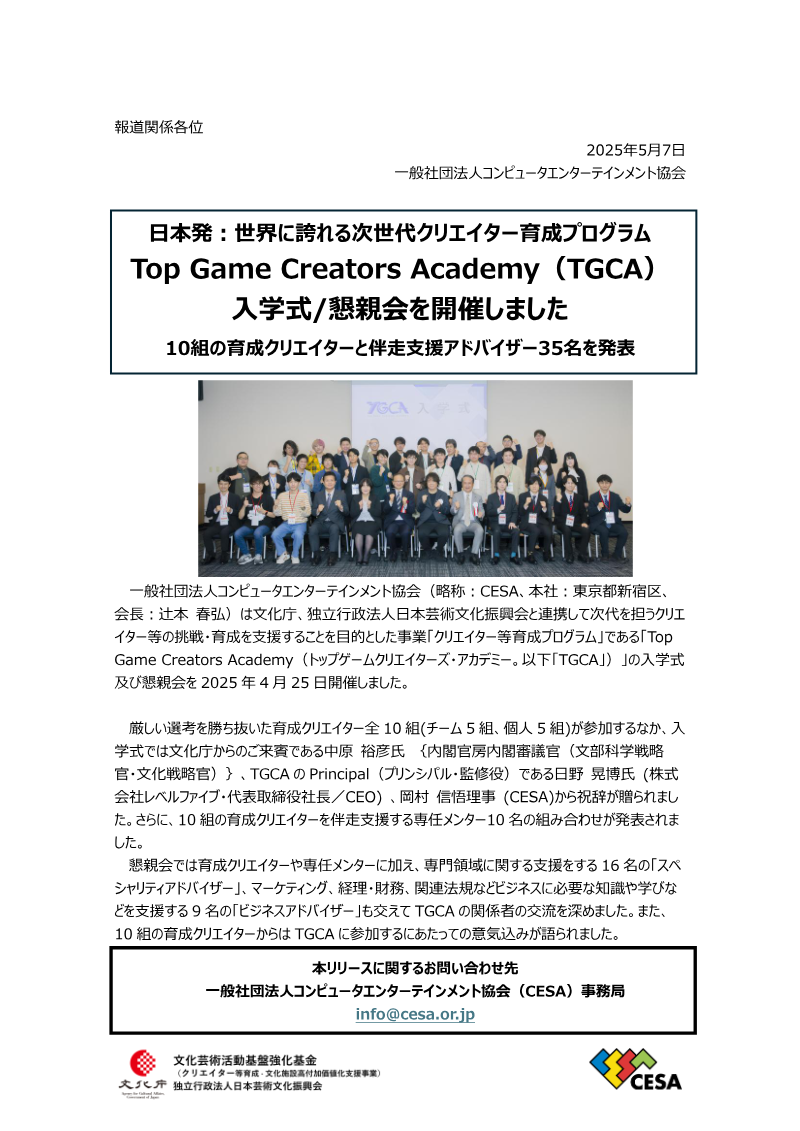
Top Game Creators Academy: 入学式/懇親会を開催しました
The Top Game Creators Academy (TGCA) was inaugurated on 25 April 2025 as a joint initiative of the Cultural Agency, the Japan Arts and Culture Promotion Agency, and the Computer Entertainment Association (CESA) to cultivate next‑generation game creators capable of delivering original IP that can compete globally. Ten selected teams—five groups and five individual creators—were formally admitted, accompanied by thirty‑five advisors who will provide ongoing mentorship, specialty guidance, and business support throughout a two‑year development cycle.
The program draws on the Cultural Arts Activity Strengthening Fund, allocating public resources to enable intensive, mentor‑driven training. Each creator cohort is paired with a dedicated mentor from leading studios such as Bandai Namco, Capcom, and Square Enix, while sixteen specialty advisors cover visual art, engineering, design, sound, and project management, and nine business advisors address marketing, finance, and legal matters. Progress meetings occur monthly, fostering collaborative feedback within multi‑person groups rather than one‑on‑one pairings.
Participants will showcase their work at major industry events, beginning with an online appearance at CEDEC in July 2025, a debut at Tokyo Game Show in September 2025, and subsequent exhibitions at the Taipei Game Show in January 2026, with potential expansion to international venues such as Gamescom in 2026. The cohort aims to graduate by March 2027, having refined both creative and commercial competencies to launch globally competitive titles.
- The Top Game Creators Academy (TGCA) launched on 25 April 2025 to develop globally competitive original IP through a two-year intensive mentorship program.
- The cohort consists of 10 teams—5 groups and 5 individuals—supported by a network of 35 advisors, including 16 specialty experts and 9 business consultants.
- Mentorship is provided by industry leaders from major studios, specifically Bandai Namco, Capcom, and Square Enix.
- The program is funded by the Cultural Arts Activity Strengthening Fund, a joint initiative involving the Cultural Agency, the Japan Arts and Culture Promotion Agency, and CESA.
- Participants will debut their projects at CEDEC in July 2025 and Tokyo Game Show in September 2025, followed by Taipei Game Show in January 2026.
+2
CESA – Computer Entertainment Supplier's AssociationMay 2025
Report18 pages
2025 Game Industry Salary Report
The 2025 Game Industry Salary Report provides a comprehensive analysis of compensation, job security, and workplace sentiment among video game professionals in the United States. Based on a July 2025 survey of 562 industry professionals, the findings reveal a landscape defined by high average earnings contrasted against significant instability. The study maintains a 3% margin of error at a 95% confidence level, covering various industry segments including AAA, indie, and co-development studios.
The average annual salary for U.S. game professionals reached $142,000 in 2025, with a median of $129,000. While 60% of respondents saw pay increases over the previous year, a profound sense of financial and professional dissatisfaction persists. Over half of the workforce feels undercompensated, a sentiment that is more pronounced among women, non-binary individuals, and non-white workers. Data highlights a persistent wage gap, with non-white workers earning 27% less than their white peers and women earning 24% less than men.
Industry stability remains a primary concern following a period of intense volatility. One-fourth of respondents experienced a layoff within the past two years, and nearly half of those individuals remain unemployed. Consequently, 80% of professionals view game development as less secure than other career paths. Despite these fears, 82% intend to remain in the industry for the next five years.
The report also tracks emerging labor trends, noting that 64% of workers support unionization and 56% are interested in joining a union. Remote work remains dominant, with approximately 60% of developers in programming and design roles working fully remotely. While 85% of employees receive health insurance, other benefits like childcare subsidies remain rare, leading 11% of the workforce to take on side hustles to meet financial needs or seek creative fulfillment.
- The average annual salary for U.S. game professionals is $142,000, yet 80% of workers perceive the industry as less secure than other career paths due to widespread instability.
- One-fourth of industry professionals experienced a layoff in the last two years, with nearly 50% of those affected remaining unemployed.
- Significant wage disparities persist, as non-white workers earn 27% less than white peers and women earn 24% less than men.
- Despite high average earnings, over 50% of the workforce reports feeling undercompensated, and 11% have taken on side hustles to meet financial needs.
- Labor sentiment is shifting toward collective action, with 64% of workers supporting unionization and 56% expressing interest in joining a union.
+2
Game Developers ConferenceMar 2025

Report21 pages
Australian Video Games Industry Policy Platform: February 2025
The Australian video games industry represents a vital economic sector, generating $339.1 million in revenue and supporting 2,465 full-time positions during the 2024 fiscal year. With 93 percent of revenue derived from international markets and over half of all studios anticipating continued income growth, the sector is positioned to evolve into a global powerhouse. The primary objective is to scale the industry to a $1 billion valuation by 2030, a goal that necessitates a strategic shift toward long-term policy frameworks, increased federal investment, and enhanced export support to facilitate international publisher partnerships and local intellectual property development.
To achieve this growth, the industry requires a modernized regulatory environment that replaces fragmented, reactive policies with evidence-based standards. Current classification and online safety laws often impose disproportionate burdens on developers, hindering innovation. By streamlining these frameworks and reducing administrative red tape, the government can provide the certainty required for studios to scale operations. Furthermore, the industry advocates for a more integrated approach to public policy, specifically by leveraging "serious games" to address societal challenges and fostering closer alignment between government initiatives and the practical needs of game developers.
Sustaining this trajectory also depends on addressing critical structural challenges, particularly regarding talent acquisition and capital access. The industry faces persistent talent shortages that demand improved migration pathways and a renewed focus on STEAM education to build a robust local workforce. By combining these educational and immigration reforms with targeted research and development incentives, Australia can foster a competitive ecosystem that attracts international investment while empowering domestic studios. Ultimately, the transition to a billion-dollar industry relies on a collaborative partnership between the public and private sectors to prioritize innovation, intellectual property protection, and sustainable economic development.
- The Australian video games industry aims to reach a $1 billion valuation by 2030, building on its 2024 fiscal year performance of $339.1 million in revenue.
- The sector currently supports 2,465 full-time positions, with 93 percent of its revenue generated from international markets.
- Over 50 percent of Australian game studios anticipate continued income growth, signaling strong potential for expansion into a global powerhouse.
- Industry growth is currently hindered by fragmented regulatory frameworks, specifically classification and online safety laws that impose disproportionate administrative burdens on developers.
- To sustain development, the industry requires improved migration pathways and enhanced STEAM education initiatives to address persistent talent shortages.
+1
Interactive Games & Entertainment AssociationFeb 2025