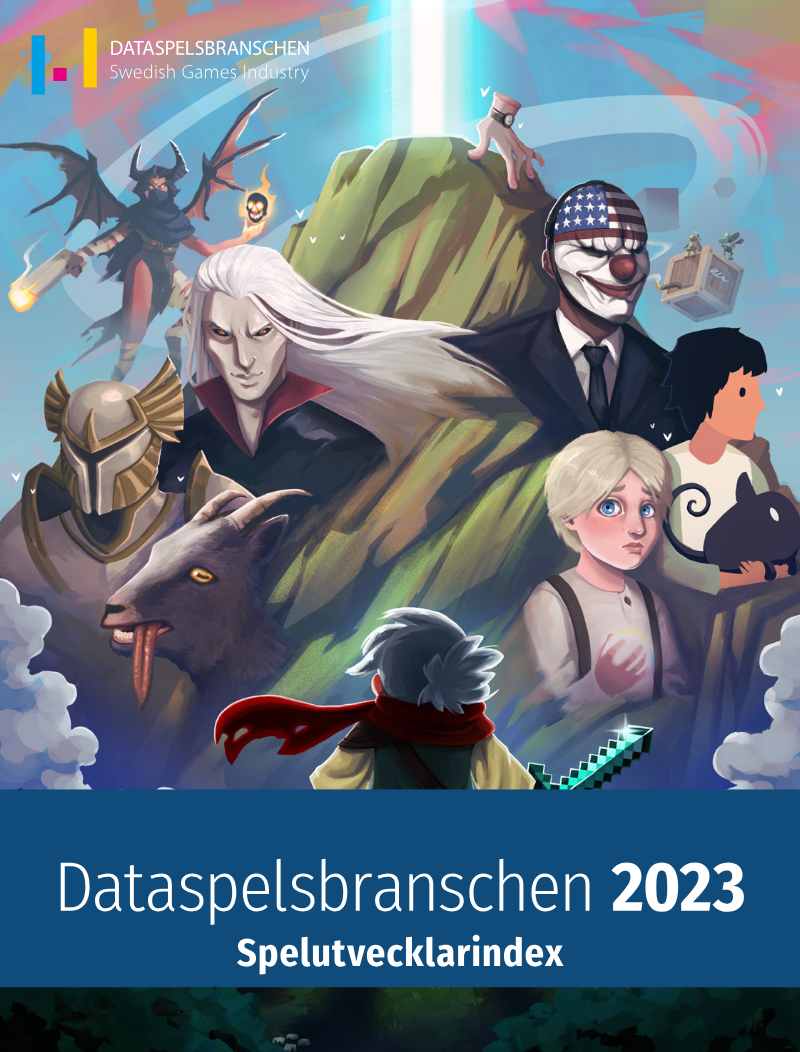
The analysis maps Sweden’s game‑development landscape, arguing that the sector’s rapid expansion has positioned the country as a leading European hub while simultaneously exposing new regulatory and societal challenges. Over the past twenty years the industry has multiplied from 71 firms with SEK 0.5 billion in revenue to more than 1 100 companies generating roughly SEK 37 billion—an increase of about 7 500 %—and employing 9 130 staff domestically, complemented by an additional 11 000 workers abroad. This growth underscores the sector’s escalating economic weight and its contribution to national employment. Geographically, the ecosystem spans all Swedish counties, comprising over 300 development studios. The highest concentrations are found in Stockholm and its surrounding regions, notably Uppsala, Värmland and Örebro, where studio density exceeds twelve entries per county. Domestically, Swedish‑produced titles commanded the majority share of the Steam market in 2024, reflecting strong consumer preference for locally created content and reinforcing the sector’s market relevance. Artificial intelligence has become a dual‑purpose tool within the industry: it is employed to generate novel game assets and to identify players exhibiting signs of radicalisation or harassment. The analysis stresses that radicalisation often migrates from in‑game interactions to external, unmoderated forums, distinguishing it from broader online hate. Consequently, it calls for coordinated, cross‑border interventions that involve regulators, academic researchers and game companies to mitigate these risks while preserving the sector’s innovative momentum.
Sweden’s video‑game sector continued to expand in 2023 despite a constrained credit environment, with domestic turnover rising 6.4 % to 34.6 billion SEK and reaching 90.4 billion SEK when foreign subsidiaries are included. The number of development firms hit a record 1,010, an 8 % increase, while employment grew to 9,089 staff in the country, also an 8 % rise, although the overseas workforce fell 4 % to 15,792. Female representation improved to 23.7 % (2,150 women), yet overall profitability declined. In 2024 the industry marked several high‑profile milestones. The Microsoft‑Activision Blizzard acquisition, valued at roughly 620 billion SEK, concluded in October 2023, and King celebrated the ten‑year anniversaries of Farm Heroes Saga and Candy Crush Soda Saga while relocating to a larger Malmö office. Mergers and acquisitions accelerated, exemplified by Embracer’s €4.9 billion sale of Gearbox to Take‑Two, Red Rover’s €212 million financing round led by Behold Ventures and Krafton, and EQT’s €28.7 billion purchase of Keywords Studios. Inclusion efforts gained momentum, with programmes such as WINGS, Game Dev Force and King’s nine‑month mentorship supporting 27 women and non‑binary participants, and 52 studios adopting formal diversity policies. Over 300 Swedish studios were catalogued, reflecting a broadening ecosystem. The government’s 2023 cultural‑canon initiative prompted the selection of fifteen landmark digital games spanning six decades, underscoring the sector’s cultural significance. Higher‑education institutions expanded game‑development curricula, launching new bachelor, master and specialist programmes, thereby strengthening the talent pipeline. Concurrently, research highlighted the limited relevance of traditional screen‑time guidelines for games and emphasized positive outcomes of play. Emerging risks identified include radicalisation, the legal and creative challenges posed by generative AI
The analysis evaluates the health and trajectory of Sweden’s video‑game sector during 2023‑24, mapping its economic performance, creative output, ecosystem structure and emerging challenges. By quantifying sales, employment, investment and cultural impact, it argues that the industry remains a growth engine for the Swedish economy while confronting structural constraints that could limit future expansion. Domestic net sales rose 6 % to SEK 34.6 billion (≈ EUR 3 billion, USD 3.2 billion) and total global revenue reached SEK 90.4 billion, a 4.5 % increase. The number of registered firms grew by 108 to 1,010, and Swedish‑owned companies expanded overseas to 218 subsidiaries in 54 countries, employing 15,792 staff abroad, of whom 29.5 % are women. Major titles such as Helldivers 2 (12 million copies in three months) and Satisfactory (6 million copies and a console launch) reinforced Sweden’s market presence, while Steam and Twitch data showed Swedish games accounting for over 700 million streamed hours in 2023 and nearly 500 million from January‑October 2024. The ecosystem is heavily concentrated in Stockholm, home to 439 studios and 5,816 employees, with secondary hubs in Skåne‑Blekinge, Västra Götaland, Västerbotten‑Norrbotten and Östergötland. Educational provision spans bachelor, master and vocational programmes, serving roughly 700 students across multiple institutions. Inclusion initiatives have broadened participation, exemplified by a game‑developer camp for about 100 gender‑diverse teens and a network of scholarships and mentorships. Nevertheless, early‑stage capital has weakened, talent pipelines remain thin—with only 644 new hires in 2023 and rising work‑permit refusals—and public‑health screen‑time guidance remains ambiguous. Capital flows revived in 2023‑24, highlighted by Embracer’s SEK 4.9 billion sale of Gearbox to Take‑Two and EQT’s SEK 28.7 billion acquisition of
The Swedish games industry underwent a period of rapid expansion in 2021, characterized by a 22% increase in domestic revenue to €2.7 billion and a 43% surge in global revenue to €5.8 billion. This growth was fueled by a record-breaking year of international acquisitions, with 81 public transactions led by major groups such as Embracer and Stillfront. By late 2022, Swedish-owned entities operated 197 studios across 49 countries, employing approximately 28,000 people worldwide. This international footprint is reflected in consumer reach, as an estimated one in four players globally has engaged with a Swedish-developed title, and Swedish-associated games accounted for 6% of all Twitch watchtime in 2021. The domestic workforce grew by 17% to nearly 8,000 employees, with women representing 22.1% of the total staff and 26% of new hires. While gender diversity is improving—evidenced by 29 companies achieving at least 50% female representation—the industry continues to struggle with a severe domestic skills shortage. This talent gap has forced Swedish firms to expand their foreign subsidiaries aggressively, with over 11,000 staff members now based abroad. Although regional hubs in Stockholm and Skåne remain dominant, growth is increasingly supported by specialized educational clusters and post-secondary programs designed to cultivate local talent. Despite its commercial success and cultural influence, the sector faces structural hurdles that could impact future scalability. Critical challenges include complex work permit processes for international recruits and a lack of early-stage financing compared to other global markets. Methodological shifts in industry tracking now prioritize national group turnover to ensure better comparability with other sectors, revealing a robust ecosystem of 785 active companies. While the industry remains a powerhouse of the Swedish economy, its long-term sustainability depends on addressing recruitment barriers and maintaining the momentum of its global acquisition strategy.
The Swedish games industry reached a significant financial milestone in 2022, with domestic revenues rising 13% to €3.1 billion and total global revenue, including foreign subsidiaries, surging 40% to €8.1 billion. This growth is characterized by a massive international footprint, as Swedish-owned companies now operate nearly 400 studios across 59 countries. Large-scale acquisitions, such as Embracer Group’s multi-billion euro purchase of Asmodee, have shifted the employment landscape, resulting in Swedish firms employing nearly twice as many people abroad as they do domestically. Within Sweden, the number of active companies grew by 20% to 939, supported by a maturing ecosystem of regional hubs and specialized educational programs. Despite this commercial success, the industry faces a critical production capacity bottleneck driven by a chronic shortage of skilled labor. While domestic employment grew to over 8,400 positions and diversity improved—with women accounting for over 44% of new entrants—the sector remains heavily dependent on foreign recruitment to sustain its trajectory. Furthermore, Swedish startups face a competitive disadvantage due to a lack of formal financial support structures compared to other European nations, forcing many to rely on organic growth or early acquisition rather than domestic venture capital. The sector is also navigating complex structural and environmental challenges. Sustainability efforts are increasingly focused on Scope 3 emissions, which represent over 99% of the industry’s carbon footprint, while legal and ethical concerns regarding generative AI and online radicalization have emerged as new operational risks. Geopolitical instability, particularly the war in Ukraine, continues to impact global workforces. Nevertheless, the integration of the Swedish E-sports Association into the Swedish Sports Confederation and the continued dominance of major entities like King, Mojang, and Stillfront Group underscore Sweden’s position as a premier global hub for game development and digital entertainment.
The 2024 overview of Sweden’s games industry presents a comprehensive assessment of the sector’s performance, challenges, and forward‑looking dynamics within the Swedish market. It argues that, despite a noticeable wave of studio closures, the industry remains resilient and is entering a phase of regeneration driven by regional clusters, targeted investment schemes, and internationally successful titles. Analysis of the year shows that development activity is increasingly concentrated in hubs such as Skövde, where new studios have emerged and produced world‑hit games like *Satisfactory*, a title that secured both D.I.C.E. and Golden Joystick awards. This creative output underscores Sweden’s capacity to generate globally competitive products even as legacy firms exit the market. Growth is attributed largely to coordinated programmes—including Redeye Gaming Day, Invest in Games, and the EU‑funded CDG‑Booster mentoring cohort—that channel capital, mentorship, and market access to emerging developers. The findings highlight a sector that, while contending with consolidation pressures, is expanding its export footprint and sustaining employment through the formation of new companies and the scaling of award‑winning projects. Investment in talent development and cluster formation emerges as a decisive factor in maintaining Sweden’s reputation as a leading European game‑development hub. Overall, the 2024 snapshot confirms that Sweden’s games industry, spanning development, publishing, and ancillary services, continues to generate significant economic value and cultural impact, positioning itself for sustained growth in the coming years.
Framsida (collage) & fristående illustrationer: Anna Nilsson Text & analys: Johanna Nylander Dataspelsbranschen är en samarbetsorganisation för ANGI och Spelplan-ASGD. ANGI representerar förlag samt distributörer och Spelplan-ASGD representerar utvecklare Dataspelsbranschen | Swedish Games Industry Klara norra kyrkogata 31, Box 22307 SE-104 22 Stockholm Kontakt: [email protected] NYCKELTAL Förändring 2012-2017 Oms.