Updated Mar 17, 2026 by CESA – Computer Entertainment Supplier's Association
Report · December 20, 2024
Published by CESA – Computer Entertainment Supplier's Association
**CESA Game Industry Report 2024 – Executive Summary (English)** --- ### 1. Publication Details | Item | Information | |------|--------------| | **Title** | CESA ゲーム産業レポート 2024 (CESA Game Industry Report 2024) | | **Publisher** | 一般社団法人コンピュータエンターテインメント協会 (Computer Entertainment Supplier’s Association, CESA) | | **Release date** | 20 December 2024 (Friday) | | **Price** | ¥55,000 (incl. tax) – both printed book and PDF/CD‑ROM versions | | **Format** | A4, 360 pages | | **ISBN / Catalog** | CESAJ‑LV‑ (internal code) | | **Production partner** | 株式会社角川アスキー総合研究所 (Kadokawa ASCII Research Institute) | | **Official page** | <https://f-ism.net/report/cesa2024.html> | | **Contact** | [email protected] | > **Citation note** – When quoting any data from the report, cite it as “CESA ゲーム産業レポート 2024”. --- ### 2. Report Structure | Chapter | Focus | |---------|-------| | **Chapter 1 – Front‑matter (Topics, Interviews, Contributions)** | Interviews with industry veterans (久夛良木健, 岡村秀樹) reflecting on 30 years of PlayStation & Sega Saturn; other key‑person case studies. | | **Chapter 2 – Market & Industry Trends (Domestic & Global)** | Macro‑level market size, platform breakdown, development costs, employment, cross‑media context. | | **Chapter 3 – User Trends** | Player demographics, platform usage, esports, multi‑platform activity. | | **Chapter 4 – CESA Activities & Member Initiatives** | Overview of CESA‑hosted events (Tokyo Game Show, CEDEC) and member‑company projects. | --- ### 3. Key Findings #### 3.1 Global Game‑Content Market * **Size (2020‑2024)** – Approximately **¥30 trillion** in 2024, nearly **double** the 2020 level (¥20 trillion). * **Growth drivers** – Strong yen‑depreciation effect post‑2022, continued expansion of mobile gaming, and rising PC‑gaming share (thanks to Steam). * **Platform share (2024)** – * **Mobile**: dominant share (≈ 60 % of global revenue). * **Console**: ~ 20 % of revenue. * **PC**: ~ 20 % (growing steadily). #### 3.2 Japan’s Content Industry & Game Share * **Total overseas export of Japanese content**: **¥4.7 trillion** (on par with semiconductor & steel sectors). * **Games’ contribution**: **≈ 60 %** of that export value → games are the primary driver of foreign‑exchange earnings within the broader content sector. #### 3.3 Domestic Game‑Industry Employment & Compensation * **Total industry employment**: **≈ 200,000** workers (including peripheral sectors). * **Average annual salary**: **¥7.08 million** – markedly higher than the average across
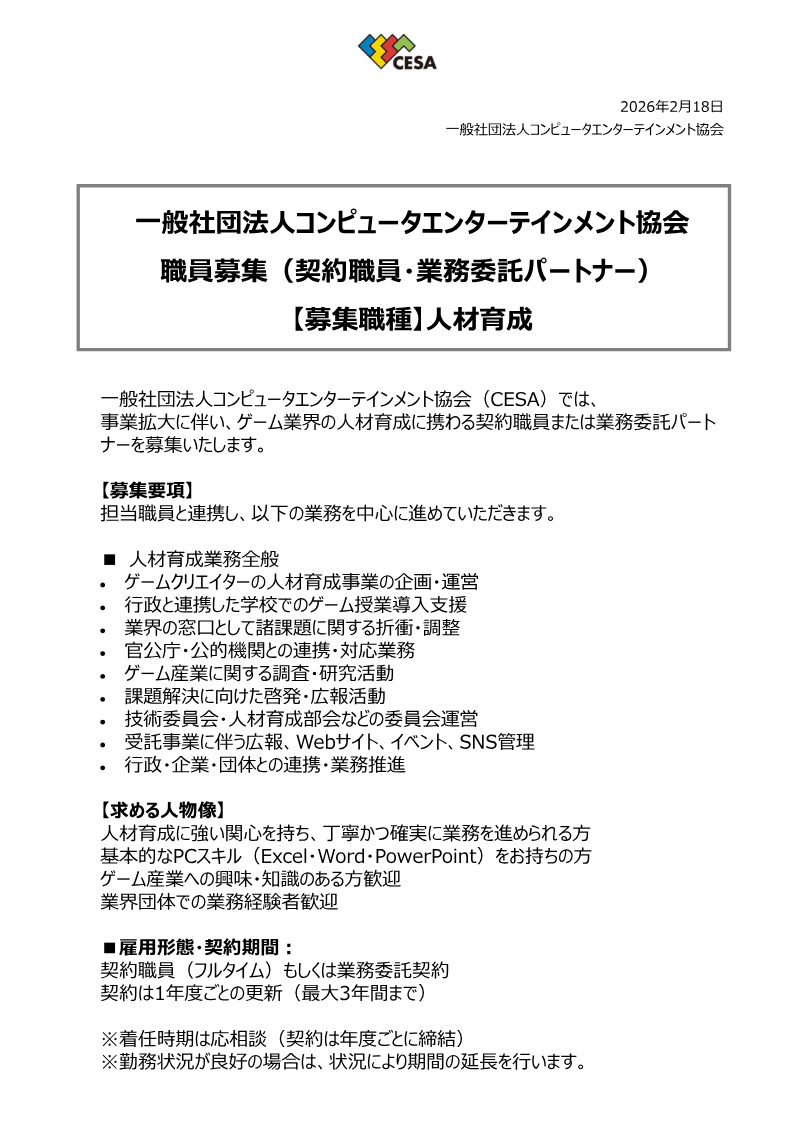
報道関係者各位 2024年12 月20 日 一般社団法人コンピュータエンターテインメント協会 『CESA ゲーム産業レポート2024』発刊 グローバルなゲーム市場推移や国内ゲーム業界の雇用就業統計など ゲーム産業の“今”が分かる内容にフルリニューアル 一般社団法人コンピュータエンターテインメント協会(略称:CESA、本社:東京都新宿区、会長:辻󠄀 本 春 弘)は、国内外のゲーム産業に関するレポートである『CESA ゲーム産業レポート2024』を2024年12 月20 日 (金)に発刊いたしました。 これまでの『CESAゲーム白書』を刷新し、さまざまなデータと多角的な分析、各企業の具体的な事例を加える形 で制作された本書では、デジタル販売による売上データも含めた国内外のゲーム市場について紹介するほか、当 協会の会員企業を対象とした調査で明らかになった国内のゲーム産業動向や、日本のコンテンツ産業全体におけ るゲーム業界の立ち位置、ユーザー動向についても詳細に解説しております。 ゲーム産業の“今”が分かる内容として、業界関係者はもちろん、一般の方々や学生の皆様にも広くお役立ていた だけるレポートとなっておりますので、ぜひご活用ください。 CESA ゲーム産業レポート2024 発行 一般社団法人コンピュータエンターテインメント協会(CESA) CESA 発売日 2024年12 月20 日(金) 価格 書籍版:55,000円(税込) PDF版(CD-ROM版):55,000円(税込) 判型 A4 CESAJ-LV- ページ数 360ページ 2024 紹介ページ https://f-ism.net/report/cesa2024.html CESA Video Game Industry Report 制作協力・販売 株式会社角川アスキー総合研究所 内容 第1 章 巻頭トピックス(特集・インタビュー・寄稿) -M31-9I9-10A COMPUTER ENTERTAINMENT SUPPLIER'S ASSOCIATION 第2 章 国内市場・グローバル市場・産業動向 第3 章 ユーザー動向 第4 章 CESA活動・会員企業の取り組み ■ 『CESA ゲーム産業レポート2024』の主なトピックス 本リリースのデータを引用される場合は、必ず出典として「CESA ゲーム産業レポート2024」と明記いただくよ うお願いいたします。 【第1 章】 フルリニューアルした本書では、巻頭特集として久夛良木健氏、岡村秀樹氏のインタビューを掲載。プレイステ ーションならびにセガサターンの30 周年を記念し、両氏がこの30年間 のゲーム産業の進化を振り返ります。 そのほか、近年のゲーム産業におけるトピックスについて、ゲーム業界のキーパーソンが事例とともに紹介する特
> **[Chart page]** This page contains visual data — view in PDF for the best experience. 【第2 章】 国内外のゲーム市場に関する分析・紹介とともに、開発コストや就業状況、他のコンテンツ産業を含めたクロ スメディアとしてのゲームなど、より幅広い視点でゲーム市場の動向を解説しています。 グローバルのゲームコンテンツ市場規模は約30 兆円。4年 で2 倍近くに伸長 2020年に20 兆円を突破したグローバルのゲームコンテンツ市場規模は、その後も右肩上がりで推移。特に 2022年以降は円安の影響を強く受け、市場規模は拡大傾向が続いています。 プラットフォームごとの内訳では、モバイルゲームがスマートフォンの普及とゲームアプリの充実によって成熟し、そ の後も市場の中で大きな割合を占めています。また家庭用ゲームとPCゲームはそれぞれ2割前後を占めてい ますが、Steamの台頭によりPCゲームが着実にシェアを伸ばしているのが特徴です。 (=) 30 $- PC5- RJ- 26.8 29.5F 21.9 5.7 25 20.6 5.0 (19%) 20 15.7 4.3 (19%) 6.4 4.3 (20%) 5.7 (22%) 15 (21%) 4.5 (21%) 3.5(22%) 4.2 (20%) 10 3.7 (20%) 17.4 (24%) 13.1 16.1 (59%) 5 8.5 12.1 (60%) (60%) (54%) (59%) 0 2019 2020 2021 2022 2023 コンテンツ産業は日本の基幹産業に並ぶ規模にまで成長。海外売上4.7兆円のうちゲームが占める割合 は約6 割にのぼり、外貨獲得に大きく貢献 コンテンツ産業全体での海外輸出高は4. 7兆円 にものぼり、日本の基幹産業である半導体産業や鉄鋼産 業と肩を並べる規模で外貨獲得に大きな役割を果たしています。 また、コンテンツ産業の中でもゲーム産業が6 割近い売上を占めていることから、日本のコンテンツ産業の海外 展開をゲームが牽引していることが明らかになりました。 BAOMRH (202 -6= (=76F9) 3,200 ·FLE 6 5.7 1,310 9 7% 3% 5 5.1 4.73679 4 7EX 4.7 5=4 3 1 4,592 3F 27,780 31% 59% 2 1.5 国内ゲーム産業総就業人口は約20 万人と推定。平均年収は708万円と他業界と比較して高水準 ゲーム関連の総産業人口は20 万人前後と予測されており、周辺産業を広く巻き込む形で雇用人口の創出 に貢献しています。 当協会の会員企業を対象に行った調査により、ゲーム産業の平均年収が708万円と高い水準であること、ま た大手企業を中心に積極的な賃上げの取り組みを行っていることも明らかになり、市場拡大の面のみならず 雇用拡大の面からも成長を続けていることがよく分かる結果になりました。
> **[Chart page]** This page contains visual data — view in PDF for the best experience. 【第3 章】 プラットフォームごとのゲームユーザーの動向やeスポーツなど、ゲームに関するユーザー動向を分析しています。 2023年の国内ゲーム人口は過去5 年間で最多の5,553万人 日本におけるゲーム人口は2020年に5,000万人を突破。その後2022年はやや数値を落としたものの、 2023年には前年比3%増の5,553万人という結果になりました。全てのプラットフォームでプレイするマルチユ ーザーは731万人と、前年の599万人から大きく増加していることが分かります。 5~59() F-LAD 5,5535 7,624 E#5-41-- PC5-41-t- \$ 2,9715A 1195 1,4455 −+}f} 817 261 2155 7315 333 1,303 1988 E/TJ-41-- 4,355A 1-+-1,4205 【第4 章】 東京ゲームショウ、CEDECといった当協会の主催イベントや会員各社の取り組みなど、産業振興と健全な業 界発展を目的としたさまざまな取り組みについて紹介しています。 ■ 一般社団法人コンピュータエンターテインメント協会(CESA)について 一般社団法人コンピュータエンターテインメント協会(CESA)は、コンピュータエンターテインメント産業に関 する調査・研究・普及・啓発などを通じて、その振興を図り、国内産業の健全な発展と国民生活の向上に貢 献することを目的として活動を行っています。 公式サイト:https://www.cesa.or.jp/ 本リリースに関するお問い合わせ先 一般社団法人コンピュータエンターテインメント協会(CESA)事務局 [email protected]
The 2025 CESA Game Industry Report presents a comprehensive assessment of the current state of the video‑game sector, emphasizing three strategic themes: the impact of artificial‑intelligence technologies on development, the latest dynamics of the global market, and emerging regulatory issues. By expanding data coverage to include China, Australia, major Western economies, India and the MENA region, the analysis offers a multidimensional view of both domestic and international trends. Global game‑content revenue reached 31.042 trillion yen in 2024, marking a 5.0 % year‑on‑year increase. Mobile games accounted for 18.433 trillion yen, roughly 60 % of total sales, and grew 6.0 % versus the prior year. PC titles posted the strongest platform growth over the past four years, expanding 59.7 % and overtaking console share, while console revenue showed modest contraction. In Japan, the total gaming population stood at 5.475 million in 2024, a slight decline from 5.553 million; mobile users fell 1.8 %, PC users rose 0.5 %, and console users decreased 0.7 %, with expectations of a rebound following the anticipated Switch 2 launch. Employment estimates indicate approximately 200 000 individuals work across the Japanese gaming ecosystem. Core developers, publishers and hardware manufacturers employ between 58 000 and 83 000 people, while ancillary sectors—such as visual production, middleware, peripherals, retail and media—constitute the remainder of the workforce. The findings derive from CESA’s own surveys, expert interviews and user studies conducted in China and Australia, supplemented by industry‑wide data sources and event reports (Tokyo Game Show, Japan Game Awards, CEDEC). The methodology blends desk research with primary fieldwork to deliver a layered, data‑rich portrait of the industry’s structure, growth drivers and regulatory landscape.
The global games market reached a record $199.4 billion in 2024, cementing its status as the preeminent force in the entertainment sector. Despite this scale, the industry faces a period of moderated growth, with projections for 2025 hovering at approximately 1%. This deceleration stems from a combination of high-profile release delays, such as the postponement of major titles, and a tightening early-stage funding environment. To navigate this landscape, firms are shifting their focus from aggressive expansion toward operational efficiency, lean development cycles, and the optimization of existing intellectual property. Strategic growth in 2025 will rely heavily on geographic diversification and demographic expansion. Emerging markets in the Middle East and Southeast Asia represent significant frontiers, while developers are increasingly targeting underserved cohorts, including older gamers and young adult females. Furthermore, the industry is leveraging user-generated content platforms like Roblox to maintain engagement among younger audiences. Hardware cycles, particularly the anticipated launch of the Nintendo Switch 2, remain a critical catalyst for consumer spending, providing a necessary boost to the broader market ecosystem. To combat the dual pressures of escalating AAA development costs and fragmented consumer attention, publishers are adopting more conservative financial models. This includes a heavy reliance on remakes, remasters, and multi-platform porting to extract maximum value from established assets. Simultaneously, companies are pursuing margin expansion through diversified monetization strategies, such as hybrid mobile models and direct-to-consumer web shops that bypass traditional app store fees. By transitioning toward holistic franchise management that spans licensing, subscription services, and cross-media integration, the industry aims to stabilize revenue streams and ensure long-term sustainability in an increasingly competitive global environment.
The analysis projects that worldwide consumer spending on video games will reach $183.9 billion in 2023, serving more than 3.3 billion players. Revenue is now detailed by downloadable content, micro‑transactions and in‑game subscriptions across PC and console platforms, reflecting a more granular view of monetisation. Estimates are derived from a top‑down model that integrates macro‑economic and census data with primary research from over 74,000 respondents in 36 key markets, supplemented by partner‑provided transaction figures and updated each quarter. Geographically, the Asia‑Pacific region remains the dominant market, accounting for 46 % of global gaming revenues, yet its growth turned negative at ‑0.2 % year‑over‑year, driven by declines in China, Japan and South Korea. The region’s publisher landscape is led by Tencent, which tops the list of publicly‑traded companies by revenue. The study covers 35 countries that together represent more than 90 % of worldwide game income, encompassing PC, console and mobile segments. Genre performance highlights shooters as the leading PC category, generating $5.5 billion—14.1 % of PC revenue—and expanding 4.9 % YoY, buoyed by titles such as Valorant, Counter‑Strike, Payday 3 and S.T.A.L.K.E.R. 2. On mobile, role‑playing games hold the largest share at 23.1 % of mobile revenue, but they are experiencing a year‑on‑year decline as Apple and Google privacy reforms have raised user‑acquisition costs. Overall, the market retains its massive scale but shows signs of slowing growth, particularly in its largest region, while shifts in privacy policy are reshaping mobile economics and shooter titles continue to drive PC revenue growth.
The global games market is entering a period of stabilization and renewed growth, with 2023 revenues projected to reach $184.0 billion. This recovery follows a post-pandemic correction and is supported by a massive player base of 3.31 billion people worldwide. While the industry faces macroeconomic pressures and shifting privacy regulations, long-term forecasts remain positive, with total revenues expected to climb to $205.4 billion by 2026. This trajectory is fueled by the maturation of the current console generation, the expansion of the middle class in emerging markets, and the increasing influence of transmedia strategies that drive engagement across multiple entertainment formats. Market dynamics are shifting significantly across different platforms and regions. Mobile gaming remains the largest revenue segment at $89.7 billion, yet it is currently experiencing a 1.4% decline as privacy policies complicate user acquisition and monetization, particularly within the RPG genre. In contrast, the PC and console segments are the primary growth engines for 2023, benefiting from a steady supply of hardware and a robust slate of high-profile releases. Geographically, the Asia-Pacific region maintains its dominance, accounting for 46% of global revenue, even as regulatory hurdles in China slow its immediate growth. Meanwhile, significant capital infusions, such as Saudi Arabia’s $38 billion investment through Savvy Games Group, are reshaping the competitive landscape. Technological and structural transformations are further defining the industry's future. Generative AI is emerging as a pivotal tool for managing the rising costs of AAA development, though its adoption is tempered by concerns over copyright and workforce impact. Revenue models have transitioned almost entirely to digital formats, with physical sales becoming negligible in the PC market and live-service models dominating console engagement. As the industry evolves, the rise of cloud gaming and handheld "complementary devices" like the Steam Deck are expanding how and where players interact with content, ensuring the market remains resilient despite shifting regulatory and economic conditions.