Updated Mar 17, 2026 by Ukie
Report · October 1, 2024
Published by Ukie
Ukie’s 2024 annual review presents a comprehensive account of the UK video‑games sector’s performance, strategic direction and advocacy work over the past twelve months. The central thesis is that the industry, now a £6 billion economic engine supporting 76 000 jobs, must be “supercharged” through coordinated efforts to energise businesses, empower talent and elevate games as cultural and educational assets. The review outlines the new five‑year “Supercharged” strategy, which frames Ukie’s campaigning and support programmes for the next decade. Key findings highlight robust economic contributions: consumer spending on games rose 4 % to £7.82 billion, while a joint analysis with FTI Consulting estimated video‑game technology spill‑overs added up to £760 million to UK GDP and created nearly 10 000 jobs in 2021. International trade activities at Gamescom and GDC generated over £70 million in business wins and attracted more than £150 million of foreign direct investment for 180 UK companies. Policy influence is demonstrated by over 100 engagements with MPs, successful submissions to Ofcom on online safety, and a manifesto that secured inclusion of the sector in major party election platforms. Education initiatives reached 299 470 learners through the Digital Schoolhouse programme, and IP protection actions removed 1.5 million infringing links and prevented £100 million of illicit digital sales. The review’s scope covers the UK video‑games ecosystem from indie studios to multinational publishers, spanning 2023‑24 and encompassing economic, cultural and regulatory dimensions. Methodologically, the analysis combines internal data on events, memberships and media coverage with external research collaborations, consultation responses and round‑table workshops to produce evidence‑based recommendations. The narrative underscores a commitment to diversity, with a newly approved five‑year EDI strategy and over 20 inclusion‑focused events, positioning the sector for sustained growth and global competitiveness.

I want to ensure that we look back on this time as the moment our industry secured its rightful place as a creative, economic, social, and cultural powerhouse.
Welcome to Ukie’s nual Annual General Meeting 2024 CEO’s Report Nick Poole - Ukie CEO It’s a pleasure to address you all for the first time as CEO. I want to start by expressing my heartfelt thanks for the welcome you have given me as Ukie members as well as my thanks to the Board and staff team for the confidence they have placed in me. As the voice of the UK’s video games industry, I want to reaffirm our unwavering commitment to supporting the dynamic and innovative businesses that make our sector the fastest growing in the creative economy. Reflections on my first year Since joining Ukie in April, I’ve been continuously inspired by the passion and dedication of our community. Visiting games businesses across the country—from indie developers to major publishers—has given me a deep appreciation for the incredible artistry and technological innovation that go into creating games. I see an industry that has come of age – that is redefining culture, education and community for billions of players in the UK and worldwide. I see British innovation and IP driving amazing player experiences around the world, with tremendous spillover benefits into industry, technology and society. Supercharging the UK’s Video Games Industry For over 40 years, the UK video games industry has shaped the modern world. Britishmade games are not only our nation’s most successful export; they are artistic marvels that showcase our rich creative heritage.
its into industry, technology and society. Supercharging the UK’s Video Games Industry For over 40 years, the UK video games industry has shaped the modern world. Britishmade games are not only our nation’s most successful export; they are artistic marvels that showcase our rich creative heritage. Our new 5-year strategy and action plan, Supercharged, sets out how Ukie will ensure that everyone everywhere benefits from the social, cultural and educational power of video games and interactive entertainment, while helping UK-based games businesses to succeed. At Ukie, we proudly champion an industry that contributes over £6 billion to the UK economy and supports 76,000 jobs.
Now, we’re shifting gears into a campaign mode, driving forward three key initiatives ukie designed to energize the industry, empower talent, elevate games, and supercharge the future of the UK’s video games sector for the next decade and beyond. • Energising Industry: Creating an kie ukie environment where local game businesses can turn innovative stories into globally successful IPs. • Empowering Talent: Supporting game businesses in nurturing today’s ukie storytellers and tomorrow’s creative entrepreneurs. • Elevating Games: Championing Britishmade games as a force for good, ensuring they receive the recognition and support they deserve. jkie Looking ahead As we look to the future, I’m filled with Nick Euton-Brown excitement about what we will achieve together. Our refreshed mission and strategic vision set a clear path for Ukie to advocate for our members and propel the UK video games industry forward. In five years, I want to ensure that we look back on this time as Members the moment our industry secured its rightful Day place as a creative, economic, social, and cultural powerhouse alongside the broader Creative Industries.
ocate for our members and propel the UK video games industry forward. In five years, I want to ensure that we look back on this time as Members the moment our industry secured its rightful Day place as a creative, economic, social, and cultural powerhouse alongside the broader Creative Industries. This is the work that I, alongside the Ukie Board and team, am dedicated to. But to make this vision a reality, it will take all of us—every developer, publisher, work-for-hire studio, freelancer, lawyer, financier—everyone who makes up this brilliant industry. Together, we will fight for our rightful place in the nation’s future. I look forward to working with all of you to achieve our shared goals and ambitions for 2024/25 and beyond.
Chair’s Report Tim Woodley - Ukie Chair, Head of Publishing at Hello Games 2024 has been an exceptional year for Ukie, marked by significant milestones and remarkable achievements that highlight Ukie’s commitment to the UK video games and interactive entertainment industry. We are proud to share these accomplishments as we continue to champion the interests of our members and secure the long-term future of the industry with a new Government. Celebrating the Industry at Buckingham Palace One of the most memorable events of the year was our visit to Buckingham Palace. It was an honour to have the UK video games industry celebrated at the Buckingham Palace Gardens. This prestigious occasion underscored the vital contribution our industry makes to the UK’s creative sector. The event provided an unparalleled opportunity to celebrate and recognise the talent, creativity, and innovation that defines the UK video games industry. Welcoming Our New CEO, Nick Poole In April, we welcomed Nick Poole as Ukie’s new CEO. Nick brings a wealth of experience and fresh energy to our organisation at a pivotal point in the development of our industry. The Ukie Board are excited to support Nick as we embark on new initiatives and strategies aimed at fostering growth and advocating for our members.
The new five‑year strategy and action plan sets out a comprehensive roadmap for the UK video‑games and interactive‑entertainment sector, positioning it as the world’s leading hub for new intellectual property and innovation by 2030. Its core thesis is that sustained growth, enhanced global perception, and a resilient, diverse talent pipeline will secure the industry’s long‑term economic and cultural impact. The plan outlines four strategic priorities—transforming public and media perceptions, building a pro‑games policy agenda, cultivating a highly skilled and inclusive workforce, and strengthening businesses through targeted support. Key initiatives include three flagship campaigns: energising industry to turn innovative stories into globally successful IPs, empowering talent by nurturing creators and entrepreneurs, and elevating games to showcase British‑made titles as forces for good. The 2024‑25 action schedule launches a coordinated PR strategy, high‑impact partnerships with cultural and digital brands, and an evidence‑led lobbying effort aimed at more competitive tax reliefs, increased investment, and the introduction of a Digital Creativity GCSE. A new research and evidence base will underpin policy advocacy, while a sector‑wide skills network and the refreshed #RaiseTheGame programme will drive diversity, equity, and inclusion across the talent pipeline. The plan also commits to environmental responsibility through participation in the Playing for the Planet Alliance and internal sustainability measures. Supporting stronger businesses will involve a refreshed membership strategy, expansion of the Ukie Worldwide platform for trade and investment, and the continuation of the Video Games Growth Programme. By inviting industry stakeholders to engage through surveys, working groups, mentorship, and board participation, the strategy seeks broad collaboration to deliver its ambitious objectives across the UK’s mobile, console, core and casual game segments throughout the 2024‑2030 horizon.
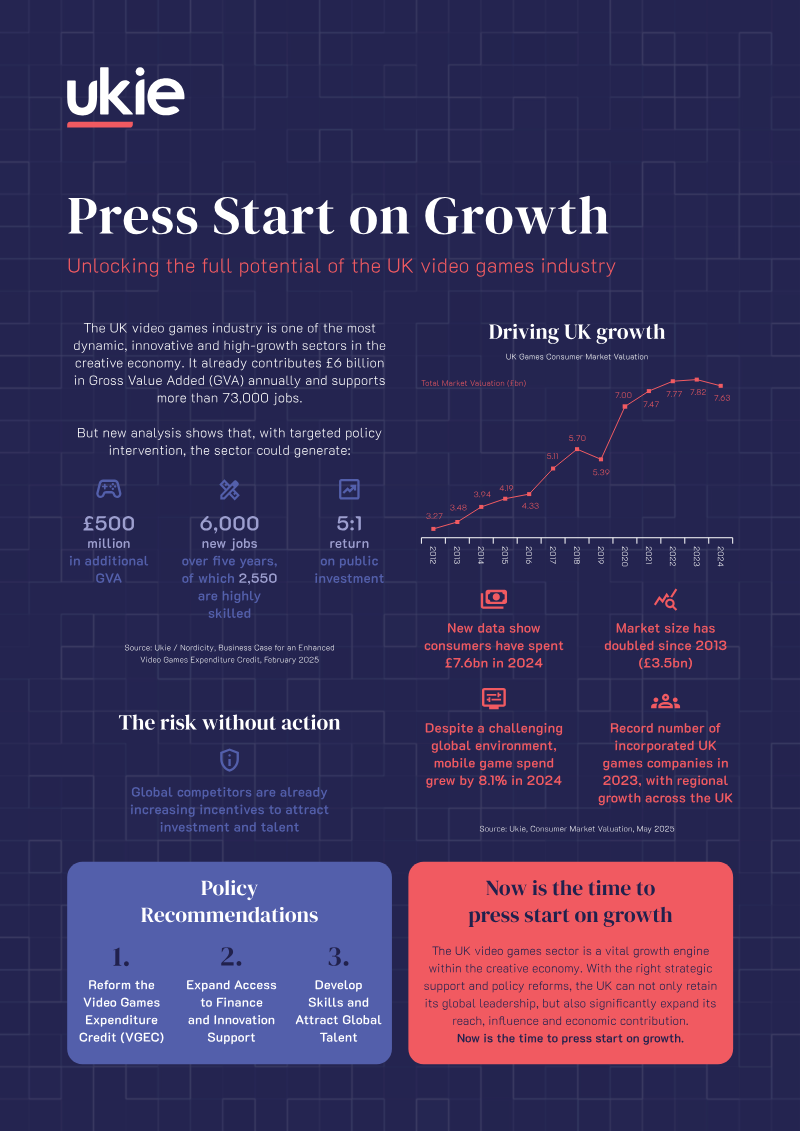
The analysis argues that the United Kingdom’s video‑games sector is a high‑growth pillar of the creative economy, already delivering roughly £6 billion in gross value added (GVA) and supporting more than 73 000 jobs, and that strategic policy action could lift its contribution to about £7.6 billion in 2024 and generate an additional £5.7 billion GVA and up to 5.4 million jobs over the next five years. The assessment covers the full UK market from 2022 through 2024, spanning software, hardware, live events, esports, ancillary merchandise and related media, and benchmarks performance against Western‑European averages. Key findings show a continued erosion of physical boxed software, which fell 34 % year‑on‑year and now accounts for only 4 % of total spend, while mobile games grew 8 %—still below the 13 % regional average. Full‑game digital purchases slipped due to a thin slate of blockbuster releases, yet overall game volume remained stable. Live‑event spending contracted 15 % after pandemic‑related cancellations, whereas esports surged 44 % YoY, driven by a rise in UK‑based tournaments. Subscription revenue rose modestly as price hikes offset a near‑saturation of console subscriber bases. Hardware sales weakened for PS5 disc and Xbox consoles and for the Nintendo Switch, while the PS5 digital edition posted record software sales at a lower price point. Game‑culture engagement declined 13 % across PC and console categories, and related toy and merchandise sales fell 8.5 %. The conclusions stress that without targeted reforms—particularly in financing, skills development, and talent support—the sector risks losing its global leadership. Conversely, coordinated policy could unlock further growth, broaden international reach, and reinforce the UK’s position as a leading hub for video‑games innovation and cultural influence. Data are drawn from industry sources such as Omdia, Ukie, NielsenIQ/GfK Entertainment, BFI, Comscore and the Official Charts Company, reflecting a comprehensive market‑valuation approach across multiple
The European video‑game sector seeks recognition as a distinct blend of technology and creative culture and urges policymakers to embed this identity in the EU’s 2024‑2029 strategic framework. By positioning games as a driver of digital innovation, cultural expression, and economic growth, the manifesto argues that tailored legislation, financing, and data‑collection mechanisms are essential to sustain the industry’s momentum and competitiveness. Between 2019 and 2024 the sector expanded by 16 %, reaching €24 billion in revenue and employing roughly 110 000 highly‑skilled workers across the Union. More than half of Europeans (53 %) now play games, with women accounting for 46.7 % of the audience and the average gamer aged 32. Research indicates that girls who game are three times more likely to pursue STEM studies, underscoring the medium’s educational impact. The self‑regulatory PEGI system, which has labelled over 40 000 titles in 40 countries, has cut non‑compliant sales by up to 50 %, demonstrating effective consumer protection without heavy legislative burden. Current EU financing tools—tax credits and grants—are deemed insufficient to match the incentives offered by hubs such as Canada, the United Kingdom and France. The manifesto calls for a dedicated funding framework that channels public resources toward innovative, creative projects, alongside flexible talent‑attraction visas and Horizon‑funded labour‑market mapping to close digital‑skills gaps. It also highlights the strain of 850 new obligations introduced between 2017 and 2022, amounting to more than 5 000 pages of regulation, which increase compliance costs for developers and publishers. To solidify the sector’s contribution, a unified intellectual‑property regime and a revision of NACE classification codes are proposed, enabling accurate economic measurement. Mandatory PEGI‑based age controls, parental‑lock tools and proactive chat moderation address the 53 % of Europeans prioritising child‑friendly environments. Finally, the industry’s low‑carbon digital products and initiatives such as “Playing for the Planet” and “Green Game Jam” are presented as foundations for a climate‑responsible future, aligning gaming with
The European video games industry represents a high-growth strategic sector that generated €26.8 billion in revenue in 2024, with digital channels accounting for 90% of all sales. This robust economic activity supports over 116,000 skilled professionals across 6,000 studios and serves a diverse player base comprising 54% of the European population. Mobile gaming remains the dominant platform, utilized by 71% of the region's 127 million players. To manage this vast ecosystem, the industry relies on the PEGI age-rating system across 40 countries, ensuring a standardized approach to consumer protection and responsible gameplay. Central to the industry’s operational integrity is a rigorous regulatory framework focused on monetization transparency and online safety. Updated standards mandate the disclosure of loot box probabilities and strictly prohibit the exchange of virtual items for real-world currency. Safety protocols are reinforced by comprehensive parental controls, currently adopted by 67% of parents, alongside mandatory age-verification tools and reporting mechanisms for harmful content. Compliance is maintained through a tiered enforcement system, where severe violations of age-rating or safety standards can result in financial penalties of up to €500,000. Beyond economic and regulatory concerns, the sector is increasingly defined by its commitment to social and environmental responsibility. Major regional initiatives across Spain, the United Kingdom, and Germany are driving diversity and inclusion through measurable policy changes and scholarships aimed at increasing female participation. Simultaneously, the industry is pursuing aggressive decarbonization through the Playing for the Planet Alliance and voluntary agreements that have already yielded significant energy savings in hardware manufacturing. These efforts are complemented by the integration of environmental themes into gameplay and the development of carbon calculators to assist studios in achieving long-term sustainability goals.