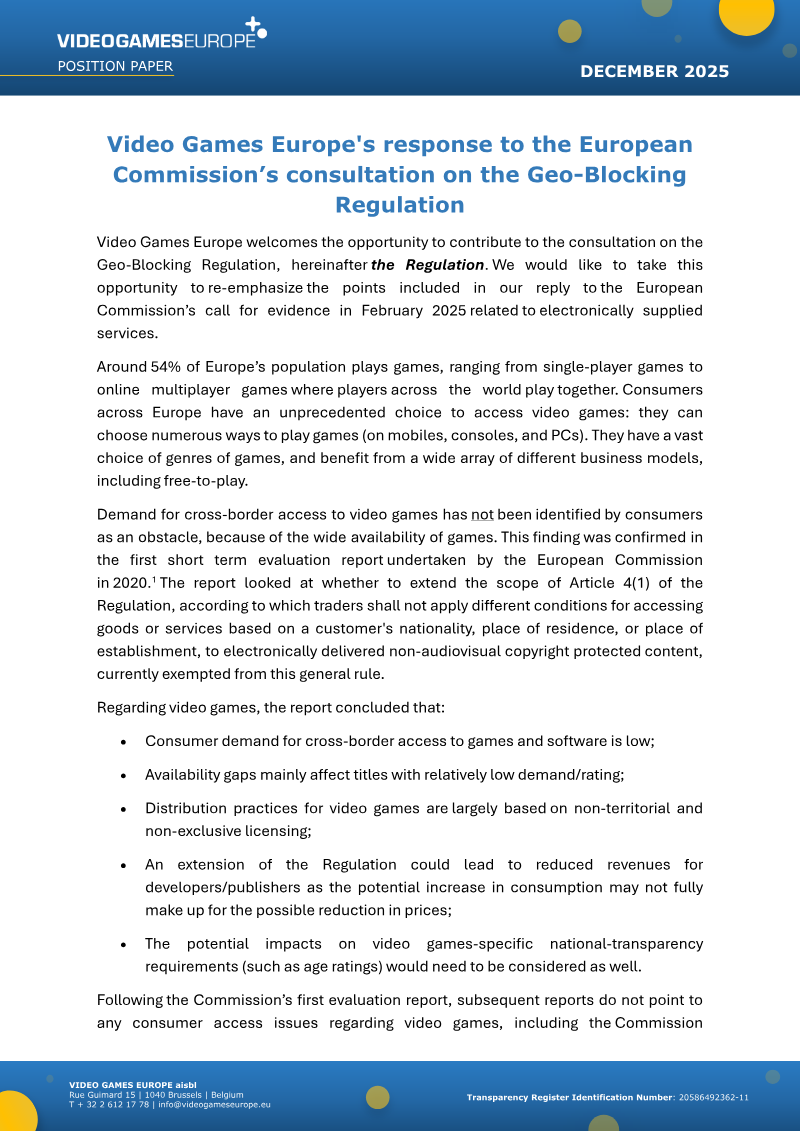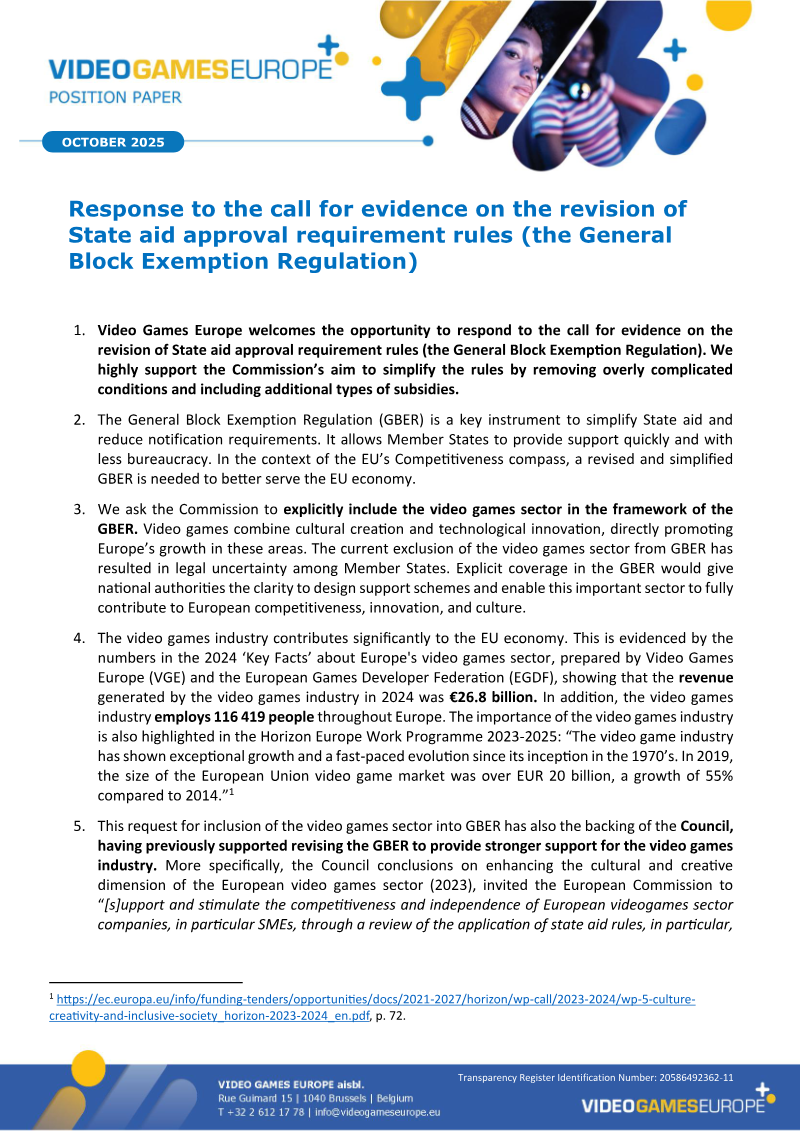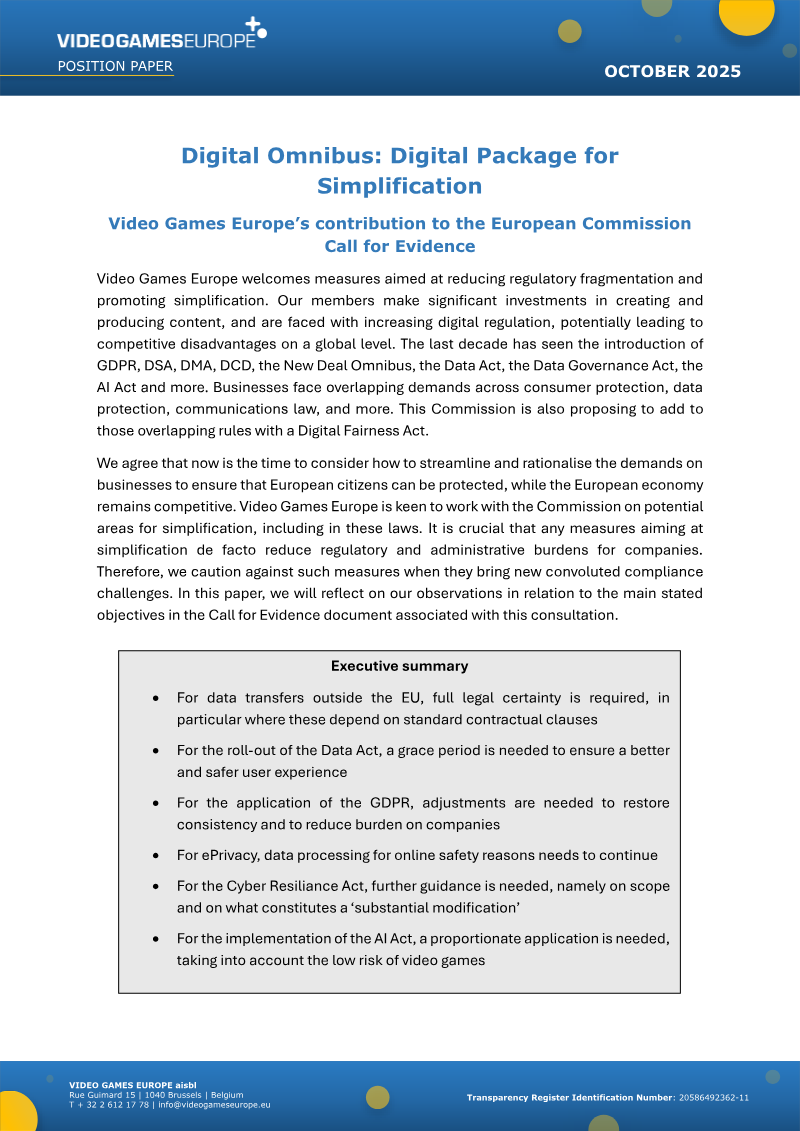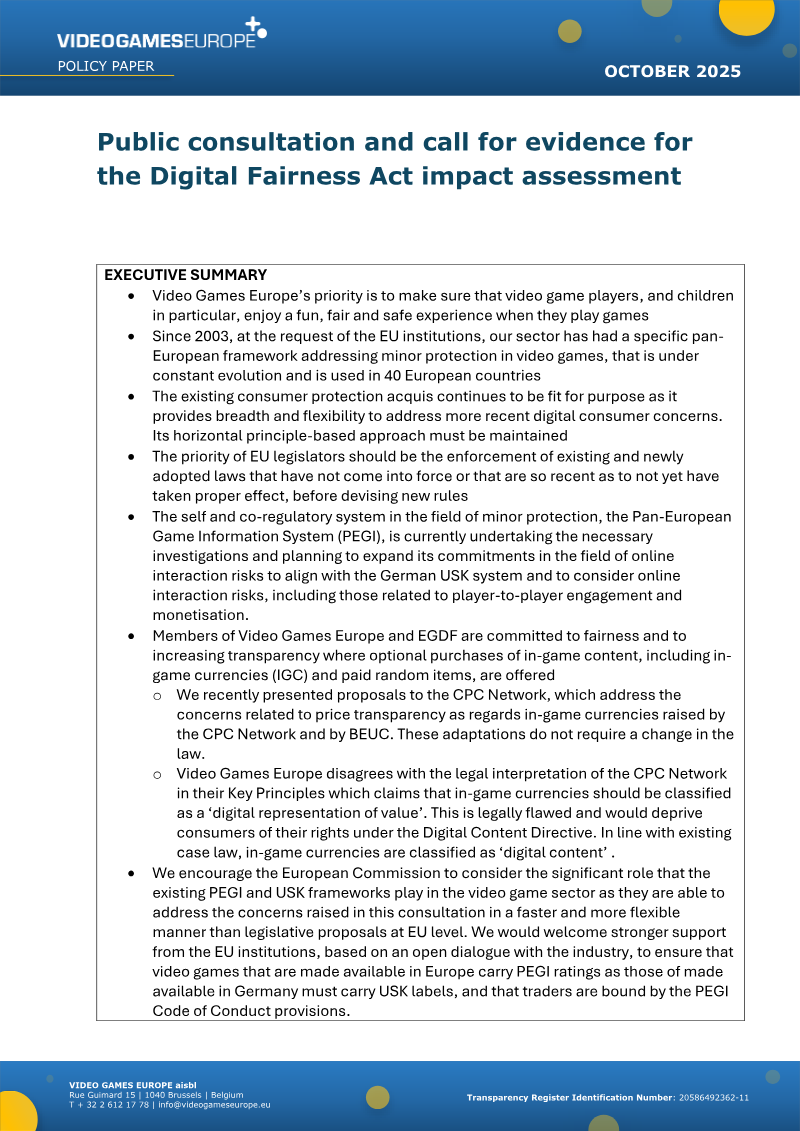
Updated Mar 17, 2026 by Video Games Europe
Report · March 1, 2024
Published by Video Games Europe
The manifesto articulates a strategic vision for positioning Europe as a leading global hub for video‑game development, emphasizing the sector’s unique blend of technology and creativity. It calls for coordinated EU‑wide actions to strengthen the talent pipeline, ensure transparent content acquisition, and protect the distinctive nature of games while integrating them responsibly into broader cultural and educational contexts. Central to the argument is the need to maintain an open, competitive market; any imposed taxes, fees, or distribution constraints are portrayed as threats to investment, innovation, and the integrity of the single European market. Key proposals include adapting the Creative Europe programme and extending the General Exemption Regulation to accommodate the specific requirements of video games, thereby aligning funding mechanisms with industry realities. The manifesto underscores the value of the PEGI rating system and co‑regulation, urging continued support for self‑regulatory frameworks that address consumer and business concerns swiftly. It advocates for comprehensive intellectual‑property safeguards, revised NACE codes to capture the sector’s economic contribution, and targeted funding through Horizon initiatives for mapping and skill‑gap analysis. The scope spans the entire European Union and its member states, covering policy, education, and market regulation for the video‑game industry over the 2024‑2029 horizon. While no quantitative survey data are presented, the text references a network of national associations and industry bodies, indicating broad stakeholder consultation. The overarching aim is to foster diversity, equality, inclusion, climate responsibility, and child‑protection within a thriving European gaming ecosystem.

Le nostre richieste all’UE Rendere l’Europa 05 della forza lavoro nel settore dei il miglior luogo per videogiochi, della disponibilità di corsi di formazione adeguati e dei gap di creare e investire Adottare le nostre proposte per assicurare competenze che ancora esistono, per acquisti trasparenti e corretti di contenuti aiutare il settore a crescere e ad avere in videogiochi all’interno dei videogiochi, offrendo successo. chiarezza e certezza ai videogiocatori, ai Supportare consumatori e ai genitori. Lavorare con noi 01 su programmi di formazione ambiziosi per l’innovazione accompagnare i genitori in un percorso Proteggere i videogiochi nella loro unicità di combinazione tra tecnologia e creatività. Non rendere l’Europa un’anomalia a livello globale cercando di includere i videogiochi in settori diversi a cui non appartengono. Mantenere un mercato aperto e competitivo: qualsiasi forma di imposizione, tassa o compenso per la distribuzione dei videogiochi disincentiverebbe l’investimento, rallenterebbe l’innovazione e distorcerebbe il mercato unico europeo. Adattare il programma Europa Creativa ed estendere il Regolamento Generale di esenzione per categoria ai videogiochi. Renderli entrambi adatti al settore dei videogiochi e alle sue esigenze uniche. Continuare la storia dell’auto e della coregolamentazione
e distorcerebbe il mercato unico europeo. Adattare il programma Europa Creativa ed estendere il Regolamento Generale di esenzione per categoria ai videogiochi. Renderli entrambi adatti al settore dei videogiochi e alle sue esigenze uniche. Continuare la storia dell’auto e della coregolamentazione Riconoscere il valore del sistema PEGI, dell’auto e della co-regolamentazione per rispondere alle preoccupazioni dei consumatori e delle imprese in modo veloce ed efficiente, e sempre in linea con la costante evoluzione del contesto digitale. L’autoregolamentazione e la co-regolamentazione sono complementi importanti alle normative esistenti. di consapevolezza e uso dei sistemi di – Anche la controllo parentale per gestire al meglio l’esperienza di gioco. proprietà intellettuale Fornire alle imprese del settore può essere resa l’opportunità equa di valutare come adeguarsi alla quantità senza precedenti divertente di nuove normative. Verificare che queste normative siano adatte allo scopo e non producano conseguenze non volute. I 10 decisori pubblici europei dovrebbero inoltre monitorare ed evitare qualsiasi Predisporre un quadro di riferimento frammentazione all’interno del mercato per l’enforcement della normativa sulla unico europeo.
e che queste normative siano adatte allo scopo e non producano conseguenze non volute. I 10 decisori pubblici europei dovrebbero inoltre monitorare ed evitare qualsiasi Predisporre un quadro di riferimento frammentazione all’interno del mercato per l’enforcement della normativa sulla unico europeo. proprietà intellettuale per supportare Creare, attrarre l’innovazione. e investire in 11 competenze e Adattare i codici NACE per dare all’Unione Europea gli strumenti per avere una talento fotografia completa del valore economico della nostra industria che fa un uso 07 intensivo della proprietà intellettuale. Investire nella formazione sia a livello 12 di UE che di Stati Membri per colmare Proteggere l’acquis dell’UEattraverso il gap di competenze digitali. Costruire il coordinamento attento delle attività network di eccellenza, promuovere di standardizzazione ICT nei contesti l’apprendimento life-long, incoraggiare le internazionali preposti. ragazze a intraprendere programmi STEM e aggiornare gli insegnanti. Adottare strategie sia a livello di UE che di Stati Membri per attrarre e mantenere Download i migliori talenti nell’ottica della diversità e del mercato globale. Utilizzare i programmi di finanziamento Horizon per un progetto di mappatura
re Le nostre azioni Protezione dei Il nostro diritti dei minori impegno per il clima Download Diversità, eguaglianza e inclusione
Imprese Associazioni nazionali DgLny SOA SERBIAN GAMES ASSOCIATION swiss interactive entertainment association VB VIDEO GAMES videogameseurope.eu [email protected] Rue Guimard 15, 1040 Brussels @videogames_EU Video Games Europe EU transparency Register ID: 20586492362-11 Cover illustration: BlackCoffee Design
The European video‑game sector seeks recognition as a distinct blend of technology and creative culture and urges policymakers to embed this identity in the EU’s 2024‑2029 strategic framework. By positioning games as a driver of digital innovation, cultural expression, and economic growth, the manifesto argues that tailored legislation, financing, and data‑collection mechanisms are essential to sustain the industry’s momentum and competitiveness. Between 2019 and 2024 the sector expanded by 16 %, reaching €24 billion in revenue and employing roughly 110 000 highly‑skilled workers across the Union. More than half of Europeans (53 %) now play games, with women accounting for 46.7 % of the audience and the average gamer aged 32. Research indicates that girls who game are three times more likely to pursue STEM studies, underscoring the medium’s educational impact. The self‑regulatory PEGI system, which has labelled over 40 000 titles in 40 countries, has cut non‑compliant sales by up to 50 %, demonstrating effective consumer protection without heavy legislative burden. Current EU financing tools—tax credits and grants—are deemed insufficient to match the incentives offered by hubs such as Canada, the United Kingdom and France. The manifesto calls for a dedicated funding framework that channels public resources toward innovative, creative projects, alongside flexible talent‑attraction visas and Horizon‑funded labour‑market mapping to close digital‑skills gaps. It also highlights the strain of 850 new obligations introduced between 2017 and 2022, amounting to more than 5 000 pages of regulation, which increase compliance costs for developers and publishers. To solidify the sector’s contribution, a unified intellectual‑property regime and a revision of NACE classification codes are proposed, enabling accurate economic measurement. Mandatory PEGI‑based age controls, parental‑lock tools and proactive chat moderation address the 53 % of Europeans prioritising child‑friendly environments. Finally, the industry’s low‑carbon digital products and initiatives such as “Playing for the Planet” and “Green Game Jam” are presented as foundations for a climate‑responsible future, aligning gaming with
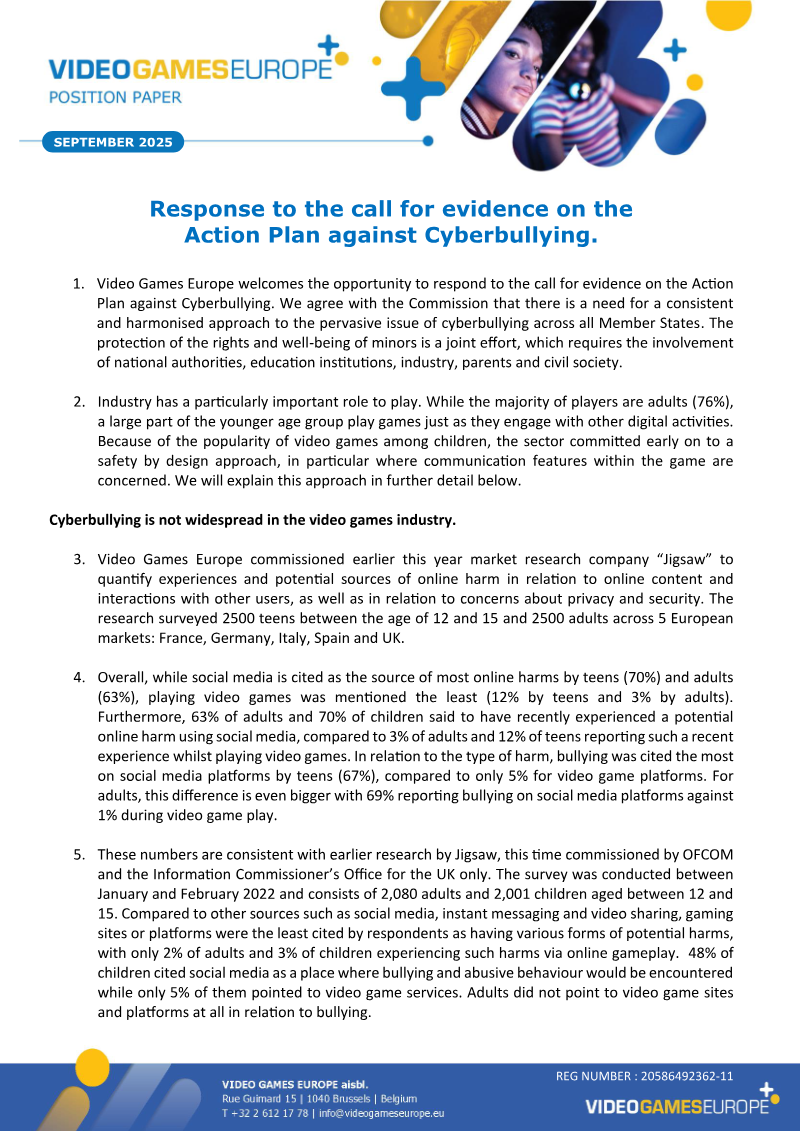
Europe’s video‑game sector has expanded by 16 % between 2019 and 2024, now delivering €24 billion in revenue and employing roughly 110 000 highly‑skilled workers. More than half of the continent’s gamers are under 20 years old, and nearly half of parents rely on the PEGI age‑rating system to ensure safe play. The industry’s dual nature—combining advanced technology with creative content—underpins a call for EU‑level measures that preserve an open, tax‑free single market, extend the Creative Europe programme, apply the General Exemption Regulation to games, and reinforce intellectual‑property protection while investing in digital‑skill education, particularly STEM pathways for girls. The PEGI framework, supported by co‑regulation, has already classified around 40 000 titles across 40 European countries, halving non‑compliance penalties and cutting energy‑consumption violations by roughly 20 %. Nevertheless, the sector faces a regulatory load of 850 new EU obligations (over 5 000 pages of rules) introduced between 2017 and 2022. A shift toward transparent self‑regulation is advocated, emphasizing clearer in‑game purchase disclosures, stronger parental‑control tools, and EU‑wide educational programmes to close digital‑skills gaps and attract diverse talent. Safety‑by‑design requirements now obligate all publishers to integrate PEGI‑based age classification, parental‑control portals, chat moderation, purchase limits and time‑spending caps, reflecting the predominance of minors among players. The climate‑and‑inclusion agenda shows progress: women represent 23.7 % of the video‑game workforce, surpassing the 17 % share in the broader ICT sector, and industry members are adopting gender‑equality guidelines and green initiatives such as the Green Game Jam. Coordinated self‑regulation, targeted public funding, and unified online‑safety strategies are presented as essential to sustain economic contribution, foster innovation, and position Europe as the leading hub for socially responsible game development.
The European video games industry represents a high-growth strategic sector that generated €26.8 billion in revenue in 2024, with digital channels accounting for 90% of all sales. This robust economic activity supports over 116,000 skilled professionals across 6,000 studios and serves a diverse player base comprising 54% of the European population. Mobile gaming remains the dominant platform, utilized by 71% of the region's 127 million players. To manage this vast ecosystem, the industry relies on the PEGI age-rating system across 40 countries, ensuring a standardized approach to consumer protection and responsible gameplay. Central to the industry’s operational integrity is a rigorous regulatory framework focused on monetization transparency and online safety. Updated standards mandate the disclosure of loot box probabilities and strictly prohibit the exchange of virtual items for real-world currency. Safety protocols are reinforced by comprehensive parental controls, currently adopted by 67% of parents, alongside mandatory age-verification tools and reporting mechanisms for harmful content. Compliance is maintained through a tiered enforcement system, where severe violations of age-rating or safety standards can result in financial penalties of up to €500,000. Beyond economic and regulatory concerns, the sector is increasingly defined by its commitment to social and environmental responsibility. Major regional initiatives across Spain, the United Kingdom, and Germany are driving diversity and inclusion through measurable policy changes and scholarships aimed at increasing female participation. Simultaneously, the industry is pursuing aggressive decarbonization through the Playing for the Planet Alliance and voluntary agreements that have already yielded significant energy savings in hardware manufacturing. These efforts are complemented by the integration of environmental themes into gameplay and the development of carbon calculators to assist studios in achieving long-term sustainability goals.
The European video games industry is a significant cultural and economic driver, characterized by steady growth and a commitment to responsible gameplay. In 2023, the European market reached €25.7 billion in revenue, a 5% year-on-year increase. The sector employs approximately 115,000 people across Europe, with 90,000 based in the EU. This growth is supported by a diverse player base; 53% of the European population aged 6-64 plays video games, with an average player age of 31.4 years. Notably, 75% of players are adults, and women make up 43.5% of the total gaming population. The industry emphasizes a robust framework for minor protection and consumer transparency through the Pan European Game Information (PEGI) system. Celebrating its 20th anniversary, PEGI has issued nearly 40,000 age rating licenses across 40 countries. Awareness of these labels is high, with 79% of parents whose children play games recognizing the system. Furthermore, the industry actively promotes diversity and inclusion through various regional initiatives and addresses environmental sustainability via the Games Consoles Voluntary Agreement and the Playing for the Planet Alliance. To maintain global competitiveness, the industry advocates for a strategic EU policy framework. Key priorities include recognizing video games as unique creative works distinct from the audiovisual sector, addressing the digital skills gap through education and STEAM programs, and maintaining a fair regulatory environment that supports small and medium-sized enterprises. The data for these findings is derived from GameTrack and Games Sales Data (GSD) surveys conducted by Ipsos, involving a sample of 60,000 individuals across major European markets to ensure national representation.