Time
Company
Documents about Time

How Futureplay Leverage GameRefinery to Make the Right Games at the Right Time
Futureplay utilizes data-driven market intelligence to align game development with current industry trends, ensuring their titles achieve product-market fit.
- Futureplay utilizes a four-step market research framework—mapping, segmenting, positioning, and competitor analysis—to reduce the role of luck in game development and ensure product-market fit.
- The company successfully transitioned from idle games like 'Idle Farming Empire' (2015) to IAP-based titles like 'Battlelands Royale' by using data-driven insights to identify new growth opportunities.
- Market mapping involves filtering out segments that fall short of revenue goals or do not align with a studio's specific domain expertise and development capabilities.

It’s Time to Retire the LTV Metric
The traditional Lifetime Value (LTV) metric is increasingly obsolete for modern mobile marketing, as it fails to account for the complexities of the current mobile ecosystem.
- The LTV (Lifetime Value) metric is an anachronism in the modern mobile economy because long-term projections are fragile, unreliable, and difficult to validate against frequently updated products.
- Mobile marketers should shift their focus from abstract, long-term LTV calculations to managing cash flow and optimizing for specific payback windows.
- Advertisers are better served by buying traffic against early-stage ROAS benchmarks and iteratively adjusting bids as more data is accumulated to prove later-stage performance.

EU Court Ruling to Alleviate Crunch Problem in Game Industry
A 2019 European Court of Justice (ECJ) ruling mandates that employers within the European Union implement objective, reliable, and accessible systems to track the daily working hours of their staff.
- The European Court of Justice (ECJ) ruled that all EU employers must implement an objective, reliable, and accessible system to track the daily working hours of every employee.
- This ruling is designed to enforce the EU Working Time Directive, which mandates a maximum 48-hour work week and a minimum of 11 consecutive hours of rest per 24-hour period.
- The regulation is expected to come into force on January 1, 2020, requiring game companies to formalize time-tracking to avoid legal liability for excessive crunch.
Tencent's PUBG Mobile Grossed More than Fortnite for the First Time in January
In January 2019, Tencent’s PUBG Mobile achieved a significant milestone by surpassing Epic Games’ Fortnite in global mobile revenue for the first time.
- In January 2019, PUBG Mobile grossed $45.2 million worldwide across the App Store and Google Play, surpassing Fortnite's mobile revenue of $37.9 million for the first time.
- PUBG Mobile experienced a 24% month-over-month revenue increase in January, marking its most successful month to date.
- Fortnite mobile revenue experienced a significant downturn in January, recording a 45% month-over-month decline.

Real Time Rendering for Feature Film: Rogue One
The integration of real-time rendering into the production of Rogue One: A Star Wars Story represents a pivotal shift in visual effects workflows, proving that high-fidelity game engine technology can meet the rigorous aesthetic standards of feature film production.
- The Advanced Development Group successfully integrated Unreal Engine into the production of 'Rogue One' to render the character K-2SO, proving game engine technology can meet high-end feature film aesthetic standards.
- The workflow utilized open standards like Alembic and Material X to import complex ILM assets into a real-time environment without requiring custom rebuilding.
- By employing custom solutions for geometry caching and temporal super-sampling, the team achieved film-quality beauty renders at 9K resolution.

Global Mobile Market Report 2019
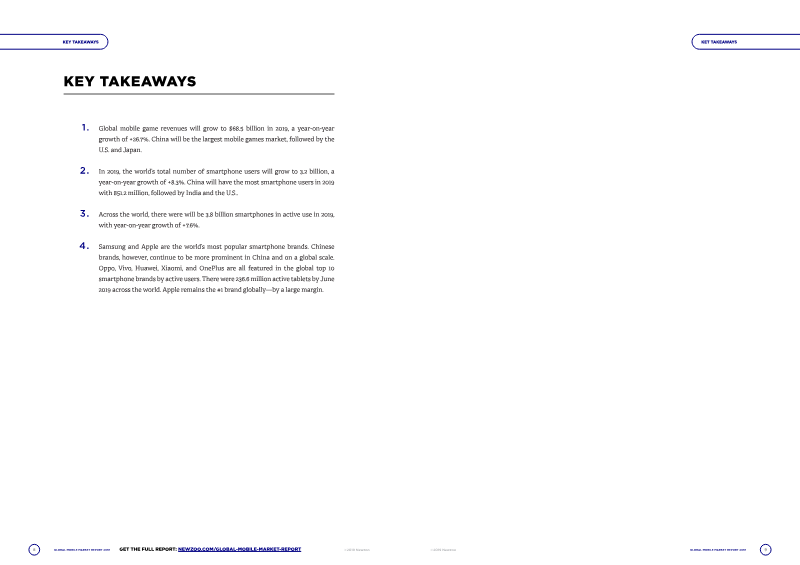
The mobile gaming industry reached a significant inflection point in 2019, characterized by the emergence of 5G technology and its potential to redefine hardware performance and user engagement.
- Global mobile game revenue reached $68.5 billion in 2019, marking a 26.7% year-on-year increase.
- The industry is supported by a global base of 3.2 billion smartphone users, with China serving as the primary market hub with 851.2 million active users.
- Hardware market leadership remains concentrated, with Samsung holding a 25.4% share of the global smartphone market and Apple commanding 67.6% of the tablet sector.
PUBG Mobile Revenue Grew 166% Last Week, Surpassing Fortnite for the First Time on iOS
PUBG Mobile experienced a significant surge in financial performance during the week of November 19, 2018, marking a pivotal shift in the competitive landscape of the mobile battle royale genre.
- During the week of November 19, 2018, PUBG Mobile worldwide player spending grew 166% to $12 million, marking its first time surpassing Fortnite in revenue since monetization began in April.
- PUBG Mobile's $12 million weekly revenue outperformed Fortnite's iOS earnings by 43% during the same period.
- On the iOS platform specifically, PUBG Mobile generated an average of $1.7 million per day compared to $1.2 million for Fortnite.

How to make your game 2X as fun! - (In No Time.)
Enhancing the player experience in game development does not require massive overhauls; rather, it relies on optimizing micro-decisions and refining visual feedback.
- Enhance gameplay depth by introducing meaningful trade-offs to frequent player actions, such as applying movement penalties to specific weapon types to force strategic combat decisions.
- Increase player engagement by integrating secondary objectives, like item collection, which force players to prioritize actions and accept tangible consequences for their choices.
- Improve the perceived polish of a prototype by implementing professional color palettes and utilizing directional, reactive particle effects.

It’s Time to Re-think A/B Testing
The transition from frequentist null hypothesis significance testing (NHST) to Bayesian statistics offers a more effective framework for A/B testing in free-to-play (F2P) mobile gaming.
- Pixel Federation transitioned from frequentist Null Hypothesis Significance Testing (NHST) to Bayesian A/B testing to improve the interpretability and business utility of their game feature experiments.
- Frequentist p-values are often misunderstood by non-technical stakeholders and offer no actionable conclusion when results are statistically insignificant, leading to wasted testing resources.
- Bayesian testing provides more intuitive metrics, such as the probability that version B is better than A and the expected loss, allowing for informed decision-making even when data is limited.

Mastering Crunch Time! - (for Game Developers.)
Sustainable game development during high-pressure crunch periods requires a strategic approach that prioritizes cognitive focus and physical well-being over destructive, long-hour work habits.
- Productivity during crunch is driven by physiological management—specifically maintaining steady blood sugar through fiber-rich nutrition, hydration, and oxygenation—rather than increasing total work hours.
- High-concentration tasks like coding and game design should be scheduled in two-to-three-hour blocks, followed by mandatory 30-to-60-minute breaks to prevent energy crashes.
- Breaks must involve physical movement, such as walking or exercise, to effectively clear the mind and restore cognitive focus for subsequent work intervals.
Bread and Games: Playing Is, and Has Always Been, a Political Act
The intersection of entertainment, politics, and corporate strategy serves as a primary focus for analyzing the modern media landscape.
- Gaming is increasingly treated as a mainstream media category rather than a siloed vertical, evidenced by YouTube folding its dedicated gaming app back into its main platform to leverage 200 million daily unique visitors.
- European gambling authorities are moving toward stricter regulations for younger audiences due to the blurring lines between interactive gaming and gambling, specifically regarding loot boxes and skin betting.
- AT&T is pivoting its post-merger WarnerMedia strategy toward aggressive, data-driven content spending to compete directly with Netflix.

How to Build a Remote Team for Better Happiness
Building a high-performing remote organization requires a fundamental shift from monitoring employee hours to prioritizing measurable output and individual impact.
- Shift management focus from monitoring employee hours to prioritizing measurable output and individual impact to drive high performance.
- Implement a rigorous recruitment process that includes a mandatory two-day trial project to evaluate both technical proficiency and the self-discipline required for autonomous work.
- Adopt a 'default-public' communication strategy where all information is searchable and accessible to the entire organization to prevent information silos.