1 free read left. Create a free account for unlimited reading + AI research.
Create free accountHow to make your game 2X as fun! - (In No Time.)
Key insights
6 takeaways- 01Enhance gameplay depth by introducing meaningful trade-offs to frequent player actions, such as applying movement penalties to specific weapon types to force strategic combat decisions.
- 02Increase player engagement by integrating secondary objectives, like item collection, which force players to prioritize actions and accept tangible consequences for their choices.
- 03Focus development efforts on high-impact, low-effort refinements to micro-decisions and visual feedback rather than pursuing massive, time-consuming overhauls.
- 04Improve the perceived polish of a prototype by implementing professional color palettes and utilizing directional, reactive particle effects.
- 05Boost game pacing and reduce downtime by incrementally increasing game speed to find an optimal balance that maintains engagement.
- 06Add a sense of liveliness and impact to gameplay through the implementation of subtle camera movements and screen shake.
Ask AI about this video
Transcript
You can easily double the fun factor of your game with almost zero effort. There are a couple of tricks in game development that give you an insane amount of bang for your buck, both for your gameplay as well as for your visuals. I used to make games at this quality level all the time when I was younger, and I remember being pretty much stuck there. Back then, I wish I would have known what I'm about to tell you right now. Let's start simple. Let's start by analyzing the most frequent decisions the player has to take in your game. In this case, the most frequent decisions are where do you go, and do you use your primary or your secondary fire? Your job as a game developer is to make these micro decisions as interesting as possible. At the moment, let's face it, both of them are pretty boring. It doesn't really matter where you go, and it doesn't really matter which fire mode you use. You can either run in circles or camp in the same corner for the entire match. It makes almost no difference in terms of outcome. Whenever you see a group of enemies, you use your bombs. When you see single enemies, you use your laser. So, that's not really an interesting
decision, either. A micro decision needs two things in order to be interesting, in my opinion. First of all, there needs to be a best solution, a best option to take, because if everything works equally well, the decision really doesn't matter. That's currently the issue with the movement. Doesn't matter where you go, because everything works just fine. Secondly, it should be challenging to figure out what the best solution is. At the moment, it's pretty obvious which fire mode is better in each given situation. That turns the decision into something the player just does without even thinking about it. That's pretty boring. Here's what you can do about it. Add trade-offs and make options more unique. The trade-off I decided to use here is you are 50% slower whenever you use your laser, and you can't move at all while firing your bombs. That makes the fire modes more different from one another, more unique, which makes the decision more interesting. But what's even better, it adds a third option, and that is not firing at all. If you want to move at your maximum speed, you need to stop shooting. That also goes very well together with the next mechanic I
decided to add. There are now these gold objects scattered on the map that you need to collect in order to score points. There are always two of them, so you can decide where you want to go to. Bam! Your movement matters now, and your fire mode matters even more. Using the bomb fire mode means you're not getting any closer to the gold objects, and sometimes you even have to stop shooting altogether because you need the extra speed. You have to decide, do you go straight to the next goal, or do you clean house first? Which ring do you want to collect first, and what's the best path to get there? I think you can tell that this already made the game so much better, and I think you can also tell that this is absolutely possible for your own video game. Just identify the core decisions the player has to take in your game, and find ways to make those decisions more interesting without adding an insane amount of complexity to your game. Remember, there needs to be a {quote} best solution, but it shouldn't be obvious what the best solution is. That's how you make these micro decisions more interesting, and that's how you bring your game play to the next level. Next thing that gives you an insane amount of bang for your buck is
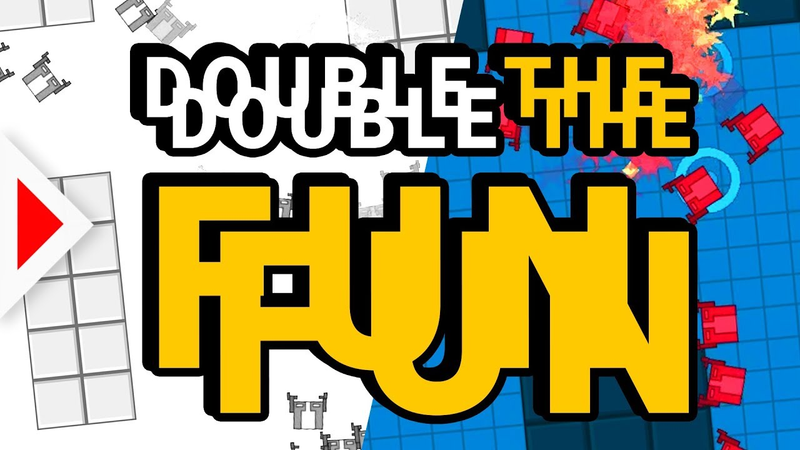
just picking decent colors. It's usually not a lot of work. You don't need to change anything about your sprites, you just need to change their colors. Coming up with a good color scheme yourself is quite challenging, so I recommend you just use one from the internet. Also, look, I'm not claiming this color scheme is already perfect by any stretch of the imagination. All I'm saying is this can give you a massive visual improvement in a very short amount of time. However, my games always used to look like this, and I see a lot of game jam games from you that look like this as well. There's no need for that. Just invest like 30 minutes into the colors, and you can have something that looks a lot more like a finished game, and a lot less like a prototype. Next thing you should absolutely do to increase the fun factor of your game is experimenting with the speed of your game. I often feel like games by unexperienced developers, including myself when I was younger by the way, are often way too slow. Pacing is obviously super important for games, so just run a couple of experiments, make your game 10% faster, 20% faster,
40% faster, and see if any of those still works. In this case, I got away with making the game 50% faster, that's what you see right here. Faster is not necessarily always better, but in most cases it means less downtime and more action. Next thing that can up your game with a minimal amount of effort is directional effects. Yes, I also changed the color of the effects, which makes them look a lot juicier, but what I'm really trying to show you here is that the effects are now rotated. They have a specific direction, they are no longer just circles like before, but they react to the direction the enemy was last shot at from. You don't need a combat-based game to do something like this. Whenever you have visual effects or particles like this in your game, make them react more to the player's actions and to the environment. They are a lot more interesting to look at if they're not exactly the same every single time. So, more dynamic and reactive effects can juice up your gameplay a lot, and in most cases they are not that hard to implement. At this point, I realized that I wasn't quite satisfied with the
colors. The color of these gold objects right here didn't quite fit in in my opinion. In case you ever have doubts like that as well, it's probably just a good idea to reduce the amount of colors even further, or at the very least that's the fastest way to fix issues with your color scheme. Next trick that gives you a massive amount of bang for your buck is camera movement. Here I just added a tiny amount of camera movement and some screen shake, of course, and it already makes the game feel a lot more dynamic and alive. After getting used to the new faster game speed, you sometimes realize that the game's still pretty slow and could be even faster. In that case, just speed it up again. As long as the additional speed doesn't change the core identity of your game, everything's fine. My name is Jonas and I document the entire journey to becoming a game developer. I share absolutely everything I learn on the way so you can become a better game developer as well. This is how you double the fun factor of your game within just a couple of hours. Wish I would have known all of that back then. In case you enjoyed this, you will
probably also enjoy these videos right here. Check them out and I'm going to see you in the next one.
Summary
Enhancing the player experience in game development does not require massive overhauls; rather, it relies on optimizing micro-decisions and refining visual feedback. The primary thesis is that developers can significantly increase a game's "fun factor" by focusing on high-impact, low-effort adjustments that improve gameplay depth and visual polish. By identifying the most frequent player actions and introducing meaningful trade-offs, developers can transform mundane tasks into engaging strategic choices.
A core finding is that micro-decisions become compelling only when they offer a clear optimal solution that is nonetheless challenging to identify. For instance, introducing movement penalties for specific weapon types forces players to weigh combat efficacy against mobility, thereby creating a more dynamic decision-making process. Integrating secondary objectives, such as collecting items, further forces players to prioritize their actions, ensuring that movement and combat choices have tangible consequences on the game outcome.
Beyond mechanics, visual and pacing adjustments provide substantial improvements with minimal development time. Implementing professional color palettes, increasing game speed to reduce downtime, and utilizing directional, reactive particle effects can elevate a prototype to a more polished state. Additionally, subtle camera movements and screen shake contribute to a sense of liveliness. The methodology emphasizes iterative experimentation—such as testing incremental speed increases—to find the optimal balance without compromising the game's core identity. Ultimately, these targeted refinements allow developers to maximize the impact of their work, ensuring that gameplay remains challenging, visually cohesive, and consistently engaging for the player.
















Comments