Digital Games
Company
Documents about Digital Games
Mafia and the Representation of Italians
This academic essay by Giulio Pitroso, published in the Transactions of the Digital Games Research Association (December 2019, Vol. 5 No 1, pp. 45-76), analyzes how video games represent Italians and the Italian Mafia.
- The author describes The Godfather (US Gold, 1991) as the archetypal model for Mafia games and lists five elements that characterize it as a prototype of the genre.
- The essay states that the Sicilian Mafia has always had a hegemonic role in representing the Italian Mafia, and that most Italian Mob games centre on American and Sicilian versions.
- The author notes that the Italian Mob games analysed are almost all set in American or fictional American cities, which the author links to an American perspective on Sicily.
Hardware Design and Representation of Graphics in Videogames: A Case Study, the Sega Saturn
Marco Liboà's article, published in the Transactions of the Digital Games Research Association (December 2019, Vol. 5 No. 1, pp.
- The Saturn's VDP2 could simulate a 3D space with 2D planes, using parallax scrolling and rotated backgrounds to stand in for the arcade's 3D elements.
- The surface of the Virtua Fighter Remix ring was rendered as a rotated bitmap on RBG0 instead of sprites, reducing the number of polygons drawn on the screen and freeing some VDP1 resources for more detailed characters.
- Texture mapping in Virtua Fighter Remix came at the cost of dynamic lighting, which the original port had included.
Can Digital Games Serve as Potential Intervention or Suicide Risk?
Digital games and mobile applications represent a promising, cost-effective frontier for mental health intervention, particularly for addressing the global crisis of suicide.
- Digital games offer a scalable, low-cost intervention for the 800,000 annual global suicide-related deaths, helping to bypass traditional barriers like high costs and social stigma.
- Cognitive training tasks, such as Attention Bias Modification (ABM), are effective in retraining focus away from negative stimuli to help manage depressive symptoms and emotional distress.
- User adherence remains a critical failure point for mental health applications, with engagement typically dropping significantly after the first month of use.
It’s About Fate, Among Other Things: Digital Games, Dialogical Teaching, and Ethics
This paper presents preliminary findings from a study of how teachers use digital games as tools for dialogical teaching of ethics.
- Digital games do not automatically produce ethical learning; their educational value depends on teachers talking students' gameplay experiences into meaning and linking them to curricular goals.
- The study uses two qualitative case studies observing seven teachers and their classes, plus semi-structured retrospective interviews, focusing on teachers as an underrepresented group in game-based learning research.
- The game The Walking Dead (Telltale Games, 2012) was used in classrooms: teachers paused at moral dilemmas and had students apply consequentialist, duty-based, and virtue-based ethical theories before discussing competing solutions.

Cultural Heritage and Environmental Communication Through Digital Games
The PAC-PAC research project at the University of Cagliari investigates whether digital games can promote and communicate cultural heritage, particularly lesser-known sites, and whether such experiences can stimulate tourism and knowledge of local traditions.
- The PAC-PAC project at the University of Cagliari tests whether digital games can promote lesser-known cultural heritage sites and stimulate tourism and interest in local traditions, premised on player-driven narratives creating emotional bonds with places.
- The project uses photographs, videos, and 360-degree views rather than conventional rendered graphics to strengthen players' connection to real environments, and it built a custom authoring tool for point-and-click adventures.
- Production follows a structured pipeline: site selection and game design documentation, location scouting with local authorities, onsite filming with a specialist crew, and post-production editing.
Play with Money: The Role of Digital Games in Promoting Financial Literacy
This paper explores the potential of mainstream digital games to enhance financial literacy, addressing the persistent low levels of financial understanding despite traditional educational interventions.
- Financial literacy remains weak among adults, and low literacy is linked to poor retirement preparation, high-interest debt, and overindebtedness, a problem the authors frame as more pressing amid economic instability and shifting social security systems.
- The authors propose digital games as an informal learning environment that could complement formal financial education programs, whose effectiveness they note has been contested.
- The study compiled a database of nearly 100,000 commercially released digital games (1963–2017, excluding mobile titles) and identified 1,295 'economic games' that simulate elements such as supply, demand, and scarcity.
Using Transformative Learning Theory to Frame and Observe Learning Processes in Digital Games
This extended abstract explores the applicability of Illeris' comprehensive learning theory, particularly its transformative learning aspects, as an analytical framework for observing and evaluating learning processes within digital computer games.
- The study proposes Illeris' Transformative Learning Theory as an analytical framework for observing learning during digital play, organised around three dimensions (content, incentive, interaction) and four internalization processes (cumulation, assimilation, accommodation, transformation) rooted in Piagetian mental schemes.
- The empirical base is blind playthroughs by five Twitch streamers and YouTube creators of World of Warcraft Classic and Undertale, two titles chosen so that the three learning dimensions differ substantially between them.
- Preliminary findings show assimilation occurs nearly constantly, often below conscious awareness, while accommodation appears intermittently, cumulation is rare (attributed to players' existing game expertise), and transformative change is difficult to identify.
Flow It, Show It, Play It: Hair in Digital Games
"Flow It, Show It, Play It: Hair in Digital Games" examines the multifaceted role of digital hair in video games, asserting that hair is not merely an aesthetic element but a potent carrier of social, cultural, and political meaning.
- Hair in video games is treated as a meaningful cultural text: the social, cultural, and political meanings hair carries in everyday life are reproduced in digital characters regardless of how realistic or stylized their rendering is.
- Hair functions as a semiotic marker in games, with examples such as Geralt's white hair signalling magical exceptionalism and hypermasculinity in The Witcher, and long hair serving as shorthand for femininity in Metroid and Bayonetta.
- A cited 2016 study of 571 games supports a correlation between female characters' sexuality and their capability, though the report's broader readings of hair are interpretive rather than quantitative.
Animal Ethics in Digital Games
Digital games reproduce and reinforce anthropocentric cultural hegemony, and this extended abstract argues that the treatment of animals deserves the same critical attention that game studies has given to gender and race.
- The authors argue that the depiction of animals in digital games is shaped by anthropocentric cultural hegemony, in which humans alone produce and control the artefacts that define non-human life, and that animal ethics remain largely unaddressed compared with violence, sexualisation, or racial representation in gaming.
- The paper frames animal ethics through three moral positions: denying animals any moral status, advocating humane treatment while still treating animals as subordinate resources, and recognising animals as sentient beings with intrinsic rights.
- Using qualitative content analysis, the authors classify Cabela's Big Game Hunter 2010, Assassin's Creed IV: Black Flag, and Far Cry 4 as reflecting the first position; Shadow of the Colossus and Red Dead Redemption as the second; and Crash Bandicoot, Neko Atsume: Kitty Collector, and The Last Guardian as the third.
Digital Games and Leisure Ecosystems
This document presents preliminary findings from an online survey investigating the relationship between digital games and leisure activities among adults in the United States.
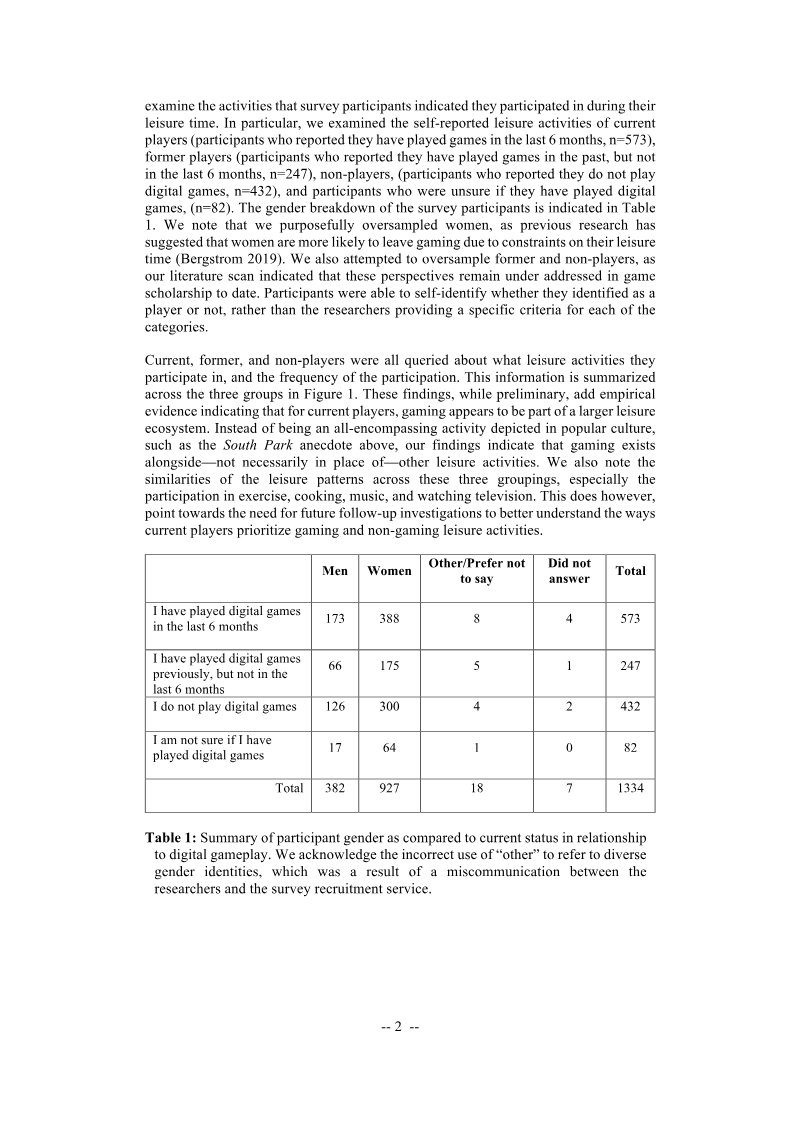
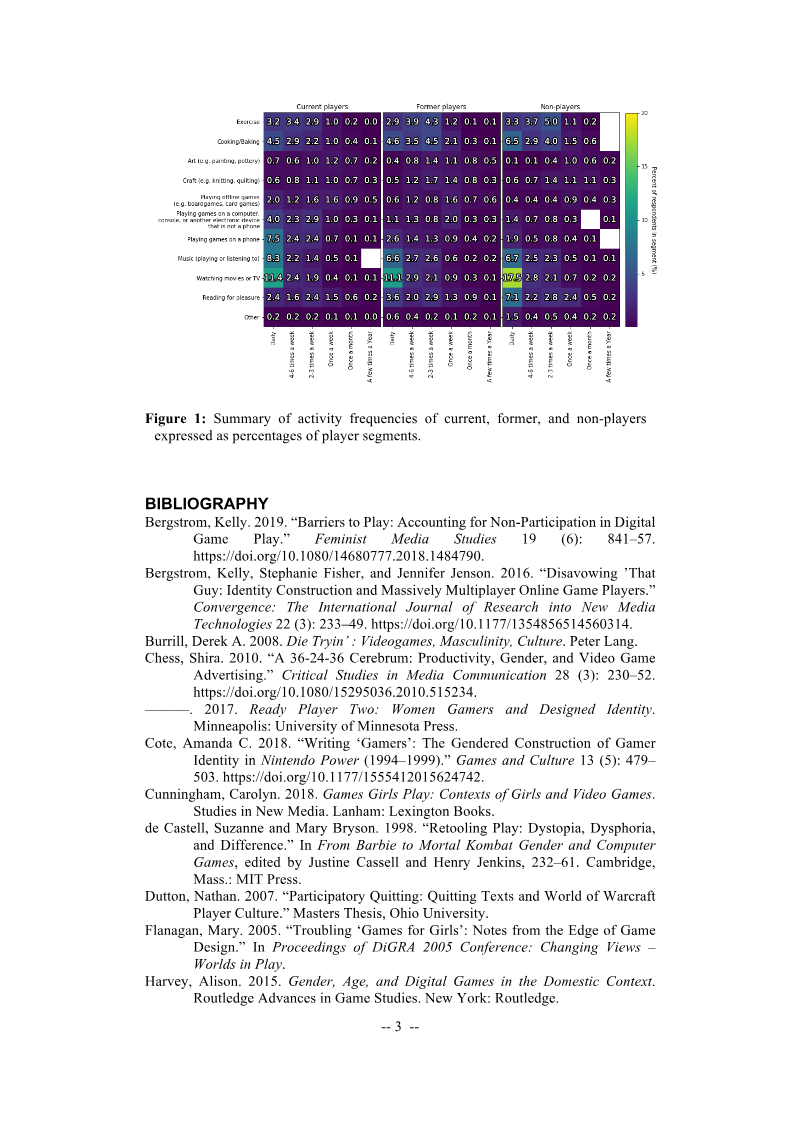
- A preliminary DiGRA 2020 study based on an October 2019 online survey of 1,334 U.S. adults found that current gamers' play is embedded within a broader leisure ecosystem rather than displacing other pursuits.
- Current, former, and non-players showed notable similarities in participation in activities such as exercise, cooking, music, and watching television, which the authors read as evidence against the stereotype of the all-consuming gamer.
- The study deliberately oversampled women and former and non-players, reflecting prior research linking women's exit from gaming to constraints on leisure time, and the sample included 927 women and 382 men.
Gender Asymmetries in the Digital Games Sector in Portugal
The document, "Gender Asymmetries in the Digital Games Sector in Portugal," investigates the significant gender disparities within Portugal's digital games industry, from education to character representation and player perception.
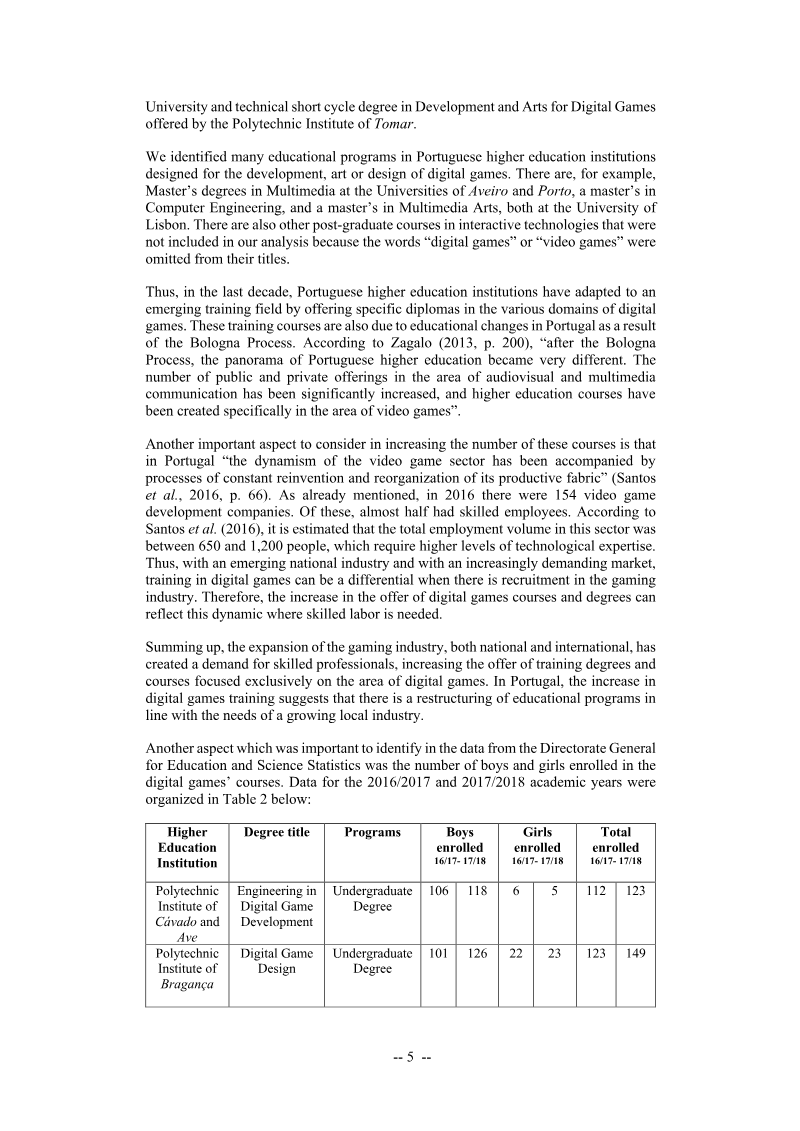
- Female enrollment in Portugal's tertiary digital games programs stayed flat at roughly 14 percent in both 2016/17 and 2017/18, even as the number of such degrees grew from one program in 2009 to ten by 2017/18.
- The authors frame women's underrepresentation in Portugal's digital games sector as a structural issue requiring systematic attention, not a temporary imbalance.
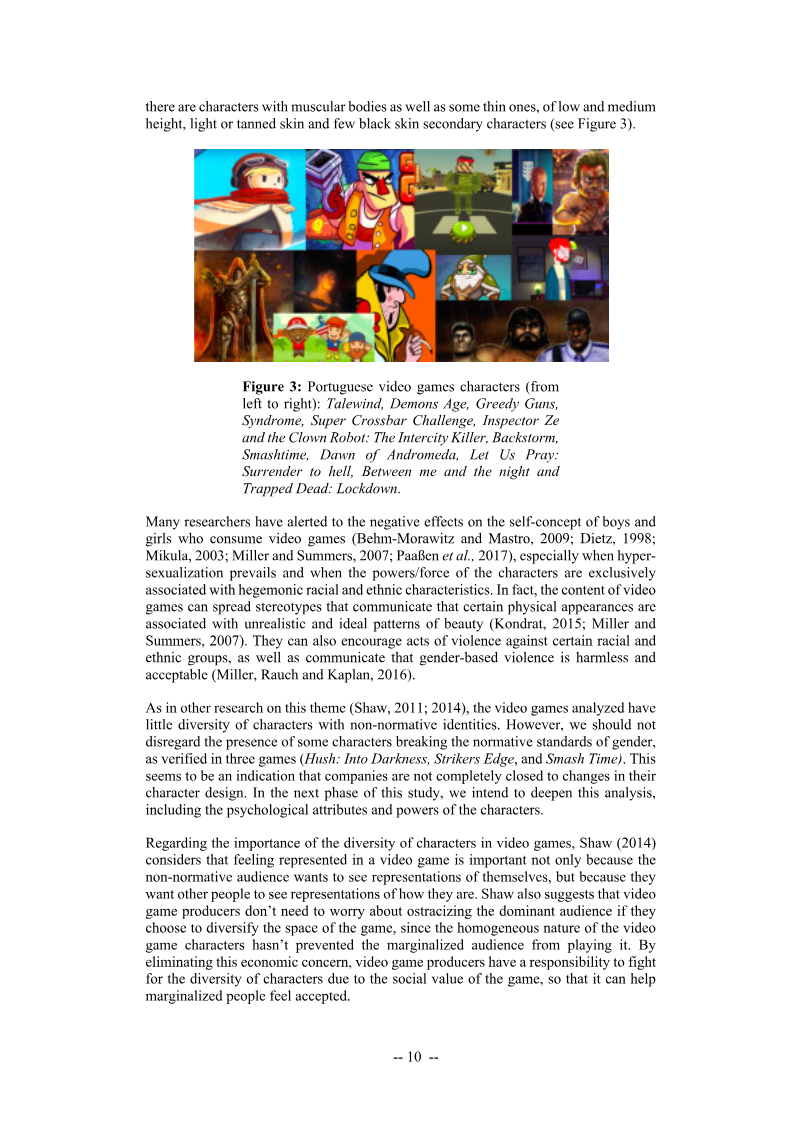
- A content analysis of seventeen Portuguese games released between 2014 and 2018 found that most lead characters are male and female characters are often hypersexualized, with a few notable exceptions.



2020 Year in Review: Digital Games and Interactive Media
The "2020 Year in Review: Digital Games and Interactive Media" report by SuperData, a Nielsen company, provides a comprehensive analysis of the global digital games and interactive media market for 2020, with projections for 2021.
- The global digital games and interactive media industry grew 12% year-over-year in 2020, reaching $126.6 billion in total revenue.
- Free-to-play titles dominated the market, accounting for 78% of total digital revenue, primarily driven by mobile gaming in Asian markets.
- Premium game sales experienced the fastest growth at 28%, bolstered by high-profile releases such as Animal Crossing: New Horizons and Call of Duty: Modern Warfare.