Loading the document
1 free read left. Create a free account for unlimited reading + AI research.
Create free accountWhitepaper DiGRA
1 free read left. Create a free account for unlimited reading + AI research.
Create free accountWhitepaperDiGRA
The console featured two distinct video processors, VDP1 and VDP2.
Key constraint. The Sega Saturn's dual-processor architecture forced developers to adopt non-linear programming methods to simulate 3D environments using 2D background layers.
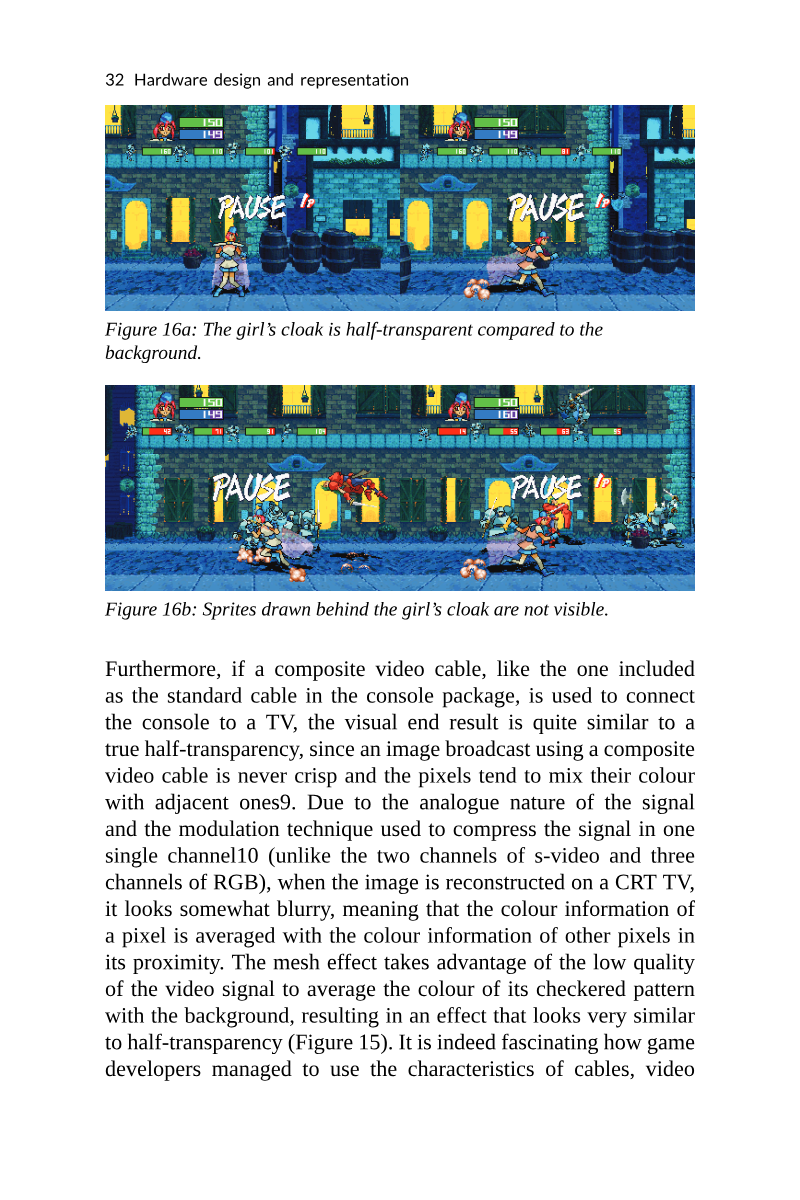
Marco Liboà's article, published in the Transactions of the Digital Games Research Association (December 2019, Vol. 5 No. 1, pp. 1-43), examines how the Sega Saturn's hardware design supports and constrains the representation of graphics in games. The Saturn is chosen for its complex circuitry and for a period in which game graphics shifted from 2D to 3D. The study draws on a platform archive of games, Sega development documentation, emulators, and an original Saturn connected to a CRT TV, and it focuses on the Virtua Fighter series. The author argues that 3D space can be simulated with 2D background layers. The Saturn's two video display processors, VDP1 for sprites and polygons and VDP2 for background layers, are described as shaping how games look. The article also covers half-transparency, where the checkered mesh effect is widely used on the Saturn. It reports that the mesh effect looked close to true half-transparency on composite video cable and CRT TV setups. The author concludes that graphical techniques did not always advance linearly across a series. Dynamic lighting from the original Virtua Fighter was absent in its remake, and texture mapping and dynamic lighting were used together only in the second half of the console's life-cycle.
Each row is a game or company this document names, each column a document, oldest first. A mark means that document names it. Select a row to see those documents.

DiGRA · 2026

DiGRA · 2026



DiGRA · 2026



DiGRA · 2026



DiGRA · 2026



DiGRA · 2026



DiGRA · 2026



DiGRA · 2026



DiGRA · 2026

DiGRA · 2026



DiGRA · 2026



DiGRA · 2026
German Research Centre for Artificial Intelligence · 2026