Digital Games
Company
Documents about Digital Games
Theorizing Digital Games: Play Theories & New Materialism
The document, an extended abstract by Soomin Hong, proposes a theoretical framework for analyzing digital games by integrating classic philosophical concepts from Bergson and Bachelard with new materialism.
- The paper proposes that digital games should be understood as "materialized play," in which the material qualities of games and their players are mutually constitutive rather than separate.
- The central argument combines Henri Bergson's view of matter as continuous (with discrete objects an artificial product of perception) and Gaston Bachelard's philosophy of science to frame game materiality theoretically.
- The core analogy is that a game's materiality functions like a scientific instrument, enabling players to select, filter, and shape the chaos around them, as Bachelard describes instruments as materialized theory.

The Impact of Social Digital Games in Online Communities on Older Adults' Digital Competences
This document outlines a research project investigating the impact of social digital games within online communities on older adults' digital competences.
- The study is an early-stage research proposal that examines whether social digital games embedded in online communities can strengthen older adults' digital competences, a gap the authors describe as largely unexplored across ageing studies, digital games, and online platforms.
- The work is organized into three phases: a systematic literature review plus a questionnaire on older adults' gaming habits (done in partnership with a local senior institution), participatory co-design producing personas and game concepts with a prototype in progress, and a planned implementation and testing phase.
- The prototype is being co-designed within the miOne senior online community in Portugal, and effects will be assessed through repeated measurement using the DigComp 2.2 digital competence framework, alongside fieldnotes and interviews.
Demonic Games: Demonic Figures and Functions in Contemporary Digital Games
The document explores the historical and theoretical presence of demonic figures and functions in digital games, aiming to develop an interpretive framework for understanding "ludic demons."
- Frans Mäyrä's paper argues that theory on monsters in games is well developed but the specific category of the demonic remains underexplored, and it builds on his earlier theory of demonic polyphony and the "Textual Self", which holds that demonic figures signal internal tensions in subjectivity and agency.
- The study traces gaming's demonic imagery to late 1970s dungeon-adventure games inspired by Dungeons & Dragons and to 1980s United States moral panics that linked role-playing games to occultism, noting that this demonological imagery persisted after those religious anxieties faded.
- In first-person shooters such as DOOM, demons serve as endless, transformable adversaries, and the paper reads the underlying anxieties about military empowerment through technology in terms of historically male relationships to power and sexuality.
Died on First Try, 10/10 Would Recommend LMAO: Studying the Appreciation of Historical Digital Games about WWII via Text Mining Methods
This study investigates player appreciation of historical digital games, specifically those set during World War II, by analyzing player reviews on Steam.
- Steam, the dominant digital PC storefront, accounts for roughly 50% to 70% of global PC game downloads, making its player reviews a substantial source of player discourse.
- The study addresses a gap in prior research, which relied mainly on focus groups and surveys, by mining large volumes of player-generated online text from Steam reviews.
- The author applies a multi-step text mining workflow in R, combining automated web scraping with unsupervised topic modeling to surface latent themes in player language.
Toward an Agential Realist Account of Digital Games: Revisiting Gamic Agency and Materiality
Yu Hao, of the School of Creative Media at City University of Hong Kong, presents a paper for DiGRA 2023 that combines debates on agency in game studies with posthumanist theory.
- The author argues that agency should be understood as an enactment rather than an attribute, which challenges the way many game scholars attribute agency to humans or nonhumans.
- The paper proposes that players and games do not pre-exist their intra-actions, and that gameplay is a series of intra-acting practices through which their agencies are enacted and reconfigured.
- The author uses Red Dead Redemption 2 to argue that its perceived naturalness may conceal technological control embedded in neoliberal, hyper-industrialized game markets.
Why Oatmeal Is Cheap: Kolmogorov Complexity and Procedural Generation
Rabii and Cook, of Queen Mary of London and King's College London, present a theoretical paper published for the Foundations of Digital Games 2023 conference, relating Kolmogorov complexity from information theory to procedural content generation in games.
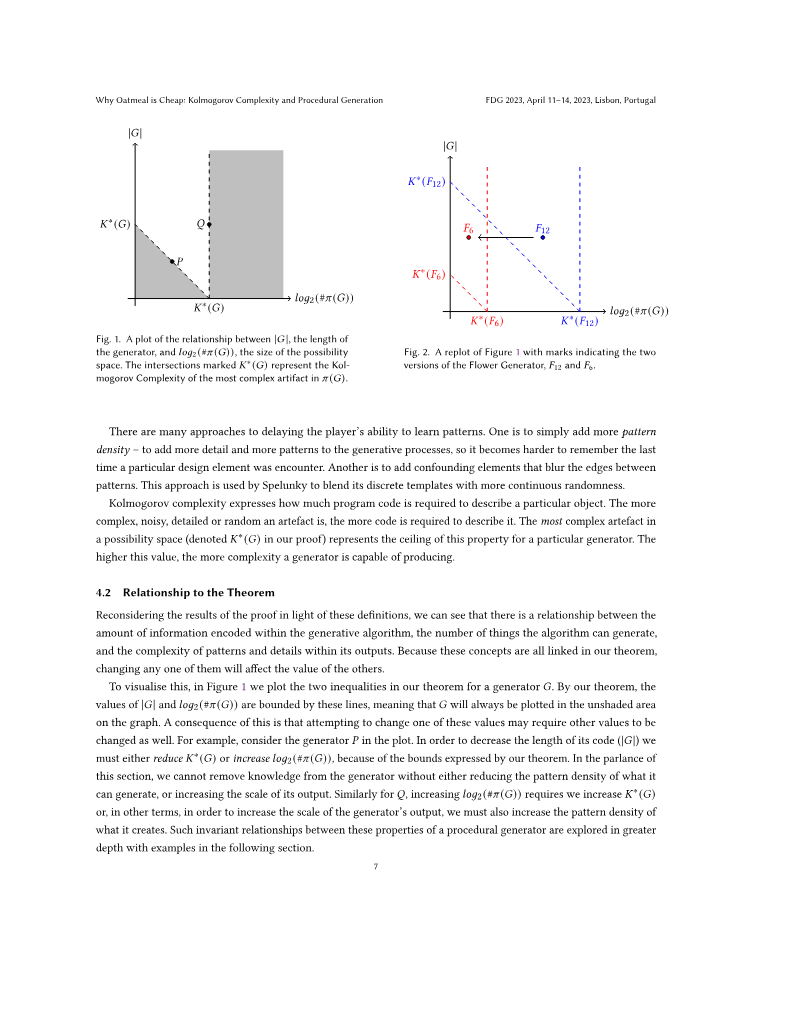
- The authors prove that for an ideal generator, the generator's code length plus the log of its possibility space size bounds the maximum Kolmogorov complexity of its artefacts.
- The authors argue that the oatmeal phenomenon is common because adding scale by combining subcomponents is cheaper than encoding new design knowledge.
- The authors state that linearly increasing the maximum complexity by scaling up the generator exponentially increases the size of the possibility space without adding encoded knowledge.
Level Generation Through Large Language Models
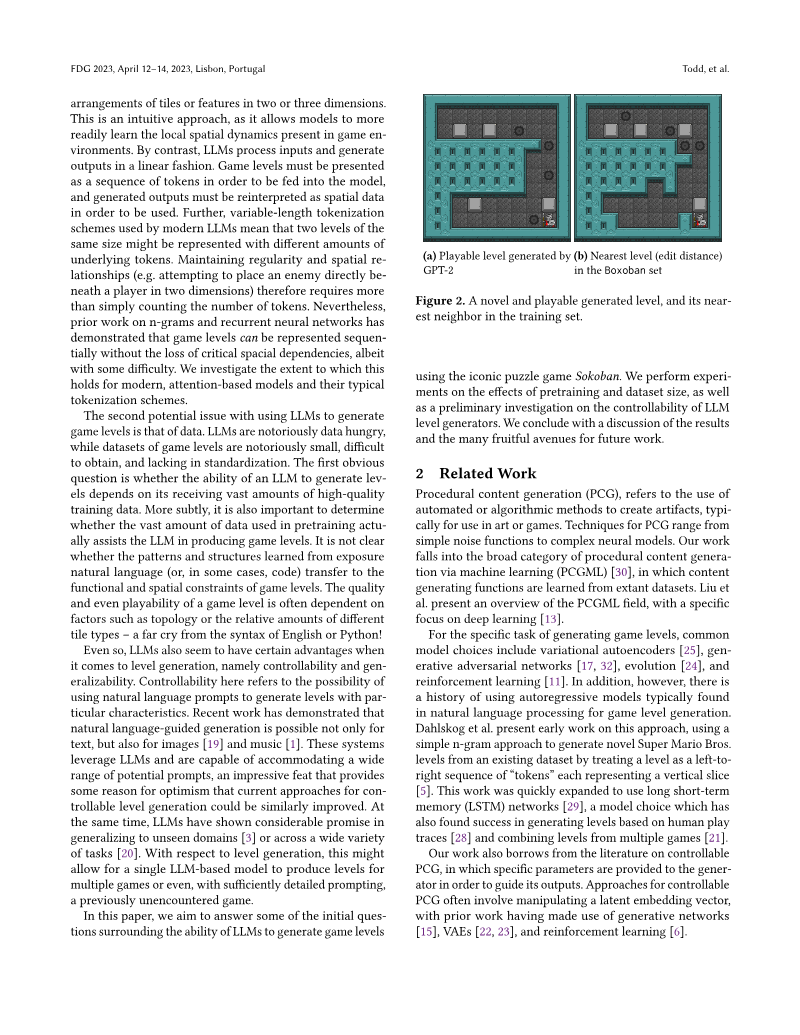
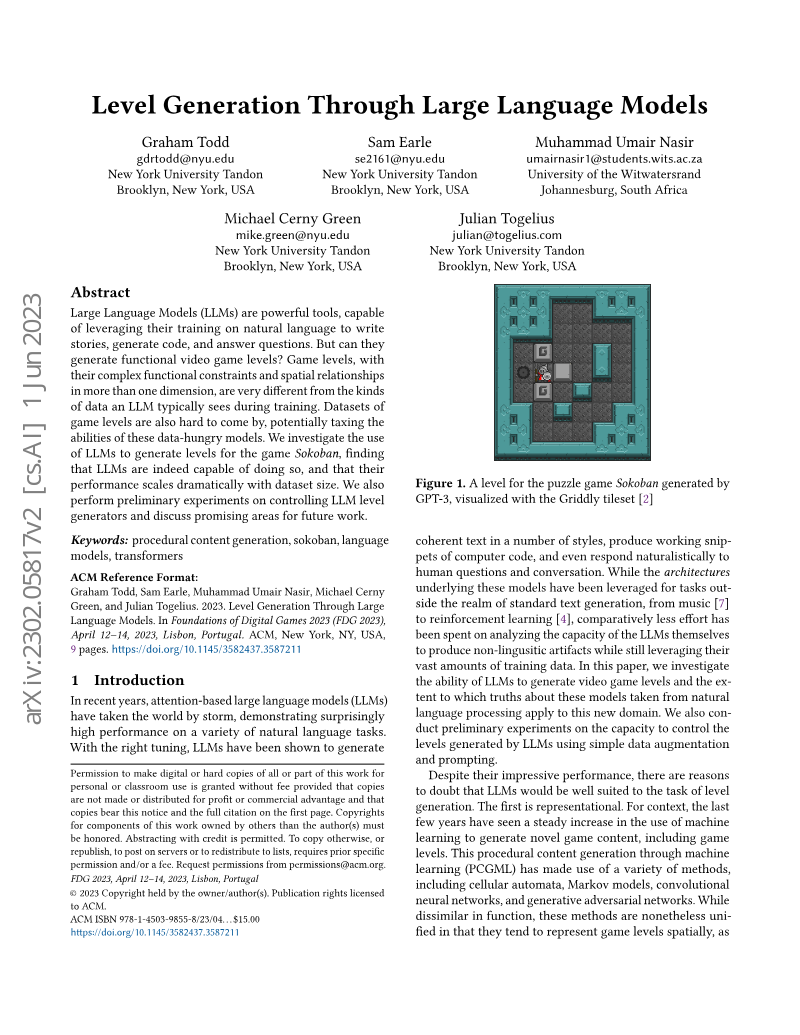
This paper by Graham Todd, Sam Earle, Muhammad Umair Nasir, Michael Cerny Green and Julian Togelius, published at the Foundations of Digital Games 2023 conference, investigates whether large language models can generate functional video game levels for Sokoban, a block-pushing puzzle game.
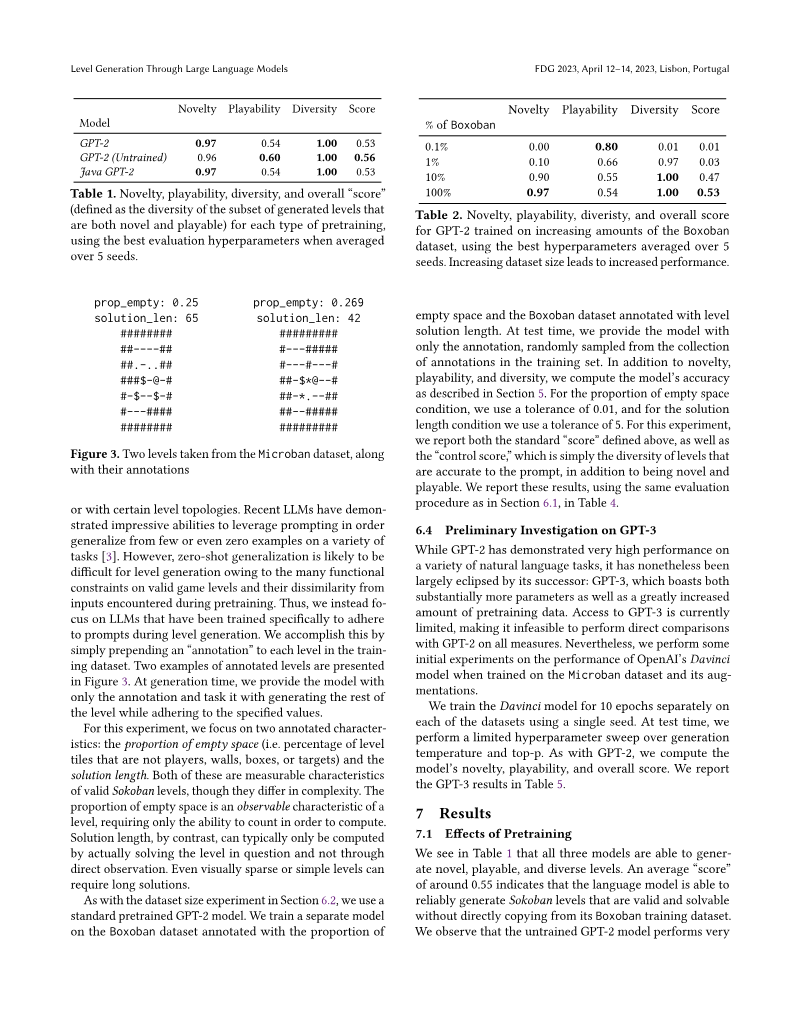
- On the Boxoban dataset, GPT-2's overall score rose as training data grew, from 0.01 at 0.1% of the data to 0.53 at the full dataset.
- Untrained GPT-2 scored 0.56 overall on Boxoban, slightly above the pretrained standard model's 0.53, and the authors attribute the difference to random variance.
- For solution-length control, GPT-2 reached an accuracy of only 0.17, while proportion-of-empty-space control reached 1.00.
The Right Variety: Improving Expressive Range Analysis with Metric Selection Methods
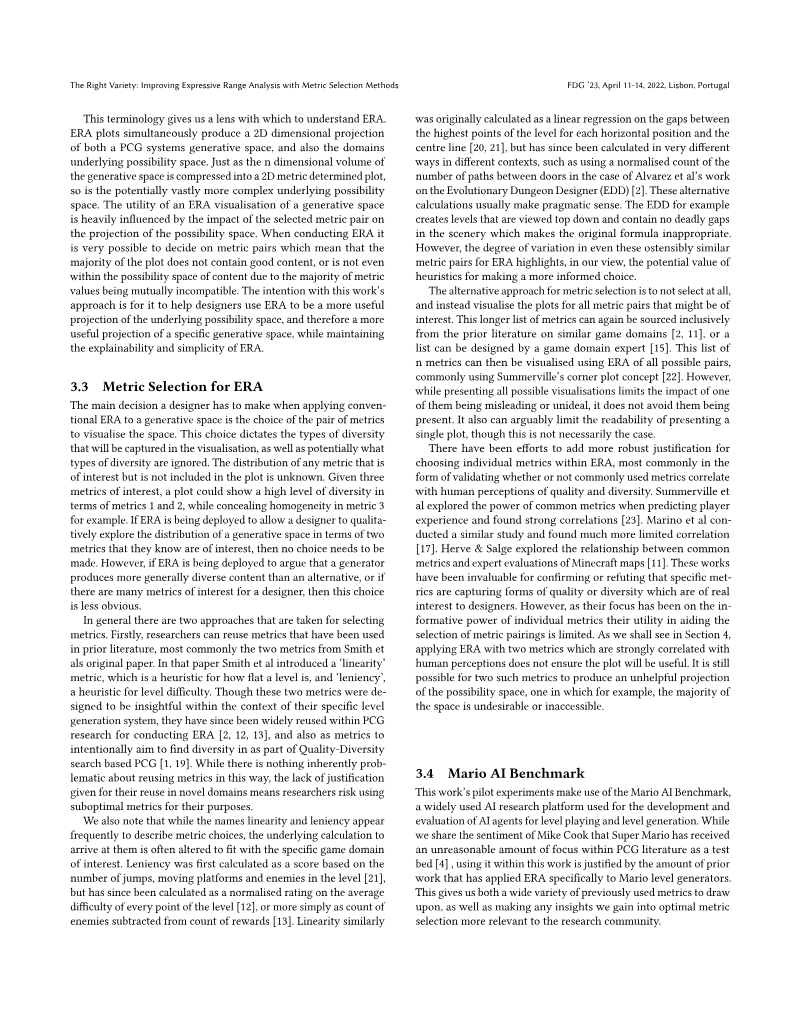
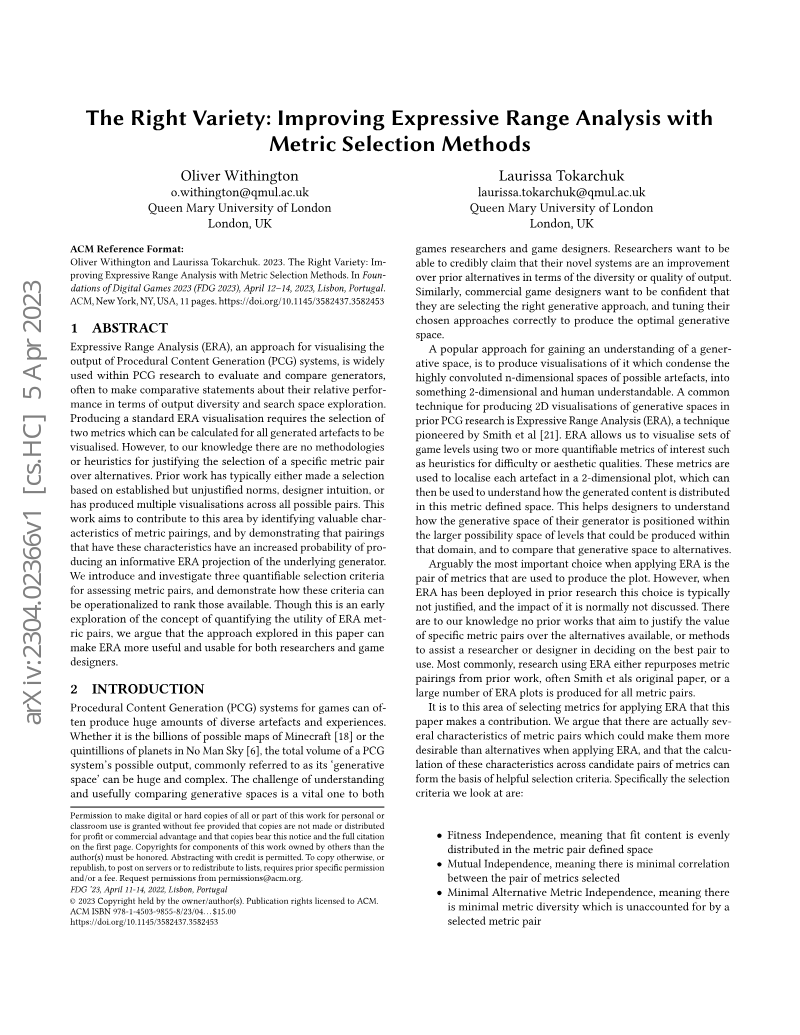
The paper by Oliver Withington and Laurissa Tokarchuk of Queen Mary University of London, published at the Foundations of Digital Games 2023 conference, addresses how metric pairs are chosen for Expressive Range Analysis (ERA), a 2D visualisation of procedural content generation (PCG) output.
- The authors argue that ERA metric pairs have typically been chosen from established norms, designer intuition, or by plotting all pairs, with little justification for the choice.
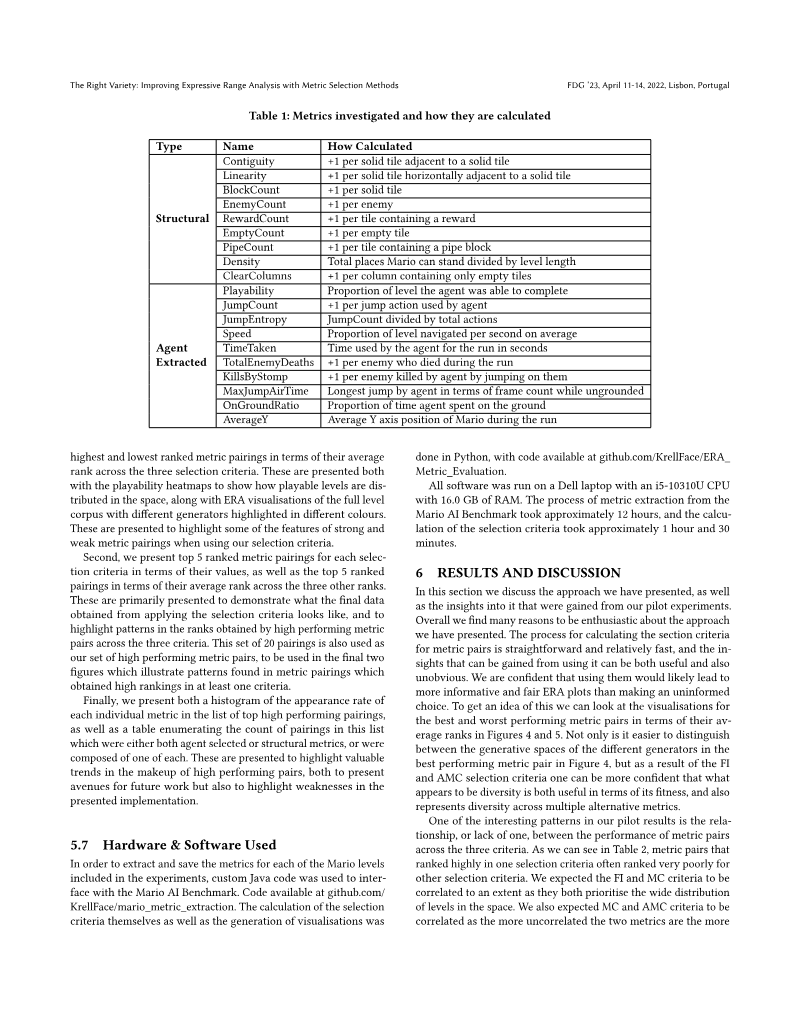
- The pilot experiment evaluated 153 unique metric pairs drawn from 18 metrics calculated for 9,015 Mario levels.
- Metric pairs ranking highly on one selection criterion often ranked very poorly on others, according to the authors' results.



Digital Games' Impact in Denmark
Digital games are a broad part of everyday life in Denmark, and a 2023 study by Seismonaut for Producentforeningen, supported by the Danish Film Institute's games scheme, is the first to examine what they mean to people.
- Digital gaming is a mainstream activity in Denmark, with 79% of the population having played a game in the past year.
- Engagement is high across all age groups, ranging from 62% of those aged 55–79 to 74% of those aged 16–24 playing on a weekly basis.
- Puzzle games are the most popular genre, preferred by 65% of respondents and yielding the highest relaxation scores among all game types.


Australian Game Development Survey FY2023 Industry Snapshot
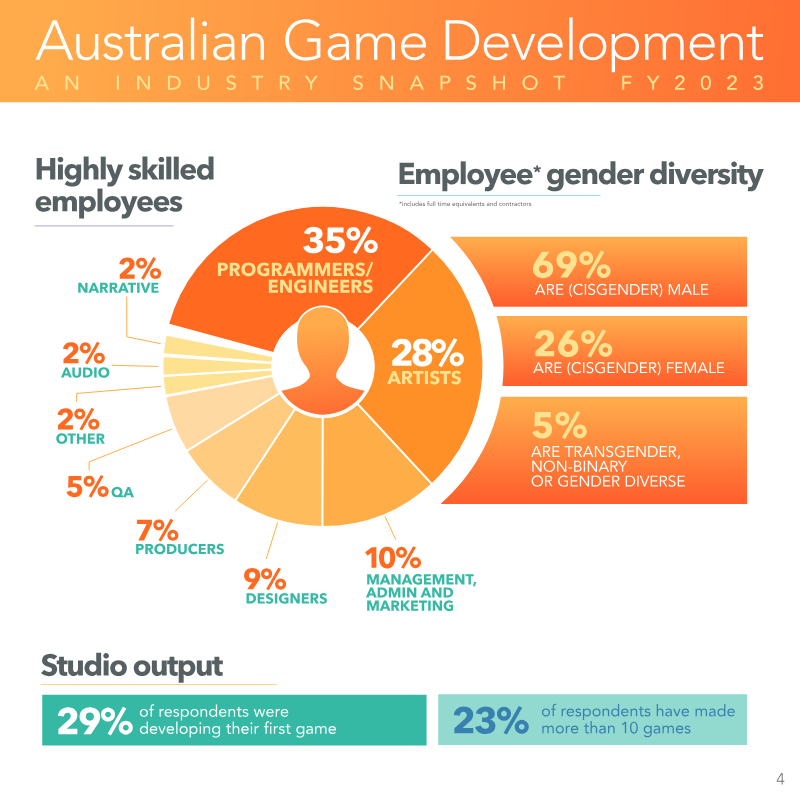
The Australian Game Development Survey FY2023 Industry Snapshot, produced by IGEA in its seventh annual edition, measures the size, employment and health of the Australian game development sector for the financial year from 1 July 2022 to 30 June 2023.
- The Australian game development industry generated $345.5 million in revenue during FY2023, representing a 21% year-over-year increase.
- The workforce grew by 17% to 2,458 full-time equivalent employees, with 63% of studios planning further hiring in the coming year.
- The sector is highly export-dependent, with 87% of total revenue derived from international markets.
Storytelling and Gameplay en Abyme in Firewatch
Alfonso Cuadrado Alvarado's article, published in Transactions of the Digital Games Research Association (November 2022, Vol. 6 No 1, pp. 123-146), analyses the 2016 walking simulator Firewatch by Campo Santo.
- The author argues that Firewatch's several plots do not form a narrative mosaic but explain, reinforce and clarify the main story of Henry's relationship with his wife.
- Delilah's storyline is described as a mirror of Henry, as both flee their pasts and withdraw into the solitude of watchtowers.
- The author argues that the game's ludonarrative relationship is a detachment rather than a contradiction, which is why the author does not classify it as dissonance.
Monster Theory and Game Studies: A Case Study for The Witcher 3: Wild Hunt
This Spanish-language paper by Rafel Guardiola Marí, published in Transactions of the Digital Games Research Association (November 2022, Vol. 6 No 1, pp.
- The author argues that The Witcher 3 constructs monstrosity through action rather than through being a monster, which the paper calls 'monstrosity in action'.
- In the Carnal Sins quest, the paper identifies the killer as Hubert Rejk, a high vampire, and locates the monstrosity in his human conduct rather than his vampiric condition.
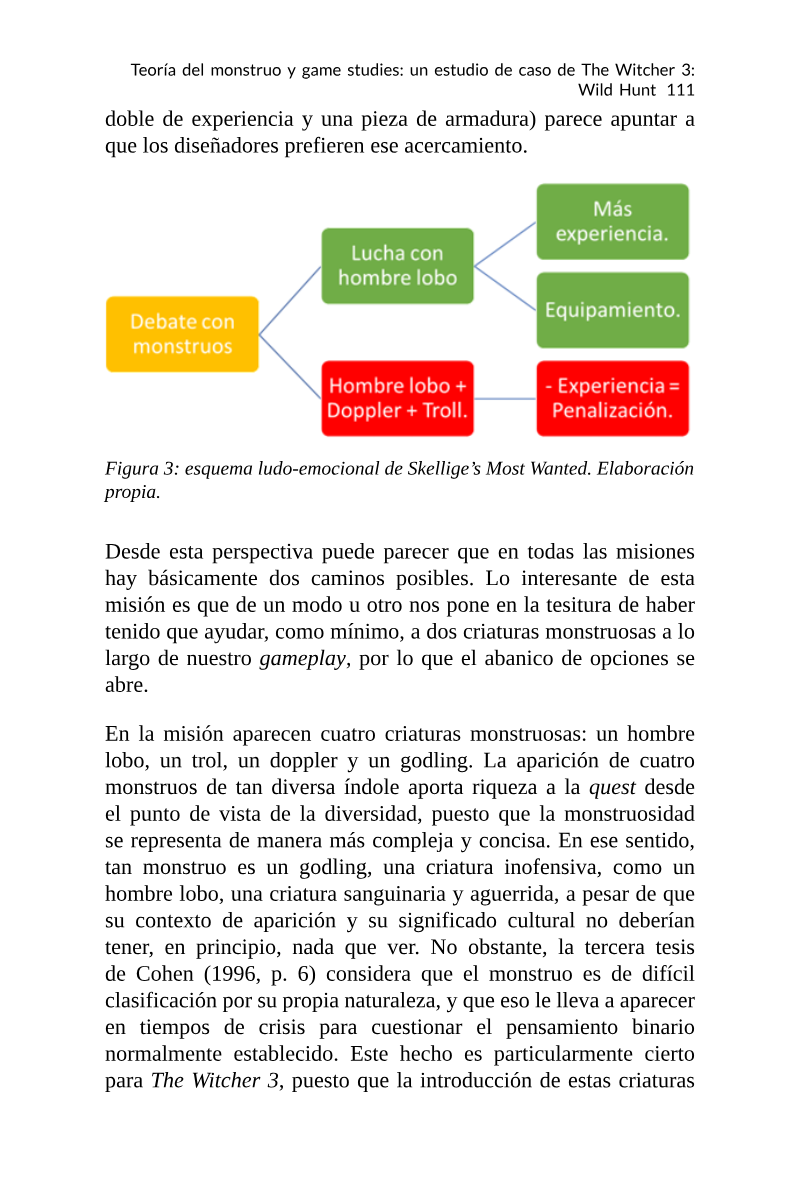
- The paper reports that in Skellige's Most Wanted, the diplomatic route yields a double amount of experience and a piece of armour compared with combat.