2015
Company
Documents about 2015
Designing for Constructive Failure: Reflections on the Design and Execution of an Introduction to Simulation Gaming
This paper reflects on the design and evaluation of a short introductory course on simulation gaming taught from 2011 to 2015 to third-year Bachelor of Business Administration students specializing in Media & Entertainment Management.
- Games can serve as a productive space for learning from failure, and the paradox of enjoyable play for serious professional ends can be deliberately harnessed in higher education, drawing on Juul, Statler et al., and Dweck's work on learning orientations.
- The course aimed to help future creative-industry managers recognize when simulation games might or might not help solve real-world problems, rather than to train game designers; it ran from 2011 to 2015 with third-year BBA Media & Entertainment Management students.
- Student reception varied across years: early non-mandatory sessions and weak incentives for preparatory reading were later replaced with stronger incentives, classic games such as the Dollar Auction and the prisoner's dilemma, and competitive paper-prototyping exercises.
Twenty-Five Years of Digital Games Research in Poland
This paper traces the history and present state of Polish video game research over roughly twenty-five years, beginning from what the authors identify as the first known peer-reviewed Polish paper on video games, published in 1991.
- The history of Polish video game research is traced over roughly twenty-five years, beginning with what the authors identify as the first known peer-reviewed Polish paper on video games, published in 1991.
- The study takes a broad scope, covering all Polish research into video games rather than only work identifying with a delineated game studies field, and combines a sociohistorical account with analysis of publications including titles, keywords, and abstracts of journal articles.
- Key developments identified include early interest among media scholars in the 1990s, a hiatus in international contacts during the 2000s, institutionalization through the Games Research Association of Poland, and recent growth in research activity.
The Mechanic Is Not the (Whole) Message: Procedural Rhetoric Meets Framing in Train & Playing History 2
This paper compares two serious games that share a nearly identical procedural rhetoric yet drew sharply different public reactions: Brenda Brathwaite's Train (2009), which received largely critical acclaim, and Playing History 2: Slave Trade (2015), which provoked a public outcry that led developers to remove one of its…
- The central thesis is that a serious game's mechanics do not fully determine how its message is received; audio-visual framing and the social frames surrounding public circulation play a decisive role in shaping meaning.
- The divergent receptions of Train (2009, Brenda Brathwaite) and Playing History 2: Slave Trade (2015) correlate with how each was presented to the public rather than with their nearly identical procedural rhetoric.
- Train circulated mainly through a carefully composed photograph of its board on a shattered glass window against a black background, which signaled seriousness and unease and positioned it as an adult art piece, activating an art frame that licenses uncomfortable engagement.
Surviving Fallout 4: A Design Fiction
This paper by Marcel Pufal and Theresa Jean Tanenbaum argues that the postapocalyptic video game Fallout 4 (Bethesda Game Studios, 2015) can be read as a design fiction: a plausible vision of a near future shaped by unsustainable resource consumption, climate pressure, and collapsing infrastructure.
- The paper argues that Fallout 4 (Bethesda Game Studios, 2015) works as a design fiction: a plausible near-future vision shaped by unsustainable resource consumption, climate pressure, and collapsing infrastructure.
- The authors frame the game as a rehearsal space where players can explore survivalist practices and sustainable behavior without the heavy-handed moralizing typical of environmental messaging.
- The analysis credits the game's believable world-building to a design process that asked what it would truly take to produce each object, structure, and settlement system, citing details like functional rain barrels and water-pumping mechanisms.
Resisting Patches and Errata: Motivations and Tactics
This paper examines the motivations and tactics behind player resistance to video game patches and errata, arguing that updates are not merely technical corrections but instruments that shape and enforce preferred ways of playing while retroactively labeling other play styles as aberrant.
- Patches and errata are framed as rhetorical documents rather than neutral technical fixes: they shape and enforce preferred play styles while retroactively labeling other play as aberrant.
- The study centers on mainstream PC and home console games, comparing single-player and multiplayer contexts, and anchors its analysis in four cases.
- The 2012 Call of Duty: Black Ops 2 balance update weakened sniper rifles and quickscoping, provoking threats against its design director.
Progress Wars: Idle Games and the Demarcation of "Real" Games
This paper examines how idle games, which reduce gameplay to a single repetitive interaction or automate it entirely, have served as a site for negotiating what counts as a "real" game.
- The paper argues that the category of "real" games is not a natural given but is actively produced through contested practices of designers, players, and critics, drawing on social constructivist views of games.
- Idle games began as parody: titles like Progress Quest (2002), StatBuilder Classic (2008), Progress Wars (2010), and Godville (2010) used reductio ad absurdum on RPG grinding mechanics to argue such progress involved no real skill.
- Ian Bogost's satirical Cow Clicker (2006) unexpectedly became hugely popular, revealing an absorptive "being in the zone" appeal that its critical intent had not anticipated.
Much Ado About Nothing? Analysis of the Polish Internet Discourse About "Hatred"
This study examines the Polish internet discourse that emerged after the trailer for "Hatred," an isometric shooter by Destructive Creations, was first released.
- The study argues that moral commotion around transgressive content, here the Polish reception of the trailer for the isometric shooter "Hatred" by Destructive Creations, acts as a catalyst for renegotiating interpretive frameworks and shifting the boundaries of Polish gaming discourse.
- The analysis draws on Pierre Bourdieu's theory of cultural economy and taste together with Aaron Julius's concept of transgressive content, treating transgression as either a tool that subverts or one that reinforces a social group's taste.
- The research used computer-aided content analysis and critical discourse analysis, conducted in September and October 2015, covering material published between October 2014 and September 2015.
Parasites to Gaming: Learning from GamerGate
Paolo Ruffino's paper uses the controversy known as GamerGate as a lens for examining the role of academia in video game culture.
- Paolo Ruffino reframes the Reddit accusation that academics are "parasites" to gaming by drawing on Michel Serres's theory of the parasite as a mediator and disruptor, arguing the real question is how academics can be "good" parasites rather than whether they are parasites at all.
- GamerGate, which escalated from summer 2014 into 2015 with harassment of prominent women in games, was framed by industry commentators as signaling the end of "gamers" as a unified consumer category.
- Ruffino argues that justifying women's presence in gaming through market data is itself an aggressive argument, because it swaps one consumer category for another while leaving the underlying discourse that treats games as industry products and participants as consumers intact.
Selling the Imperium: Changing Organisational Culture and History in EVE Online
Webber and Milik's study examines how organisational identity and cultural change were pursued within EVE Online, centred on the 2015 renaming of the Clusterfuck Coalition (CFC) as "The Imperium."
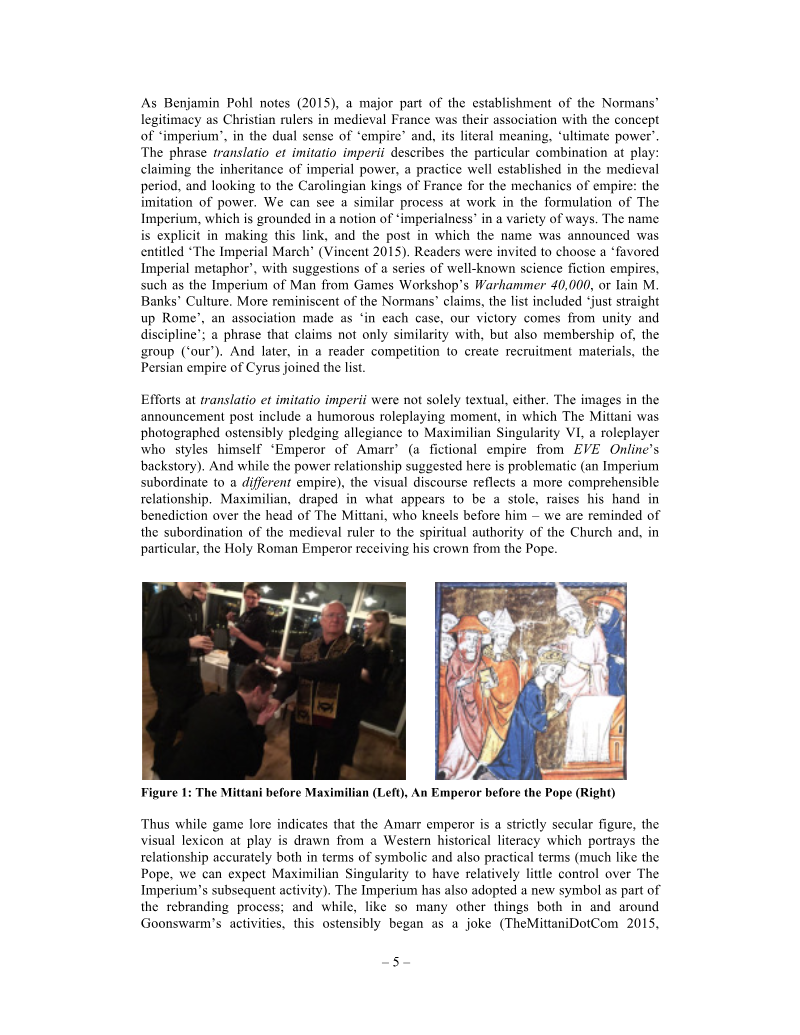
- The 2015 renaming of the Clusterfuck Coalition (CFC) to "The Imperium" drew on imperial and Western historical symbolism, such as the Black Eagle emblem, the Maximilian pledge image, and viceroyalty structures, to build a "usable past" that conferred legitimacy and an impression of maturity.
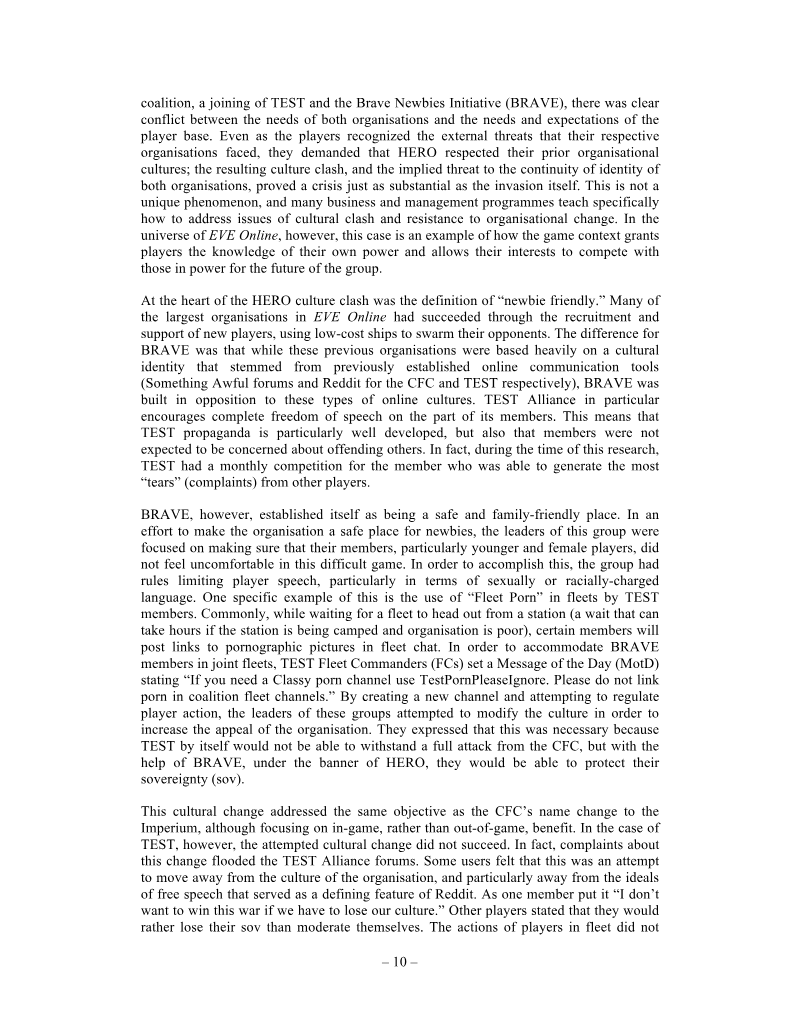
- The authors compare the Imperium's dynastic project to the medieval Norman model and read the largely muted community response to the rebranding as implicit acceptance of leadership's direction.
- The crowdfunded Fountain War history book failed on Kickstarter amid widespread community distrust of The Mittani's motives, with players fearing propaganda or revisionism and viewing commercialisation and perceived real-money trading as eroding the alliance's historic identity.
Game Jams as an Opportunity for Industry Development
This study examines whether game jams can strengthen community and lay groundwork for industry development in Tasmania, a small and isolated Australian state where the games sector has been weakly supported and poorly visible.
- Game jams are proposed as a bottom-up way to connect isolated developers in Tasmania, a small Australian state with a weakly supported, poorly visible games sector, with the authors arguing community-building must precede formal industry growth.
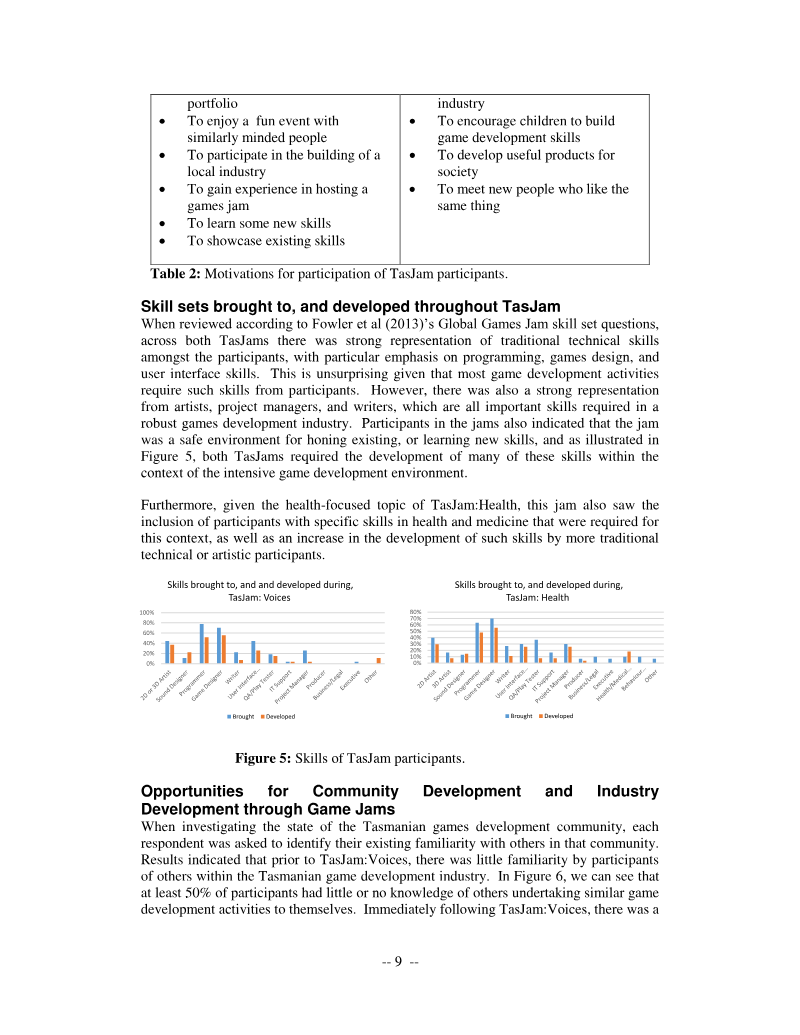
- The two 2015 state-wide jams drew 60 participants forming 16 teams at TasJam:Voices and 80 participants producing 14 games over 32 hours at TasJam:Health.
- Familiarity among local developers was low before the jams and rose markedly afterward, with over 70% of respondents reporting increased familiarity and most reporting new professional and personal contacts.
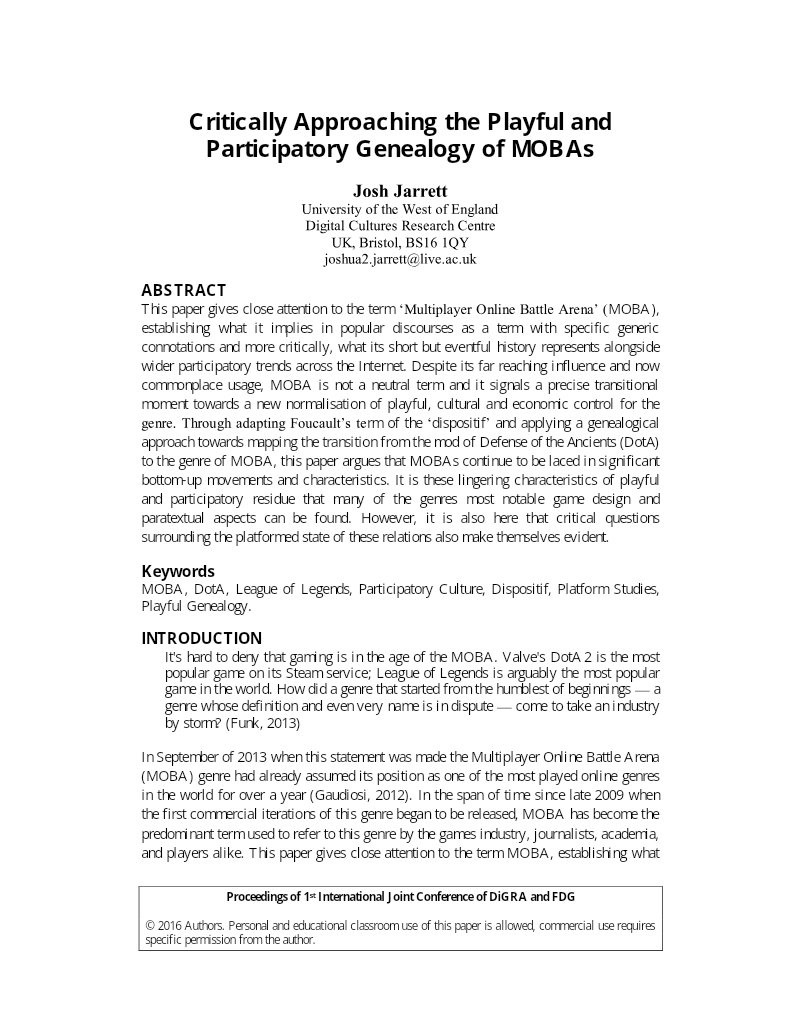
Critically Approaching the Playful and Participatory Genealogy of MOBAs
Josh Jarrett's paper argues that MOBAs, despite their commercial dominance, retain substantial bottom-up, participatory roots that trace back to grassroots modding, most notably Defense of the Ancients (DotA) on Blizzard's Warcraft III.
- DotA, a grassroots modding project on Blizzard's Warcraft III, is presented as the participatory origin of the MOBA genre, and the paper uses Foucault's dispositif and genealogical method to analyse its evolution.
- The paper argues that the move from DotA to League of Legends (released 2009) traded bottom-up creativity for accessibility, with Riot Games redefining the genre through top-down design that resisted DotA's emergent mechanics such as creep denying.
- DotA's competitive play was held back by missing features including reconnect functions, persistent accounts, and skill-based matchmaking, pushing its community toward paratextual clients that were hard for newcomers to access.
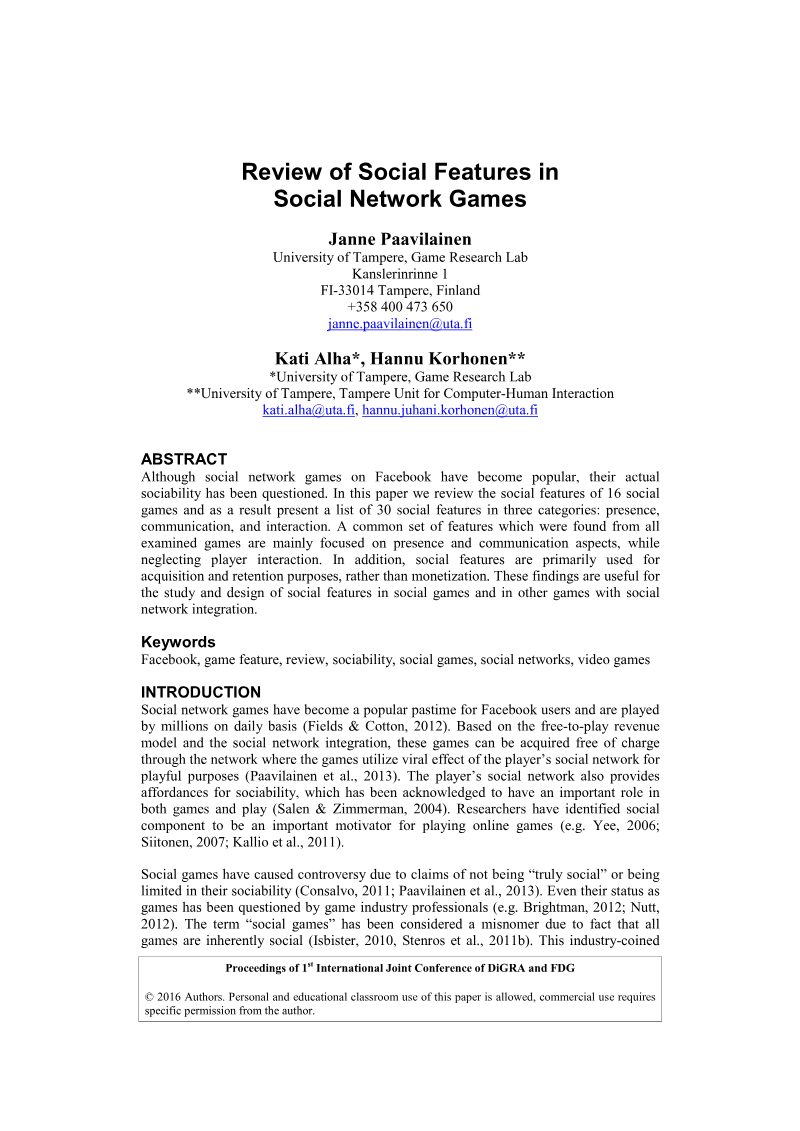
Review of Social Features in Social Network Games
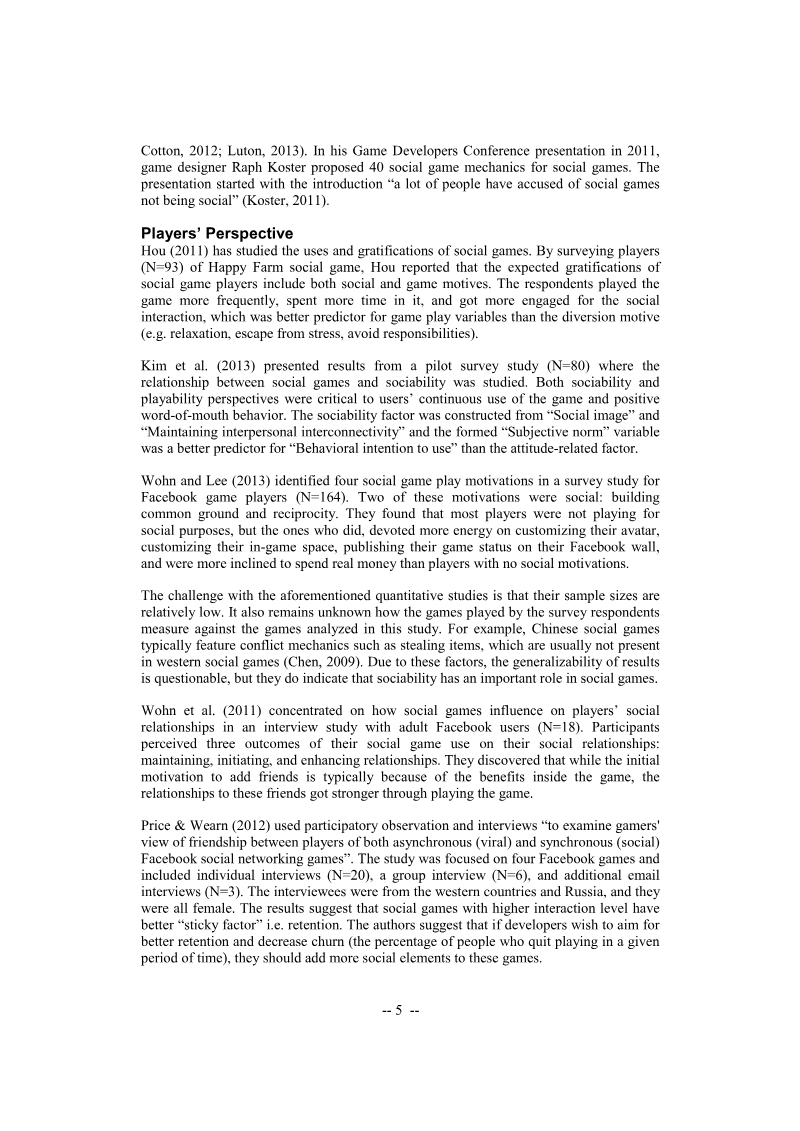
This review examines the social features of 16 Facebook social games, addressing the contested question of whether such games genuinely qualify as social.
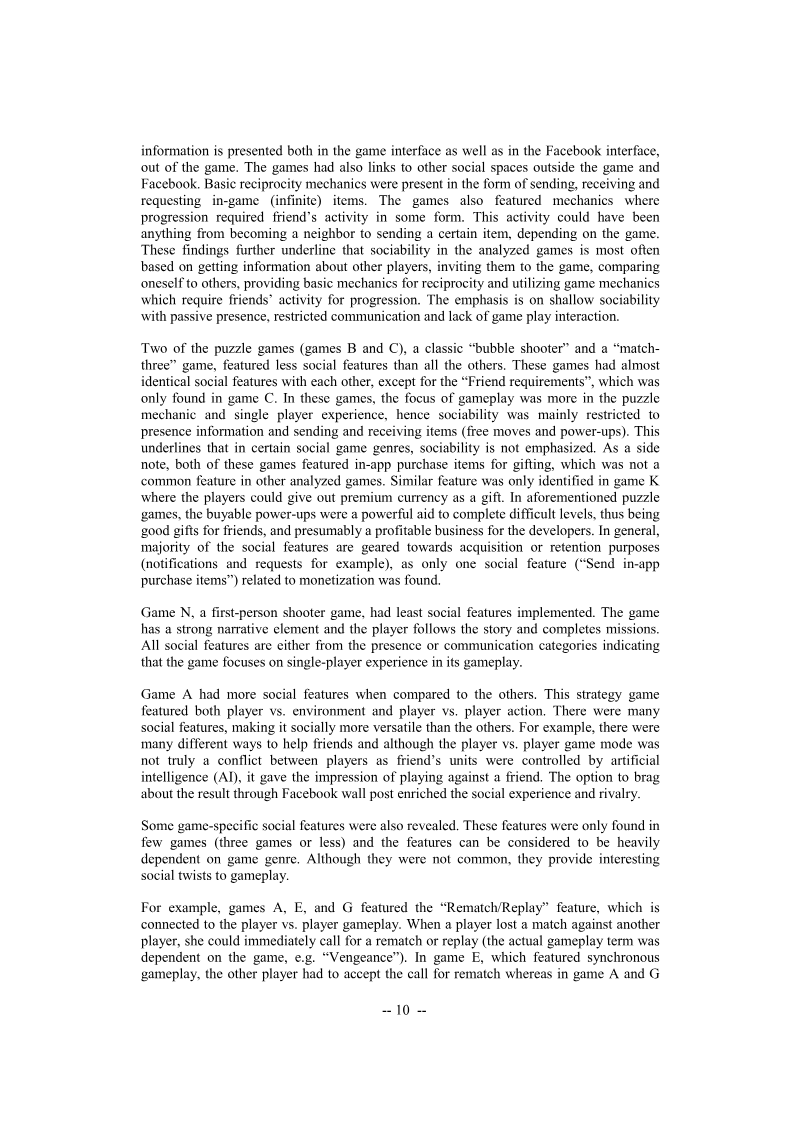
- Of 16 Facebook social games analysed, 30 social features were identified, but informational and invitational features (presence indicators, off-game links, Facebook notifications, invite requests) appeared in every title.
- Genuine player-to-player interaction and team formation were largely absent, leading the authors to describe these games as "massively parallel single-player games."
- Gameplay interaction and monetized gifting were comparatively rare, and only one feature was directly tied to monetization.