1 free read left. Create a free account for unlimited reading + AI research.
Create free accountWhitepaper DiGRA
1 free read left. Create a free account for unlimited reading + AI research.
Create free accountWhitepaperDiGRA
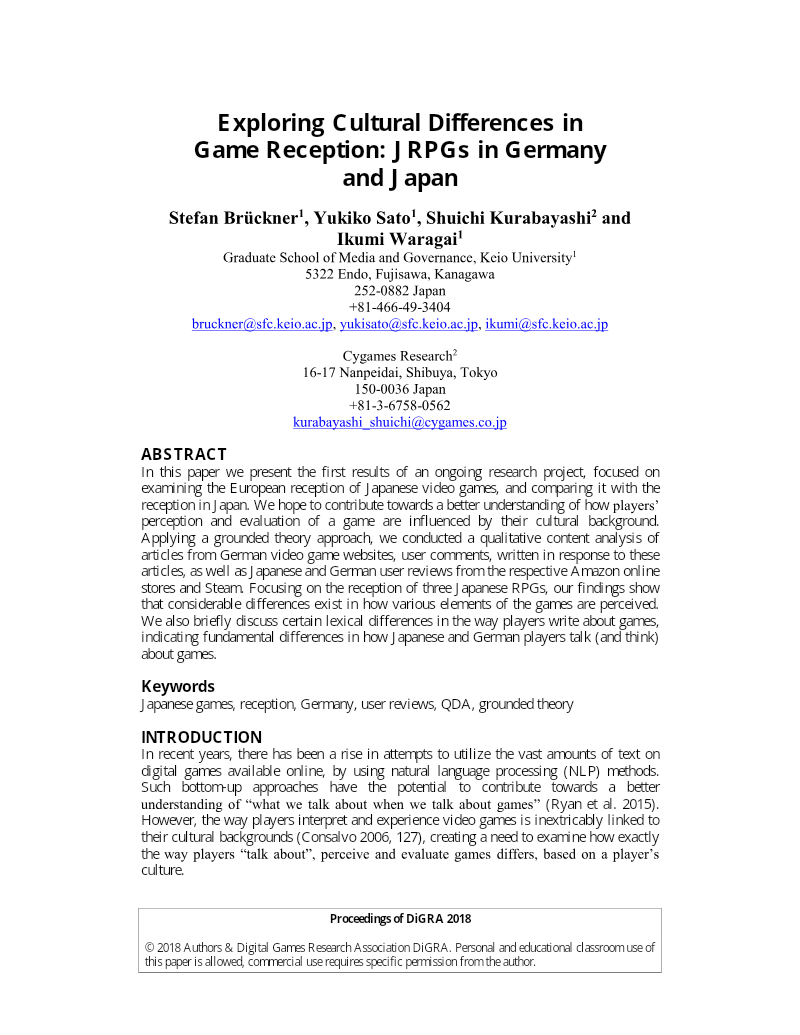
Josh Jarrett's paper argues that MOBAs, despite their commercial dominance, retain substantial bottom-up, participatory roots that trace back to grassroots modding, most notably Defense of the Ancients (DotA) on Blizzard's Warcraft III. Drawing on Foucault's concept of the dispositif and a genealogical method, the analysis contends that the move from DotA to League of Legends, released in 2009, marked a shift toward new forms of playful, cultural, and economic control in which participatory residue and platformed power relations coexist. The work rests largely on qualitative evidence gathered through online ethnography, and it situates the genre's rise against clear indicators of mainstream reach by 2012 and 2013, including DotA 2 leading Steam and League of Legends ranking among the most played games worldwide.
The study examines how DotA's competitive play was constrained by the absence of features such as reconnect functions, persistent accounts, and skill-based matchmaking. These limitations pushed its community toward paratextual clients that were difficult for newcomers to access. Re-platforming the genre into League of Legends resolved many of these problems and broadened its social and competitive appeal, yet it also allowed Riot Games to redefine the genre through top-down design principles that resisted DotA's emergent mechanics, such as creep denying. The author frames this as a paradox in which commercialization delivered accessibility while narrowing the collective, bottom-up creativity that originally characterized the genre.
Extending this argument, the paper reads the shift from DotA to LoL as a broader tension between emergent play and imposed control. Steve Feak's 2010 remark that LoL could never be "DotA" once it became a new game serves as a telling marker of this divide. Although Dota 2 developers and some players rejected the label, "MOBA" nonetheless became the accepted genre name, and by 2015 it had become Dota 2's second most popular Steam tag. The conclusion positions MOBAs as nodes within a wider connective ecology of platforms, esports, streaming, and fan communities, where bottom-up participation is increasingly obscured by commercial and affective logics.
DiGRA · 2018
DiGRA · 2015