2015
Company
Documents about 2015
The Path to the Game Recommender Engine
Quantic Foundry's October 2015 post traces how the company built its Game Recommender Engine, a web app that gives personalized game suggestions to people who complete the Gamer Motivation Profile.
- Quantic Foundry developed a game recommender engine by leveraging data from over 140,000 Gamer Motivation Profile participants to identify and match similar player profiles.
- To prevent popular titles like World of Warcraft or GTA from dominating recommendations, the engine uses a 'QF score' that adjusts a game's local frequency against its baseline popularity.
- The team processed over 22,000 unique game title entries by using Mechanical Turk to standardize text inputs against Wikipedia entries, ensuring consistent data for analysis.

What Should I Do If I Can't Afford User Acquisition?
Eric Seufert addresses a question facing many smaller app developers: what to do when rising mobile install costs make paid user acquisition unaffordable.
- Developers who cannot afford paid user acquisition should not attempt direct-response mobile advertising campaigns, as these are not a viable growth strategy without a positive return on investment.
- App marketing strategy must be driven by product design, meaning developers should build apps specifically designed to achieve organic growth if they lack the budget for paid acquisition.
- Rising mobile user acquisition costs are often interpreted as a sign of a maturing economy where users are highly valuable, rather than solely a barrier to entry for smaller developers.
How to Design Mario Levels That Don’t Suck
This October 2015 blog post, published on the game marketing site How To Market A Game, introduces a presentation on designing effective 2D Mario levels.
- The core principles of effective 2D platformer design are exemplified by the historical development choices found in the Super Mario series.
- Consistent level design patterns are a fundamental requirement for creating high-quality, playable 2D platformer stages.
- The release of Mario Maker democratized level design, allowing creators to apply established Nintendo design methodologies to their own custom stages.

Creative Industries Including Games Add $3.848b to NZ Economy
New Zealand's creative industries contributed $3.848 billion to GDP in 2014, according to a PwC report commissioned by WeCreate, an alliance of the country's creative sectors that includes the New Zealand Game Developers Association.
- New Zealand’s creative industries (games, music, books, and film/television) contributed $3.848 billion to the national GDP in 2014.
- The creative sector supports approximately 42,000 full-time equivalent (FTE) jobs when accounting for both direct and wider industry employment.
- Film and television is the largest contributor to the sector, accounting for 74% of the total GDP impact and 31,416 total FTE jobs.

Whale Spending and Retention in Freemium Apps
Eric Seufert challenges the conventional wisdom that "whales," or highly monetizing freemium users, drive product economies through large-ticket purchases or short bursts of spending.
- Retention is the primary driver of long-term monetization, as evidenced by the fact that none of the top 10 grossing apps are currently in the top 10 downloaded list.
- Successful freemium apps prioritize long-term user engagement over short-term purchasing bursts, with over 50% of the top 10 grossing apps having been released prior to 2014.
- The dominance of established apps in the top grossing charts suggests that the inability to retain users over long periods, rather than poor app store discovery, is the primary barrier for new entrants.
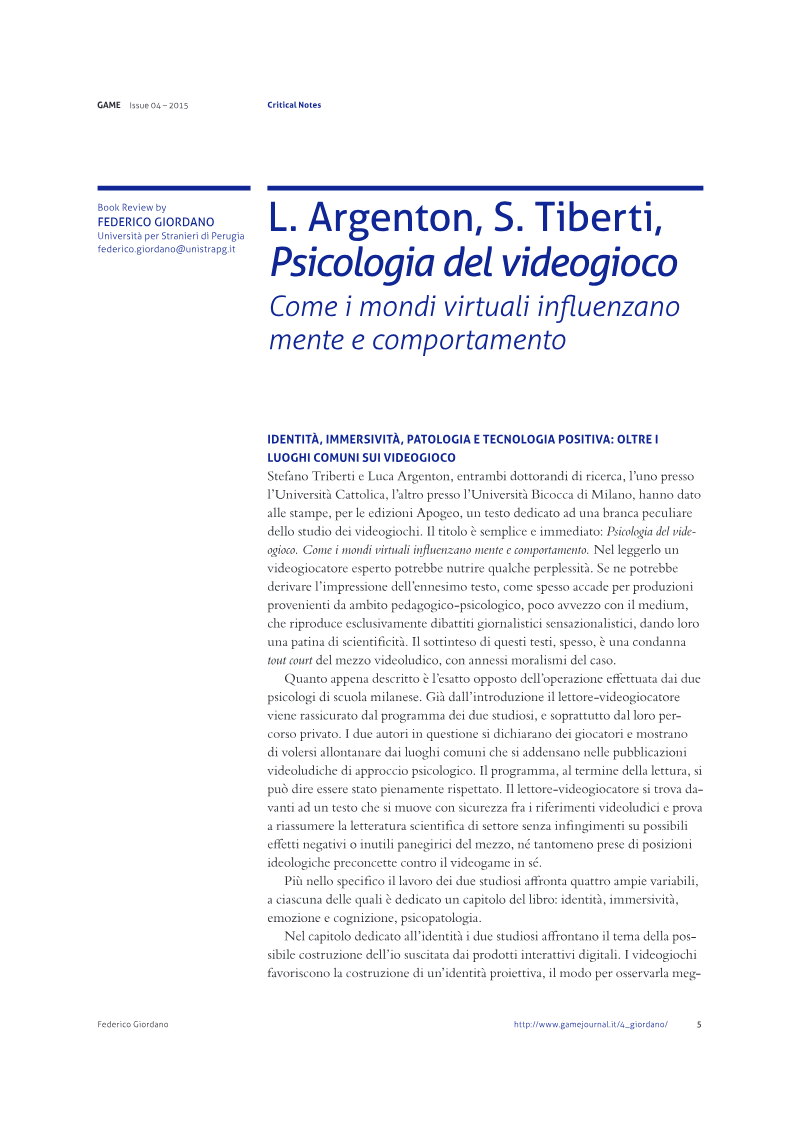
Psicologia del Videogioco: Come i Mondi Virtuali Influenzano Mente e Comportamento
Federico Giordano recensisce Psicologia del videogioco di Stefano Triberti e Luca Argenton (Apogeo), un volume italiano del 2015 che sintetizza la letteratura psicologica sui videogiochi evitando sia la condanna moralistica del medium sia l'apologia acritica.
- The book "Psicologia del videogioco" (Apogeo, 2015) by Milan psychology PhD researchers Luca Argenton and Stefano Triberti offers a balanced synthesis of the scientific literature on games, neither condemning nor uncritically praising them, and avoids the sensationalist, moralizing tone common in earlier texts.
- The authors write as gamers themselves, which the reviewer credits with helping them move beyond common clichés about the medium.
- The book is organized around four themes: identity, immersion, emotion and cognition, and psychopathology.
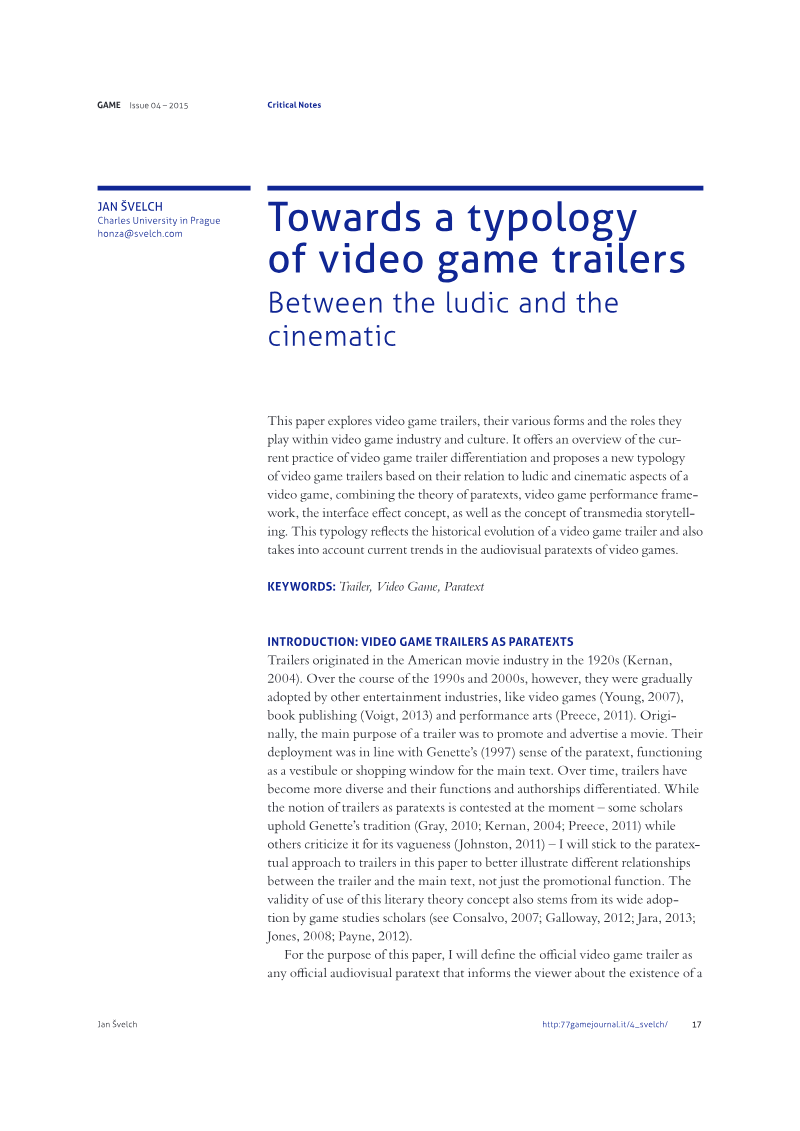
Towards a Typology of Video Game Trailers: Between the Ludic and the Cinematic
Video game trailers, borrowed from the American film industry of the 1920s and adopted by games during the 1990s and 2000s, have diversified in form, function, and authorship, yet lack a shared classification.
- Jan Švelch's 2015 paper in Critical Notes (Issue 04) argues that existing trailer classifications based on formal criteria are descriptive and inconsistently applied, and calls for a theory-driven typology that explains how a linear trailer represents a nonlinear game.
- The paper's proposed typology has three categories: performance trailers (staging player interaction to show possible gameplay in linear form), transmedia trailers (expanding a game's fictional world through cinematic footage as a tool of transmedia storytelling), and interface trailers (mimicking a game's interface to convey interactivity and creating two layers of paratextuality).
- Current publisher and press discourse classifies trailers by four overlapping criteria: content (gameplay footage, CGI, live action), date (teaser, reveal, announcement, launch), venue (e.g., E3, Gamescom, Tokyo Game Show), and focus (story, combat, multiplayer).
IGEA's Submission to the ECRC Inquiry into the Future of Australia's Video Game Development Industry
The Interactive Games and Entertainment Association (IGEA) announced on 9 September 2015 that it had lodged its response to the Senate Environment and Communications References Committee's inquiry into the future of Australia's video game development industry.
- The Interactive Games and Entertainment Association (IGEA) submitted seven recommendations to the Senate Environment and Communications References Committee’s (ECRC) Inquiry into the Future of Australia’s video game development industry on September 9, 2015, aiming to help the local development community leverage global opportunities and overcome challenges.
- IGEA also made a submission in February 2017 to the Standing Committee on Employment, Education and Training's Inquiry into Innovation and Creativity: Workforce for the New Economy, focusing on the labor force within Australia's video game development industry.
- In September 2019, IGEA submitted to the Joint Standing Committee on Trade and Investment Growth's Inquiry into supporting Australia’s exports and attracting investments, addressing barriers to growth for Australian businesses.
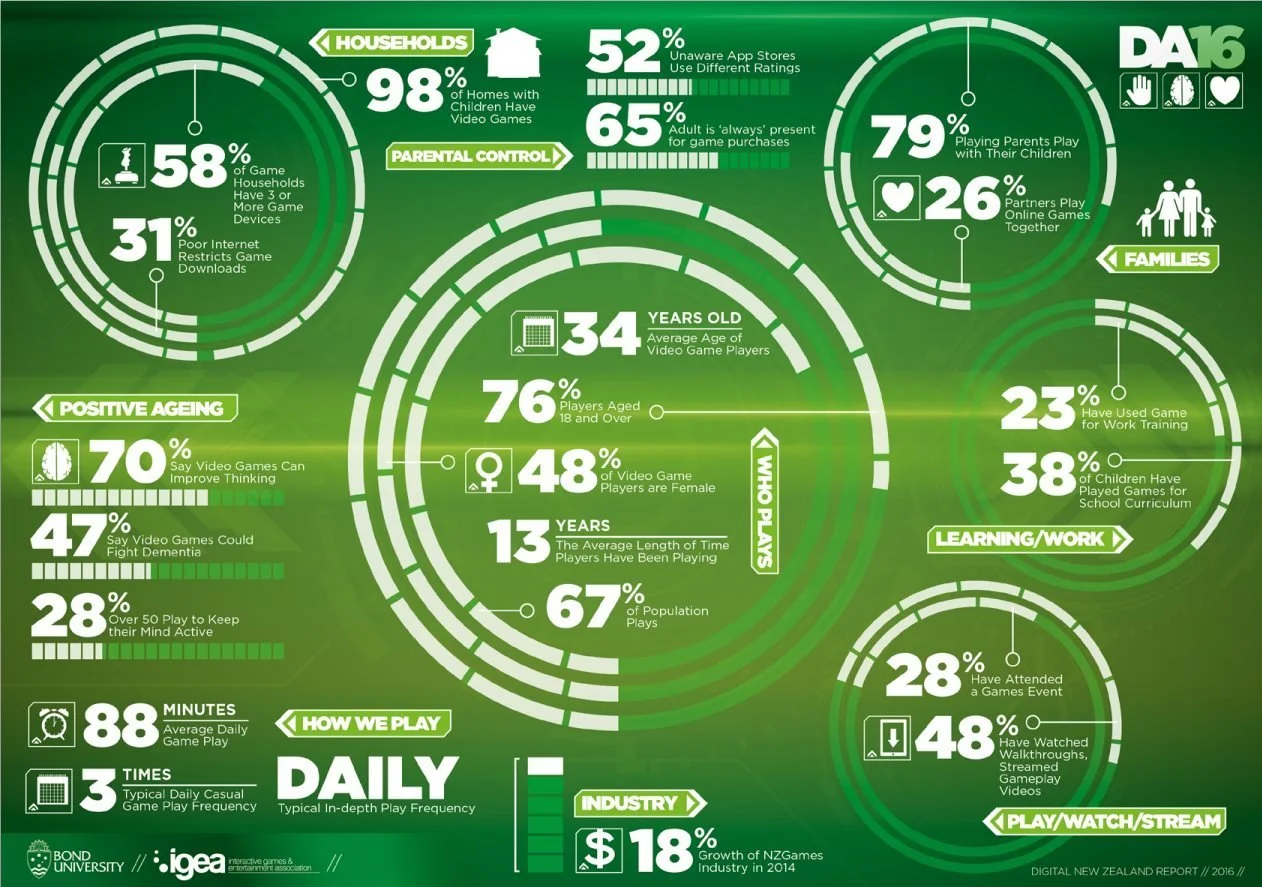
Digital NZ Report 2016: Games Are Popular Mainstream Media
New Zealand's video game audience has broadened well beyond its youthful stereotype, according to the Digital New Zealand Report 2016, released in September 2015 by the Interactive Games & Entertainment Association (IGEA) and led by Professor Jeff Brand of Bond University.
- The New Zealand digital games industry grew by 18% since 2013, reaching a total value of $347 million with $78 million in revenue generated by local businesses.
- Digital game sales experienced a 34% surge while traditional retail sales declined by 2%, and the sector added 134 full-time jobs in FY2015 to reach a total of 568 positions.
- Video games have become a mainstream activity in New Zealand, with 67% of the population playing and gaming devices present in 98% of family homes.

6 Ways Your Indie Mobile Game Can Top the Charts
Indie mobile developers cannot out-spend giants like Supercell, King, and Machine Zone on paid user acquisition, so their best chance at chart success lies in core game design and alternative marketing.
- Multiplayer games are a critical driver of revenue, accounting for 60% of consumer spending among top mobile titles according to a 2015 App Annie E3 report.
- Indie developers should prioritize App Store Optimization (ASO) by conducting keyword research before finalizing game concepts to ensure organic discovery in a market dominated by high-budget paid acquisition.
- To differentiate from large publishers who focus on scaling existing mechanics, indie studios should innovate with unique interaction models like haptic feedback, gyroscope usage, and NFC-based multiplayer gestures.
Gender Differences in Gaming Motivations Align with Stereotypes, but Small Compared to Age Differences
Gender differences in gaming motivations are real and follow familiar stereotypes, but they are modest next to the differences between younger and older gamers.
- Age is a significantly stronger predictor of gaming motivation than gender, with age explaining three times the variance in competitive drive compared to gender.
- While gender differences in gaming motivations align with traditional stereotypes, the effect sizes are small, with an 87% overlap between male and female preferences in the most polarized category, Competition.
- Female gamers are more likely to be driven by Design, Fantasy, Story, and Completion, while male gamers are more likely to be driven by Competition, Challenge, Excitement, and Strategy.

Is China Attractive to Western Mobile Developers?
Western mobile developers weighing entry into China face a tension between a vast market opportunity and substantial structural barriers.
- The Chinese smartphone market, which accounts for 30% of global sales, has reached saturation, with growth now driven by replacement cycles rather than new users.
- Despite market saturation, China remains a massive opportunity with over 900 million projected smartphone users and an estimated $6.5 billion in mobile gaming revenue for 2015.
- Western developers face significant barriers to entry, including extreme hardware and app store fragmentation, regulatory hurdles, and the necessity of partnering with local firms.