1 free read left. Create a free account for unlimited reading + AI research.
Create free accountArticle G|A|M|E – The Italian Journal of Game Studies
1 free read left. Create a free account for unlimited reading + AI research.
Create free accountArticleG|A|M|E – The Italian Journal of Game Studies
Jan Švelch's paper, published in Issue 04 of Critical Notes in 2015, proposes a new typology of video game trailers grounded in their relationship to the ludic (rule-based, interactive) and cinematic (narrative, fictional) dimensions of games. Its central argument is that existing classifications, which rely on formal criteria such as footage type, release timing, venue, and focus, are descriptive and inconsistently applied, and that a theory-driven framework is needed to understand how the linear form of a trailer represents a nonlinear game. The paper draws on paratext theory (Genette), Juul's concept of games as rules and fiction, Fernández-Vara's performance framework, Galloway's interface effect, and transmedia storytelling.
The author surveys current practice in trailer categorization, identifying four criteria used in publisher and press discourse: content (gameplay footage, CGI, live action), date (teaser, reveal, announcement, launch), venue (E3, Gamescom, Tokyo Game Show), and focus (story, combat, multiplayer). The paper notes that these categories overlap and are applied inconsistently, and it traces the historical evolution of game trailers from early hardware-focused television advertising, such as a 1982 Zaxxon spot, to a standard marketing tool by the 1990s, supported by the rise of dedicated trailer websites and exhibitions.
The proposed typology comprises three categories: performance trailers, which stage player interaction with a game to show possible gameplay in linear form; transmedia trailers, which expand a game's fictional world through cinematically produced footage and serve as tools of transmedia storytelling; and interface trailers, which mimic a game's interface to convey interactivity and create two layers of paratextuality. The work is primarily theoretical and conceptual rather than empirical, offering no survey or sample data, and is presented as a starting point for future research on the production, content, and audience reception of game trailers.
Each row is a game or company this document names, each column a document, oldest first. A mark means that document names it. Select a row to see those documents.
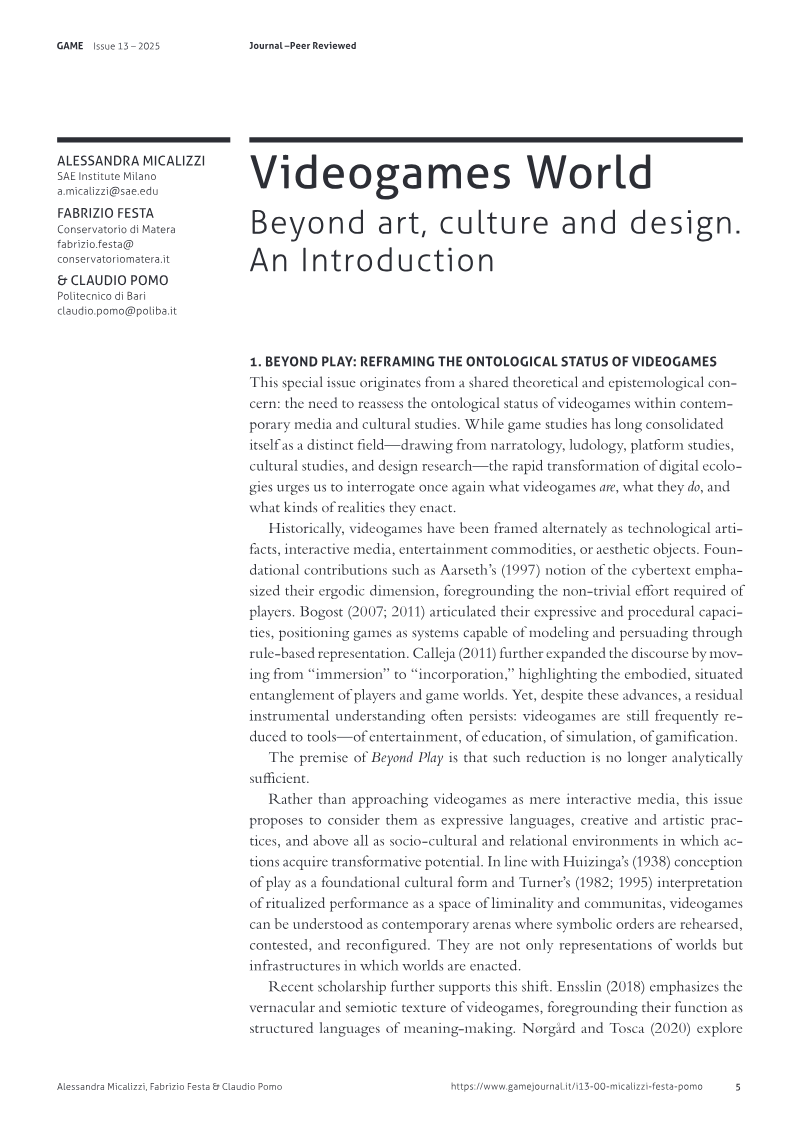
G|A|M|E – The Italian Journal of Game Studies · 2026
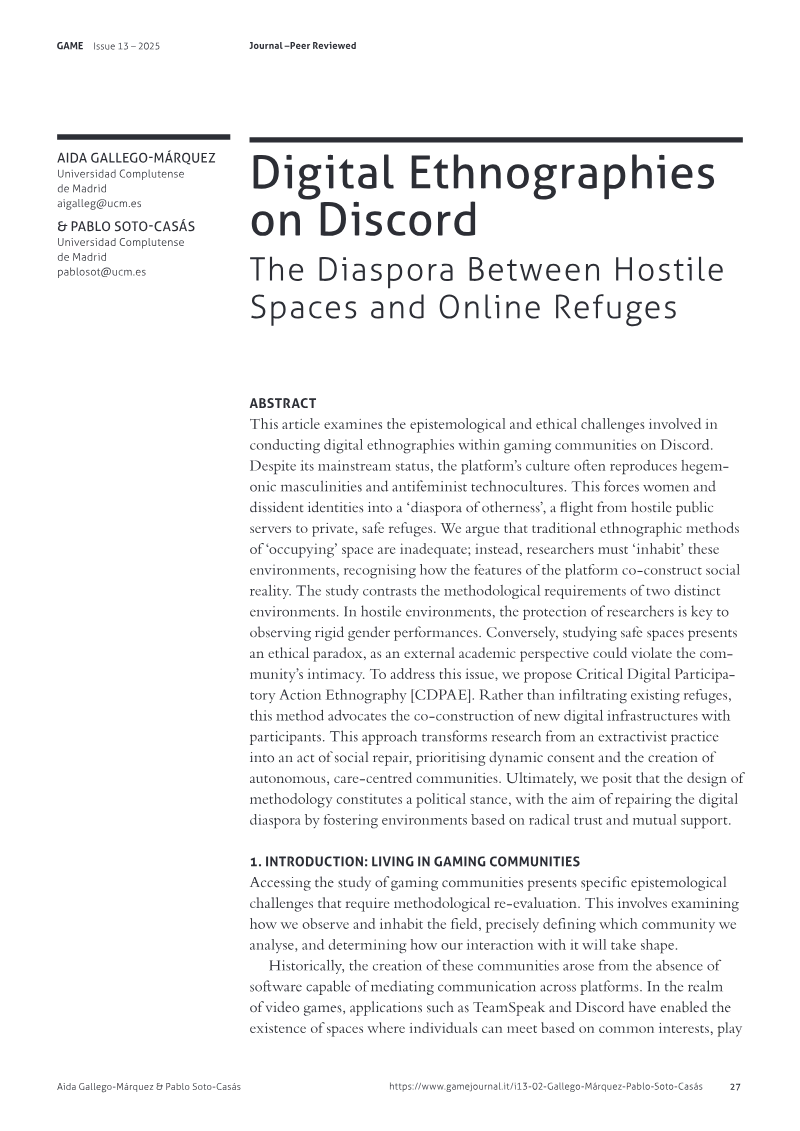
G|A|M|E – The Italian Journal of Game Studies · 2026
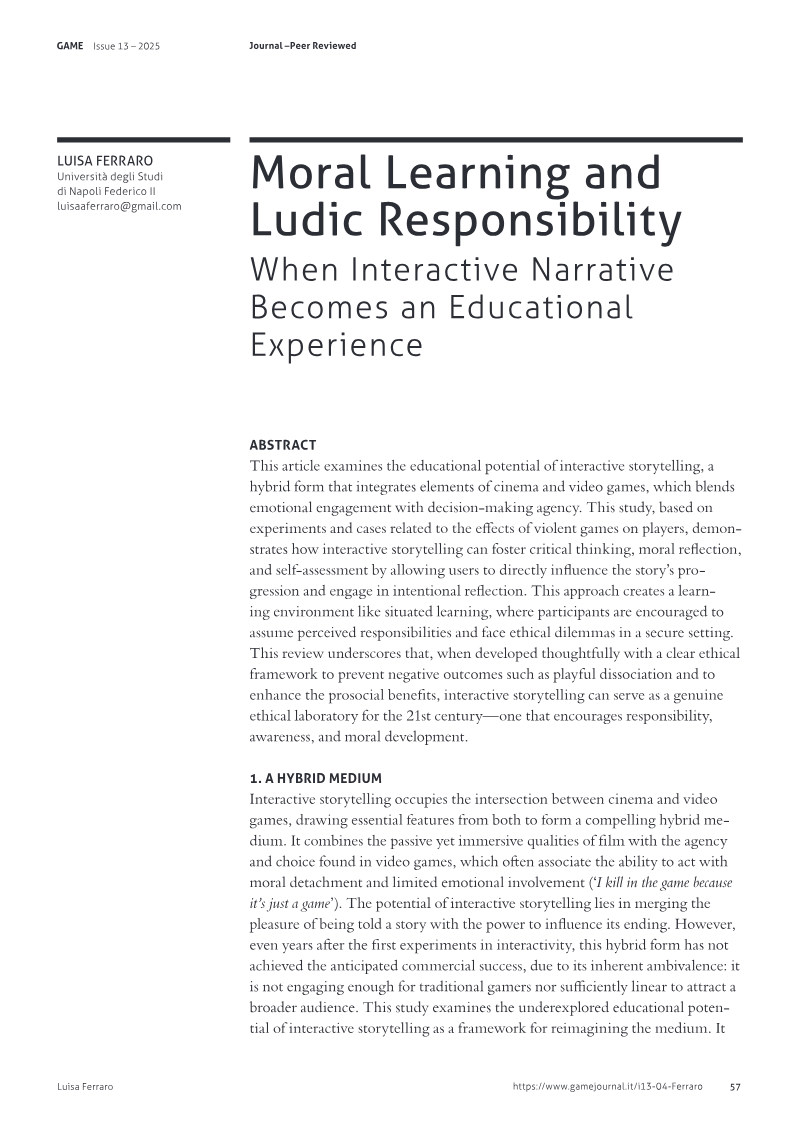
G|A|M|E – The Italian Journal of Game Studies · 2026
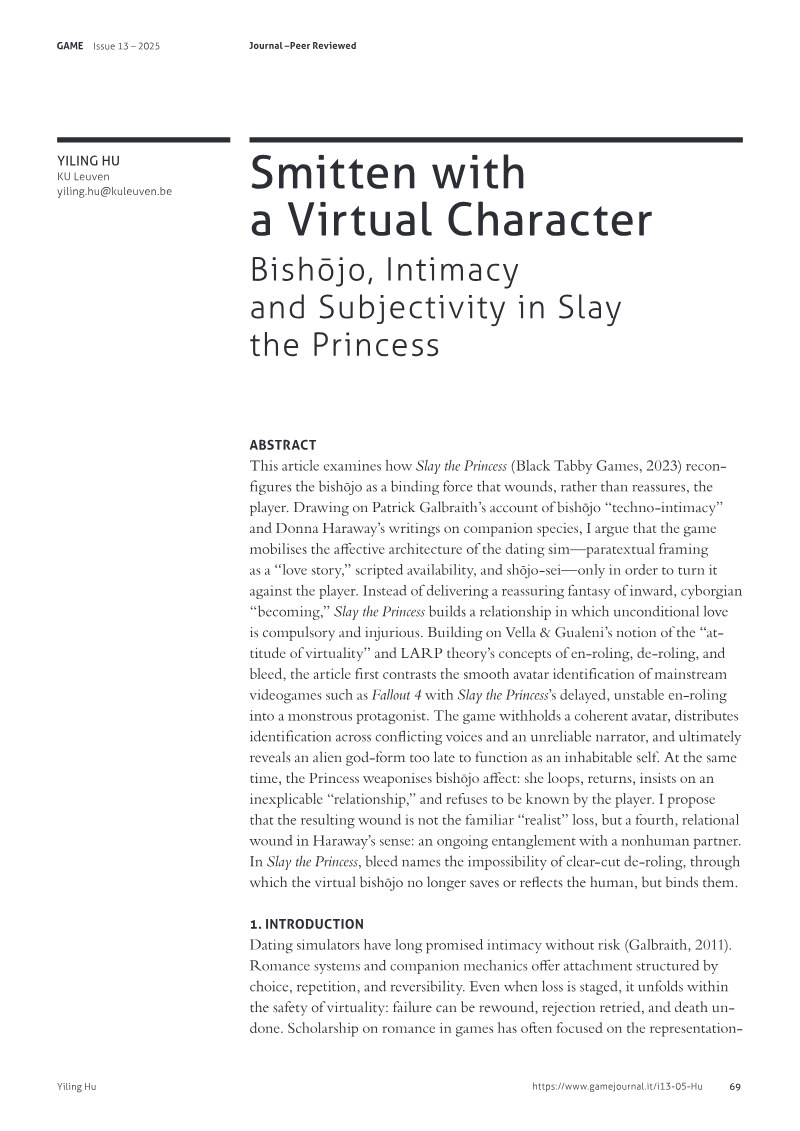
G|A|M|E – The Italian Journal of Game Studies · 2026
G|A|M|E – The Italian Journal of Game Studies · 2026
G|A|M|E – The Italian Journal of Game Studies · 2026
G|A|M|E – The Italian Journal of Game Studies · 2026
G|A|M|E – The Italian Journal of Game Studies · 2026
G|A|M|E – The Italian Journal of Game Studies · 2026
G|A|M|E – The Italian Journal of Game Studies · 2026
G|A|M|E – The Italian Journal of Game Studies · 2026
G|A|M|E – The Italian Journal of Game Studies · 2026
Two & a Half Gamers · 2026