Homo Ludens
Publishes academic articles and reports on video games, in Polish and English. Topics include game psychology, player aggression and addiction, the uncanny valley, game spaces, game law and Polish RPG fandom.
Documents
Play in Poland: Promoting Play in Gedania 1922 Preschool and CreoGedania Alternative School
This paper examines five years of introducing free play into Gedania 1922 Preschool and the CreoGedania alternative school in Gdańsk, Poland, while situating these efforts within the broader state of play in Polish education.
- Free play forms the core of the Gedania 1922 Preschool and CreoGedania alternative school in Gdańsk, Poland, which has spent five years introducing it alongside science-based activities in physics, chemistry, and astronomy, with computer tasks limited to roughly 10% of classes.
- The author argues free play supports cognitive, emotional, social, and physical development, and that Polish schools need structural change, including more unstructured play and stronger emphasis on soft skills such as communication, empathy, and conflict resolution.
- The schools' outdoor spaces expanded from the Playpod, opened in 2016 with parental help, to GratoSfera in 2018, a larger area built from 12-metre shipping containers filled with loose parts, where teachers intervene only in conflicts and children return materials to their designated places.
The Great War as a Theme of Video Games: Challenges for Edutainment in Valiant Hearts and Battlefield 1
Video games set during the Great War have grown into a distinct thematic category, and this paper examines their potential as educational tools through a comparative analysis of Valiant Hearts and Battlefield 1.
- Valiant Hearts is presented as the stronger educational vehicle of the two titles, praised for emotionally resonant, diverse narratives that place military events within social, economic, and cultural context, though critics flag a Franco-centric perspective and negative portrayal of German characters.
- Battlefield 1 is judged to have a convincing historical setting but weaker educational value, because its informative content is tied to violent tasks, its multiplayer emphasizes stylized combat, and it departs from historical realism to serve gameplay.
- Edutainment is framed as the combination of engagement and learning, distinguishing purpose-built serious games from mainstream commercial titles; its benefits include intrinsic motivation, while its risks include entertainment overshadowing instruction.
Recipe for Game Lending Libraries: Participatory Budget as a Way of Financing the Creation of Game Lending Libraries in Poland
This article examines how participatory budgets (budżety partycypacyjne/obywatelskie) can finance the creation of toy and game lending libraries in Poland, using the Warsaw project "Wypożyczalnie gier planszowych w bibliotece" as a case study.
- Participatory budgets are presented as an effective financing tool for establishing board game lending collections within existing public libraries in Poland, using Warsaw's "Wypożyczalnie gier planszowych w bibliotece" project as the central case study.
- Participatory budgeting spread rapidly after first appearing in Sopot in 2011, reaching 62 Polish cities by 2013.
- Warsaw recorded 27 proposals for game lending libraries in libraries, media centers, or cultural houses, all of which were funded, while Kraków and Katowice had only one proposal each among the voivodeship cities analysed.
Codified Gestures and Scenic Learning: Two Techniques Based on Gestures and Body Movement for Enhancing English Language Learning in the Primary Classroom
This paper examines two embodied techniques for teaching English to primary school pupils: codified gestures, in which each gesture carries a dictionary-style meaning linked to a word, and scenic learning, a drama-derived method combining choral repetition of text with body movement and facial expression.
- Two embodied techniques are examined for teaching English to primary pupils: codified gestures, where each gesture carries a dictionary-style meaning tied to a word, and scenic learning, a drama-derived method combining choral text repetition with body movement and facial expression.
- The empirical component is a five-day theatrical project in one rural Wielkopolska primary school (2017/2018) with 50 grade five and six pupils randomly assigned to the two gesture-based conditions.
- Knowledge of English prepositions of place and movement was tested one week before, immediately after, and six weeks after the project, across several test variants at three difficulty levels.
Leadership, Circuition, and Shift in Tabletop Wargaming Community
This paper, by Jacek Mianowski of Kazimierz Wielki University in Bydgoszcz, examines the life cycle of tabletop wargaming communities, covering how groups form, how they sustain themselves, and the mechanisms that lead to their decline.
- The report proposes a three-stage model of wargaming community development: small group dynamics, organised play once a group reaches roughly six or more active players, and national and international competition with events of twenty to over a hundred participants.
- Community sustainability depends on engaged players willing to act, support from local hobby shops and publishers, and games that remain appealing enough to attract new participants.
- Decline typically stems from power struggles, negative public discourse on social media, and the departure of community leaders, while revival requires a shift toward forward-looking conversation and renewed civic engagement.
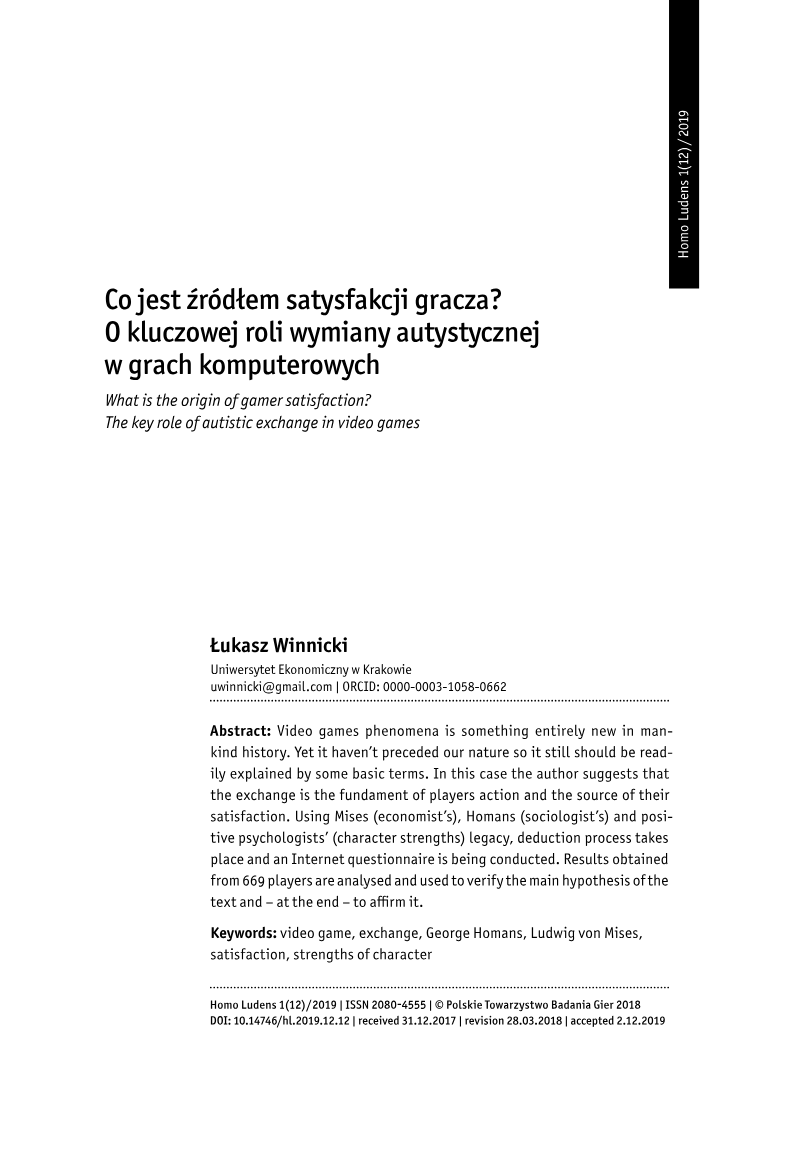
Co Jest Źródłem Satysfakcji Gracza? O Kluczowej Roli Wymiany Autystycznej w Grach Komputerowych
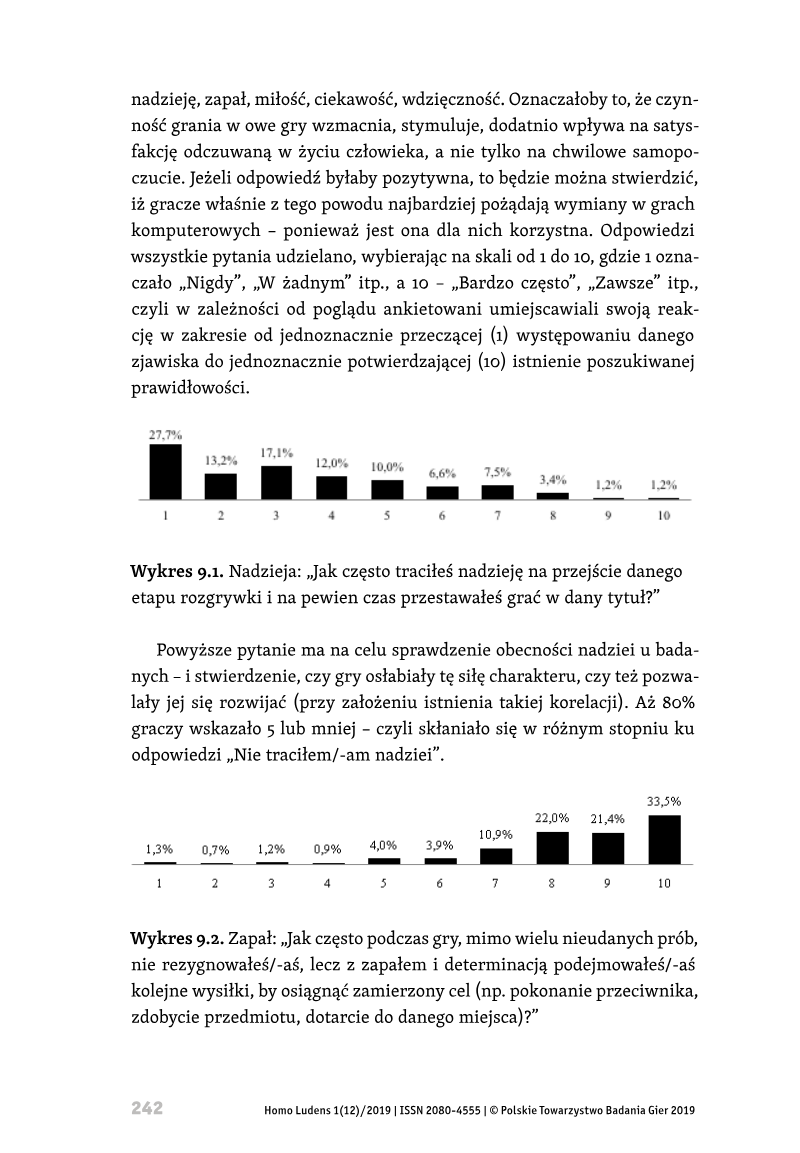
Łukasz Winnicki's article, published in Homo Ludens in 2019, argues that satisfaction in video games arises from what he terms "autistic exchange," a concept adapted from Ludwig von Mises in which an individual exchanges effort or time with their environment rather than with other people.
- Winnicki's 2019 article in Homo Ludens argues that satisfaction in video games stems from 'autistic exchange,' an indirect exchange of effort or time with the environment rather than with other people, adapted from Ludwig von Mises and tested against George Homans' five sociological exchange propositions, all of which the author concludes apply to gaming.
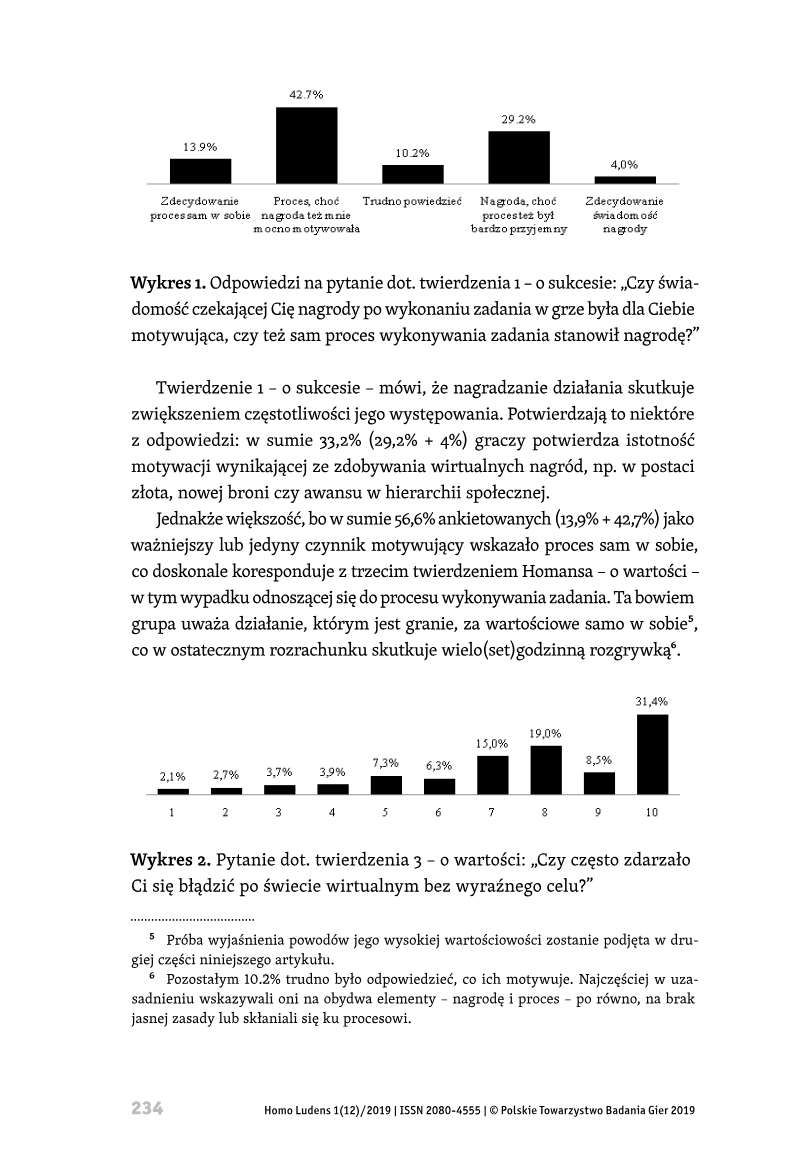
- The study's basis is an online survey of 669 respondents, predominantly young men who play computer role-playing games, in which 56.6% valued the gameplay process itself as rewarding and 33.2% cited reward-driven motivation.
- Roughly 70.7% of players reported anger after in-game setbacks, which often found aggressive outlets, yet about 66.2% felt better afterward, a pattern the author uses to support the Homans propositions.
Glitch as the Representation of the Uncanny in Oxenfree
Agata Waszkiewicz's article examines how the audiovisual glitch functions as a representation of the uncanny in Oxenfree (2016), a narrative-driven independent game by Night School Studio that blends Gothic mystery with coming-of-age storytelling.
- Waszkiewicz argues that the Gothic finds a natural home in video games because players are both active participants and passive recipients of a predetermined story, and that glitch is a key device for expressing the uncanny in Oxenfree (2016), developed by Night School Studio.
- In Oxenfree, glitches act as a visual marker of the rift between the living and the spectral world, distorting the image to disorient players and mirror the characters' unease.
- The article distinguishes spontaneous glitches (code errors) from deliberately designed 'glitch-alike' effects, and classifies Oxenfree's glitches as the latter.
From Symbolism to Realism: Physical and Imaginary Video Game Spaces in Historical Aspects
This study examines how the physical and imaginary spaces of video games have developed from early symbolic representations toward increasingly realistic and detailed worlds.
- The study argues that video game spaces evolved from abstract, symbolic settings in early titles like Spacewar!, Space Invaders, and Asteroids toward increasingly realistic, continuous, and detailed worlds, a shift tied to technological advancement.
- The analysis frames early game spaces as simplified 'allegories of space' in the sense described by Espen Aarseth, relying heavily on player imagination to fill in what the graphics did not show.
- Key milestones in the trajectory include the flip-screen technique in Adventure and Gravitar, the side-scrolling and off-screen virtual space introduced by Defender (1980/1981), the 2D era of Super Mario Bros. (1985) and Contra (1988), the pseudo-3D of Wolfenstein and Doom, and the true 3D turn of Super Mario 64 on the Nintendo 64.
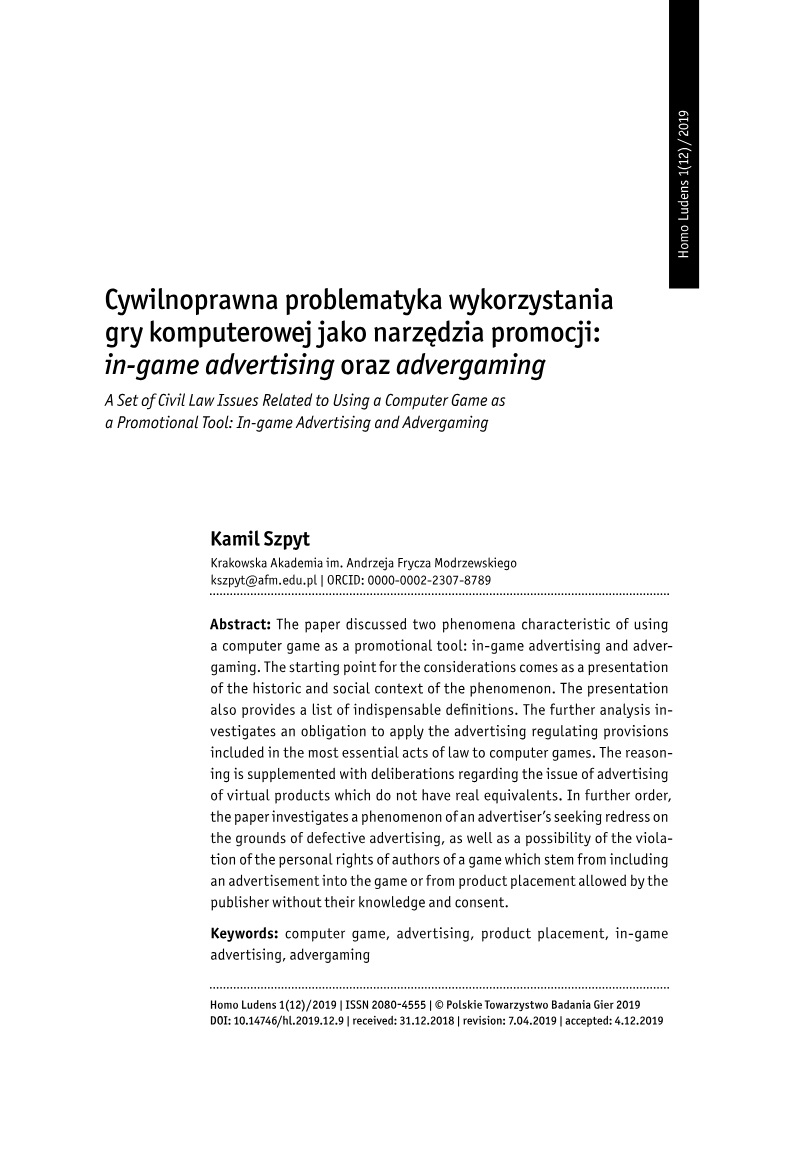
Cywilnoprawna Problematyka Wykorzystania Gry Komputerowej Jako Narzędzia Promocji: In-Game Advertising Oraz Advergaming
This academic study, published in 2019 in the Polish journal Homo Ludens by Kamil Szpyt, examines the civil-law dimensions of using computer games as promotional vehicles, with particular attention to in-game advertising, including product placement, and advergaming.
- The paper's central thesis is that existing Polish civil law is largely adequate to govern in-game advertising and advergaming, so game-specific legislation is unnecessary, though courts and scholars must interpret those rules in light of the medium's distinctive characteristics.
- The Audiovisual Media Services Act and the Press Law do not apply to games, because games lack the separate whole, simultaneous reception, and periodicity these statutes require, while most other advertising regulations, such as the Act on Counteracting Alcoholism, do apply.
- Legal uncertainty persists for brand extensions into virtual goods and loot boxes, which had not yet been classified as gambling under Polish law as of the study's 2019 publication.
Two Faces of Flow: Preliminary Results From a Game Addiction Study
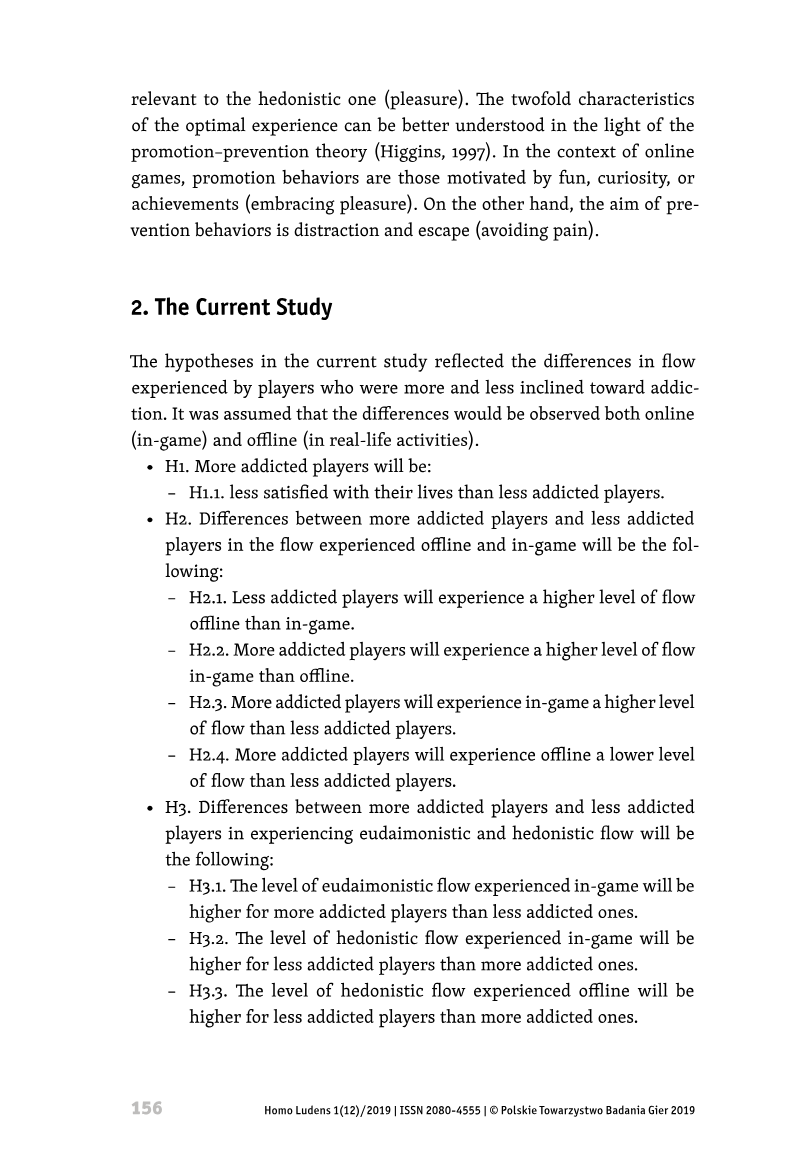
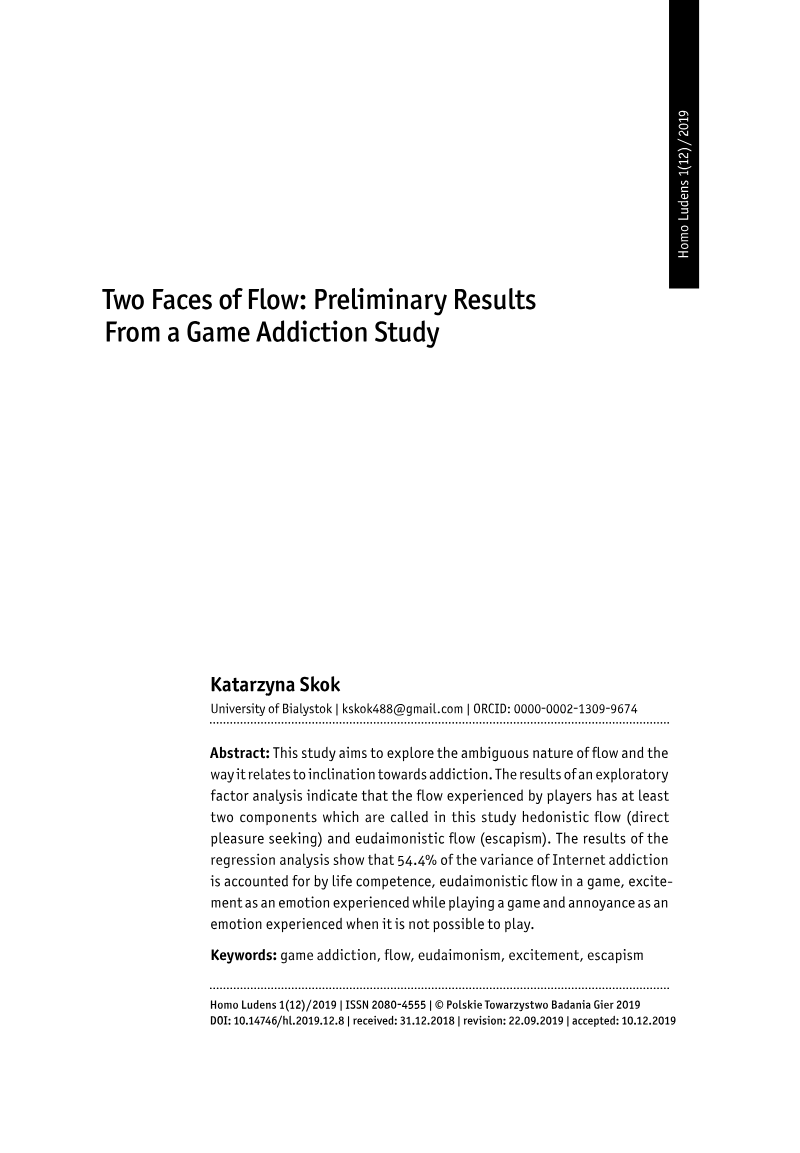
Preliminary research on game addiction examines whether the psychological experience of flow in gaming is uniform or divided into distinct components with different implications for player well-being.
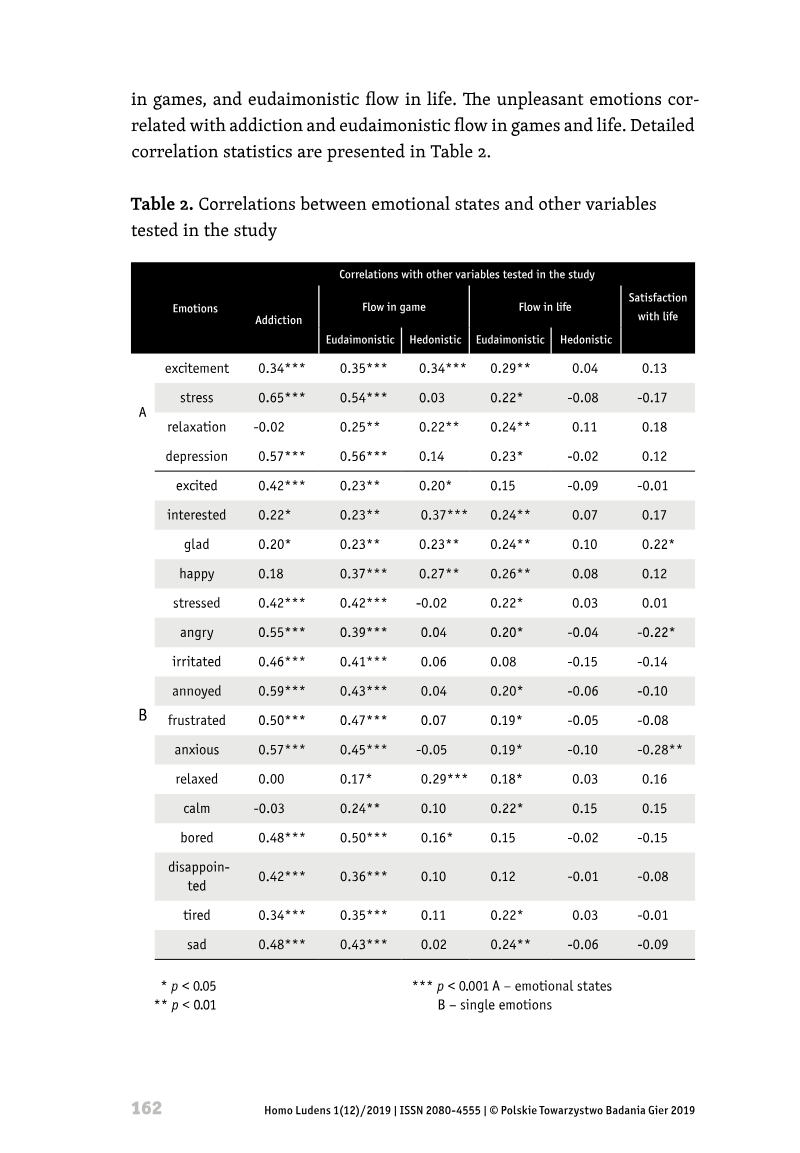
- The study distinguishes hedonic flow (play pursued for pleasure) from eudaimonic flow (play used as escapism), arguing that the two relate differently to addiction.
- Hedonic flow remains the dominant gaming experience across players, while eudaimonic flow is markedly elevated among addicted players, suggesting it functions as a compensatory strategy rather than simple enjoyment.
- Among 111 fully completed surveys of non-clinical participants, addicted players averaged 3.21 on in-game eudaimonic flow versus 2.55 for less addicted players, alongside lower life satisfaction.
Uncanny Valley in Video Games: An Overview
Dawid Ratajczyk's review examines the uncanny valley hypothesis, originally proposed by Masahiro Mori in 1970, and its application to video game characters.
- The uncanny valley hypothesis, first proposed by Masahiro Mori in 1970, holds that increasingly realistic but imperfect human characters can provoke eeriness rather than engagement, and rising rendering power alone may not resolve this.
- Empirical studies generally support a non-monotonic relationship between realism and likability, with some identifying multiple uncanny dips rather than a single one.
- The eyes and facial regions appear to be the most important triggers, while realism in inanimate environments does not seem to provoke the effect.
Aggressive Worlds: Aggression, Self-Esteem and MMORPG Gamer Playstyles
This study examines the relationship between self-esteem, aggression, and playstyle preferences among massively multiplayer online role-playing game (MMORPG) players, situating the inquiry within Polish debates over video game violence and industry self-regulation.
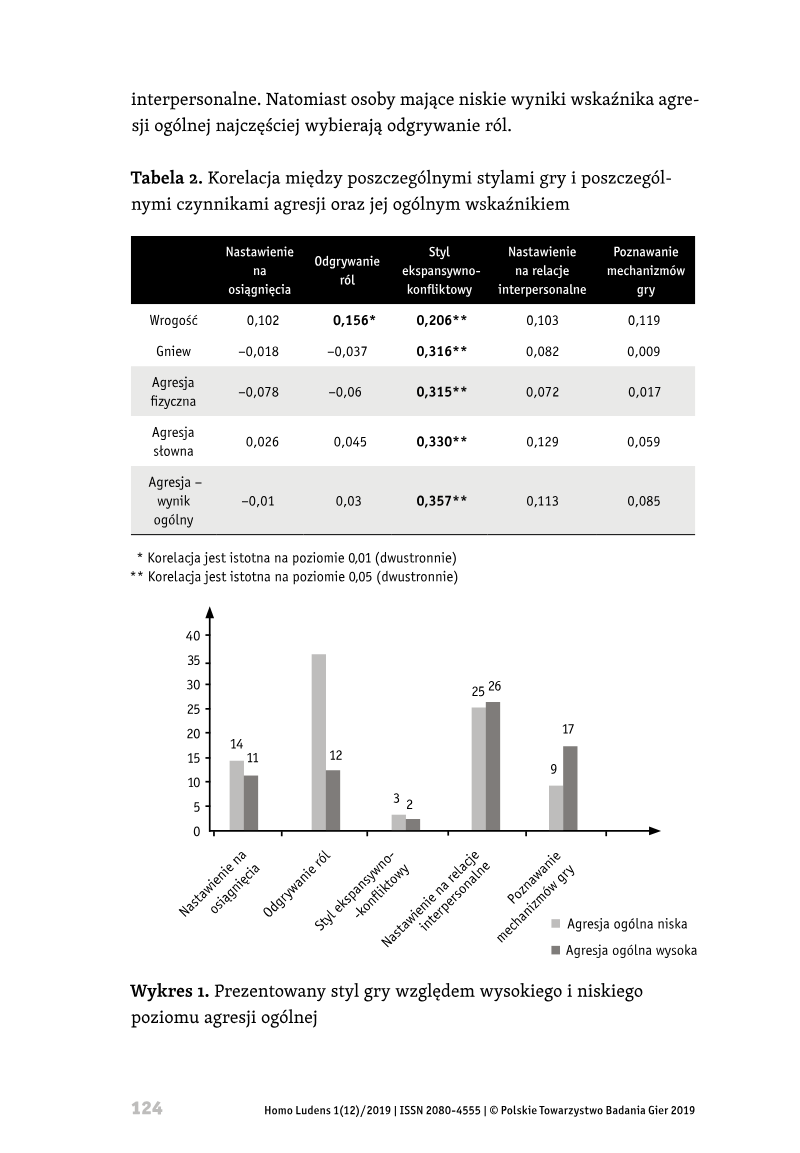
- Lower self-esteem is linked to higher hostility, anger, and overall aggression among MMORPG players, based on an online survey of 192 male players conducted in 2011.
- The expansive-conflict or "griefing" playstyle showed the strongest association with aggression, yet only 2.6% of respondents preferred it.
- Players with high general aggression most often chose socializing-oriented play, while those with low aggression most often selected role-playing.
Reports about Homo Ludens
6 documents by other writers name Homo Ludens in the title or summary.
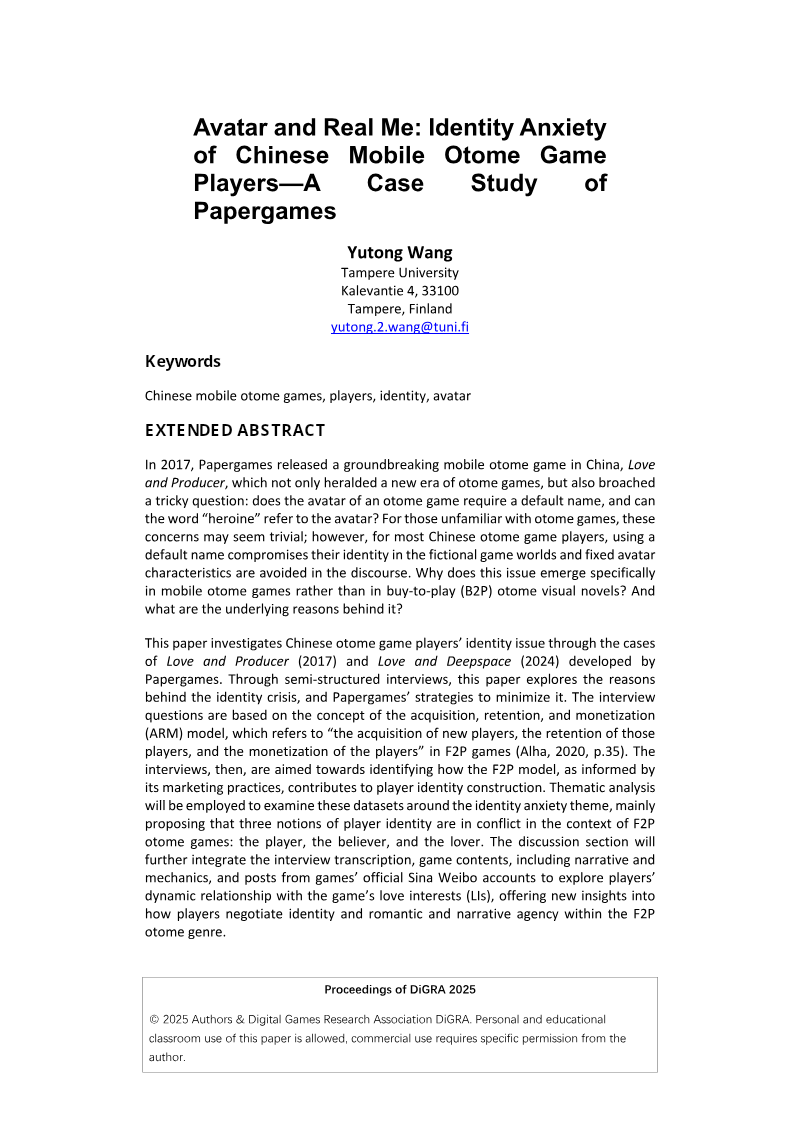
Avatar and Real Me: Identity Anxiety of Chinese Mobile Otome Game Players: A Case Study of Papergames
This paper examines identity anxiety among Chinese players of free-to-play mobile otome games, using Papergames' Love and Producer (2017) and Love and Deepspace (2024) as case studies.
- The paper argues that existing otome game scholarship, which treats avatars as stable and players as closely identifying with them, fails to explain mobile players, who often reject or feel unease toward their avatar's presence in the two-dimensional game world.
- Within free-to-play otome games, the paper proposes that three identities, the player, the believer, and the lover, come into conflict, and it distinguishes mobile otome games from buy-to-play otome visual novels in how player identity is constructed.
- The study uses semi-structured interviews with thematic analysis organized around the acquisition, retention, and monetization model, supplemented by game narrative and mechanics and official Sina Weibo posts from the developers; the interview sample size is not specified in the extended abstract.
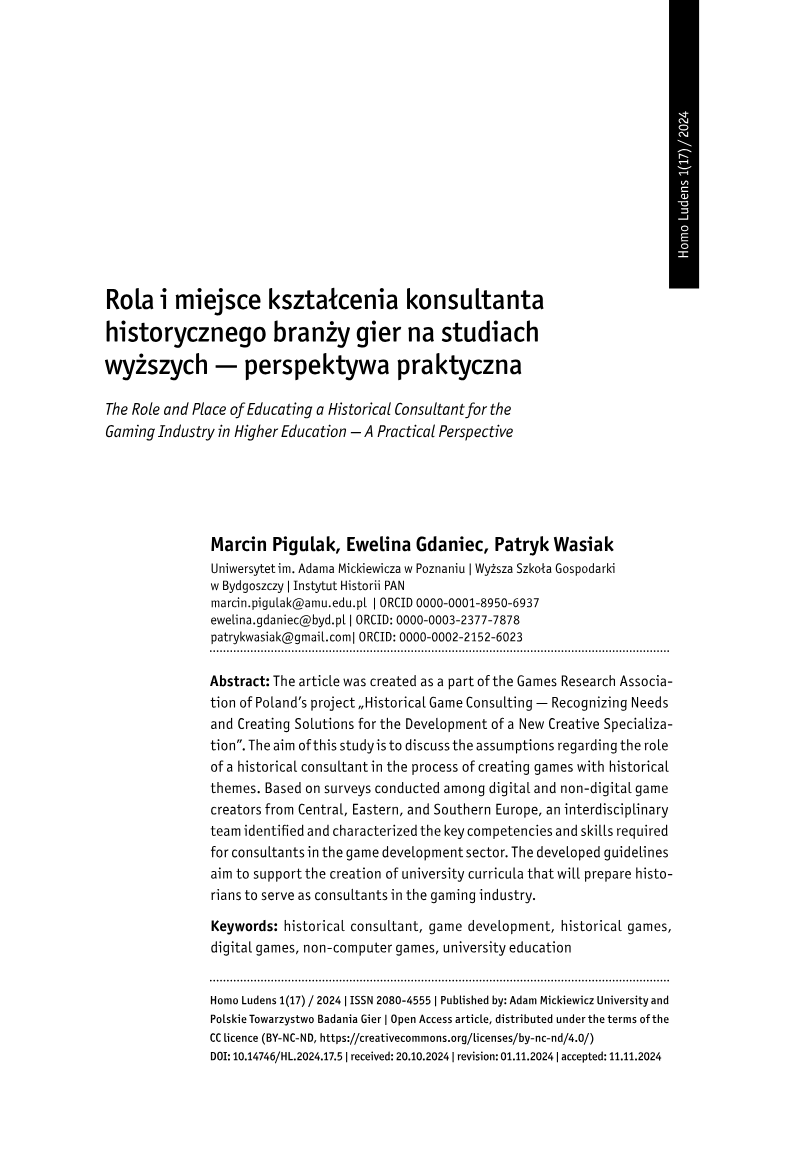
The Role and Place of Educating a Historical Consultant for the Gaming Industry in Higher Education: A Practical Perspective
This study, authored by Marcin Pigulak, Ewelina Gdaniec, and Patryk Wasiak and published in Homo Ludens in 2024, examines the emerging role of historical consultants in the game industry and argues that universities should deliberately prepare historians for this work.
- Historical games increasingly shape public perceptions of the past, so the authors argue universities should deliberately train historians to work as game consultants.
- Survey respondents across Central, Eastern, and Southern Europe, with a focus on Poland, said consultants add value by ensuring authenticity, enhancing immersion and reputation, and saving development time.
- Polish game development is dominated by small studios: in 2023, 316 of 494 Polish firms had teams under 25 people, which leaves consultant responsibilities varied and often ill-defined.

Playing A|part Together in Animal Crossing: New Horizons During the COVID-19 Pandemic
This study examines how Animal Crossing: New Horizons functioned as a social space for players during the COVID-19 lockdowns of 2020.
- The study combines a collective autoethnography by eleven Quebec-based researchers with a computer-assisted analysis of 47,643 English-language, pandemic-related tweets posted between March and June 2020 about Animal Crossing: New Horizons.
- Players framed the game primarily as a place to maintain friendships, with "friend" and "hang" at the center of the main lexical network of pandemic-related tweets.
- A subset of 16,626 "date"-related tweets showed the game was frequently used for virtual dates, though many were sarcastic or involved non-player characters rather than genuine romantic partners.



Brazil Games Industry Report 2022
Brazil's games industry has grown rapidly and is maturing, though it remains highly concentrated and constrained by funding, tax, and talent problems.
- Brazil is the 12th largest games market globally and the leader in Latin America, generating approximately USD 2.3 billion in 2021.
- The industry has experienced rapid expansion, with a 102% increase in active studios since 2018 and a 336% revenue increase in USD since 2015.
- The sector is shifting toward original intellectual property, with 93% of companies now focusing on proprietary IP rather than a pure service-provider model.
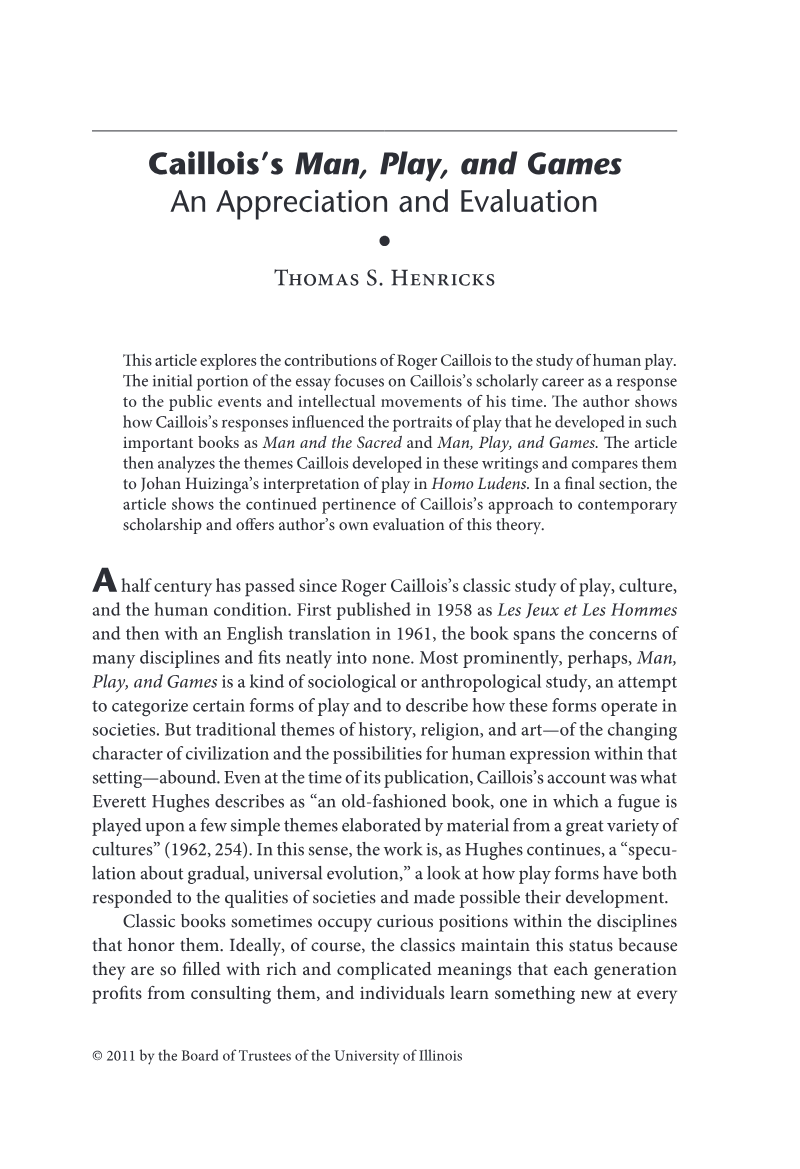
Caillois's Man, Play, and Games: An Appreciation and Evaluation
Thomas Henricks's appreciation of Roger Caillois's Man, Play, and Games (1958) revisits a book best known for its typology of play and its response to Johan Huizinga's Homo Ludens, while drawing attention to its less examined concern with the corruption of play in modern society.
- Caillois argues that Huizinga wrongly equated play with the sacred: play is defined by free, self-controlled engagement, whereas ritual imposes obligation and submission to a higher force.
- Caillois proposes a fourfold typology of play, agôn (competition), alea (chance), mimicry (simulation), and ilinx (vertigo), arranged on a continuum between improvisational paidia and rule-bound ludus, a distinction that remains foundational in game studies.
- Caillois contends that unchecked play impulses can degenerate into obsession, greed, or self-delusion, and treats the decline of fair play in a profit-driven, cynical society as a central concern.
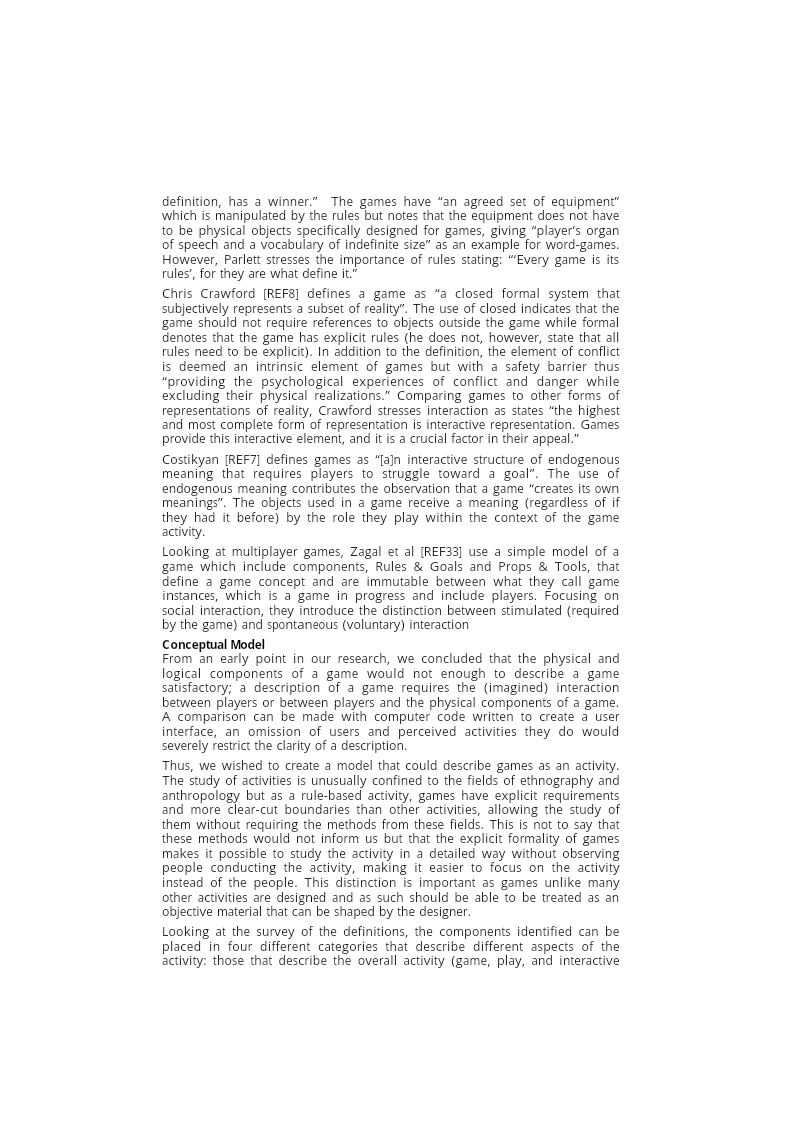
Describing Games: An Interaction-Centric Structural Framework
Björk and Holopainen's "Describing Games: An Interaction-Centric Structural Framework" proposes a vocabulary for describing games that serves as a bridge between abstract game theory and the practical needs of game designers.
- The framework's core contribution is a shared terminology for describing game structure and player interaction, rather than empirical findings.
- Björk and Holopainen argue that existing models from game theory and play theory are either too abstract to guide design or too narrow to apply broadly, and position their interaction-centric structure as a complement to game design patterns.
- The framework organizes game components into four categories: holistic, bounding, temporal, and objective, with each core concept situated in one of them.