Homo Ludens
Publishes academic articles and reports on video games, in Polish and English. Topics include game psychology, player aggression and addiction, the uncanny valley, game spaces, game law and Polish RPG fandom.
Documents
Chess Movies Between Ludology and Visual History: An Introduction
This introduction argues that chess films deserve scholarly attention as a distinct genre, one that can be studied through an interdisciplinary framework combining ludology, the study of games, with visual history.
- The introduction argues that chess films merit scholarly study as a distinct genre, analyzed through an interdisciplinary framework combining ludology (the study of games) with visual history, on the premise that each film reflects its era and society's changing perceptions of chess.
- The author proposes a three-part typology of chess films: those where chess is central to the plot, those where it functions as metaphor, and those where it serves as a stylistic prop, framed as parallel to sport films that operate as both entertainment and historical evidence.
- The survey spans a broad period from 1925 to 2020 and covers a filmography of 83 titles, with emphasis on Polish and Montenegrin documentary and fiction film alongside major international works.
Turn-of-the-Century Anxieties: Sanitarium and the Recovery of American Identity
Wojciech Sitek's article reads the 1998 adventure game Sanitarium (DreamForge Intertainment) as a cultural artifact of late-1990s American anxieties, arguing that the game's psychiatric-hospital setting, fragmented narrative, and apocalyptic undertones express a collective unease about national identity as the millennium…
- Sitek reads the 1998 adventure game Sanitarium (DreamForge Intertainment) as a cultural artifact of late-1990s American anxieties about national identity as the millennium approached.
- The article argues the game confronts national historical failures and warns of collapse, but ultimately offers a hopeful vision of renewal grounded in individualism and free-market values.
- Sanitarium's critique of late-capitalist America covers privatized healthcare, corporate exploitation, and buried traumas such as the treatment of Native Americans and human experimentation.
On Games and Playing and Their Aspects in the Bible and in the Koran
Włodzimierz Lapis's study, published in Homo Ludens (2021), examines how the Bible and the Quran conceptualize games, play, and competition, and it does so through close lexical and textual analysis of the two scriptures.
- The Bible frames the Christian life as an athletic contest, using the language of rivalry and contest (współzawodnictwo, zawody) and urging believers to strive for an imperishable crown (1 Corinthians 9; 2 Timothy 4). Competition is judged harmful when driven by envy or intrigue, but positive when it serves a good cause.
- The Quran describes worldly life as "mere play and amusement" and explicitly forbids the lottery-game maysir, which it calls a grave sin and a work of Satan, along with lot-casting and divination.
- Lapis concludes that the Bible places greater trust in human free will, while the Quran establishes firm prohibitions aimed at preventing harm and injustice, marking a sharp contrast in how the two traditions regulate play and chance.
Borrowing, Easter Egg and Centonization: The Case of The Witcher Series
This study examines intertextuality in CD Projekt Red's The Witcher series, arguing that borrowings, Easter eggs, and especially centonization provide a productive framework for understanding how the games are constructed and experienced.
- The study argues that centonization, a literary method of composing texts from borrowed quotations, paraphrases, and allusions, is the principal world-building mechanism of The Witcher 3: Wild Hunt.
- Borrowings in the series are decoded differently depending on the player's cultural competence, so the same element may be experienced superficially, as part of a metagame, or as a full act of interpretive decoding.
- The author draws on Teresa Cieślikowska and Ewa Okopień-Sławińska to argue that the game's borrowings go beyond Gérard Genette's standard account of intertextuality, creating a layered 'semantic journey' that deepens with the player's cultural knowledge.
The Image of Nikola Tesla and His Inventions in Digital Games
This study examines how the Serbian-American inventor Nikola Tesla is represented in digital games, drawing on twelve titles released through 2018 that feature him as a character.
- The study analyzes twelve digital games released through 2018 that feature Nikola Tesla as a character, using a cognitive definition method and Nikita Tolstoy's three-code framework to organize his attributes into seven categories.
- Across nearly all titles Tesla is depicted as slim, mustached, suited, exceptionally intelligent, and absorbed in his work, forming a consistent core image.
- Rivalry with Thomas Edison is the dominant relationship, appearing in about three-quarters of the games and often framed around the "War of Currents."
Video Game Market in Poland
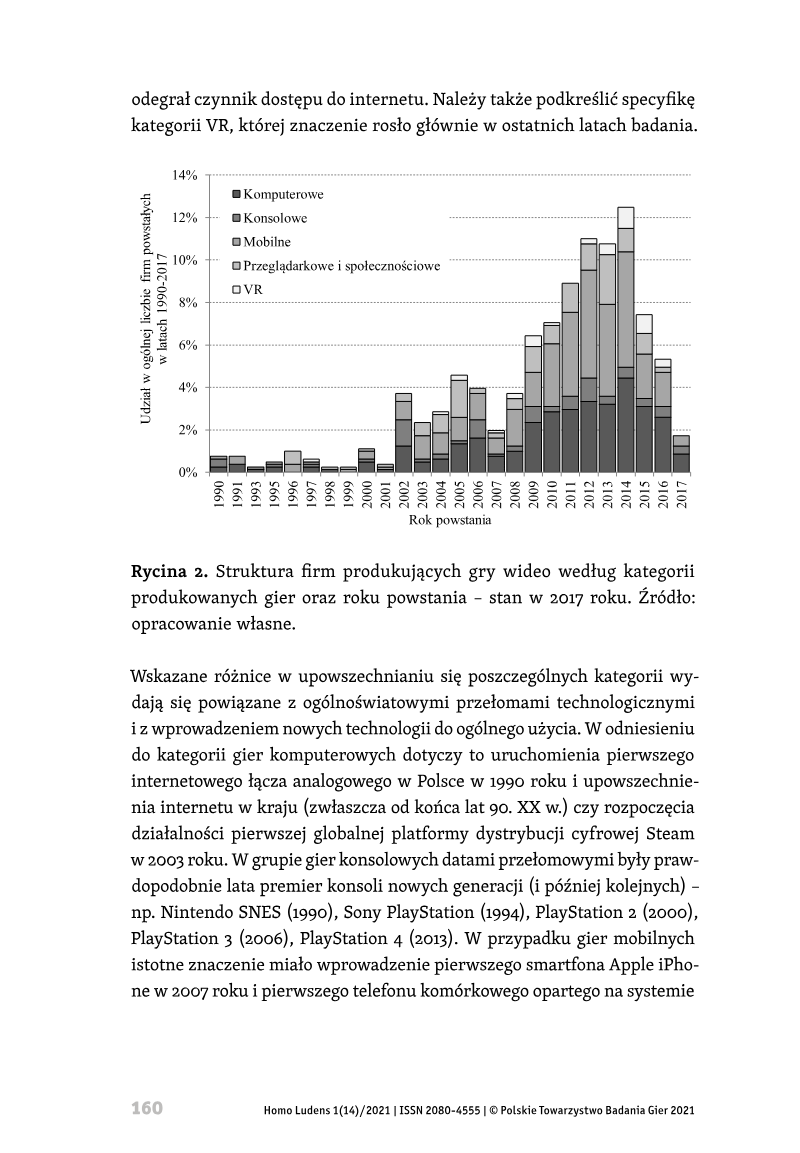
The study examines how the video game market in Poland took shape, focusing on game producers headquartered in the country as of late 2017.
- The study identified 621 video game producers in Poland via the Polish Gamedev database and supplementary sources, and after excluding foreign-registered, headquarterless, and inactive firms, analysed the remaining active producers as of late 2017.
- Most Polish producers are focused on a single category: 52% work in one category, about 30% in two, and roughly 16% in three or more.
- Mobile games are the most common output at 62% of firms, followed by PC games at 58%, browser and social games at 25%, and virtual reality at 7%.
Distanced Play, i.e. Adaptation of Ludic Tools in Distance Education
This paper, written in Polish by Paulina Kaźmierczak of the University of Łódź and published in 2021 in the journal Homo Ludens, examines how traditional ludic (game-based and play-based) teaching materials can be adapted for online instruction in Polish as a foreign language.
- Physical classroom tools, especially board games, do not transfer directly to remote lessons, so distance instruction requires deliberate adaptation of ludic materials.
- Paulina Kaźmierczak's 2021 paper (University of Łódź, published in Homo Ludens) frames the problem through Teresa Siek-Piskozub's categorisation of games, play, and simulations as core ludic strategies in language teaching.
- The author argues that instructors' digital skills and creativity matter as much as the availability of ready-made materials, which is especially important because resources for teaching Polish are far scarcer than for English.
Escape Room as an Adult Education Tool
This study examines whether escape rooms can serve as an effective adult education tool, a question the authors note has received little empirical attention despite growing interest in games for learning.
- Escape rooms can measurably improve adult knowledge: across eight nutrition questions in a study of 258 participants in five countries (Belgium, England, Finland, Israel, Poland), the share of correct answers rose after play, most sharply on calories in protein (37% to 72%) and complementary proteins (33% to 51%).
- The study tested 'Zombie Attack,' a nutrition-themed escape room developed under the EIT Food 'Games of Food' project, with puzzles covering balanced diet, protein science, and food's environmental impact, run between September and November 2018.
- Participants rated the experience as highly enjoyable without exception, though the sample may have skewed toward people who already favour this kind of entertainment.
Uncertainty in Games: Potential Benefits and Disadvantages
Katarzyna Skok's article, published in Homo Ludens in 2020, examines how uncertainty functions in games as a driver of player engagement and as a design tool with both benefits and risks.
- Uncertainty drives player engagement largely through dopamine release, with the strongest response when outcomes are neither fully predictable nor certain.
- Randomness can sustain compulsive, variable-reward engagement, but it frustrates players who perceive outcomes as luck-dependent rather than skill-dependent.
- Artificial intelligence can surpass humans in analytic games such as chess and Go, but remains comparatively limited in psychological games like poker, where opponent behavior and deception are central.
Educational Features of Gaming
This document, by Karol Kowalczuk of the University of Białystok and published in the journal Homo Ludens in 2020, argues that computer games have moved beyond their traditional identity as entertainment and possess genuine educational value that modern schooling should recognize and use.
- The paper argues that computer games have genuine educational value that modern schooling should recognize, positioning them as a practical alternative to lecture-based teaching that struggles to engage today's students.
- The core thesis is that games' multisensory, dynamic, and immersive qualities match the learning preferences of 'digital natives,' the generation raised with digital media, drawing on Marc Prensky's digital native/digital immigrant distinction.
- The argument is grounded mainly in theory rather than original empirical research, and the author explicitly acknowledges that its propositions require further empirical testing, a field still emerging in Polish video game studies.
Rhetorics and Mechanics of Player Safety in the Nordic-American Larp Discourse
Nordic-American larp safety discourse underwent a substantial transformation between roughly 2010 and 2019, moving from a risk-accepting culture to one oriented toward prevention.
- Nordic-American larp safety discourse shifted from a risk-accepting, immersionist culture (roughly 2010 to 2019) toward a prevention-oriented one, with early frameworks such as Hamlet (2002) and KAPO (2011) placing the burden of signaling distress on players through safe words.
- By around 2016 to 2017, the dominant view held that organizers and participants should take all reasonable steps to prevent harm, and responsibility for boundary violations shifted onto whoever crossed them, supported by consent and calibration mechanics such as the "OK check" introduced around 2012 to 2014.
- The author links this shift to the professionalization of larp through Nordic-American collaboration, citing the College of Wizardry and the New World Magischola.
Games in Glottodidactics of the Polish Language: Theoretical Perspective and Practical Conclusions
This article, written in Polish by Paulina Kaźmierczak of the University of Łódź, examines the use of games and playful activities in teaching Polish as a foreign language.
- Games should be treated as an integral component of Polish as a foreign language instruction rather than occasional filler, with the most effective tools combining several pedagogical functions at once.
- The article grounds its position in Huizinga's cultural theory of play and Teresa Siek-Piskozub's ludic strategy, in which the learner pursues the satisfaction of play while the teacher pursues defined lesson objectives.
- A survey of commercially available playful materials, mainly workbooks and teacher's books from the past decade, found that most fit several of Caillois's categories (agon, alea, mimicry, ilinx) and Siek-Piskozub's scheme at once.
Reports about Homo Ludens
6 documents by other writers name Homo Ludens in the title or summary.
Avatar and Real Me: Identity Anxiety of Chinese Mobile Otome Game Players: A Case Study of Papergames
This paper examines identity anxiety among Chinese players of free-to-play mobile otome games, using Papergames' Love and Producer (2017) and Love and Deepspace (2024) as case studies.
- The paper argues that existing otome game scholarship, which treats avatars as stable and players as closely identifying with them, fails to explain mobile players, who often reject or feel unease toward their avatar's presence in the two-dimensional game world.
- Within free-to-play otome games, the paper proposes that three identities, the player, the believer, and the lover, come into conflict, and it distinguishes mobile otome games from buy-to-play otome visual novels in how player identity is constructed.
- The study uses semi-structured interviews with thematic analysis organized around the acquisition, retention, and monetization model, supplemented by game narrative and mechanics and official Sina Weibo posts from the developers; the interview sample size is not specified in the extended abstract.
The Role and Place of Educating a Historical Consultant for the Gaming Industry in Higher Education: A Practical Perspective
This study, authored by Marcin Pigulak, Ewelina Gdaniec, and Patryk Wasiak and published in Homo Ludens in 2024, examines the emerging role of historical consultants in the game industry and argues that universities should deliberately prepare historians for this work.
- Historical games increasingly shape public perceptions of the past, so the authors argue universities should deliberately train historians to work as game consultants.
- Survey respondents across Central, Eastern, and Southern Europe, with a focus on Poland, said consultants add value by ensuring authenticity, enhancing immersion and reputation, and saving development time.
- Polish game development is dominated by small studios: in 2023, 316 of 494 Polish firms had teams under 25 people, which leaves consultant responsibilities varied and often ill-defined.

Playing A|part Together in Animal Crossing: New Horizons During the COVID-19 Pandemic
This study examines how Animal Crossing: New Horizons functioned as a social space for players during the COVID-19 lockdowns of 2020.
- The study combines a collective autoethnography by eleven Quebec-based researchers with a computer-assisted analysis of 47,643 English-language, pandemic-related tweets posted between March and June 2020 about Animal Crossing: New Horizons.
- Players framed the game primarily as a place to maintain friendships, with "friend" and "hang" at the center of the main lexical network of pandemic-related tweets.
- A subset of 16,626 "date"-related tweets showed the game was frequently used for virtual dates, though many were sarcastic or involved non-player characters rather than genuine romantic partners.



Brazil Games Industry Report 2022
Brazil's games industry has grown rapidly and is maturing, though it remains highly concentrated and constrained by funding, tax, and talent problems.
- Brazil is the 12th largest games market globally and the leader in Latin America, generating approximately USD 2.3 billion in 2021.
- The industry has experienced rapid expansion, with a 102% increase in active studios since 2018 and a 336% revenue increase in USD since 2015.
- The sector is shifting toward original intellectual property, with 93% of companies now focusing on proprietary IP rather than a pure service-provider model.
Caillois's Man, Play, and Games: An Appreciation and Evaluation
Thomas Henricks's appreciation of Roger Caillois's Man, Play, and Games (1958) revisits a book best known for its typology of play and its response to Johan Huizinga's Homo Ludens, while drawing attention to its less examined concern with the corruption of play in modern society.
- Caillois argues that Huizinga wrongly equated play with the sacred: play is defined by free, self-controlled engagement, whereas ritual imposes obligation and submission to a higher force.
- Caillois proposes a fourfold typology of play, agôn (competition), alea (chance), mimicry (simulation), and ilinx (vertigo), arranged on a continuum between improvisational paidia and rule-bound ludus, a distinction that remains foundational in game studies.
- Caillois contends that unchecked play impulses can degenerate into obsession, greed, or self-delusion, and treats the decline of fair play in a profit-driven, cynical society as a central concern.
Describing Games: An Interaction-Centric Structural Framework
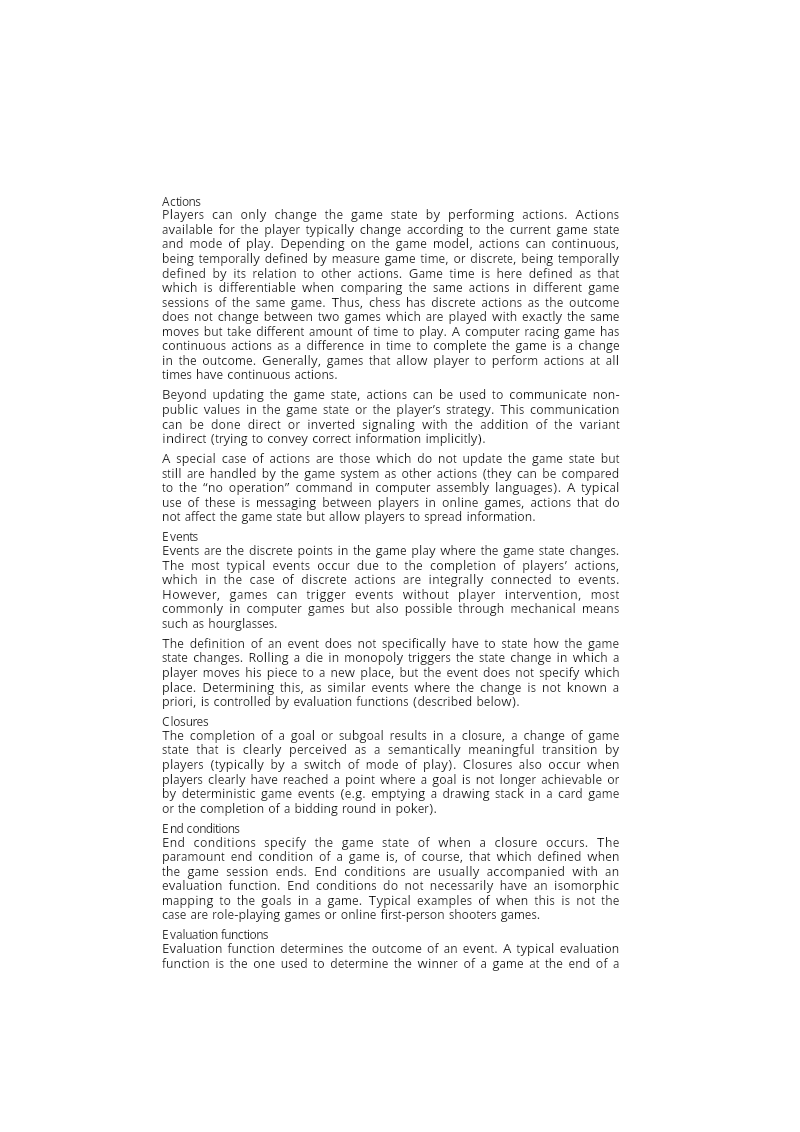
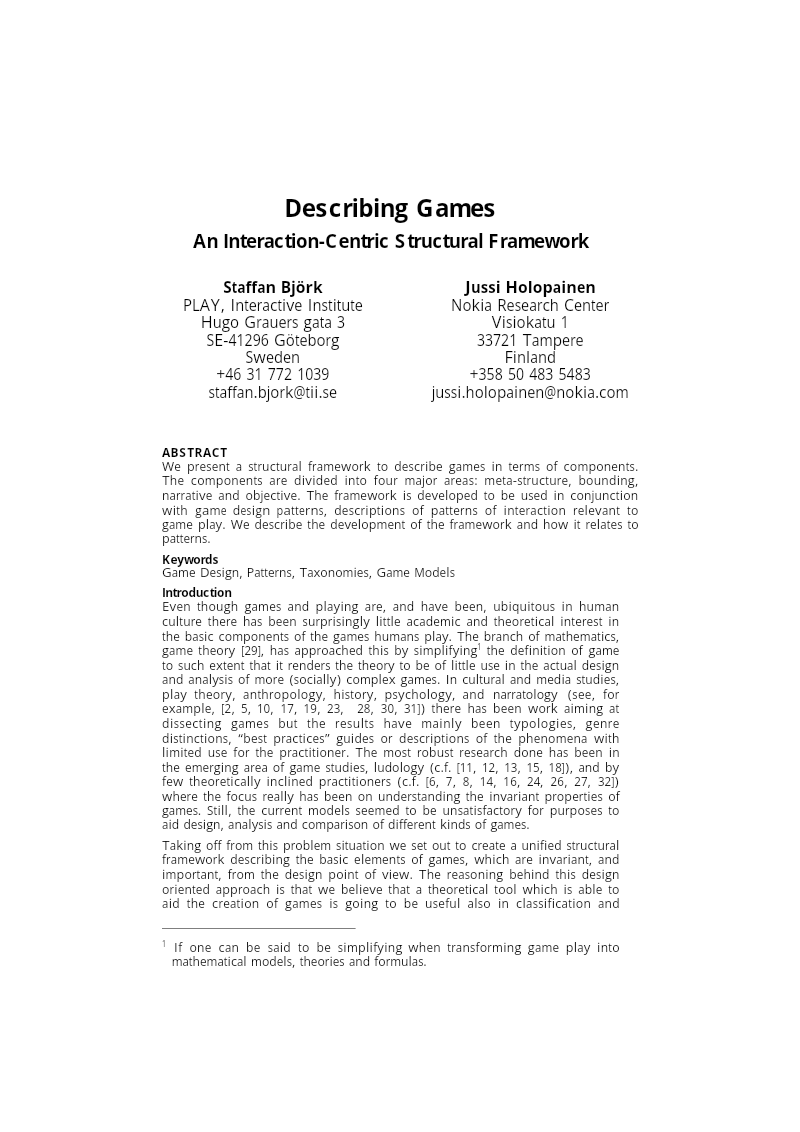
Björk and Holopainen's "Describing Games: An Interaction-Centric Structural Framework" proposes a vocabulary for describing games that serves as a bridge between abstract game theory and the practical needs of game designers.
- The framework's core contribution is a shared terminology for describing game structure and player interaction, rather than empirical findings.
- Björk and Holopainen argue that existing models from game theory and play theory are either too abstract to guide design or too narrow to apply broadly, and position their interaction-centric structure as a complement to game design patterns.
- The framework organizes game components into four categories: holistic, bounding, temporal, and objective, with each core concept situated in one of them.