Homo Ludens
Publishes academic articles and reports on video games, in Polish and English. Topics include game psychology, player aggression and addiction, the uncanny valley, game spaces, game law and Polish RPG fandom.
Documents
Geocaching, or Looking for Treasures
Geocaching is presented in this article as a GPS-based outdoor game in which participants locate hidden containers, called caches, using published coordinates.
- Geocaching is a GPS-based outdoor game in which players find hidden containers (caches) using published coordinates, and the author presents it as a tool for tourism, recreation, and education.
- The activity began in May 2000, when American Dave Ulmer hid a container in a forest and shared its coordinates with a GPS user group, and the first dedicated website launched in September 2000.
- By the time of writing, the global network listed roughly 3 million caches across 191 countries, with over 642 million logbook entries recorded.
Methods and Tools for Game Writing and Narrative Design in Professional Books
This review synthesizes methods and software for game writing and narrative design as presented in nine professional manuals published between 2019 and 2022, a corpus chosen for comprehensiveness after four narrower books were excluded.
- The review synthesizes methods and software from nine professional game-writing manuals published between 2019 and 2022, organized around eight topic areas and distinguishing theories, methods, and software as working categories.
- The most recurring recommendations across the sources are structured character and worldbuilding templates, iterative design, and story-gameplay integration techniques such as breadcrumbing, funneling, and gating.
- The sources sharply disagree on narrative structure: one author rejects the Three-Act Structure for games in favor of Nonlinear Modules, while another views most games as a middle ground between linear and fully nonlinear forms.
Dialogue in the Past and Nowadays: Group Work During Stationary and Distance Lessons
This article examines how group work, a staple of stationary language instruction, can be adapted to distance learning in Polish as a foreign language classes.
- The paper argues that the dialogic approach to teaching transfers readily to online Polish as a foreign language classes, provided instructors understand the basic mechanics of available digital tools.
- Nearly all stationary group methods, including whole-group discussion, brainstorming, collaborative storytelling, debates, World Café, and random team assignment, can be reproduced remotely with suitable online tools.
- Videoconferencing platforms Microsoft Teams, Zoom, and Google Meet support whole-class discussion and breakout rooms, but breakout functionality is not always available in free versions and is restricted in some Google Meet tiers.
E-Chess and Performatics
Jacek Szymala's "E-Chess and Performatics" proposes a framework for understanding chess, particularly computerized and online chess, through the concept of performatics, which he characterizes as causative, efficient, equal, and active.
- The report's central thesis is that computerization paradoxically diminishes chess's performativity by archiving games and eroding the 'here and now' immediacy of live spectatorship, even as it deepens human-computer collaboration.
- Jacek Szymala frames his analysis through 'performatics,' which he characterizes as causative, efficient, equal, and active.
- The author situates the shift toward technical performance and human-machine hybridity in the 1996–2006 period, marked by matches between Kasparov and Kramnik and computer opponents.
Polish Adaptation of the Igroup Presence Questionnaire
The Polish adaptation of the Igroup Presence Questionnaire (IPQ-PL) addresses the need for a validated instrument to measure presence, the subjective sense of being located within a virtual environment, which is widely regarded as a key determinant of the effectiveness of virtual reality and video game experiences.
- The Polish Igroup Presence Questionnaire (IPQ-PL) is a validated instrument for measuring presence, the subjective sense of being located within a virtual environment, which is treated as a key determinant of virtual reality and video game effectiveness.
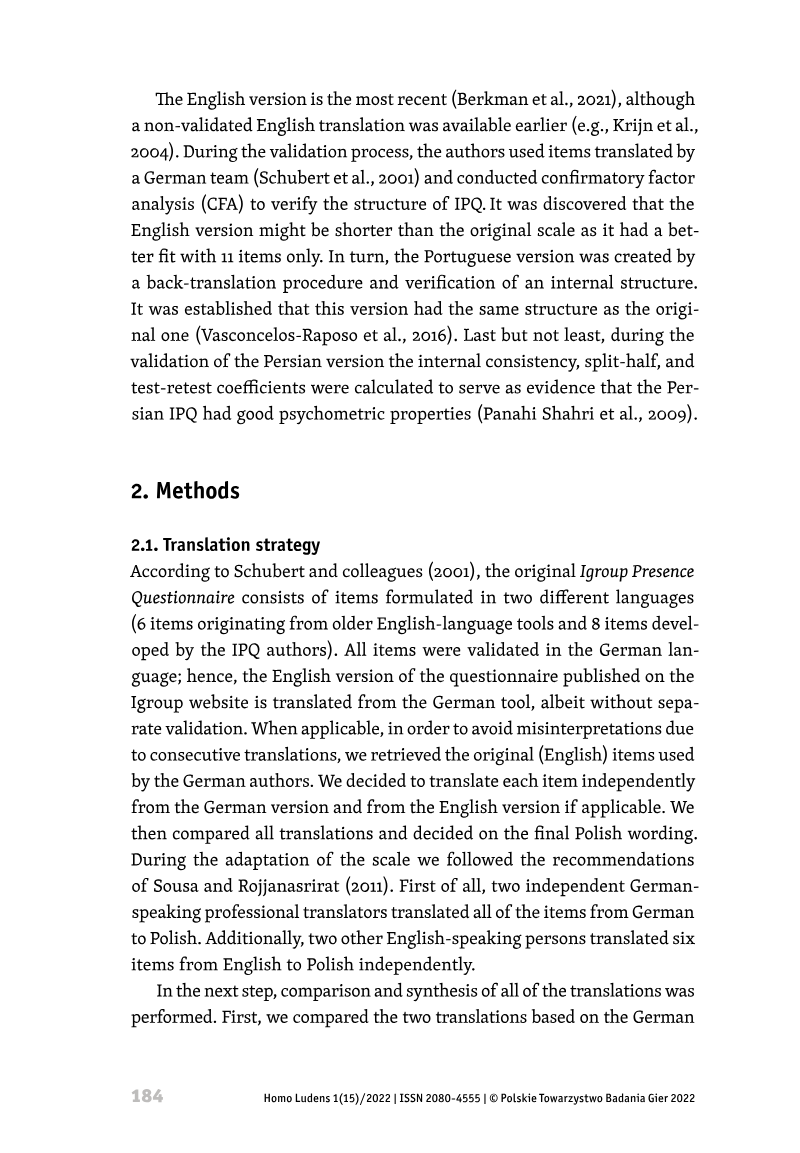
- The IPQ was chosen over the PQ, ITC-SOPI, and MEC-SPQ for its strong cross-national psychometric record and its separate perceived-realism dimension, and adaptation involved forward translations from German and English, synthesis, and a pilot study that standardized the term "virtual world."
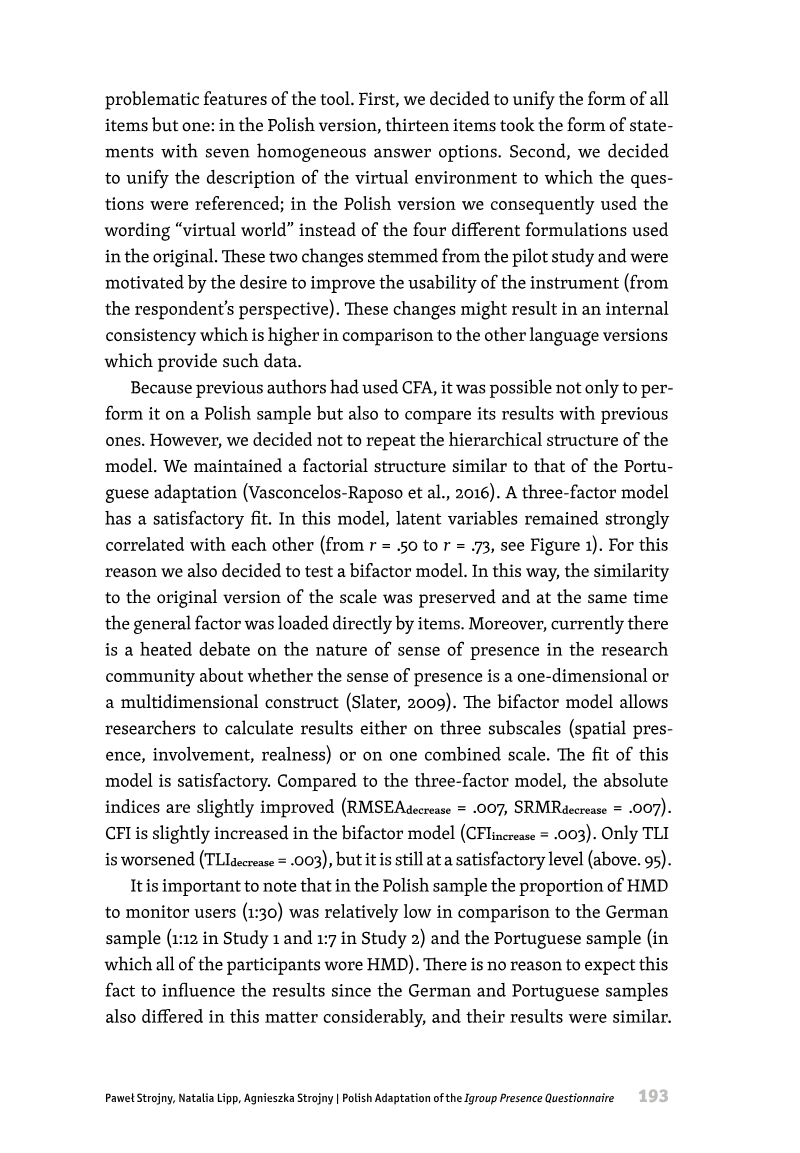
- Testing on 245 online participants (predominantly male, mean age 24, mostly regular monitor and third-person 3D game users) showed acceptable fit for both a three-factor model (CFI .969, RMSEA .061) and a marginally better bifactor model (CFI .972, RMSEA .054).
Sonic and Musical Realism in Historical Games
Pietruszewski's article argues that the audio-musical layer of historical video games is an underexplored source of immersion, one that has received far less scholarly attention than visual and narrative realism.
- Sonic authenticity in historical games is mostly achieved through stylization and deduction rather than strict historical accuracy, and reconstructing ancient soundscapes such as Egypt's is inherently speculative even when plausible.
- The study's central claim is that period-appropriate musical forms, instrumentation, and geographic placement enhance player immersion, with collective-memory associations doing much of the work of signaling 'the past' to listeners.
- A survey of 70 historical games, drawn largely from the IMDb Top 50 History Video Games list, sorted soundtracks into historical music, historicizing stylization tied to a location, and freely applied music.
Review of Educational Benefits of Game Jams: Participant and Industry Perspective
Kolek, Mochocki, and Gemrot's review examines whether game jams deliver educational value, with particular attention to the industry's perspective, an area the authors identify as underexplored.
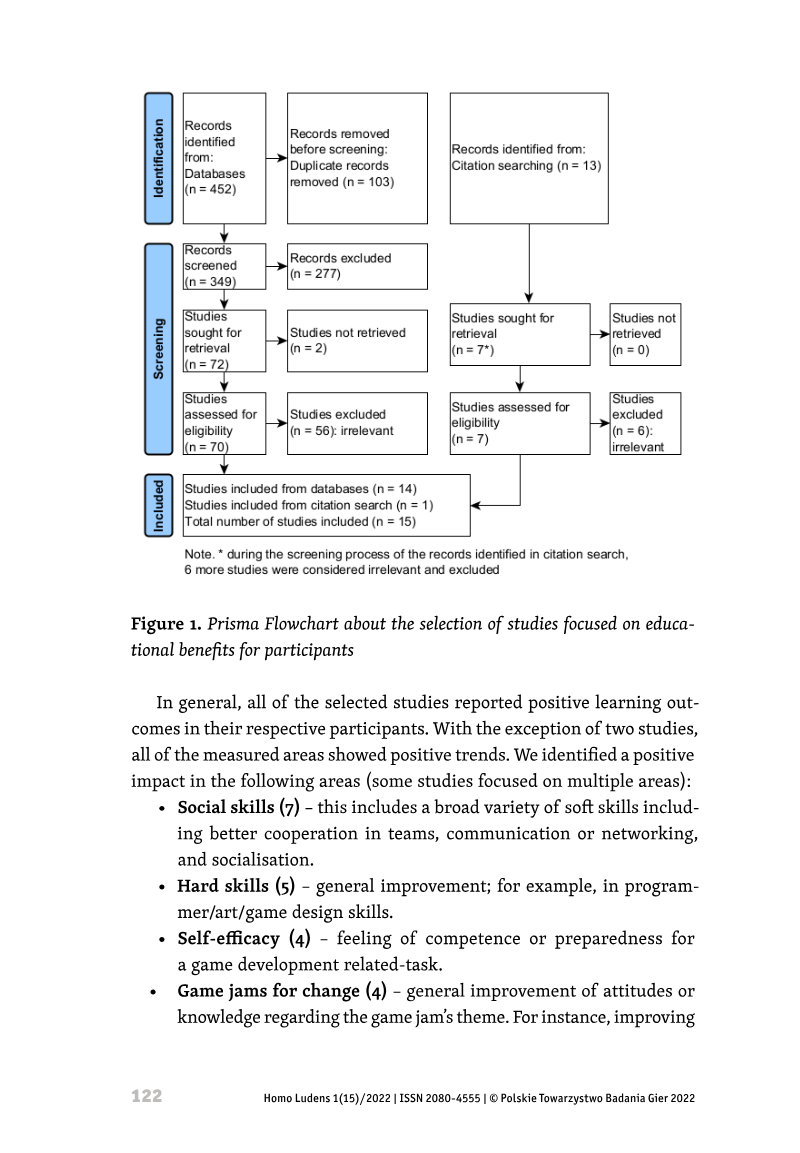
- Game jams are linked to skills valued by the games industry, but the participant evidence base is thin: of 15 empirical studies, most use small samples and only five include control groups.
- A systematic review screened 362 texts across ten academic databases, identifying 15 studies on participant learning outcomes and 12 on industry perspectives.
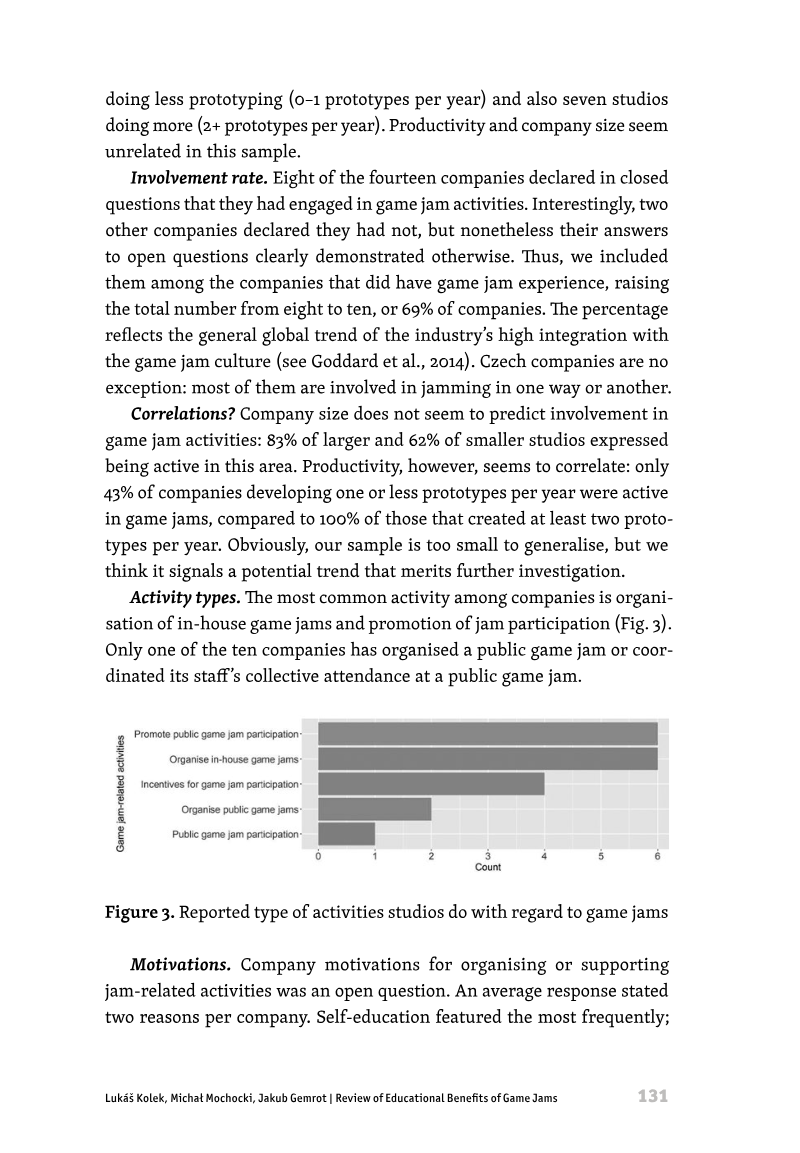
- The authors' own survey of 14 Czech game companies (early 2021) found 69% involved in jam activities, and all high-productivity firms (two or more prototypes per year) participated versus 43% of low-productivity firms.
Creating Interactive Board Games in Language Education: A Review of Tools
This article, written in Polish by Agnieszka Kruszyńska of the University of Łódź and published in 2022 in the journal Homo Ludens, examines how board games traditionally used in classroom language teaching can be adapted for distance learning.
- The article, by Agnieszka Kruszyńska of the University of Łódź and published in 2022 in the journal Homo Ludens, reviews how traditional classroom language-teaching board games can be adapted for distance learning.
- It clarifies terminology by distinguishing gamification from game-based learning and game-based pedagogy, and notes that teachers often misapply these labels to traditional word games.
- The core comparison evaluates six free online tools for building interactive board games: Genially, Google Slides, Flippity, Learnhip, Gamestructor, and QuizWhizzer, against criteria such as ease of editing, embedding text/audio/images, visual appeal, dice and token support, platform integration, and collaborative play.
Tracing Wajda: Polish Digital Games About World War II Between Center and Periphery
This study examines Polish digital games about World War II produced in the past decade, arguing that while earlier Polish titles treated the war as adventure or comedy, the 2010s brought a turn toward portraying it as national trauma.
- Polish digital games about World War II shifted in the 2010s from treating the war as adventure or comedy to portraying it as national trauma, with each examined title reproducing the martyrological framing associated with Andrzej Wajda's war trilogy.
- The study analyses three games released between 2011 and 2021: Ashes and Diamonds, Warsaw, and My Memory of Us.
- The analysis frames Polish developers as occupying a periphery relative to a cultural center identified with the American games industry, and notes that Western critics often dismissed their work as derivative.
Translation, Decoding, Game: A Case Study
This case study by Arkadiusz Jabłoński examines the translation and interpretation of a single song, "It Ain't Necessarily So" from George and Ira Gershwin's opera Porgy and Bess (1935), by framing these processes as language games in the sense proposed by Stanisław Barańczak.
- The study frames translation as a goal-directed, rule-governed 'language game' (after Stanisław Barańczak), where translators diagnose a source text's challenges, define the task, and propose a solution, and different readings of the same rules yield substantively different target texts.
- Using the Gershwins' 'It Ain't Necessarily So' from Porgy and Bess (1935) as its case, the author compares the existing Polish version (attributed to Andrzej Zaorski, popularized by Edyta Geppert in the 1980s) with a new 2021 translation the author produced.
- The earlier Polish version exhibits what the author calls extreme domestication: biblical motifs are treated superficially, several stanzas are omitted or substantially altered, and new material reflecting late-PRL political and religious conditions is added, which the author argues distorts the original's skeptical treatment of biblical narratives.
Nordic Culture and the Gothic as Commonplaces in Virtual Reality: Representation of Historical Style in Selected Examples of Fantasy Computer Games
Szymański's article, published in Homo Ludens in 2021, examines how fantasy computer games reproduce historical art styles, particularly Nordic and Gothic visual traditions, as commonplaces of visual culture.
- Szymański (Homo Ludens, 2021) argues that fantasy games use recognizable visual stereotypes of Nordic and Gothic art as commonplaces, and these simplifications are better read as creative, intertextual reinterpretations than as historical documents.
- The author attributes many historical simplifications in games such as Civilization, Medieval Total War: Viking Invasion, and The Elder Scrolls V: Skyrim, including horned Viking helmets derived from nineteenth-century visual culture, mainly to marketing and gameplay requirements rather than deliberate distortion.
- Commercially successful titles typically blend historical settings with fantastical elements, while educational serious games remain less popular, according to the article's survey from Perseus and Andromeda (1983) through Civilization (1991 onward) to the Assassin's Creed series.
Board Game in Communication: Definition Problems
The paper examines why "board game" resists a stable definition and argues that the term is best understood as a prototype category rather than one defined by fixed essential features.
- The paper argues that "board game" lacks a consensus definition and is better understood as a prototype category built around core features such as a board, pieces, cards, offline play, and a ludic purpose.
- Survey respondents answered inconsistently about traditional criteria like the physical board, absence of technology, static play, and fixed rules, and often counted card games and hybrid titles as board games.
- The author distinguishes play (zabawa) from game (gra) by goal-orientation and the possibility of winning or losing, drawing on Huizinga, Caillois, and related scholarship.
Reports about Homo Ludens
6 documents by other writers name Homo Ludens in the title or summary.
Avatar and Real Me: Identity Anxiety of Chinese Mobile Otome Game Players: A Case Study of Papergames
This paper examines identity anxiety among Chinese players of free-to-play mobile otome games, using Papergames' Love and Producer (2017) and Love and Deepspace (2024) as case studies.
- The paper argues that existing otome game scholarship, which treats avatars as stable and players as closely identifying with them, fails to explain mobile players, who often reject or feel unease toward their avatar's presence in the two-dimensional game world.
- Within free-to-play otome games, the paper proposes that three identities, the player, the believer, and the lover, come into conflict, and it distinguishes mobile otome games from buy-to-play otome visual novels in how player identity is constructed.
- The study uses semi-structured interviews with thematic analysis organized around the acquisition, retention, and monetization model, supplemented by game narrative and mechanics and official Sina Weibo posts from the developers; the interview sample size is not specified in the extended abstract.
The Role and Place of Educating a Historical Consultant for the Gaming Industry in Higher Education: A Practical Perspective
This study, authored by Marcin Pigulak, Ewelina Gdaniec, and Patryk Wasiak and published in Homo Ludens in 2024, examines the emerging role of historical consultants in the game industry and argues that universities should deliberately prepare historians for this work.
- Historical games increasingly shape public perceptions of the past, so the authors argue universities should deliberately train historians to work as game consultants.
- Survey respondents across Central, Eastern, and Southern Europe, with a focus on Poland, said consultants add value by ensuring authenticity, enhancing immersion and reputation, and saving development time.
- Polish game development is dominated by small studios: in 2023, 316 of 494 Polish firms had teams under 25 people, which leaves consultant responsibilities varied and often ill-defined.

Playing A|part Together in Animal Crossing: New Horizons During the COVID-19 Pandemic
This study examines how Animal Crossing: New Horizons functioned as a social space for players during the COVID-19 lockdowns of 2020.
- The study combines a collective autoethnography by eleven Quebec-based researchers with a computer-assisted analysis of 47,643 English-language, pandemic-related tweets posted between March and June 2020 about Animal Crossing: New Horizons.
- Players framed the game primarily as a place to maintain friendships, with "friend" and "hang" at the center of the main lexical network of pandemic-related tweets.
- A subset of 16,626 "date"-related tweets showed the game was frequently used for virtual dates, though many were sarcastic or involved non-player characters rather than genuine romantic partners.


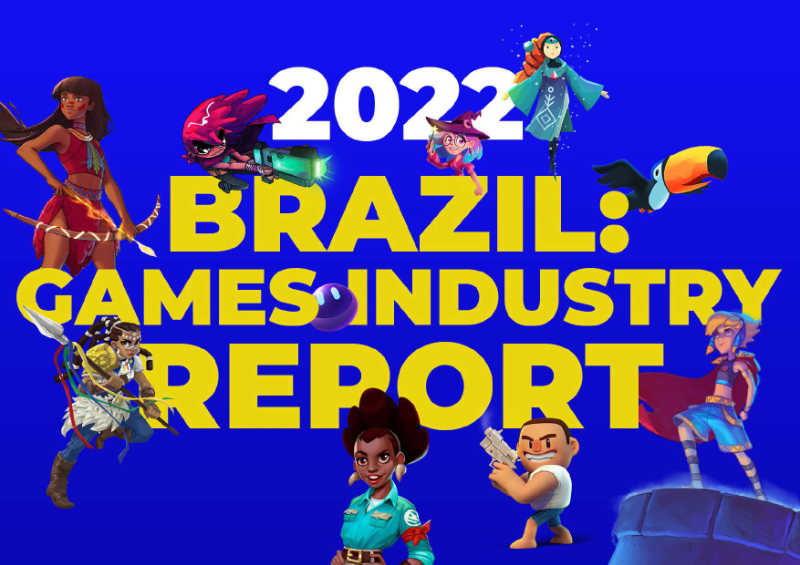
Brazil Games Industry Report 2022
Brazil's games industry has grown rapidly and is maturing, though it remains highly concentrated and constrained by funding, tax, and talent problems.
- Brazil is the 12th largest games market globally and the leader in Latin America, generating approximately USD 2.3 billion in 2021.
- The industry has experienced rapid expansion, with a 102% increase in active studios since 2018 and a 336% revenue increase in USD since 2015.
- The sector is shifting toward original intellectual property, with 93% of companies now focusing on proprietary IP rather than a pure service-provider model.
Caillois's Man, Play, and Games: An Appreciation and Evaluation
Thomas Henricks's appreciation of Roger Caillois's Man, Play, and Games (1958) revisits a book best known for its typology of play and its response to Johan Huizinga's Homo Ludens, while drawing attention to its less examined concern with the corruption of play in modern society.
- Caillois argues that Huizinga wrongly equated play with the sacred: play is defined by free, self-controlled engagement, whereas ritual imposes obligation and submission to a higher force.
- Caillois proposes a fourfold typology of play, agôn (competition), alea (chance), mimicry (simulation), and ilinx (vertigo), arranged on a continuum between improvisational paidia and rule-bound ludus, a distinction that remains foundational in game studies.
- Caillois contends that unchecked play impulses can degenerate into obsession, greed, or self-delusion, and treats the decline of fair play in a profit-driven, cynical society as a central concern.
Describing Games: An Interaction-Centric Structural Framework
Björk and Holopainen's "Describing Games: An Interaction-Centric Structural Framework" proposes a vocabulary for describing games that serves as a bridge between abstract game theory and the practical needs of game designers.
- The framework's core contribution is a shared terminology for describing game structure and player interaction, rather than empirical findings.
- Björk and Holopainen argue that existing models from game theory and play theory are either too abstract to guide design or too narrow to apply broadly, and position their interaction-centric structure as a complement to game design patterns.
- The framework organizes game components into four categories: holistic, bounding, temporal, and objective, with each core concept situated in one of them.