1 free read left. Create a free account for unlimited reading + AI research.
Create free accountArticle Homo Ludens (Polish Game Research Society)
1 free read left. Create a free account for unlimited reading + AI research.
Create free accountArticleHomo Ludens (Polish Game Research Society)
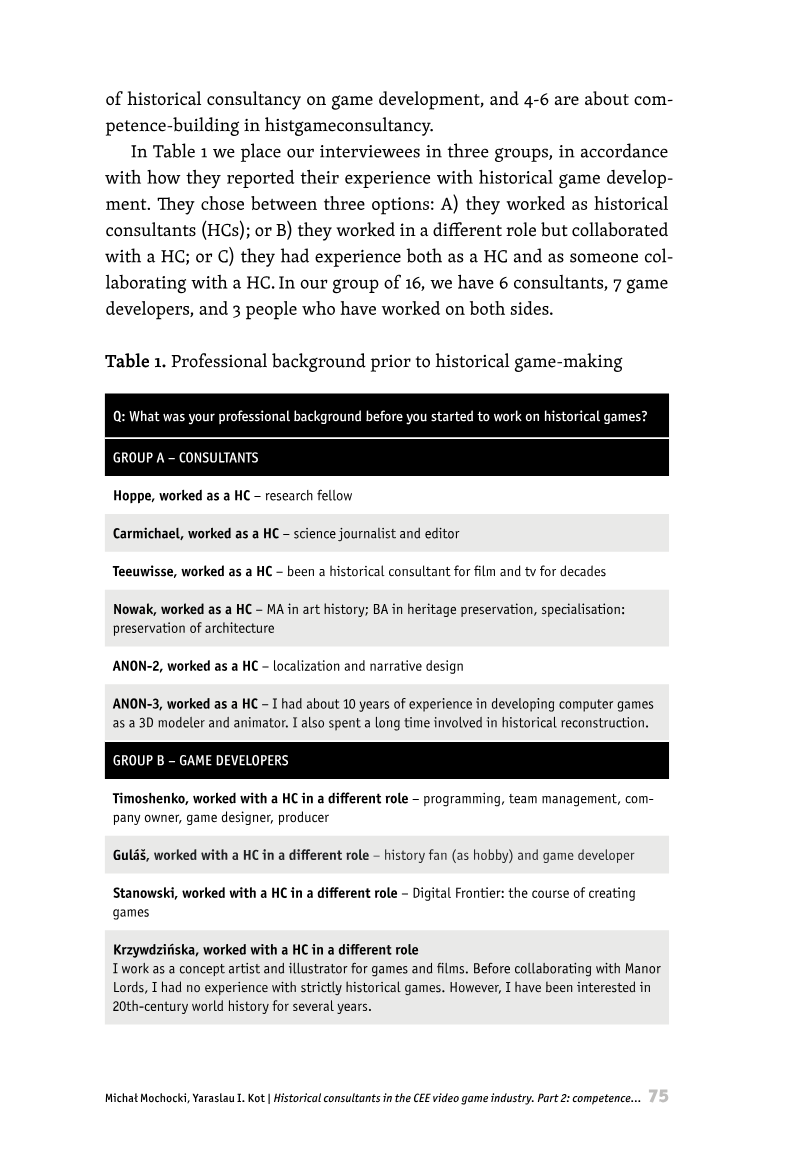
This study, authored by Marcin Pigulak, Ewelina Gdaniec, and Patryk Wasiak and published in Homo Ludens in 2024, examines the emerging role of historical consultants in the game industry and argues that universities should deliberately prepare historians for this work. Its central thesis is that as historical games increasingly shape public perceptions of the past, factual fidelity and academically grounded content become more important, and that higher education curricula should be designed to equip graduates with the specialized competencies this role demands.
The research rests on a survey of digital and analog game creators across Central, Eastern, and Southern Europe, with particular attention to the Polish sector, where small studios dominate the market; in 2023, 316 of 494 Polish firms had teams under 25 people, which shapes the varied and often ill-defined scope of consultants' responsibilities. Developers' attitudes toward historical content fall into three tendencies: prioritizing historical fact, as in wargames; balancing accuracy with entertainment; or subordinating history to gameplay, with commercial pressures and casual players often favoring less strict accuracy. Respondents consistently found that consultants add value by ensuring authenticity, enhancing immersion and reputation, and saving development time.
The findings also reveal what distinguishes successful collaborations from unsuccessful ones. Best practice, illustrated by titles such as Kingdom Come: Deliverance and the Assassin's Creed series, is associated with early role clarity, consultant involvement across all production stages, and effective communication. Poor outcomes tend to arise from unclear scope, unrealistic expectations, and consultants who lack understanding of game development constraints and mechanics.
On this basis, the authors identify core competencies including familiarity with game engines, project-management and collaboration tools, graphics software, foreign-language skills, and an understanding of game mechanics. They propose a six-area first-cycle curriculum covering game design basics, historical research and source criticism, communication, digital tools, practical experience, and cultural diversity, together with a set of learning outcomes intended to guide university programs.
Each row is a game or company this document names, each column a document, oldest first. A mark means that document names it. Select a row to see those documents.
Game Dev Unchained · 2025