1 free read left. Create a free account for unlimited reading + AI research.
Create free accountArticleHomo Ludens
The paper situates its discussion in the shift to learner-centered pedagogy and the sudden move to distance education during the pandemic.
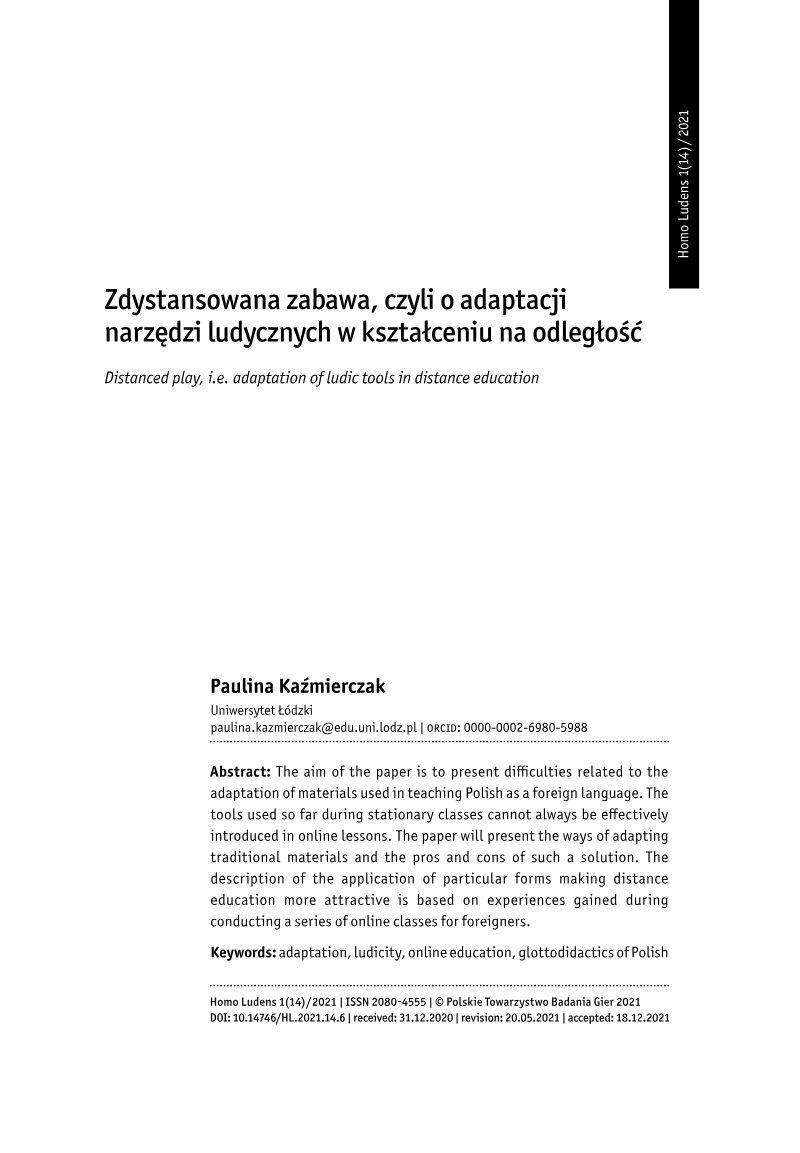
This paper, written in Polish by Paulina Kaźmierczak of the University of Łódź and published in 2021 in the journal Homo Ludens, examines how traditional ludic (game-based and play-based) teaching materials can be adapted for online instruction in Polish as a foreign language. Its central aim is to identify the difficulties that arise when physical classroom tools, particularly board games, cannot be transferred directly to remote lessons, and to propose practical adaptation strategies. The author grounds the discussion in the broader shift toward learner-centered pedagogy and in the sudden move to distance education prompted by the pandemic, which pushed instructors to develop digital competences and creative solutions.
The paper's theoretical framing draws on the work of Teresa Siek-Piskozub, who distinguishes between games, play, and simulations as the core categories of the ludic strategy in language teaching. The author argues that the instructor's own digital skills and creativity are as important as the availability of ready-made materials, noting that resources for Polish are far scarcer than those for English. The main body presents a set of adaptation methods: digitizing scanned board games in PDF readers with virtual or chat-based movement, running game variants without dice, using the Classroomscreen and Genial.ly platforms to create interactive boards and Jumanji-inspired formats, and combining boards with quizzes in QuizWhizzer. Each variant is evaluated for technical skill required, preparation time, group size, and reusability, with licensing and copyright risks flagged as a central concern. The paper concludes that adapting existing physical tools to online form is a viable and reusable solution, though it still depends on instructors' digital literacy and awareness of intellectual property constraints.
Homo Ludens · 2025
Homo Ludens · 2025
Homo Ludens · 2025
Homo Ludens · 2025
Homo Ludens · 2024
Homo Ludens · 2024
Homo Ludens · 2024
Homo Ludens · 2024
Homo Ludens · 2024
Homo Ludens · 2024
Homo Ludens · 2024
Homo Ludens · 2024
European Conference on Games Based Learning (ECGBL) · 2026



European Conference on Games Based Learning (ECGBL) · 2026



European Conference on Games Based Learning (ECGBL) · 2026
























Comments