1 free read left. Create a free account for unlimited reading + AI research.
Create free accountArticleHomo Ludens
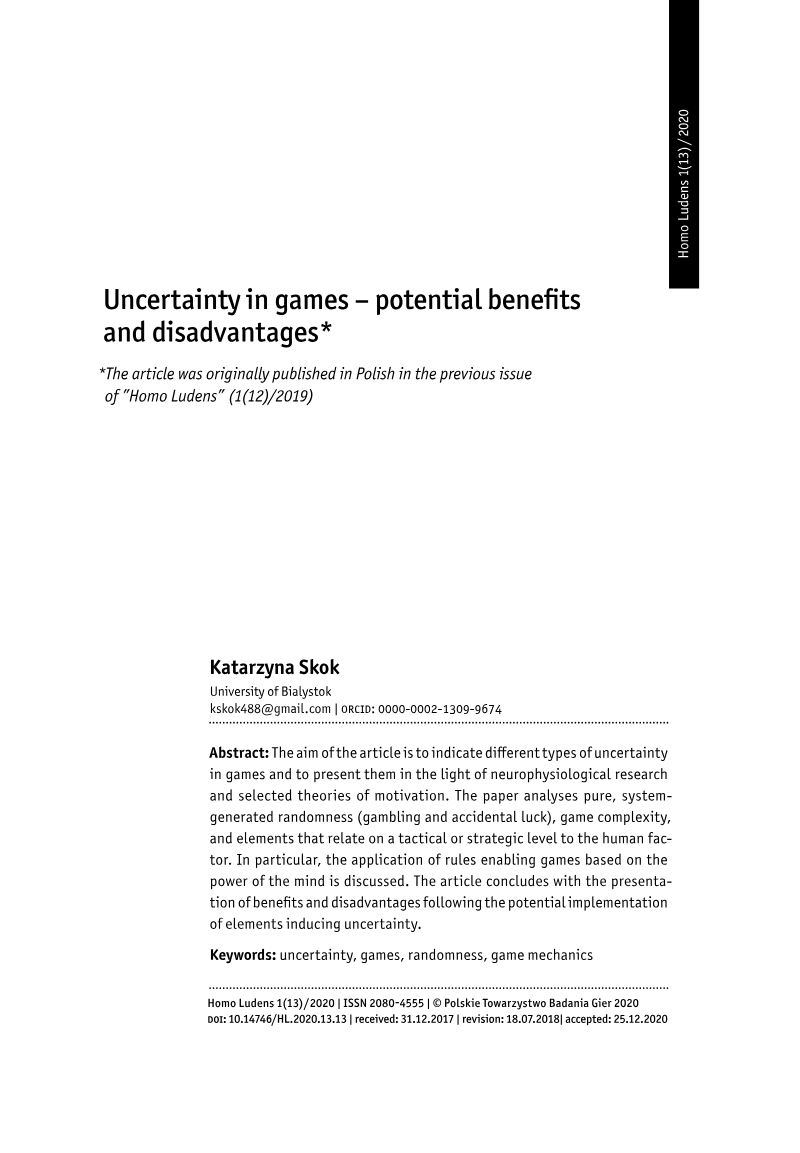
The article argues that uncertainty stimulates player engagement mainly through dopamine release. The response is strongest when outcomes are neither fully predictable nor certain.
Katarzyna Skok's article, published in Homo Ludens in 2020, examines how uncertainty functions in games as a driver of player engagement and as a design tool with both benefits and risks. The central argument is that uncertainty stimulates engagement through dopamine release, with the strongest response occurring when outcomes are neither fully predictable nor certain. The author builds on Costikyan's taxonomy of eleven sources of uncertainty and proposes her own division between system-generated uncertainty, arising from randomness and complexity, and uncertainty rooted in the human factor, such as bluffing and psychological competition.
The analysis identifies a key trade-off at the core of game design. Randomness can sustain compulsive, variable-reward engagement, yet it may frustrate players who perceive outcomes as dependent on luck rather than skill. Complexity and human-driven uncertainty present a different profile: artificial intelligence can surpass human players in analytic games such as chess and Go, but remains comparatively limited in psychological games like poker, where opponent behavior and deception remain central. Drawing on Apter's reversal theory, regulatory focus theory, and flow theory, the article argues that uncertainty can heighten playfulness and achieve optimal challenge, while poor calibration against player skill may produce anxiety, boredom, or a sense of unfairness.
The conclusions are that uncertainty is a valuable design element when it remains peripheral to skill-based play, serves as an alternative to routine gameplay, and is structured so that it does not reward luck over effort. The Polish-language paper underlying this work classifies uncertainty into three types, pure system randomness, programmed AI complexity, and tactical or strategic human uncertainty, and draws on neurophysiological research and motivational theories to weigh its benefits against its drawbacks, including concerns about gaming addiction.
Homo Ludens · 2025

Homo Ludens · 2025


Homo Ludens · 2025
Homo Ludens · 2025
Homo Ludens · 2024

Homo Ludens · 2024
Homo Ludens · 2024
Homo Ludens · 2024
Homo Ludens · 2024
Homo Ludens · 2024

Homo Ludens · 2024

Homo Ludens · 2024















Comments