1 free read left. Create a free account for unlimited reading + AI research.
Create free accountArticleHomo Ludens
The paper argues the term works better as a prototype category built around core features than as a fixed definition.
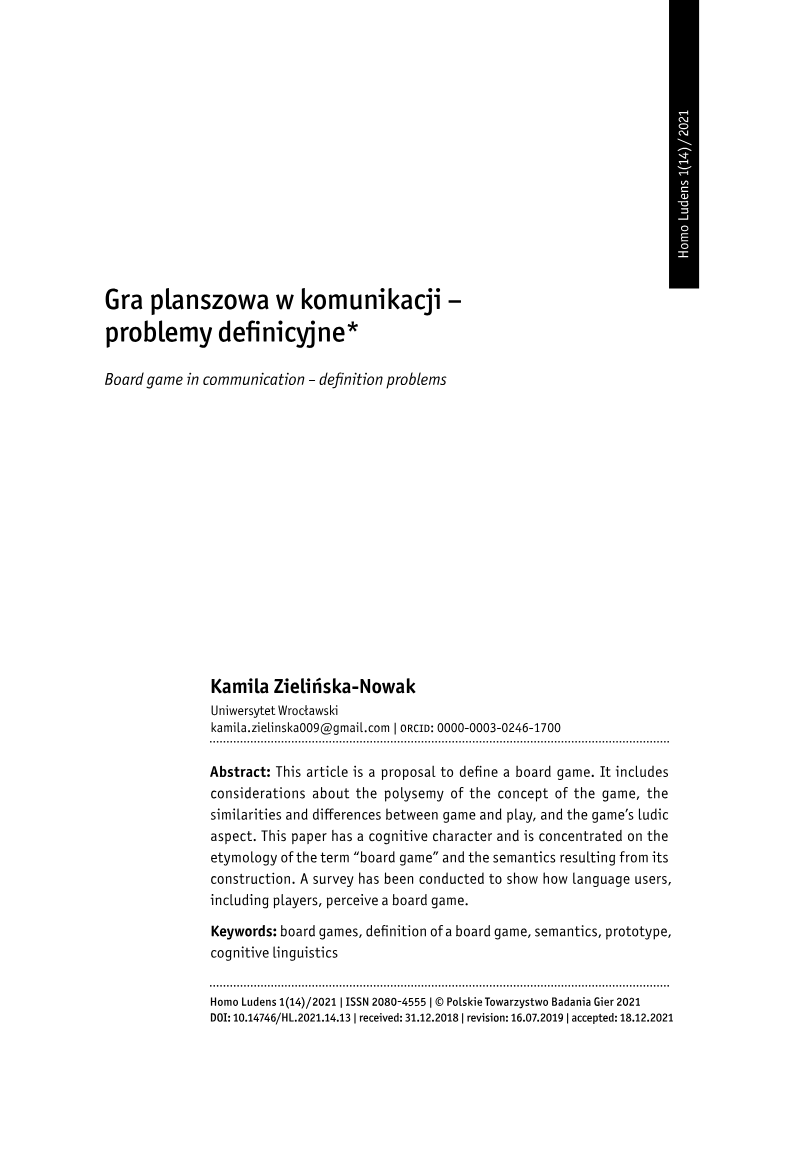
The paper examines why "board game" resists a stable definition and argues that the term is best understood as a prototype category rather than one defined by fixed essential features. Its central thesis is that researchers and ordinary language users converge intuitively on a core set of characteristics, including a board, pieces, cards, offline play, and a ludic purpose, even though no consensus definition exists. The analysis draws on a Polish-language academic framework, combining a historical semantic review of Polish dictionaries, which traces the broadening of the term "gra" (game), with survey evidence from respondents about how they classify games.
The findings point to growing instability at the boundary of the category. Respondents gave inconsistent answers about traditional features such as the physical board, the absence of technology, static play, and the presence of a fixed rule set, and they frequently counted card games and hybrid titles as board games. The author distinguishes the broader concept of play (zabawa) from the more structured concept of game (gra) by goal-orientation and the possibility of winning or losing, drawing on Huizinga, Caillois, and related scholarship. This leads to a proposed prototype: a material-component game with a board or shared surface, at least two players, a fixed rule set, turn structure, and defined win conditions, with solo games and table-based games occupying peripheral positions.
The scope is primarily Polish lexicographic and academic discourse, with the bibliography relying heavily on Polish sources and game studies literature alongside several international references. The conclusion is that the proposed definition captures how "board game" functions in communicative practice, reflecting perceptions of physical traits, gameplay, means, and organization, rather than describing the intrinsic properties of the artifacts themselves.
Homo Ludens · 2025
Homo Ludens · 2025
Homo Ludens · 2025
Homo Ludens · 2025
Homo Ludens · 2024
Homo Ludens · 2024
Homo Ludens · 2024
Homo Ludens · 2024
Homo Ludens · 2024
Homo Ludens · 2024
Homo Ludens · 2024
Homo Ludens · 2024



European Conference on Games Based Learning (ECGBL) · 2026



European Conference on Games Based Learning (ECGBL) · 2026
European Conference on Games Based Learning (ECGBL) · 2026















Comments