
Game Studio Unlocked
Studio-building, leadership, and indie operations, by Sebastian Cardoso.
Documents

Be a Poet for Your Game
The primary thesis of this analysis is that a deep, intuitive understanding of a game’s genre is the most critical factor in successful game development, superseding operational concerns like management, production processes, and team structure.
- The most critical factor for a game's success is a deep, foundational understanding of its genre, which the author describes as writing an 'ode' to that space.
- Successful games are built on three core pillars: an emotional root (the core feeling), a specific player fantasy, and a defined currency (what the player trades to progress).
- Developers must move beyond intuition to explicitly define these genre pillars so that larger teams can maintain a consistent creative vision throughout production.
The Video Game Executive Playbook: Part One
The primary challenge facing independent game studios is not a deficiency in creative talent, but a systemic failure in executive leadership.
- Indie game studios often fail not due to lack of talent, but because running a studio requires different skills than game development, a transition many executives don't fully recognize or prepare for.
- The core duties of a chief executive, as identified by Fred Wilson, include defining and communicating vision, recruiting and retaining top talent, and ensuring the organization's financial stability.
- Effective executives prioritize the studio's needs over personal preferences, even if it means tackling uncomfortable tasks like difficult hiring decisions, cutting beloved features, or fundraising.
Game Studio Due Diligence: Publisher and Investor Perspectives
Investors and publishers evaluate game studios through a comprehensive framework that balances creative output with organizational stability.
- Game studio due diligence involves evaluating seven key areas: the game, the team, leadership, culture, technology, work systems, and finances.
- Self-assessment is crucial for studio founders because they are uniquely positioned to address issues uncovered and often lack objective perspective due to emotional investment.
- Key cultural metrics include eNPS (above +20 is good, +40 is strong), internal mobility (healthy studios fill 15-20% of roles internally), and crunch (IGDA 2023 survey found a third of developers still crunch, with output per hour falling past 50 hours/week).

Managing the Emotional Rollercoaster of Game Development
Game development morale is not a random occurrence but a predictable, cyclical phenomenon that maps closely to the phases of production.
- Game development morale follows a predictable arc, with a significant, expected dip in engagement occurring consistently at the project's midpoint.
- Negative setbacks impact a team's inner state two to three times more heavily than equivalent wins lift it, necessitating a proactive strategy to protect and celebrate small, visible successes.
- Psychological safety is the primary factor in team performance; leaders should view silence or systematic compliance as a warning sign that the team no longer feels safe raising problems.
The Next Game Decision
Independent game studios frequently face existential risks by selecting new projects through reactive decision-making rather than structured strategic planning.
- Before deciding on a next project, studios must evaluate five practical constraints: existing contractual obligations, current revenue, transferable technical assets, team burnout levels, and creative direction.
- Review existing publishing contracts for restrictive clauses like rights of first negotiation or last refusal, which can limit future autonomy; if present, negotiate hard deadlines for publisher commitments to avoid being trapped.
- Data from Video Game Insights indicates that second games on Steam average $168,000 in revenue compared to $120,000 for debuts, a 40% increase, though only one in three studios successfully ships a second title.
Canceling a Game in Production
The decision to cancel a game during production represents a critical strategic pivot that requires balancing objective performance metrics against the psychological biases inherent in creative development.
- Game cancellations typically occur due to external factors like investor pull-outs or funding collapse, or internal issues such as consistently negative playtest results, mismanagement of funds, or an inability to make the game good with existing resources.
- Projects often persist longer than they should due to escalation of commitment (sunk cost fallacy), the IKEA effect (overvaluing self-built items), social cohesion (fear of being seen as disloyal), and a lack of consistent gameplay feedback.
- To mitigate cancellation risks, studios should define clear 'pass' and 'fail' conditions for playtests, assess the path forward with current team and resources, monitor team belief, and establish a financial floor for winding down.
A Live Operations Primer for Game Studios
Live operations represent a fundamental shift in game development, transitioning from the finite cycles of traditional premium titles to an indefinite, service-oriented model.
- Live service games typically require five years of development compared to two to three years for traditional titles, and 95 percent of studios surveyed in 2023 were building or maintaining them.
- Server-authoritative design is essential for live games, as it allows developers to fix issues via server-side configuration and content delivery without requiring new client patches.
- Launch capacity issues are often labor-intensive backend problems rather than simple hardware constraints, as evidenced by Helldivers 2, which required code optimization rather than just additional server power to handle over 450,000 concurrent players.
How to Get to a Game Publisher Term Sheet
Securing a game publisher term sheet is a complex, often misunderstood process for independent studios.
- Publishers prioritize three factors when considering a game: the demo (80-90% of the decision), the development team, and how well the game fits their business strategy.
- A 'demo' for pitching is a carefully selected, high-quality portion of the game, demonstrating its value without needing every system or being a 'vertical slice' (which is often misunderstood as a miniature full game).
- Publishers play demos briefly and often distracted, so the strongest selling points must be presented within the first few minutes, with skippable intros and checkpoints for longer demos.
What Bad Looks Like in the Games Industry
Systemic dysfunction currently defines the modern gaming industry, characterized by a pervasive culture of labor exploitation and strategic mismanagement that threatens long-term creative viability.
- The games industry is experiencing a massive wave of layoffs, with approximately 45,000 jobs lost between 2022 and July 2025, despite the global market reaching $184 billion in 2023.
- Labor exploitation remains systemic, with 85% of game workers performing unpaid overtime and many studios weaponizing 'passion' to justify poor working conditions and lower pay.
- Major publishers frequently engage in destructive acquisition cycles, such as Microsoft closing Arkane Austin and Tango Gameworks shortly after purchase, or EA’s long-term history of dismantling storied studios like Visceral and Westwood.
Poor Performance Is Not a Game Engine Problem
The prevailing industry narrative that game engines are responsible for poor performance in modern titles is a fundamental misdiagnosis.
- Poor game performance, particularly frame rate issues, is primarily a result of development process shortcomings rather than the game engine itself.
- Common development mistakes leading to performance problems include over-reliance on visual features, inadequate use of profilers, poor GPU/CPU budgeting, lack of ongoing optimization, unoptimized assets, insufficient testing on dev kits, and aggressive minimum specifications.
- Several high-profile games, including The Callisto Protocol (Dec 2022), Lords of the Fallen (Oct 2023), Immortals of Aveum (Aug 2023), Remnant II (Jul 2023), STALKER 2 (Nov 2024), The Oblivion Remaster (Apr 2025), Borderlands 4 (Sep 2025), and MindsEye (Jun 2025), launched with significant performance issues, often attributed incorrectly to Unreal Engine.
Conflict Resolution for Indie Game Studios
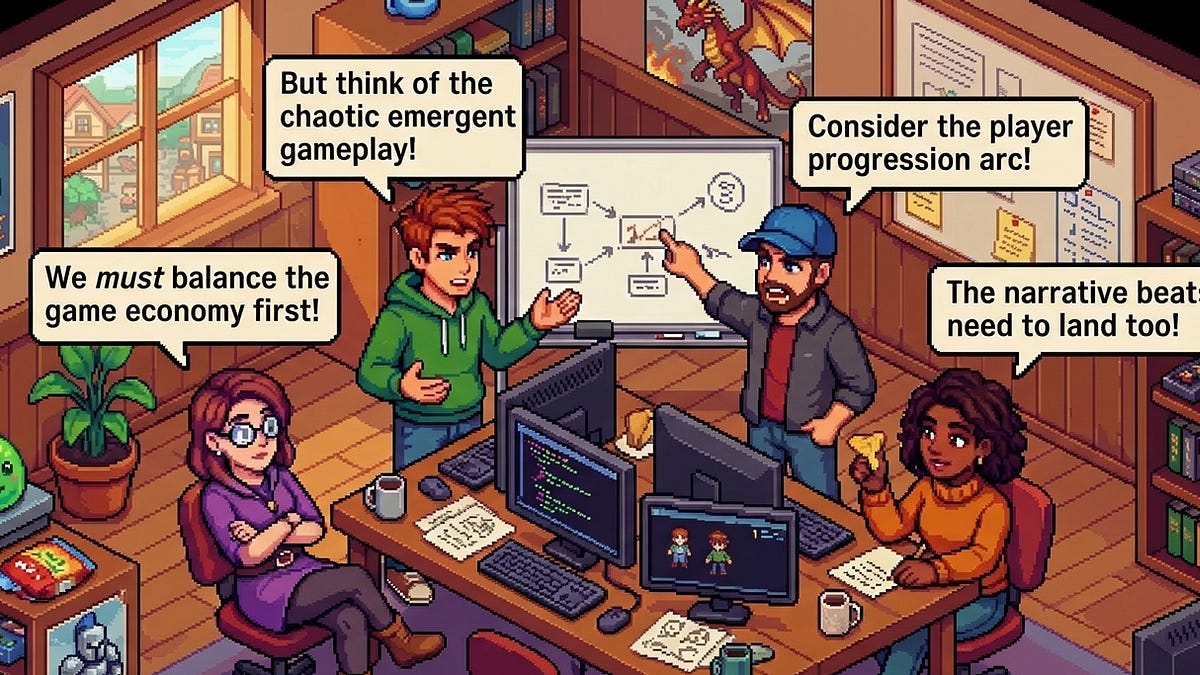
Conflict is an inherent byproduct of the game development process, arising from the collaboration of diverse disciplines—such as art, engineering, and design—on creative, high-stakes projects.
- In small studios of 5–20 people, conflict lacks organizational buffers and radiates quickly, making it a studio-wide problem rather than an isolated interpersonal issue.
- Use the 'Waterline Model' to diagnose conflict by addressing issues in order of depth: structure (roles and ownership), dynamics (unspoken rules and safety), interpersonal relationships, and finally, individual performance.
- Structural problems, such as overlapping responsibilities between leads, are often the root cause of what appears to be interpersonal tension; clarifying ownership can resolve these conflicts.
Cultivating a Culture of Experimentation
True innovation within the game development industry necessitates a fundamental structural commitment to organizational conditions that prioritize intrinsic motivation over superficial corporate initiatives.
- Original game studios like FromSoftware, Klei, and Supergiant cultivate innovation through six mutually reinforcing conditions, rather than superficial programs like hackathons or 'creative time'.
- Studio independence is a structural precondition for innovation, allowing studios to kill prototypes, change major systems, or extend production cycles without publisher pressure, as seen with FromSoftware's early Souls games and Klei's self-funded period until 2021.
- Consistently original studios tend to maintain small, clearly led teams (e.g., Klei had 11 people in 2009, House House made Untitled Goose Game with 4), defending against growth to minimize coordination overhead and allow teams to 'hold the game in their heads'.