User Acquisition reports and market data
Documents
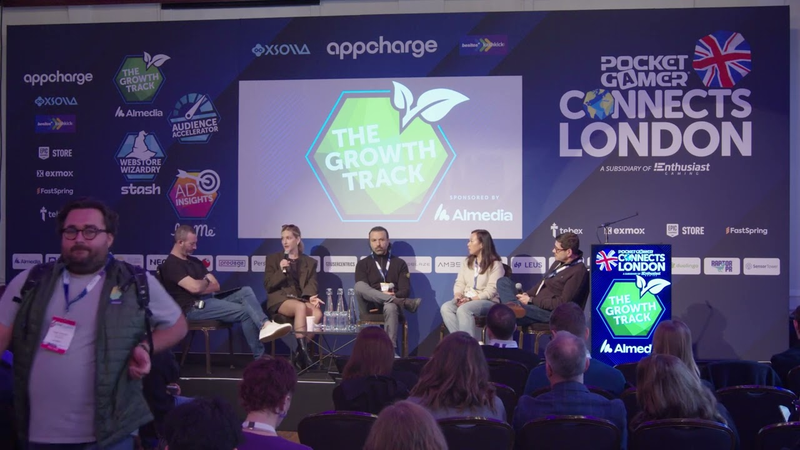
Panel: Best Practices For Navigating The Rewarded UA Space.
Rewarded user acquisition has evolved from a volume-centric strategy into a sophisticated, data-driven channel focused on long-term player loyalty.
- Rewarded user acquisition has evolved from a high-fraud, low-quality volume play into a data-driven channel that provides high-intent users who engage with games deeply to reach specific milestones.
- Unlike traditional media sources that may require up to 365 days to realize ROI, rewarded UA allows developers to recover costs and generate revenue earlier, facilitating faster reinvestment and scaling.
- Modern rewarded platforms utilize adaptive economy models and real-time automation to personalize reward structures based on individual user behavior, moving away from outdated fixed-CPI models.
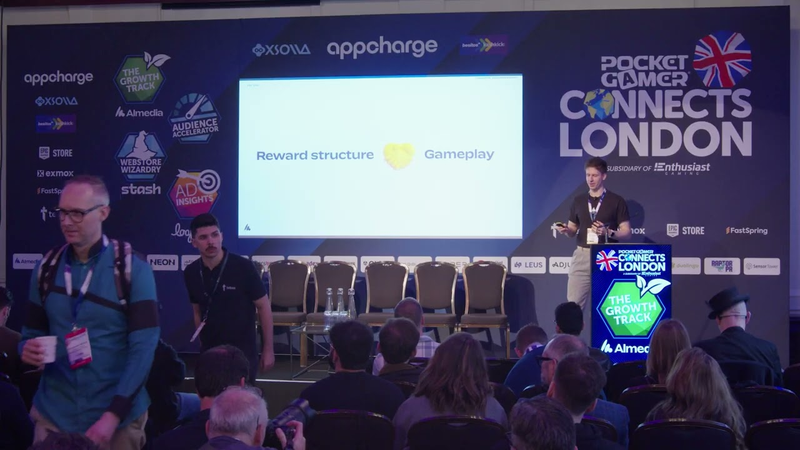
Session: Rewarded UA In 2026: The Growth Playbook - Jan Sommerfeld, Almedia.
Rewarded user acquisition (UA) is evolving from a simple volume-based strategy into a sophisticated, data-driven channel that functions as a long-term loyalty program.
- Rewarded user acquisition has shifted from focusing on install volume to prioritizing long-term engagement, with platforms now extending reward windows from 30 days to 90 days and beyond to drive Day 360 performance.
- The US market for rewarded platforms has grown to an estimated 100 to 150 million users, with major players like Freecash acquiring 3 to 4 million users per month and reaching a total user base of 60 million.
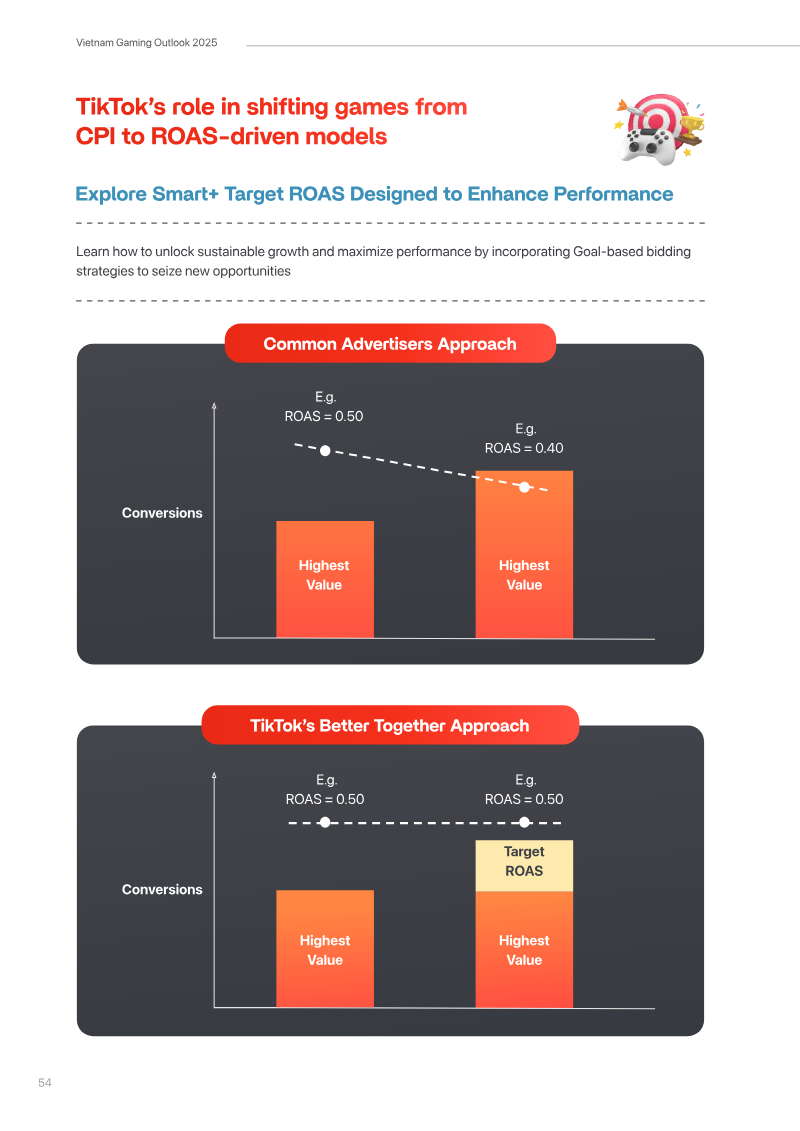
- Modern rewarded platforms now utilize automated bidding systems, such as Almedia's 'Max ROAS,' which allow advertisers to define return-on-ad-spend targets rather than manually managing individual CPIs.

Session: Future of UA: Creatives, Predictions & Funding - Halil Ibrahim Özdemir, Leus Capital.
The mobile gaming industry faces significant challenges in user acquisition (UA), specifically regarding the identification of high-performing creative assets, the accuracy of long-term return on ad spend (ROAS) and lifetime value (LTV) predictions, and the availability of sufficient marketing capital to scale effectively.
- Leus Capital provides marketing capital funding for mobile game studios, covering up to 80% of monthly User Acquisition (UA) budgets to help scale operations without requiring traditional equity investment or publishers.
- The firm utilizes a predictive analytics tool that claims 99% accuracy in forecasting app performance, including ROAS and LTV metrics, across channels, countries, and companies for up to 52 weeks.
- Leus Capital offers a 'Visual' search tool that allows studios to identify 'heat creatives' by analyzing competitor strategies, hook types, and CTA performance across various ad networks.

Session: From Installs To Lifetime Value How Snapchat Powers Gaming Growth - Sara Antonelli, Snap.
Snapchat’s strategy for driving growth in the gaming sector centers on a four-pillar framework: scalable audience reach, performance-driven solutions, accurate measurement, and automated onboarding.
- Snapchat's 'App Power Pack' suite of performance solutions has demonstrated a 25% lift in app installs for advertisers focusing on mid-funnel volume.
- Snapchat's audience is highly relevant to gaming, with 78% of daily Snapchat users engaging with gaming apps and a significant portion playing multiple times per day.
- Target Cost bidding solutions have enabled gaming advertisers to achieve up to 84% lower CPIs and 90% lower cost per purchase, while simultaneously driving six times more first-time depositors.
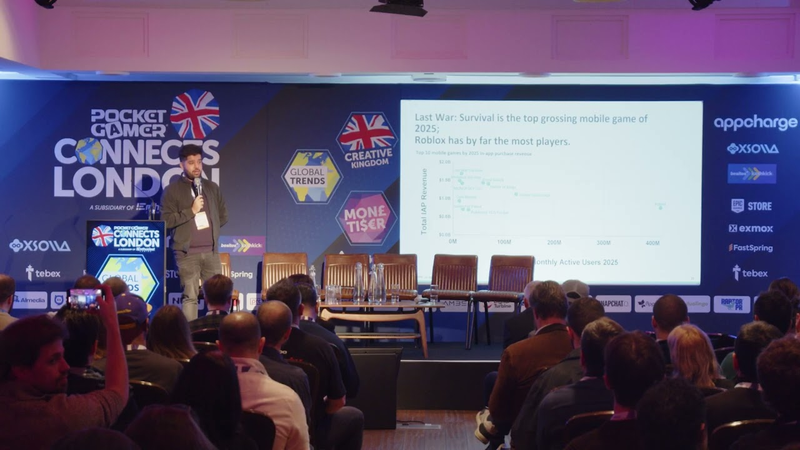
Session: State of the Gaming Industry - Chirag Ambwani, Sensor Tower
The global gaming industry demonstrated significant resilience and growth in 2025, marking a record-breaking year across mobile, PC, and console platforms.
- The mobile gaming market is shifting toward a live-service model, evidenced by a decline in new game launches from nearly 100,000 in 2022 to under 70,000 in 2025 as publishers prioritize existing titles.
- Mobile revenue remains resilient at $82 billion, despite a 15% decline in downloads, with the UK market showing notable strength through 10% year-over-year revenue growth.
- Competition in the mobile space is increasingly dominated by Eastern publishers, who now hold five of the top nine spots in the Western market with titles like 'Whiteout Survival' and 'Last War: Survival' grossing over $1 billion within a year of launch.

How Finch turned self-care into a $100M+ game
Finch has established itself as a dominant force in the mental health and stress management sector by successfully merging productivity tools with addictive, Tamagotchi-style gamification.
- Finch has achieved a valuation exceeding $100 million by merging mental health utility with Tamagotchi-style gamification, reaching 10 million daily active users.
- The app maintains a strong 20% day-60 retention rate by utilizing streak mechanics, collectibles, and emotional engagement to sustain its core loop.
- The company bypasses mobile store fees by utilizing a direct-to-consumer web model powered by Stripe, which includes a 'Guardian' program for gifted subscriptions.

TWiG #369: Genie 3 Explodes, Game Stores Die, & High Guard Stumbles
The gaming industry is currently undergoing a period of intense volatility, characterized by the rapid obsolescence of traditional retail models and the disruptive, often speculative, influence of generative artificial intelligence.
- The unveiling of Google DeepMind’s Genie 3, capable of generating 3D environments, triggered a $47 billion valuation drop across the gaming sector as markets reacted to the potential disruption of traditional production models.
- Physical game retail is in a state of collapse, evidenced by widespread storefront closures in the UK and the downsizing of major chains, cementing digital distribution as the industry's undisputed standard.
- High-budget marketing playbooks are failing to sustain player retention, as demonstrated by Highguard’s rapid decline despite high initial visibility, highlighting the necessity of clear value propositions and transparent community engagement.
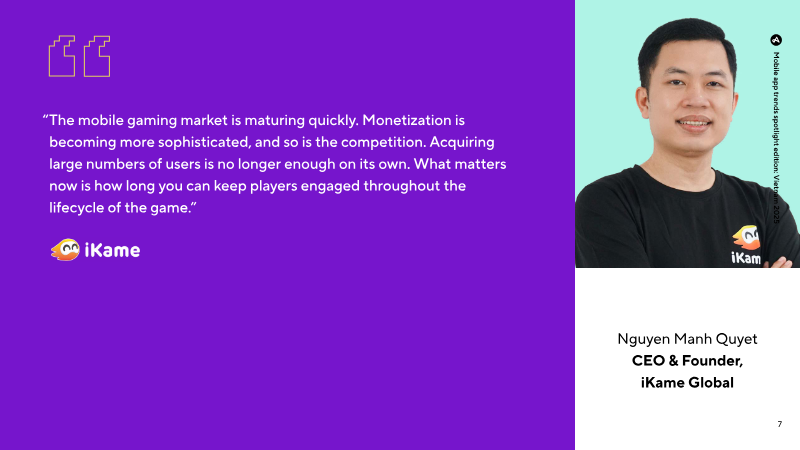

Mobile App Trends: Vietnam 2025
Vietnam’s mobile app economy is experiencing rapid expansion as of early 2025, driven by high smartphone penetration and a tech-forward population.
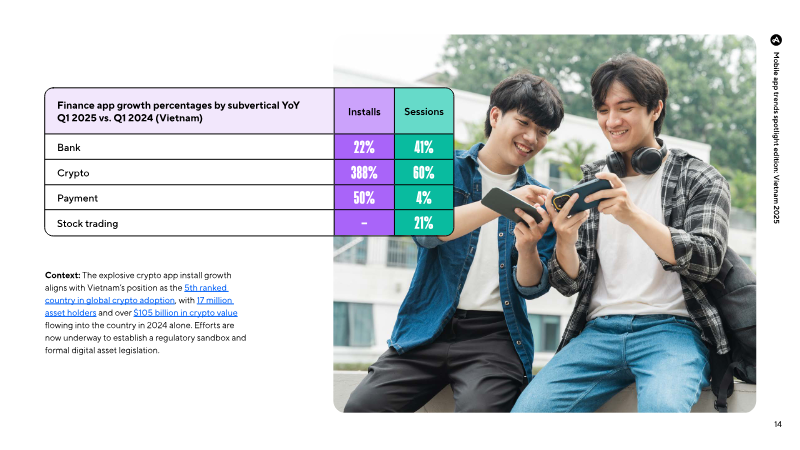
- Vietnam’s finance sector experienced massive Q1 2025 growth, with app installs rising 64% and sessions increasing 84% year-over-year, driven by mobile wallet adoption and cryptocurrency usage.
- The gaming sector saw a 9% year-over-year decline in installs and sessions during Q1 2025, despite maintaining a resilient 49% App Tracking Transparency (ATT) opt-in rate.
- Vietnam is a top-tier global mobile market, ranking 11th in total app downloads and 9th in time spent within apps during 2024.
Vietnam Gaming Outlook 2026: Building Sustainable Growth
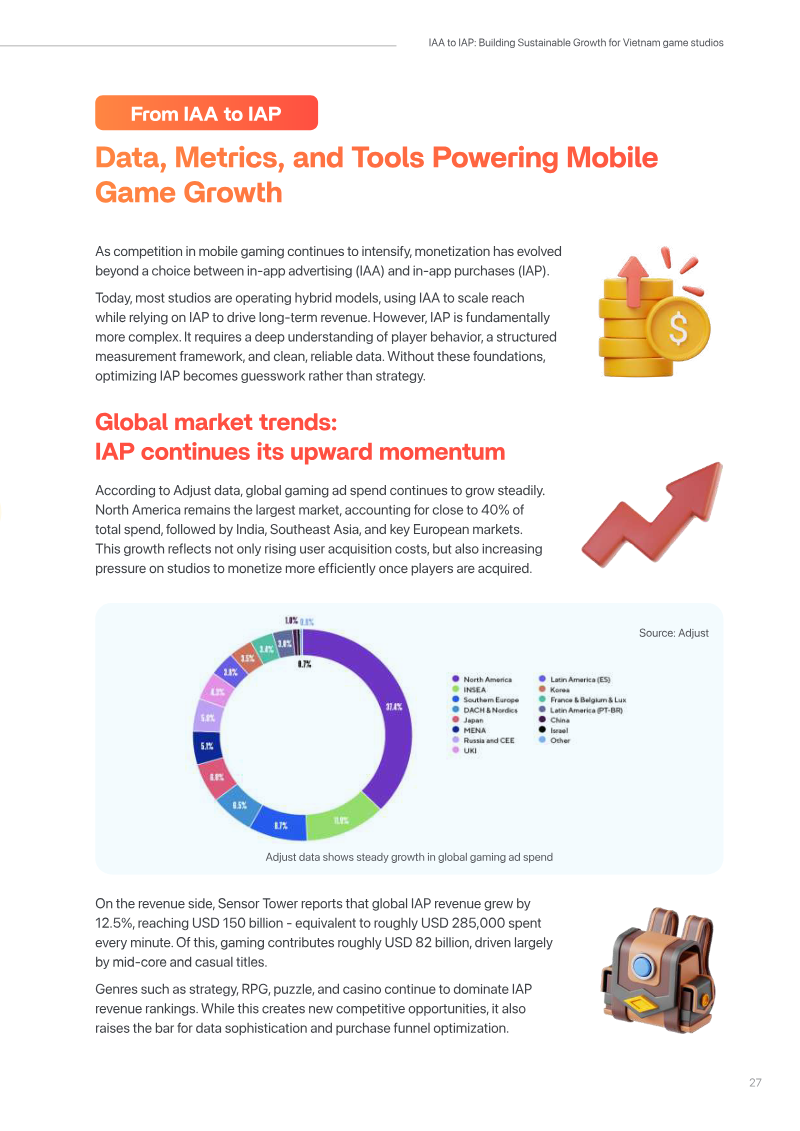
Vietnam’s mobile gaming landscape is rapidly evolving from a download-centric, ad-driven model to a hybrid ecosystem that prioritizes in-app purchases (IAP) and subscription revenue.
- Vietnam’s mobile gaming sector is shifting from an ad-driven model to hybrid-casual titles prioritizing in-app purchases (IAP) and subscriptions, following a 65% surge in local IAP growth in 2025.
- While Vietnam led global Google Play downloads with 6.1 billion installs in 2024, the market generated only $430 million, highlighting the profitability ceiling of pure advertising models.
- Localized pricing strategies, including purchasing power parity tiers and one-tap tokenized payments, can increase conversion rates by over 20% and reduce checkout abandonment by up to 30%.

The soft launch checklist everybody needs to follow by Matej Lancaric
A successful soft launch in the mobile gaming industry requires a rigorous technical and operational foundation to ensure that subsequent data analysis—such as CPI, retention, and ROAS—is accurate and actionable.
- Prioritize a dedicated 'technical stage' during soft launch to verify that tracking, attribution, and monetization infrastructure are accurate before scaling, as flawed data leads to unreliable performance metrics.
- Implement a Mobile Measurement Partner (MMP) and Firebase to track core events, including installs, sessions, purchases, and ad impressions, while ensuring revenue deduplication across SDKs to prevent double-counting.
- Maintain app stability by keeping crash and 'App Not Responding' (ANR) rates below established thresholds to avoid platform penalties and ensure a reliable user experience.
Unit Economics for Free-To-Play Games
Transitioning from hobbyist game development to a sustainable commercial enterprise requires a rigorous, data-driven approach to unit economics.
- Transitioning from a hobbyist to a professional game developer requires treating game development as a business model where revenue generation, scaling, and profitability are forecasted before or during development rather than hoping for success post-launch.
- Use an LTV (Lifetime Value) calculator to model financial assumptions, such as targeting $1.2 million in revenue, to determine if a game concept is viable before committing significant resources.
- Pricing strategies must align with the required LTV; for example, setting an 'Ad Removal' IAP at $3.99 may fail to meet business goals if the model requires a higher average revenue per paying user to achieve profitability.

From Drumming to Downloads: Why ASO Is All About Discipline
Sustainable organic growth in the mobile gaming industry depends on treating app store presence as a dynamic, live channel rather than a static asset.
- Sustainable organic growth requires an 'always-on' discipline rather than sporadic efforts, treating the app store as a live, evolving channel that demands consistent maintenance.
- Teams should move away from manual, repetitive tasks by leveraging AI and automation tools, which can reduce manual workflow time by up to 40%.
- To prove the value of organic growth to stakeholders, teams must measure incrementality by establishing clean baselines and cross-referencing console data with Mobile Measurement Partner (MMP) metrics.