VideoTwo & a Half Gamers
The soft launch checklist everybody needs to follow by Matej Lancaric
4 Feb 202618 min video
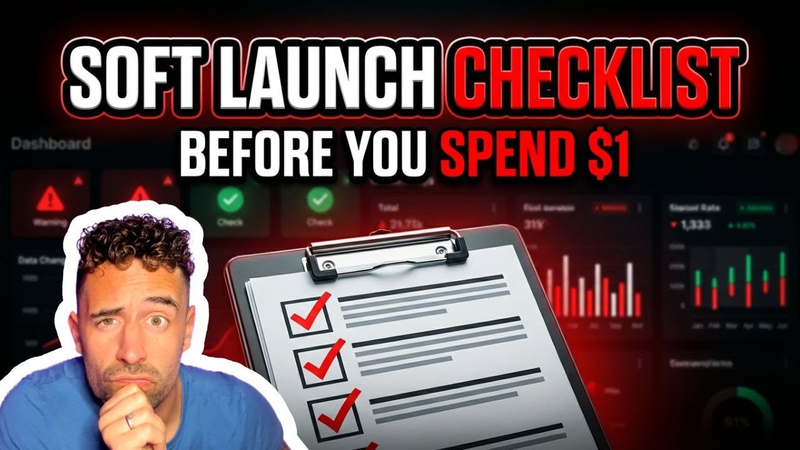
That's why I'm always pushing for a technical stage of the soft launch where you go over all of these and you're 500% sure that everything is correct. So it's very important also super important.
It's [music] made of golden coins with the [music] two and a half is the midnight crew talking UA adverts and game design too. M [music] feeling shaking the insight. We're rocking those vibes till the early day lives. But hey, you a master eyes on the prize. Tracking data through the cyerspace skies. Felix [music] stacks colors like a wizard in disguise. Jacks lift us to the highest. Two and a half gamers talking smack. [music] Slow hockey stick got your back. Ads are beautiful. They like the way. Click it fast. [music] Don't delay. Uh-huh. Uh-huh. Uh-huh. [music] Uh-huh.
[music]
Hello everybody. Welcome to another solo episode. Today I'm going to talk about the soft launch checklist. My name is Mate Lanterich and I'm your host. So I was inspired by Felix last week because he was do he was doing a soft not soft launch ad monetization 101 checklist. And what do you need to do to get prepared for adding ad monetization and start earning some money? So today I'm going to talk about a soft launch checklist because recently I started working with with few games that are entering soft launch and the recurring theme or topic was so what do we need to do or how do we need to prepare in order to actually successfully start soft launching the game. So I'm going to talk about a technical and attribution kind of point of view monetization economy and product and the content and live ops kind of pipelines and just a little bit of creatives.
Don't forget like this is only a checklist. This is not a full guide. If you want a full guide, scan the QR code or just go to and find the soft launch bible which is basically the whole guideline of how to soft successfully soft. So well let's start with the technical side of things which is very very important and if you skip this step you are not going to go really far with the soft launch. So MMP and the implementation of the MMP is very crucial h but it doesn't really end there. You need to track the key events obviously the install either like the session as well purchase and ad impression uh to actually evaluate the the revenues and draw us on the campaign side but also inlementing another engagement events like tutorial completion level achieved or whatever play 30 minutes you can really really go deep and try to track different events
but these are kind of like the basic thing to do because this this is going to be used also for the campaign optimization afterwards. So you need to be definitely sure that you're collecting all the data and analyze the the campaigns afterwards because again you will use these for UA and strategies which obviously helps to improve your metrics afterwards because different events on the campaign optimization side mean also different audiences and also different performance different retention or different ROS numbers like the purchase that I mentioned or ad impression that I mentioned because those two are two different sides of the LT. TV, but and then obviously you need to track all of these. If you don't have MMP in place and you're only kind of starting very lean, you have Facebook SDK and you have Firebase, you still need to implement these events. Ideal scenario is you have an MMP, whatever it might be. uh and then you have a Firebase as an SDK and
you track also different events because as I mentioned in the previous episodes about Google um MVP setup and MVPU setup you need Firebase for purchase campaigns. So ideal scenario MMP and Firebase if you don't have MMP then you go with Facebook SDK and then you run face basically Facebook and Google campaigns in soft launch. If you want to go deeper and have a UA diversification in place and have more channels, you definitely need an MMP because for example, if you run up, you need MMP. You can't run up campaigns without it. So tracking place then we have the iOS fun and conversions and schemas. So you need to understand like how the schema works. set up different conversion schemas as we've done before from custom where you have engagement events and purchase to just revenue brackets to
kind of configure this properly uh as soon as you go to soft launch and have ideal scenario is you have the AT prompt logic already in place. The funny thing about iOS these days is nobody cares about scan conversion schemas anymore because we have meta aggregate and even measurement. We have fingerprinting. We have uh Tik Tok ADC which I always blinking on what is actually advanc dedicated campaign which is aggregated even measurement. Same thing. And for this to work you still need to have the MMP setup. You need to implement the AM enhanced measurement which is few clicks basically in your attribution provider/MP and deep links need to work but it's like it's few different things that you need to check in Facebook and your MMP. So this is this is very important. So because then I mean I know my go-to platform is basically Google Play but then if you are using iOS as a platform as the first platform then you need to
have this set up so you can actually track at least some performance. Then in the first technical stage what I usually do is to monitor crashes, ANRS well app not responding and all of these funny funny things which you need to be under certain threshold because then uh Google is going to penalize you because your app is crashing and it's not responding. So in Google's eyes your app suck your game suck and we don't want that. So you need to keep uh that in place the the monitoring of the of the crashes and ANRS to be able to kind of ensure the quality and stability of your game or app. Then let's move on to kind of monetization and economy. You need to be sure that uh you're looking at the correct data and not reporting accurate revenue because what happened few times before we were sending revenue from Facebook SDK and from MMP. So then we
were seeing duplicate revenue which doesn't really help that much when you're making decisions and you're looking at incorrect data. So you need to be sure again you are not double counting revenues and everything is in in place. That's why I'm always pushing for a technical stage of the soft launch where you go over all of these and you're 500% sure that everything is correct. That's very important. Also super important thing you're actually having inapp purchase validation in place because happened a few times already. We got cheaters in the game and suddenly there were spikes of revenues and we were obviously happy about the performance until we found out it's actually fraud and these purchases doesn't they don't exist. So this needs to be server to server validation so you can uh you live happy life in the in the soft launch. Then you go we move towards the ad mediation which already was
covered by Felix last week. So go and check that video out. But again soft launch you need to have all the med well you need to set up the mediation preferably max because then you can use uplavin for ua and then again you have slightly better position better position meaning you have an option to run up campaigns blended and uh and otherwise campaigns but that's that's topic for slightly different session then you're adding the ad networks into your bidding stack for maximizing revenue as soon as I added new ad networks into my like apps family of apps. Uh the revenue grew quite significantly although it's still like at scale small scale but suddenly they are competing against each other and you can get way better revenue. So instead of having only one ad network in your ad monetization stack do more five of them for example Facebook I have appli Google unity I have integral as well and then some others. So think
about it but also think about balancing the user experience with monetization and also this means basically finding the the balance between interstitials and retention and and admonetization and retention and the sweet spot between these two KPIs. Then uh obviously when you implement your placements you are testing it in the testing environment and then when you push to your builds on production sometimes you don't switch the the testing environment in your ads and therefore you can still see testing ads instead of the real ones. Happened to me a few times. Not a pleasant experience. So watch out. Definitely check that box before you go go global. And also a try interesting thing that I started experimenting uh was also obviously like you need to set up the pricing strategies but also think about the pricing in the different geo locations.
I mean this is quite interesting exercise for you. Obviously different taxes in different geos but also different kind of monetization power right so the the usual example players can't afford to pay $10 for a special offer like they're paying in UK or US but they can afford like five or six which then converts into more revenues because if there was a flat $10 across all the geos you might get zero payers. In this case where there's the the the price gloation pricing, you might get a little bit more uh pairs and higher conversions. What else do we need? You know, we're setting up kind of going to to soft lounge. We have some vertical slides or not vertical slide. We already should have a game with a proper content pipeline. But uh this being in soft lounge requires couple of months. What is going
to happen when we enter the soft launch until you end the soft launch, right? So you need to get a plan of the content road map in place. What's going to happen after we go to soft launch? So example, we go to soft launch, we start testing retention. What is what is next from the con from the product perspective? Are we going to have more content um adding added into the game? How often? when are the special offers coming or is there a actual feedback loop from the players like what's like how the onboarding looks like and what's going to change then obviously like the feedback loop I mentioned we are testing something in soft launch with real players we need to get pretty much feedback from the players and then implement that feedback so we can we can post it live as we move forward in soft launch an ideal scenario when like before going global and when you're testing monetization It's pretty much having live ops calendar in place or using any type of
live ops tools. For example, my my friends from from Kino, they're doing a very good job. But then like manage the game events and promotions pretty much because live ops have a very big impact on the overall LTV of your players, right? So when you're moni when you're testing monetization, that is quite important to have in place. If it's not in the place, then it needs to be kind of ready right after global launch is done because that has an effect on the on the ROS of your campaigns as well. If you have a PVP well synchronous PVP game, then you also need to think about how to ensure the liquidity of players and so you know like the matchmaking actually works and players are not playing against bots because that sucks and people can find out quickly. So this is mainly on the UAP side but also I mean on the server side and from the technical point of view you need to be able to ensure like the the PVP and
everything is actually working well. So again, as I said, like here the balanced match and fair matchmaking in this case, it's usually from the UA perspective and mobile app instant campaigns just getting players into the game and then combining that with actual retention or up event optimized campaigns for engagement or retention campaigns slash purchase campaigns. Basically they kiss they you measure the quality of the players and the KPIs and retention KPIs and monetiz monetization KPIs on those high quality uh campaigns but at the same time so they can play with each other flooding the the game with CPI campaigns. So pretty much that's pretty much how how it's done. And then we have the most important part obviously it's which is creatives. I mean what needs to be done before you go to soft launch. So app store and Google play store listings
the text short description long description ideally well depends on your like soft launch strate strategy but localized also these um uh these store listings and then all like the category said and edge ratings and whatn not. But also look from the visual standpoint there needs to be icons, screenshots, feature graphic and then you need a keyword set basically. So what keyword set means is the keywords which you are going to use in the description and also the keyword that you are going to add into the apple keywords tab which is 100 characters. That's pretty much it I think. And then you can play around with the custom product pages and create different product pages depending on the actual creative. Then actual creative meaning for the soft launch you need to start with videos and then eventually move to playables as well later down the line.
So with creatives, I'm always saying you need to have at least like five videos and then it needs to be kind of in the first stage around the game and the features and showcase the gameplay. I know these days game play doesn't work but it's a different context for soft launch not to have misleading ads is very crucial because then the only one who is misled is basically you because you're looking at up data. So here again creatives five videos go with game play feature around the well features around the game play showcase that into the in the the videos and then I mean this is just like the first starter pack five videos and then you start adding more and more when you progress with the soft launch because it's very important since you are going to be kind of soft launching a game in a very like a small set of of geos. So,
you need more creatives because you're going to basically target almost everybody in those small countries and then then uh the creative fatigue is going to hit you hit you in your face. So, what else do we need? If you have any questions, guys, if you have any comments towards the soft launch checklist, please uh reach out. But if we do a quick recap, so you need MMP ready, integrated and receiving all the key events. You need to have iOS kind of scan conversion scheme mapped iOS uh also aggregated measurement configured. Then the re revenue dduplication passing uh the IIPS purchase validation pricing in place at prompt logic as well. Then all the
privacy policies updated in the in the stores also app file on your website. Kudos to to Felix who brought it up last time in the previous episode. Also all the store listings ready localized with all the categories and age ratings icons, screenshots, feature graphic, everything visual. Obviously you need to have the soft launch geos chosen in place and then you have all the creatives ready. Pretty much that's uh that's it. So it's not as complicated as you would think, but again prepare well. Uh it's going to be very interesting, right? Thank you very much for uh watching this episode. Again, if you have any questions, please put them under the into the comments under the video. And see you next time. Bye-bye.
Auto-generated captions from YouTube — names and numbers may be misheard.
Distilling the key insights…
A successful soft launch in the mobile gaming industry requires a rigorous technical and operational foundation to ensure that subsequent data analysis—such as CPI, retention, and ROAS—is accurate and actionable. The primary thesis is that if the underlying infrastructure is flawed, performance metrics become unreliable, leading to poor decision-making. Developers must prioritize a "technical stage" of the soft launch to verify that all tracking, attribution, and monetization systems are functioning correctly before scaling.
Key technical requirements include the implementation of a Mobile Measurement Partner (MMP) and Firebase to track essential events like installs, sessions, purchases, and ad impressions. Proper configuration of iOS conversion schemas and App Tracking Transparency (ATT) logic is critical, as is the implementation of server-to-server purchase validation to prevent fraud. Furthermore, developers must ensure revenue deduplication across SDKs to avoid double-counting, and monitor app stability by keeping crash and "App Not Responding" (ANR) rates below established thresholds to avoid platform penalties.
Monetization and product readiness involve setting up ad mediation—ideally with multiple networks to maximize competition—and balancing ad frequency with user retention. Pricing strategies should be localized to reflect the purchasing power of different geographic regions. Additionally, a content roadmap and live-ops calendar must be prepared to maintain player engagement throughout the soft launch period. Finally, store listings must be fully optimized with localized assets, and a robust creative pipeline—starting with at least five gameplay-focused videos—is necessary to mitigate the risk of rapid creative fatigue in smaller test markets. This comprehensive checklist serves as a prerequisite for any developer aiming to transition from a technical soft launch to a successful global release.

Two & a Half Gamers · 2026

Two & a Half Gamers · 2026

Two & a Half Gamers · 2026

Two & a Half Gamers · 2026

Two & a Half Gamers · 2026

Two & a Half Gamers · 2026

Two & a Half Gamers · 2026

Two & a Half Gamers · 2026

Two & a Half Gamers · 2026

Two & a Half Gamers · 2026

Two & a Half Gamers · 2026

Two & a Half Gamers · 2026

Two & a Half Gamers · 2026

Deconstructor of Fun · 2026
Deconstructor of Fun · 2026

Two & a Half Gamers · 2026

Deconstructor of Fun · 2026

Two & a Half Gamers · 2026

Two & a Half Gamers · 2025
Deconstructor of Fun · 2025
Two & a Half Gamers · 2025
Two & a Half Gamers · 2025

Deconstructor of Fun · 2025
Two & a Half Gamers · 2025
Comments