Tenjin
Research11 documents
Documents
Report19 pages
Hyper-Casual 9 Games Benchmark Report: Q3 2022
The report presents a quantitative assessment of hyper‑casual mobile games for the third quarter of 2022, focusing on acquisition costs, retention performance, and geographic distribution. It identifies a narrowing cost‑per‑install (CPI) gap between Android and iOS, now at 10 cents compared with an average of 15 cents over the previous four years, suggesting intensified competition on Android. Retention benchmarks reveal a consistent advantage for iOS across all performance tiers: top‑tier games achieve 51 % day‑1 and 22 % day‑7 retention versus 42 % and 16 % on Android; top‑25 games show 33 %/9 % versus 26 %/5 %; median titles record 25 %/6 % against 19 %/3 %. These figures illustrate a pronounced disparity between platforms, with iOS retaining users more effectively at every level.
Geographically, the analysis lists leading markets by player volume and revenue potential. The United States, Japan, South Korea, Brazil, the United Kingdom, Canada, Germany, India, France, and Indonesia appear repeatedly as key regions, with Japan and South Korea consistently ranking among the top three. The data imply that hyper‑casual titles should prioritize these territories for user acquisition and monetization strategies.
Methodologically, the study aggregates data from over 100 k games tracked by GameAnalytics, a leading analytics provider that serves one‑third of global mobile players. The benchmark draws on CPI figures, retention rates, and regional player counts to deliver actionable insights for developers and publishers seeking to optimize performance in the hyper‑casual segment during Q3 2022.
- iOS maintains a significant retention advantage over Android across all performance tiers, with top-tier iOS games achieving 51% day-1 and 22% day-7 retention compared to 42% and 16% on Android.
- The cost-per-install (CPI) gap between Android and iOS has narrowed to 10 cents, down from a four-year average of 15 cents, indicating intensified competition on the Android platform.
- Median hyper-casual titles show a clear performance disparity between platforms, with iOS recording 25% day-1 and 6% day-7 retention versus 19% and 3% on Android.
- Japan and South Korea consistently rank among the top three global markets for both player volume and revenue potential in the hyper-casual segment.
- Key regions for user acquisition and monetization strategies include the United States, Japan, South Korea, Brazil, the United Kingdom, Canada, Germany, India, France, and Indonesia.
TenjinJan 2025
Report11 pages
From Hyper to Hybrid: 2023 Follow-up
The mobile gaming landscape experienced a notable shift in monetization and user acquisition patterns between 2022 and the first half of 2023. In-app purchase (IAP) activity demonstrated robust growth across both major mobile operating systems, with Android and Apple platforms recording increases of 23% and 24%, respectively. This upward trend in monetization suggests a resilient consumer base despite broader economic fluctuations within the mobile app ecosystem.
Geographic distribution of installs remained relatively stable on Android, with India, Brazil, and the United States maintaining their positions as the top three markets. Conversely, the iOS landscape underwent more significant regional changes, as the United Kingdom, Canada, and Germany gained prominence, displacing China and Saudi Arabia from the top five rankings. These shifts highlight the evolving importance of Western markets for iOS-based mobile game developers.
Ad network performance also saw a realignment in competitive dominance. On Android, Google Ads ascended to the top position for total installs in the first half of 2023, while Meta entered the top five. On iOS, AppLovin reclaimed the leading position, and Meta secured a top-five spot, reflecting a dynamic advertising environment where major platforms continue to vie for market share.
This analysis relies on anonymized data aggregated by Tenjin from January 1, 2022, through June 30, 2023. The findings are restricted to ad networks and countries that achieved a minimum threshold of 25 million installs, ensuring that the reported trends represent significant market activity. By tracking these metrics, the data provides a clear view of the shifting priorities and regional focus areas for mobile publishers navigating the transition toward hybrid monetization models.
- In-app purchase (IAP) activity grew significantly between 2022 and H1 2023, with revenue increasing by 23% on Android and 24% on Apple platforms.
- On iOS, the United Kingdom, Canada, and Germany have displaced China and Saudi Arabia in the top five markets for installs, signaling a pivot toward Western regions.
- Google Ads became the top-performing network for Android installs in H1 2023, while AppLovin reclaimed the leading position for iOS installs.
- Meta has successfully re-entered the top five ad networks for both Android and iOS, reflecting increased competition for market share among major advertising platforms.
- Android install distribution remained stable, with India, Brazil, and the United States continuing to hold the top three positions throughout the reporting period.
+4
TenjinJan 2023

Report11 pages
From Hyper to Hybrid in 2023
The report examines mobile advertising and in‑app purchase (IAP) trends across Android and iOS platforms from January 2022 through June 2023, focusing on the shift toward hybrid marketing strategies. Key findings show a 23 % rise in Android IAPs and a 24 % increase on Apple, indicating robust revenue growth for both ecosystems. Geographic analysis reveals that India, Brazil, the United States, Indonesia, and Mexico remain the top five Android install markets in both 2022 and H1 2023, while iOS installs shift from China and Japan in 2022 to Canada and Germany in H1 2023, underscoring changing regional appetites.
Ad network performance also evolved: Google Ads ascended to the top Android spot in H1 2023, overtaking AppLovin, while Meta entered the top five on both platforms. On iOS, AppLovin moved from second to first place, and Google Ads entered the top five for the first time. These shifts suggest advertisers are reallocating spend toward networks with stronger cross‑platform reach and data capabilities.
The methodology relies on anonymized Tenjin data collected between 1 January 2022 and 30 June 2023, with rankings limited to networks and countries exceeding 25 million installs. Tenjin positions itself beyond attribution, offering a data‑science platform, SKAdNetwork reporting, LTV analytics, automation APIs, and cost aggregation to support hyper‑growth for small and medium publishers. The report thus provides actionable insights into platform performance, regional dynamics, and network effectiveness for mobile marketers navigating the hybrid advertising landscape.
- In-app purchase revenue grew significantly between January 2022 and June 2023, with a 23% increase on Android and a 24% increase on iOS.
- Google Ads became the top-performing network for Android installs in H1 2023, while AppLovin rose to the number one position for iOS installs.
- Meta has successfully entered the top five ad networks on both Android and iOS platforms as of H1 2023.
- The top five Android install markets remained consistent from 2022 through H1 2023, led by India, Brazil, the United States, Indonesia, and Mexico.
- iOS install market focus shifted geographically between 2022 and H1 2023, moving away from China and Japan toward Canada and Germany.
+1
TenjinJan 2023

Report27 pages
From Hyper to Hybrid in 2023 (2023)
The report examines the evolving landscape of mobile gaming in 2023, focusing on the decline of pure hyper‑casual profitability and the rise of hybrid models that blend ad revenue with in‑app purchases. It attributes the downturn to factors such as iOS App Tracking Transparency, post‑COVID user behavior shifts, and stricter publisher gatekeeping that now demands “absolute hit” metrics. Consequently, developers increasingly self‑publish and diversify monetization strategies, incorporating IAPs and meta gameplay elements.
Key findings highlight that India leads in ad impressions and IAP volume, while the United States dominates eCPM earnings across both Android and iOS platforms. Apple Search Ads remains the top iOS ad network, securing three of the highest positions, whereas Applovin dominates Android advertising. In monetization channels, ironSource and Meta networks top the rankings for revenue generation on both operating systems. The data set spans global markets, covering major regions such as North America and Asia, and includes both Android and iOS ecosystems.
The methodology relies on Tenjin’s comprehensive data warehouse, aggregating millions of installs and ad impressions to produce rankings and predictive insights. The analysis integrates LTV prediction models, attribution visualization, and advanced metrics to provide actionable guidance for publishers transitioning from hyper‑casual to hybrid monetization strategies.
- The mobile gaming market is shifting away from pure hyper-casual models toward hybrid strategies that combine ad revenue with in-app purchases (IAP) to counter declining profitability.
- Profitability in the hyper-casual sector has been negatively impacted by iOS App Tracking Transparency, post-COVID user behavior shifts, and higher publisher thresholds for hit metrics.
- The United States leads global eCPM earnings across both Android and iOS, while India holds the top position for total ad impressions and IAP volume.
- Apple Search Ads is the dominant ad network on iOS, occupying three of the top-ranked positions, whereas Applovin leads the Android advertising landscape.
- IronSource and Meta are the top-performing networks for revenue generation across both Android and iOS operating systems.
+3
TenjinJan 2023
Report27 pages
Hyper to Hybrid: Mobile Gaming Market Trends 2023
The mobile gaming landscape is undergoing a fundamental shift as developers transition from hyper-casual to hybrid-casual business models. This evolution is driven by a significant downward trend in ad revenue profitability, influenced by Apple’s App Tracking Transparency framework, shifting post-pandemic user behaviors, and increased selectivity from major publishers. To maintain sustainability, developers are increasingly adopting self-publishing strategies and integrating sophisticated meta-gameplay components alongside in-app purchases to diversify revenue streams beyond traditional advertising.
Data from the 2022 calendar year reveals a cooling market for ad-centric models, characterized by declining ad impressions and effective cost per mille (eCPM) across both Android and iOS platforms. Conversely, the volume of in-app purchases grew on both operating systems, signaling a successful pivot toward hybrid monetization. Geographically, India emerged as the leader for Android installs, while the United States maintained its position as the primary market for both ad revenue and in-app purchase value across all devices.
The competitive landscape for ad networks and monetization channels shows distinct platform preferences. Apple Search Ads dominates iOS rankings for installs, retention, and lifetime value, while AppLovin and ironSource lead the Android market. AppLovin currently stands as the top monetization channel by total ad revenue on both platforms. These findings are based on anonymized data from the full 2022 period, utilizing a weighted average methodology for performance metrics and focusing on networks and regions that exceeded a threshold of 25 million installs. The analysis underscores a broader industry movement toward deeper player engagement and more complex economic structures in mobile gaming.
- Mobile developers are shifting from hyper-casual to hybrid-casual models to counter declining ad revenue profitability caused by Apple’s App Tracking Transparency and post-pandemic behavioral shifts.
- In-app purchase volume grew across both Android and iOS in 2022, signaling a successful industry-wide pivot toward diversified revenue streams beyond traditional advertising.
- Ad-centric monetization models faced a cooling market in 2022, characterized by a downward trend in both ad impressions and effective cost per mille (eCPM) on all platforms.
- Apple Search Ads is the top-performing channel for iOS installs, retention, and lifetime value, while AppLovin and ironSource lead the Android market.
- AppLovin currently serves as the leading monetization channel by total ad revenue across both Android and iOS platforms.
+3
TenjinJan 2023
Report27 pages
From Hyper to Hybrid: Hypercasual Gaming Trends 2023
The mobile gaming landscape is undergoing a significant structural shift as developers transition from hyper-casual models toward hybrid-casual strategies. This evolution is driven by a marked decline in ad revenue profitability, influenced by the implementation of App Tracking Transparency on iOS, shifting post-pandemic user behaviors, and increased selectivity from major publishers. To maintain sustainability, developers are increasingly integrating in-app purchases and meta-gameplay components into their titles while opting for self-publishing models to retain greater control over their assets.
Data from 2022 reveals a downward trend in ad impressions and eCPMs across both Android and iOS platforms. Conversely, the volume of in-app purchases grew on both operating systems, signaling a successful pivot toward diversified monetization. Geographically, the United States remains the dominant market, ranking first for both ad revenue and in-app purchases across platforms. India emerged as the leading territory for total installs on Android, highlighting the importance of emerging markets for scale, even as monetization remains concentrated in Tier 1 regions.
The competitive landscape for ad networks and monetization channels shows distinct leaders. Apple Search Ads dominates the iOS ecosystem, securing the top position in multiple categories including retention and lifetime value. On Android, AppLovin and ironSource lead the market. AppLovin specifically stands out as the top monetization channel by total ad revenue on both operating systems. For eCPM performance, Meta Audience Network and ironSource lead on Android and iOS respectively.
These findings are based on anonymized data collected throughout the 2022 calendar year, utilizing a weighted average methodology. The analysis focuses on high-scale performance, only including countries and ad networks that exceeded a threshold of 25 million installs. This comprehensive view underscores a broader industry movement where the traditional reliance on pure advertising is being replaced by a more balanced, hybrid approach to game design and revenue generation.
- The mobile gaming industry is shifting from hyper-casual to hybrid-casual models, driven by declining ad revenue profitability and the impact of iOS App Tracking Transparency.
- Developers are increasingly adopting in-app purchases and meta-gameplay components to replace the traditional reliance on pure advertising revenue.
- Data from 2022 shows a consistent downward trend in ad impressions and eCPMs across both Android and iOS platforms, while in-app purchase volume grew.
- The United States remains the primary market for both ad revenue and in-app purchases, while India leads in total Android installs, emphasizing the split between scale in emerging markets and monetization in Tier 1 regions.
- AppLovin is the leading monetization channel by total ad revenue across both iOS and Android platforms.
+1
TenjinJan 2023
Report17 pages
Hyper-Casual Games Benchmark Report: Q4 2022
The benchmark focuses on hyper‑casual mobile games during the fourth quarter of 2022, comparing performance metrics across iOS and Android and highlighting shifts from the previous quarter. Data are drawn from GameAnalytics, which tracks more than 100 000 titles and reaches roughly one‑third of the global mobile player base, providing a broad, cross‑regional view of the segment.
Cost‑per‑install (CPI) reached an all‑time high of $0.20 median on both platforms, with the overall median CPI rising to $0.42. Android’s median CPI grew by $0.05 while iOS saw a larger increase of $0.17. Among the top ten ad‑spending countries, the United States posted the highest iOS median CPI at $0.80, overtaking France and Germany, while Brazil dropped out of the ranking. South Korea and Canada recorded the steepest CPI hikes on Android, each climbing $0.06 from Q3 2022. The report covers major markets in North America, Europe, Asia‑Pacific and Latin America, reflecting a worldwide scope.
Retention benchmarks reveal a consistent advantage for iOS. In the top‑2 % of games, Day 1 retention was 45 % on iOS versus 38 % on Android, and Day 7 retention stood at 19 % versus 14 %. For the top‑25 % tier, Day 1 rates were 33 % (iOS) and 28 % (Android), with Day 7 at 10 % and 6 % respectively. Across all titles, median Day 1 retention was 24 % on iOS and 23 % on Android, while median Day 7 retention was 7 % versus 4 %. The gap between elite, good and average games is pronounced, underscoring the importance of early‑stage player engagement.
Overall, Q4 2022 saw rising acquisition costs and modest but platform‑dependent retention
- Hyper-casual median CPI reached an all-time high of $0.42 in Q4 2022, with iOS experiencing a significant $0.17 increase compared to the previous quarter.
- iOS consistently outperformed Android in retention, with top-tier (top 2%) games achieving 45% Day 1 retention on iOS compared to 38% on Android.
- The United States recorded the highest iOS median CPI among top ad-spending countries at $0.80, while Brazil fell out of the top ten ranking.
- Android median CPI grew by $0.05 in Q4 2022, with South Korea and Canada seeing the steepest regional increases at $0.06 each.
- Day 7 retention for the top 25% of games reached 10% on iOS versus 6% on Android, highlighting a widening performance gap between platforms.
+3
TenjinDec 2022
Report19 pages
Hyper-Casual Benchmark Report Q3 2022
The hyper-casual gaming landscape continues to evolve as developers navigate shifting attribution models and monetization strategies. Analysis of the sector reveals that advertising remains the primary revenue driver, with a heavy reliance on high-volume user acquisition and optimized ad mediation. Data from 2021 and 2022 indicates that the top-performing ad networks for hyper-casual titles are those capable of delivering massive scale at low costs per install, while simultaneously providing robust monetization tools to capture value from short-lived player lifecycles.
Geographic trends show a significant concentration of activity in established markets, though emerging regions are increasingly contributing to the global install base. The industry segments covered include both Android and iOS platforms, with a specific focus on how privacy changes have impacted attribution and marketing efficiency. Statistics suggest that while the cost of acquiring users has fluctuated, the most successful publishers are those utilizing sophisticated data analytics to balance spend across a diverse range of ad networks.
Methodological insights derived from industry benchmarks highlight the importance of real-time data processing and cross-platform tracking. By examining the performance of the top ten ad networks, it becomes clear that market leadership is defined by the ability to integrate seamlessly with attribution partners. The findings conclude that the hyper-casual market remains resilient, provided that developers adapt to the technical requirements of modern mobile advertising and maintain a rigorous focus on retention metrics and effective ad placement strategies.
- Hyper-casual revenue remains primarily driven by high-volume user acquisition paired with optimized ad mediation to maximize value during short player lifecycles.
- Market leadership among ad networks is defined by the ability to deliver massive scale at low costs per install while integrating seamlessly with attribution partners.
- Successful publishers are mitigating the impact of privacy-driven attribution changes by utilizing sophisticated data analytics to balance ad spend across diverse networks.
- Real-time data processing and cross-platform tracking are essential technical requirements for maintaining performance in the current mobile advertising landscape.
- While hyper-casual activity remains concentrated in established markets, emerging regions are increasingly contributing to the global install base.
+3
TenjinSept 2022
Report17 pages
The Hyper-Casual Benchmark Report: Q3 2022
The hyper-casual mobile gaming sector experienced a notable escalation in acquisition costs during the latter half of 2022, characterized by rising median cost-per-install (CPI) rates across both Android and iOS platforms. By the fourth quarter of 2022, median CPI reached all-time highs of $0.20 on Android and $0.42 on iOS. This upward trend in acquisition spending was global, as no major market tracked by ad spend experienced a decrease in median CPI on Android, while iOS markets saw varied fluctuations, including a significant decrease in the United States and notable increases in France and Germany.
Retention metrics reveal a consistent performance advantage for iOS over Android across all tiers of game quality. For the top 2% of hyper-casual titles, iOS achieved a 45% Day 1 retention rate compared to 38% on Android, with Day 7 retention figures similarly favoring iOS at 19% versus 14%. This performance gap persists among the top 25% of games and the median cohort, where iOS maintains a higher percentage of returning players. These findings underscore a widening disparity between high-performing titles and average games, emphasizing the critical importance of engagement optimization in a landscape of increasing user acquisition costs.
The analysis draws upon data from over 100,000 games and one-third of the global mobile player base to establish these benchmarks. By segmenting performance by platform and geographic region, the data highlights the shifting economic landscape for developers and publishers. The findings suggest that while market saturation and rising costs present significant challenges, the ability to maintain player retention remains the primary differentiator between top-tier hyper-casual games and the broader market.
- Retention is the primary differentiator for success, with top-tier hyper-casual games significantly outperforming the median cohort as acquisition costs rise.
- Median cost-per-install (CPI) reached record highs in Q4 2022, hitting $0.20 on Android and $0.42 on iOS.
- iOS consistently outperforms Android in retention, with top-tier titles achieving 45% Day 1 retention on iOS compared to 38% on Android.
- Day 7 retention metrics show a persistent gap between platforms, with top-tier iOS titles retaining 19% of players versus 14% on Android.
- Rising acquisition costs are a global trend, as no major Android market tracked in the report experienced a decrease in median CPI during the period.
+5
TenjinJan 2022
Report18 pages
Hyper-Casual Games Benchmark Report
The report presents a quarterly benchmark of hyper‑casual mobile games, focusing on cost‑per‑install (CPI), cost‑per‑lead (CPL), and retention metrics across Android and iOS platforms. In Q4 2022, median CPL rose modestly to $0.20 on both platforms, with Android up by $0.05 and iOS up by $0.17 from Q3, reflecting a tightening cost environment for user acquisition. Median CPI reached an all‑time high of $0.42, indicating higher spending per install during the period.
Geographically, the analysis highlights top markets by ad spend. For Android, China, South Korea, and Australia remain leaders; France and the Netherlands appear as secondary markets. In iOS, the United States dominates CPI costs, followed by Japan and South Korea, with France and Germany showing notable increases. Mexico emerges as a new market experiencing CPI decline, while Brazil’s CPI rises to become the highest in its segment.
Retention benchmarks reveal platform‑specific performance. Across all game tiers—top 2 %, top 25 %, and median—the day‑1 retention rates are higher on iOS than Android, with the greatest gap observed in top 2 % games (45 % vs. 38 %). Day‑7 retention follows a similar pattern, underscoring iOS’s advantage in sustaining early player engagement for hyper‑casual titles.
Methodologically, the data derive from a sample of over 100 000 games tracked by GameAnalytics, covering Q4 2022 and comparing against Q3 benchmarks. The report’s scope spans global markets, with a focus on the most active regions for mobile advertising spend.
- Median CPI for hyper-casual games reached an all-time high of $0.42 in Q4 2022, signaling a significant increase in user acquisition costs.
- Median CPL rose to $0.20 on both Android and iOS in Q4 2022, with Android costs increasing by $0.05 and iOS costs by $0.17 compared to Q3.
- iOS consistently outperforms Android in player retention, with top-tier games achieving 45% day-1 retention on iOS compared to 38% on Android.
- The United States remains the most expensive market for iOS user acquisition, while China, South Korea, and Australia lead ad spend on Android.
- Mexico is currently experiencing a decline in CPI, whereas Brazil has seen its CPI rise to the highest level within its specific market segment.
TenjinJan 2022
Report1 pages
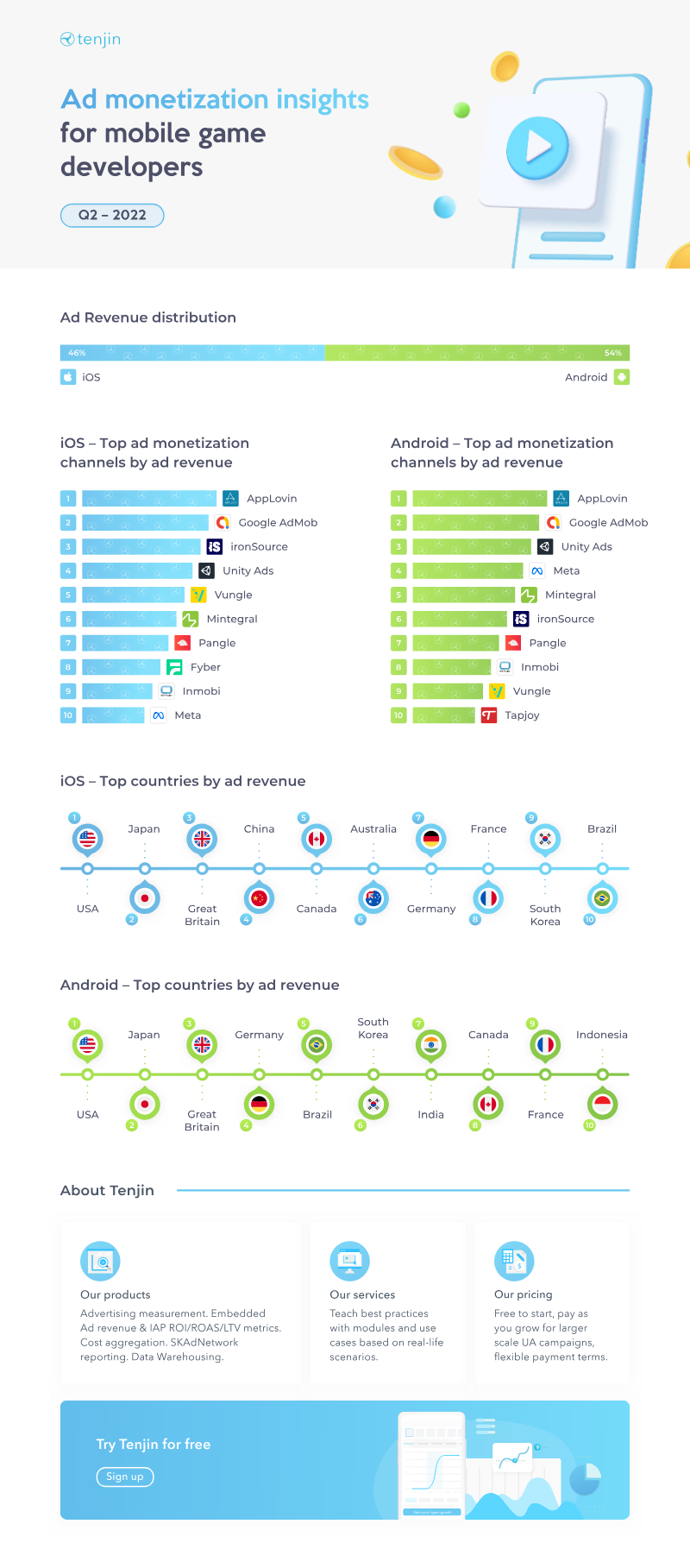
Ad Monetization Insights for Mobile Game Developers 2022
The 2022 ad monetization briefing delivers a data‑driven overview of revenue‑generation strategies for mobile game developers, emphasizing measurement, optimization, and regional performance trends. Core insights reveal that ad‑based income accounts for a majority share of total monetization, with a highlighted 54 % figure indicating the proportion of revenue derived from advertising across the surveyed markets. The analysis spotlights key territories—Germany, Japan, South Korea, Canada, and Indonesia—illustrating how each region contributes to overall earnings and how localized user acquisition (UA) campaigns influence cost structures and return on ad spend.
A central theme is the importance of precise analytics to drive return on investment (ROI), return on ad spend (ROAS), and lifetime value (LTV) calculations. The briefing outlines a suite of measurement tools that aggregate ad revenue, in‑app purchase (IAP) data, and cost metrics, integrating SKAdNetwork reporting for iOS environments and offering flexible data‑warehousing solutions. These capabilities enable developers to assess campaign performance at scale, compare cost aggregation across organic and paid acquisition channels, and refine budgeting decisions based on real‑time insights.
Tenjin’s platform is positioned as a turnkey solution for developers seeking to embed advanced measurement modules without upfront cost, operating on a free‑to‑start, pay‑as‑you‑grow pricing model. The service package includes advertising measurement, cost aggregation, and data‑warehousing, designed to support both emerging studios and larger publishers in optimizing ad revenue streams. While specific methodological details such as sample size or data sources are not disclosed, the briefing draws on 2022 market data to inform best‑practice recommendations for maximizing monetization efficiency across the highlighted global regions.
- Advertising accounts for 54% of total revenue across the mobile game markets surveyed in 2022.
- Effective monetization requires integrating ad revenue, in-app purchase data, and cost metrics to accurately calculate ROI, ROAS, and LTV.
- Key regional markets for mobile game monetization include Germany, Japan, South Korea, Canada, and Indonesia.
- Developers must utilize tools that support SKAdNetwork reporting for iOS environments and aggregate cost data across both organic and paid acquisition channels.
- Tenjin offers a measurement platform for ad revenue and cost aggregation that operates on a free-to-start, pay-as-you-grow pricing model.
+1
TenjinJan 2022