Spain

51 documents·11 publishers

Documents

Page 1
Whitepaper8 pages

White Paper on Video Game Development Sector in Spain

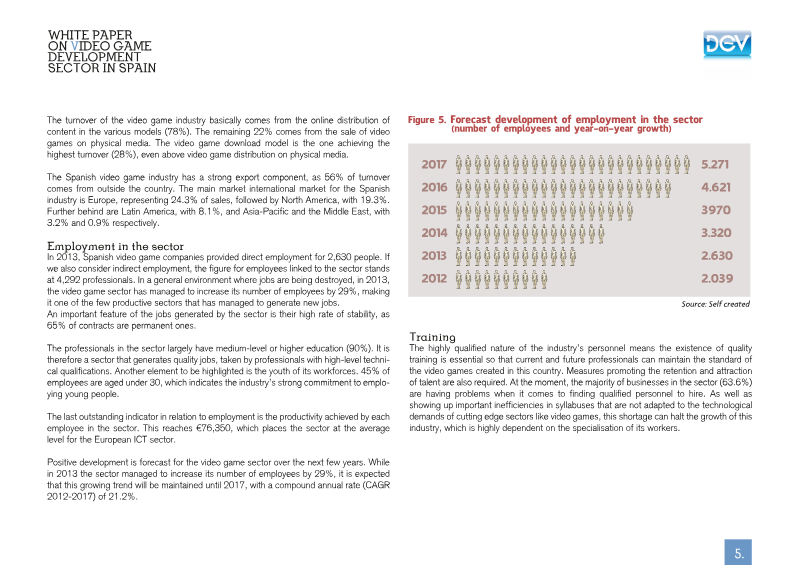
The Spanish video game development sector has emerged as a vital component of the national digital economy, characterized by rapid growth, high innovation, and a strong global orientation. As of 2013, the industry comprised 330 companies, largely concentrated in Madrid and Catalonia, with a workforce that is notably young and highly qualified. The sector generated 313.7 million euros in turnover in 2013, with projections suggesting a compound annual growth rate of 23.7% through 2017. This expansion is driven primarily by online distribution models, which account for 78% of industry revenue, and a robust export market that represents 56% of total sales.

The industry is defined by its youth, with 68% of firms established within the last five years and 97% of capital originating domestically. Employment trends are equally positive; the sector supported 2,630 direct jobs in 2013, marking a 29% increase from the previous year, with a high proportion of permanent contracts. Despite this success, the industry faces significant challenges, particularly a talent gap, as 63.6% of businesses report difficulty finding qualified personnel. This highlights a misalignment between current educational curricula and the specialized technical demands of the video game market.

To sustain this momentum, the sector advocates for an integrated support plan that includes fiscal incentives for research and development, public funding for prototypes, and streamlined internationalization efforts. Recommendations emphasize the need for specialized technology clusters, improved tax treatment for intangible assets, and stronger synergies with transversal industries such as health and education through the development of serious games. By addressing these structural needs and fostering closer collaboration between public administration, private investors, and academic institutions, the industry aims to solidify its position as a competitive, high-productivity leader within the European digital landscape.

  • The Spanish video game sector generated 313.7 million euros in 2013, with a projected compound annual growth rate of 23.7% through 2017.
  • Online distribution models drive the industry's financial performance, accounting for 78% of total revenue, while exports represent 56% of sales.
  • The industry is characterized by rapid expansion and youth, with 68% of the 330 existing companies established within the five years prior to 2013.
  • Direct employment reached 2,630 jobs in 2013, a 29% increase from the previous year, though 63.6% of firms struggle to find qualified personnel due to a mismatch between education and industry needs.
  • Capital investment in the sector is overwhelmingly domestic, with 97% of funding originating within Spain.
+1
Spanish Association for the Game and Entertainment Software Development and Publishing IndustryJan 2021
Page 1
Whitepaper106 pages

Accessibility for Developers: Spain

NCE Videojuegos Accesibles (Spanish Video Games Association): Arturo Monedero and Miriam Fdez Simon (Spanish National Organisation of the Blind Foundation: Juan Aguado Delgado and Enrique García Cortés (@kike_mep) Front and back cover illustration: Natalia Morillo (@heynatnatart) Illustrations of accessibility guidelines: Pablo Ruiz Moyano and Alba Martos Melero Laura Enciso Baringo and Pablo Pérez Ortega Introduction 1 star Context 3D audio .......

  • Video games are a significant recreational option in Spain, with over 18 million regular users, and globally, nearly 400 million of the three billion players have some form of disability.
  • The Spanish Video Game Association (AEVI) and the ONCE Foundation's Ga11y project are collaborating to establish clear accessibility guidelines for game developers, aiming for universal accessibility for players and professionals with disabilities.
  • A primary barrier to video game accessibility is often the controller hardware, not just the software, highlighting the need for games to be compatible with various adapted peripherals.
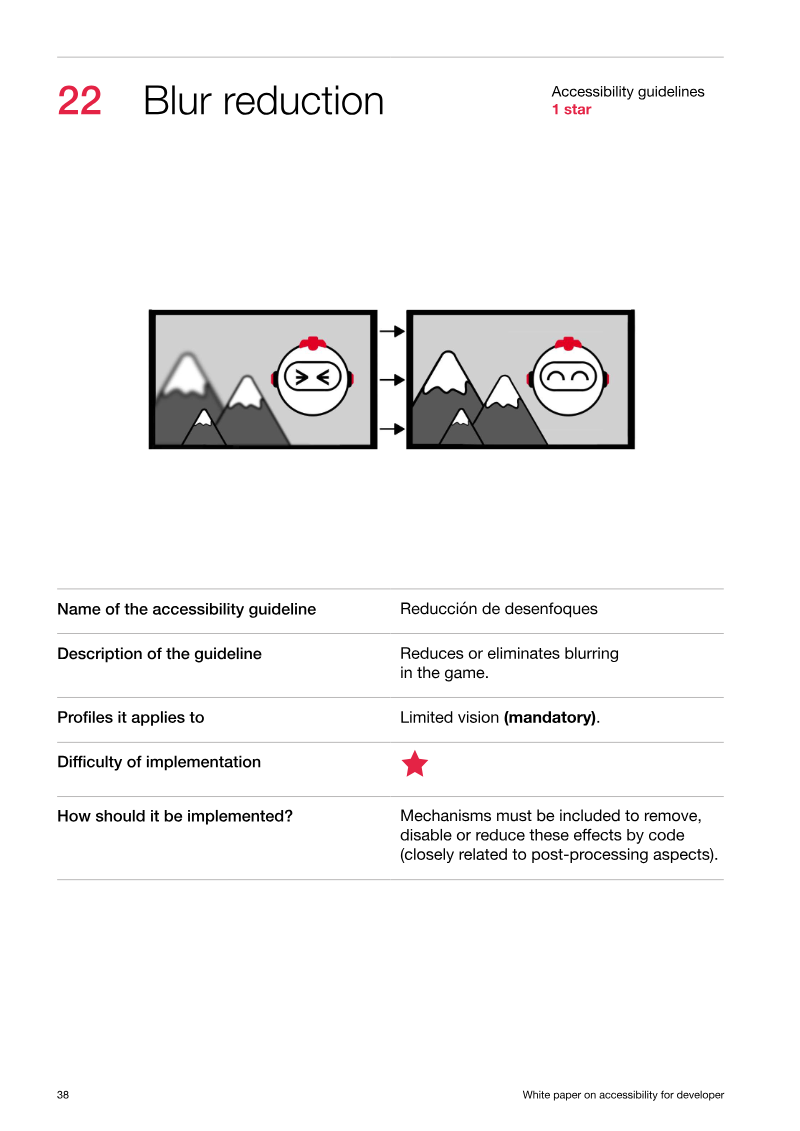
  • The report details specific accessibility guidelines, such as 'D-pad' for manipulation limitations, 'Sound mixing' for limited hearing, 'Visual accessibility pre-settings' for visual impairments, and 'Not dependent on voice interaction' for limited vocal capability, each with implementation difficulty and target profiles.
  • Examples of accessibility peripherals include the QuadStick, a USB game controller compatible with PS3, PS4, Nintendo Switch, and PC, which uses a joystick and blow/suction sensors for control and costs approximately 400€.
+1
Fundación ONCEJan 2021
Page 1
Whitepaper95 pages

Libro Blanco del Desarrollo Español de Videojuegos 2021

Fondo Europeo de Desarrollo Regional Foto: Francesco Ungaro (Pexels) LIBRO BLANCO DEL DESARROLLO ESPAÑOL DE VIDEOJUEGOS 2021 1. Íntroduccion 6 2. Tribuna 8 3. Medidas para incentivar la economía de la industria española de desarrollo de videojuegos en 2022 10 4.

  • The Spanish video game industry advocates for a tax incentive for video game production, similar to that for the audiovisual industry, to attract international projects and investment. This measure is common in other European countries like France, Italy, Belgium, and the UK.
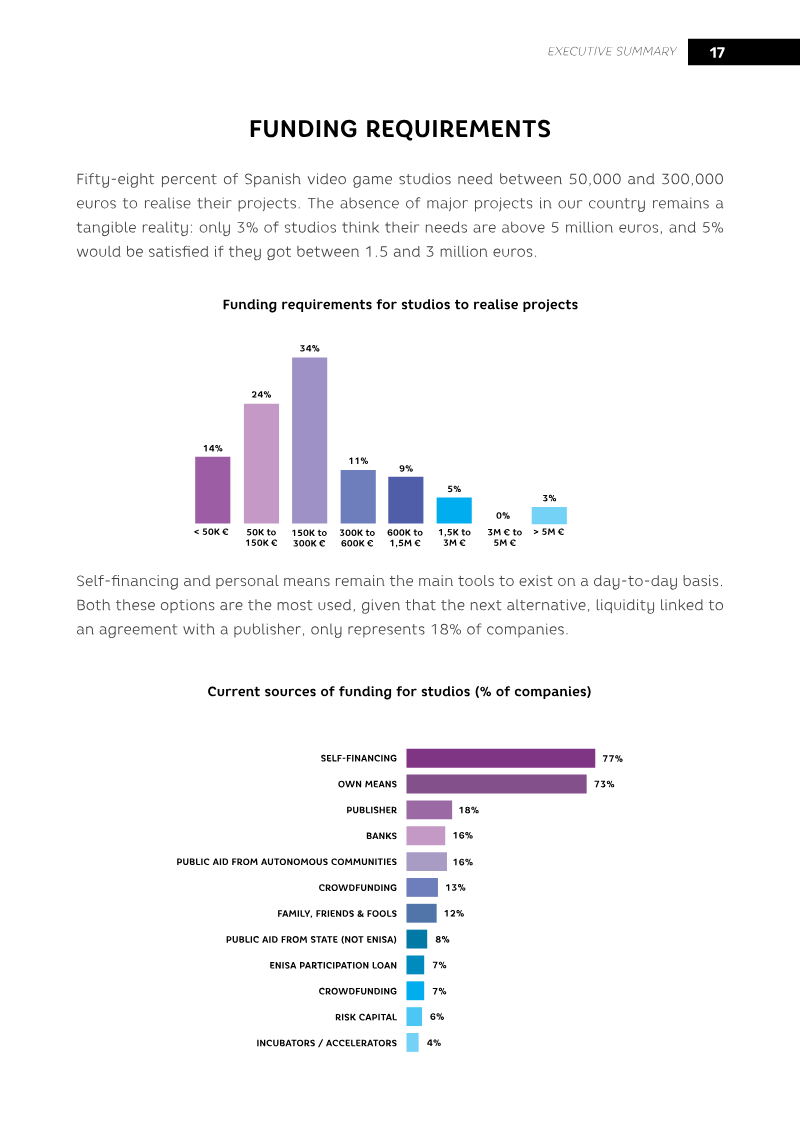
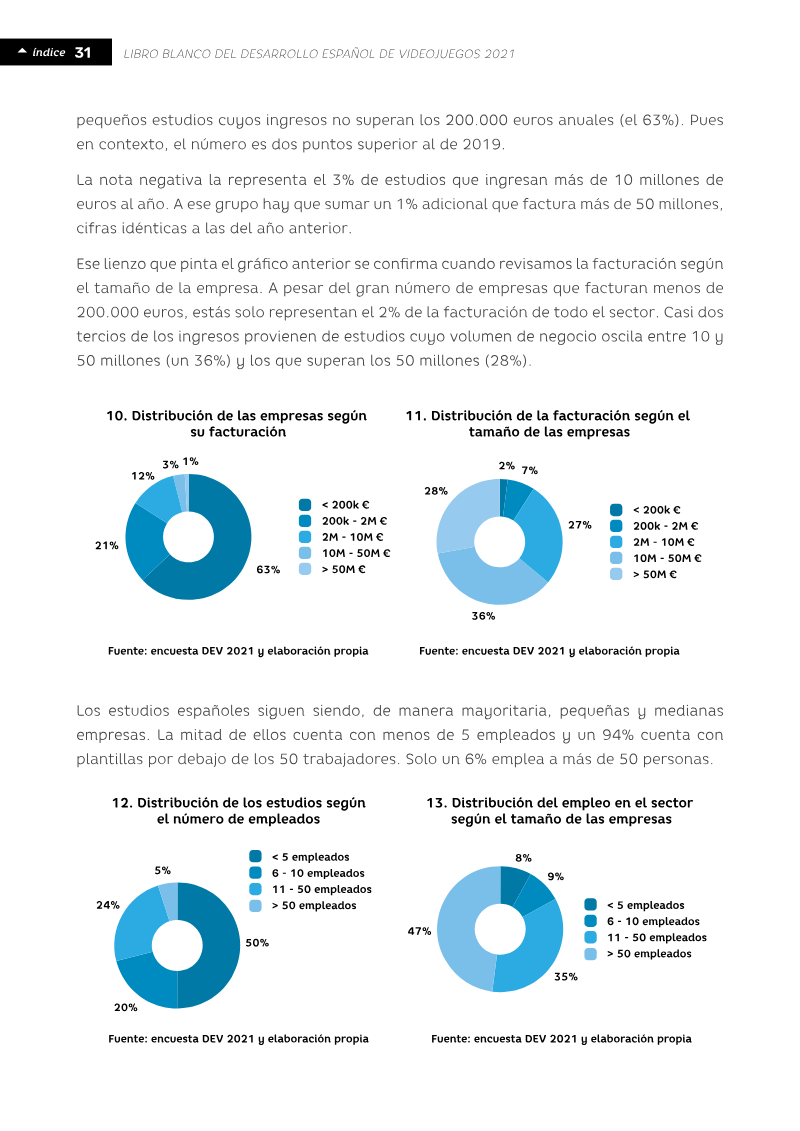
  • The primary funding sources for Spanish studios are their own resources (74%) and self-financing (71%). Funding from publishers increased from 18% to 28%, while bank financing decreased from 16% to 7%.
  • Over half (52%) of the Spanish video game industry workforce is under 30 years old, with only 5% over 45. The majority of workers (43%) have 3-6 years of experience.
  • 88% of Spanish studios develop their own intellectual properties. 54% self-publish, a decrease from the previous year, while 45% engage in development for third parties/outsourcing, and 22% develop serious games.
  • Serious games are a significant niche, with 21% of published games falling into this category. They are primarily directed at the Education sector (85%), followed by Culture (37%) and Tourism (33%).
+1
Fondo Europeo de Desarrollo RegionalJan 2021
Page 1
Report41 pages

La Guía de los Esports

Resumen ejecutivo de “La Guía de los Esports” (Basado en los ocho apartados que aparecen en el material proporcionado)

1. Contexto macro‑económico del sector Tamaño del mercado: US $947.1 M en 2020; proyectado a superar el billón de dólares en los próximos años. Audiencia global: > 215 millones de “entusiastas” (personas que ven competiciones al menos una vez al mes). Motor de crecimiento: Broadband rápido y fiable. Las regiones con mejor conectividad (Este de Asia, Norte de Europa y Norteamérica) concentran la mayor parte del potencial de mercado.

2. Evolución de géneros y penetración regional Nuevos géneros híbridos: Battle‑royale (desde 2017) – p.ej. Fortnite, PUBG. Auto‑battlers (desde 2019) – p.ej. Teamfight Tactics, Dota Auto‑Chess. Penetración de audiencia (por población): | Región | % de población | Fans estimados | |--------|----------------|----------------| | China | 6.09 % | 88 M | | Norteamérica | 4.93 % | 18.2 M | | Europa | 3.90 % | 29.2 M | | Latinoamérica | (dato incompleto) | — | La distribución es muy desigual; los mercados emergentes aún presentan gran margen de expansión.

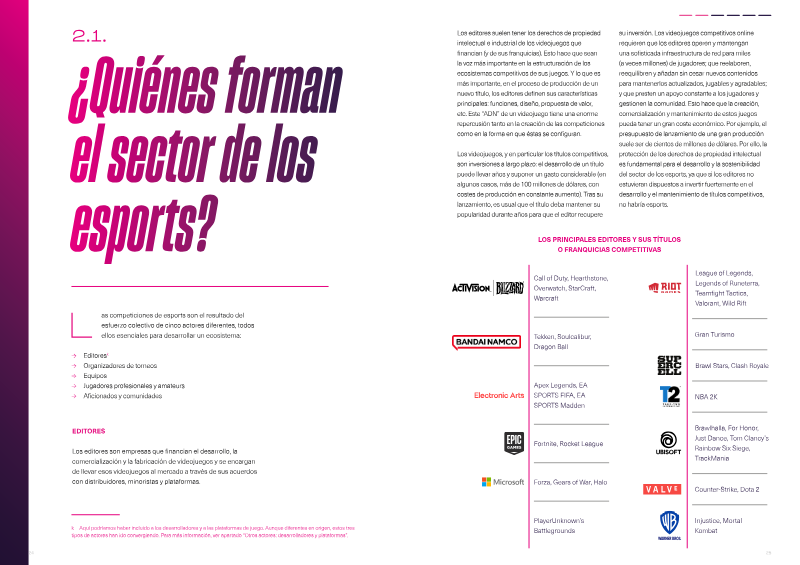
3. Arquitectura del ecosistema Propiedad intelectual: Los publishers (editores) son dueños del IP, financian el desarrollo y establecen las reglas competitivas. Actores interdependientes: Desarrolladores → crean el juego. Plataformas (Steam, Epic, consolas) → distribución y hosting. Organizadores de torneos → eventos y ligas. Equipos profesionales → gestión de jugadores y marcas. Jugadores (pro y amateur) → contenido y rendimiento. Creadores de contenido (streamers, youtubers) → comunidad y monetización. Profesionalización: Programas de becas multimillonarios, ligas estructuradas (ej. LCS, LEC, Overwatch League) y contratos con cláusulas de exclusividad y derechos de imagen.

4. Crecimiento de audiencia y de ingresos Audiencia total: 435.9 M (2021) → 577.2 M (estimado 2024) – CAGR +7.7 %. Ingresos: < $1.1 B (2021) → proyección > $1.5 B para 2024 (

  • The esports market is projected to grow from under $1.1 billion in 2021 to over $1.5 billion by 2024, maintaining a compound annual growth rate (CAGR) of 7.7%.
  • Global esports viewership is expected to reach 577.2 million people by 2024, up from 435.9 million in 2021.
  • Market potential is heavily concentrated in regions with high-speed broadband infrastructure, specifically East Asia, Northern Europe, and North America.
  • China leads global market penetration with 88 million fans, representing 6.09% of its population, significantly outpacing North America (4.93%) and Europe (3.90%).
  • The ecosystem is defined by publisher-controlled intellectual property, where developers dictate competitive rules and league structures like the LCS, LEC, and Overwatch League.
+2
AEVIJan 2021
Page 1
Report108 pages

Análisis del Impacto del COVID‑19 y Mejores Prácticas de Teletrabajo en el Sector de los Videojuegos: Dec 2020

Resumen Ejecutivo Documento: Análisis del Impacto del COVID‑19 y Mejores Prácticas de Teletrabajo en el Sector de los Videojuegos – Diciembre 2020

El informe examina cómo la pandemia de COVID‑19 transformó los mercados financieros, la producción, el consumo y la organización de la industria de los videojuegos. A partir de datos de mercado, encuestas a desarrolladores y análisis de herramientas de trabajo remoto, se extraen lecciones y recomendaciones que siguen siendo relevantes para 2024‑2025.

1. Mercados y comportamiento del consumidor | Aspecto | Observaciones clave | Implicaciones | |---|---|---| | Acciones | Los índices globales cayeron al inicio de la pandemia, pero los valores vinculados a videojuegos (Tencent, Ubisoft, etc.) superaron a los índices generales, que permanecen por debajo de los niveles pre‑COVID. | Los videojuegos se consolidan como “refugio defensivo” y sector de crecimiento. | | Actividad de juego | Picos de usuarios concurrentes en Steam dejaron de seguir patrones semanales; ventas de hardware (Nintendo Switch) y de software digital se dispararon en marzo‑mayo 2020. Las ventas físicas cayeron drásticamente. | La demanda se desplazó a canales digitales; los fabricantes de hardware que ofrecieron portátiles (Switch, Switch Lite) se beneficiaron. | | Móvil | (Resumen incompleto en el texto) – se indica un aumento de la actividad en plataformas móviles, reforzando la tendencia “play‑anywhere”. | Los estudios con presencia móvil ganaron cuota de mercado y deben reforzar sus pipelines cross‑platform. |

2. Impacto en la fuerza laboral de los estudios IGDA Survey (2 500 devs) 18,5 % detuvieron contrataciones. 13,3 % cancelaron pasantías. 8,6 % (dato incompleto) redujeron equipos o pospusieron proyectos. Consecuencias Reducción de la capacidad de escalar proyectos a medio plazo. Aumento de la incertidumbre laboral y de la carga de trabajo para los equipos existentes.

3. Cambios en los hábitos de consumo de juegos Servicios de suscripción (e.g., Xbox Game Pass, PlayStation Now) mostraron resiliencia y crecimiento sostenido. Nuevas suscripciones aumentaron rápidamente al inicio de la pandemia, pero su ritmo se estabilizó por debajo del crecimiento de los usuarios activos de juegos tradicionales. Implicación: Los modelos basados en suscripción son ahora una pieza central de la estrategia de ingresos y requieren inversión en contenido continuo (LiveOps, DLCs).

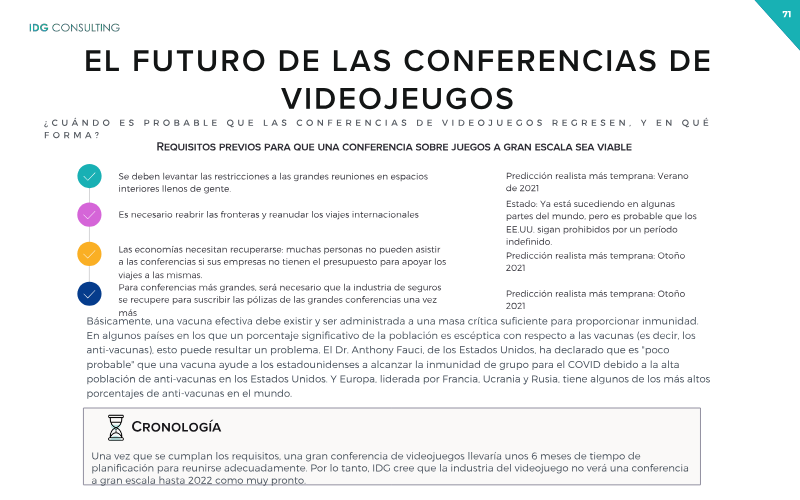
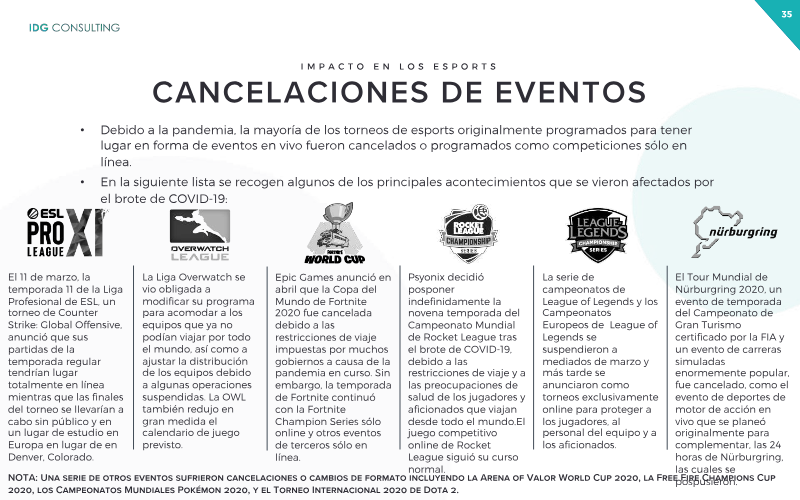
4. Esports y eventos competitivos Los torneos migraron totalmente a entornos online. League

  • Video game stocks, including companies like Tencent and Ubisoft, outperformed global market indices during the pandemic, establishing the sector as a defensive asset class with long-term growth potential.
  • Consumer demand shifted decisively toward digital channels between March and May 2020, causing a sharp decline in physical sales while hardware platforms offering portability, such as the Nintendo Switch, saw significant spikes in sales.
  • Subscription services like Xbox Game Pass and PlayStation Now proved resilient, becoming a central pillar of revenue strategy that necessitates ongoing investment in LiveOps and DLC content.
  • The IGDA survey of 2,500 developers revealed that 18.5% of studios halted hiring and 13.3% canceled internship programs, leading to reduced project scalability and increased workforce instability.
  • Gaming activity patterns shifted during the pandemic, with concurrent user counts on platforms like Steam breaking traditional weekly cycles and mobile gaming activity increasing, reinforcing the industry-wide 'play-anywhere' trend.
+1
IDG ConsultingDec 2020
Page 1
Whitepaper26 pages

White Paper on Spanish Video Game Development 2020

Promoted by: With support from: Promoted by: With support from: LÍNEA Covid-19<sub>CULTURA</sub> One more year, DEV, the Spanish Association of Video Games and Entertainment Software Producers and Development Companies, keeps its commitment to the sector it represents by publishing the White Paper on Spanish Video Game Development, the leading report that makes an in-depth analysis of the video game industry in our The White Paper, this year celebrating its seventh edition, is aimed at dev...

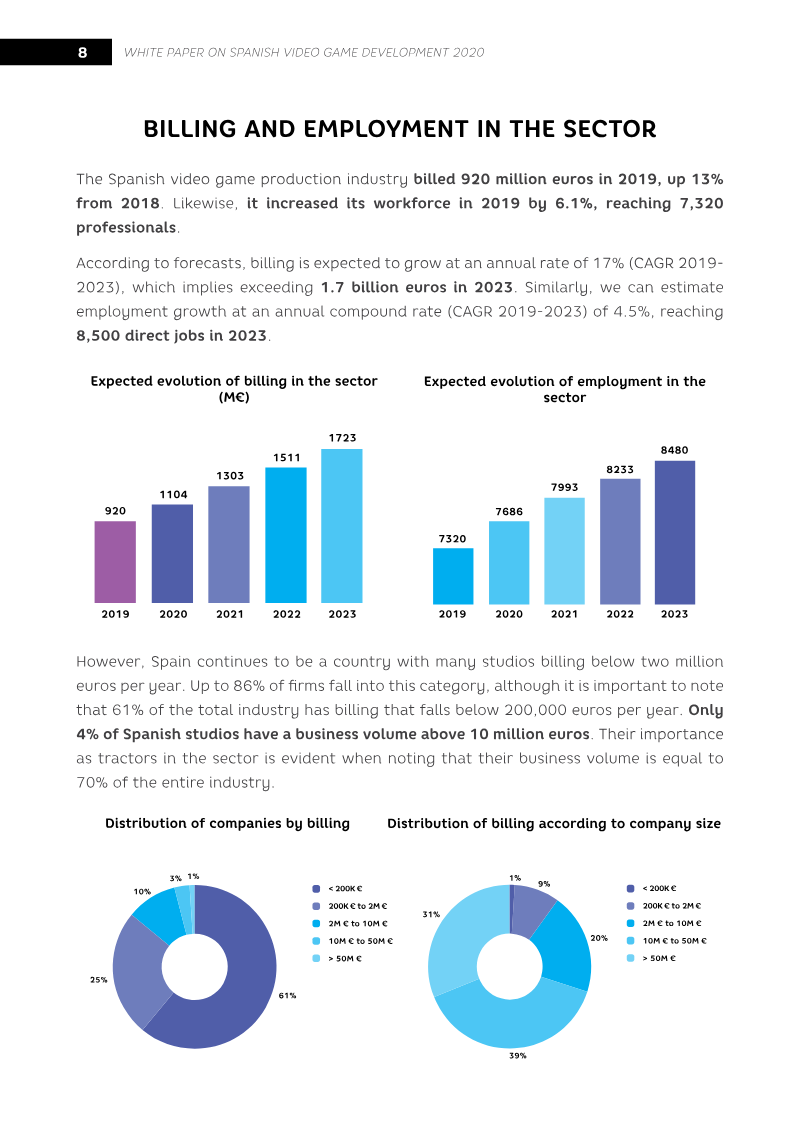
  • The Spanish video game industry billed 920 million euros in 2019, a 13% increase from 2018, and is projected to exceed 1.7 billion euros by 2023 with an annual growth rate of 17%.
  • Employment in the sector grew by 6.1% in 2019, reaching 7,320 professionals, and is estimated to reach 8,500 direct jobs by 2023.
  • Despite being the fifth European and tenth global market, 86% of Spanish studios bill below 2 million euros annually, with 61% billing under 200,000 euros, indicating a prevalence of small companies.
  • Catalonia leads in both billing (51%) and employment (46%) within the Spanish video game industry, followed by Madrid (28% billing, 26% employment).
  • A significant 66% of the industry's revenue comes from international markets, highlighting its export-oriented nature.
+1
DEV - Spanish Association of Video Games and Entertainment Software Producers and Development CompaniesJan 2020
Page 1
Report14 pages

Videojuegos en el aula: ¿Qué se está haciendo en España? Manual para docentes

Spanish educators are increasingly embracing video games as legitimate pedagogical tools, recognizing their capacity to foster creativity, decision‑making, empathy and social interaction. Initiatives such as the “The Good Gamer” guide produced by the Association of Video Game Educators (AEVI) and the incorporation of titles like Minecraft Education Edition illustrate a shift toward using interactive media for subjects ranging from biodiversity and water‑management to digital competence. A diverse portfolio of serious‑games and gamified projects now supports classroom instruction, including bullying‑prevention applications such as Diana frente al espejo and Teacher+, curriculum‑reinforcement platforms like Academons and Villi Adventures, and culturally oriented experiences from museum tours to ballet simulations. These resources are employed not only to convey academic content but also to develop social‑emotional skills and preserve cultural heritage.

Collaboration across the ecosystem is extensive. Major industry players—including EA, Microsoft, Nintendo, Ubisoft and Take‑Two—alongside numerous independent studios, are partnering with Spanish universities and specialized schools such as Universidad Complutense, Universidad de La Coruña and Voxel School. This coalition is coordinated through bodies like the Interactive Software Federation of Europe, facilitating the design, testing and deployment of classroom‑based video‑game projects. The convergence of commercial expertise, academic research and educational policy signals a systemic endorsement of games as a core component of modern curricula throughout Spain, reflecting a broader European trend toward integrating interactive technology into formal learning environments.

  • Spanish education is integrating video games as formal pedagogical tools to teach subjects ranging from biodiversity and water management to digital competence.
  • Major industry players including EA, Microsoft, Nintendo, Ubisoft, and Take-Two are actively partnering with Spanish universities like Universidad Complutense and Voxel School to develop and deploy classroom projects.
  • Gamified resources are being utilized for social-emotional development, specifically through bullying-prevention applications such as 'Diana frente al espejo' and 'Teacher+'.
  • Curriculum-reinforcement platforms like 'Academons' and 'Villi Adventures' are being deployed alongside 'Minecraft Education Edition' to support standard academic instruction.
  • The adoption of these tools is coordinated by organizations such as the Association of Video Game Educators (AEVI) and the Interactive Software Federation of Europe to align commercial expertise with educational policy.
AEVIJan 2020
Page 1
Report14 pages

Las Mujeres Juegan, Consumen, Participan: Contribución a la Industria de Videojuegos en 2020

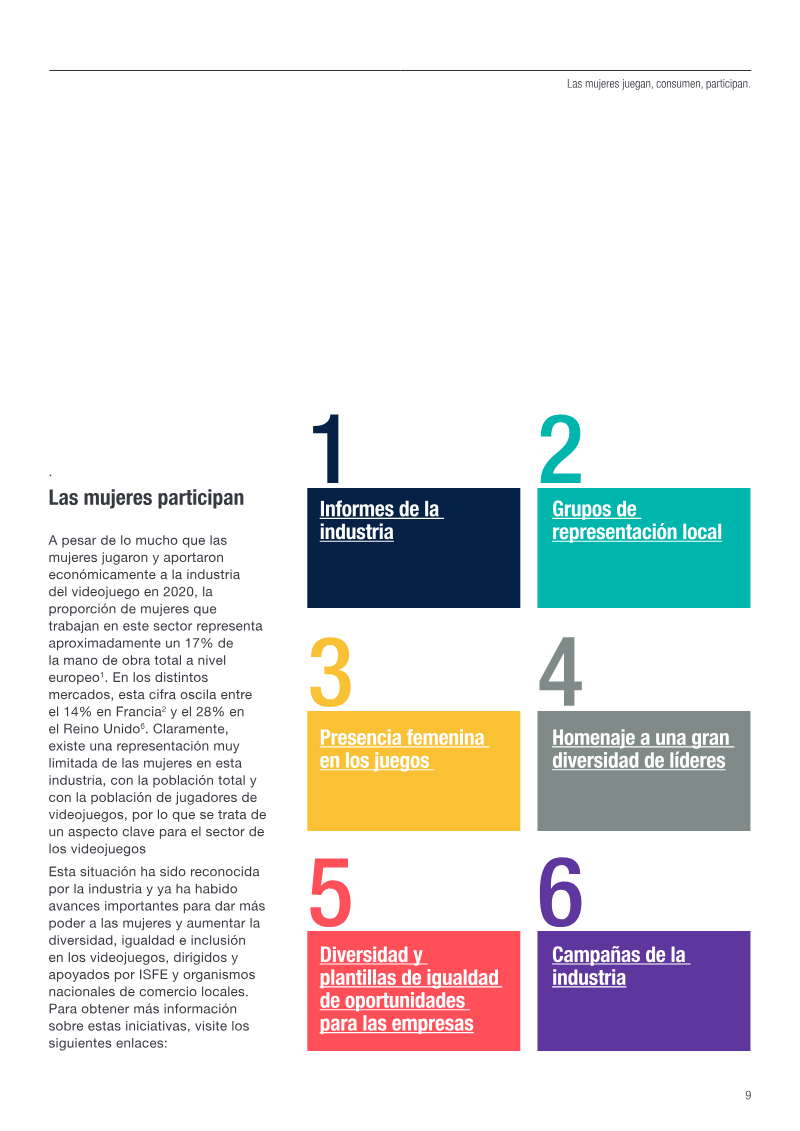
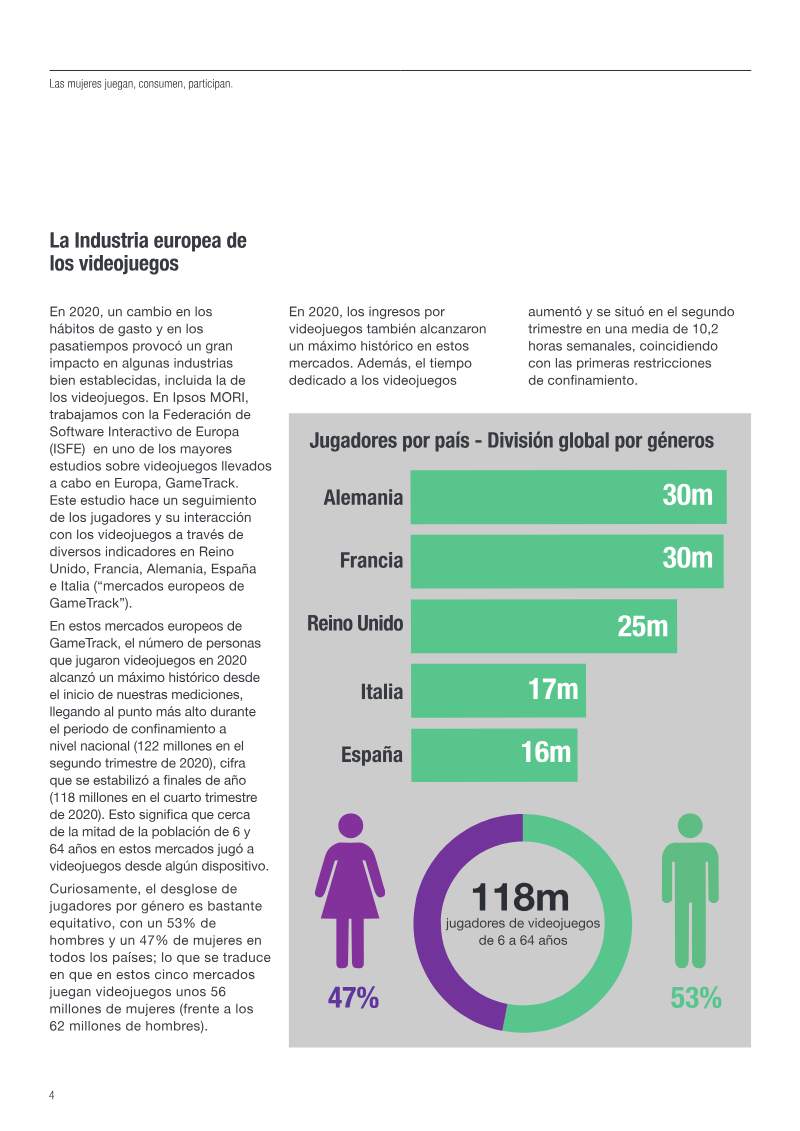
The analysis highlights how women have become a decisive force in the European video‑game market in 2020, both as players and as consumers. By the end of the year 118 million people aged 6‑64 were active gamers across Spain, France, Germany, Italy and the United Kingdom, with women accounting for 47 % of that base—up from 45 % in 2019. During the second‑quarter lockdown a record 60 million women played, and their average weekly playtime rose to 8.8 hours, with console sessions increasing by roughly one hour compared with the previous year. Mobile gaming proved especially important, as smartphone and tablet usage among women grew 3 % between Q1 2019 and Q4 2020.

Financially, women generated 38 % of total video‑game spending in the five markets, translating into approximately €6.8 billion of the €17.8 billion industry revenue—a 31 % year‑on‑year increase. Their purchases were split evenly between console titles and mobile apps, each contributing about €3 billion. The sector’s overall revenue rose by €3.2 billion in 2020, underscoring the economic impact of the expanding female audience.

Work

  • Women accounted for 47% of the 118 million active gamers across Spain, France, Germany, Italy, and the UK in 2020, up from 45% in 2019.
  • Female gamers generated €6.8 billion in spending in 2020, representing 38% of total industry revenue and a 31% year-on-year increase.
  • During the 2020 Q2 lockdown, 60 million women played video games, with average weekly playtime rising to 8.8 hours and console sessions increasing by approximately one hour.
  • Spending by women was split evenly between console titles and mobile apps, with each category contributing approximately €3 billion to the total.
  • Smartphone and tablet usage among female gamers grew by 3% between Q1 2019 and Q4 2020, highlighting the rising importance of mobile platforms.
+1
AEVIJan 2020
Page 1
Report35 pages

Los Esports en España: Situación Actual y Posición de la Industria

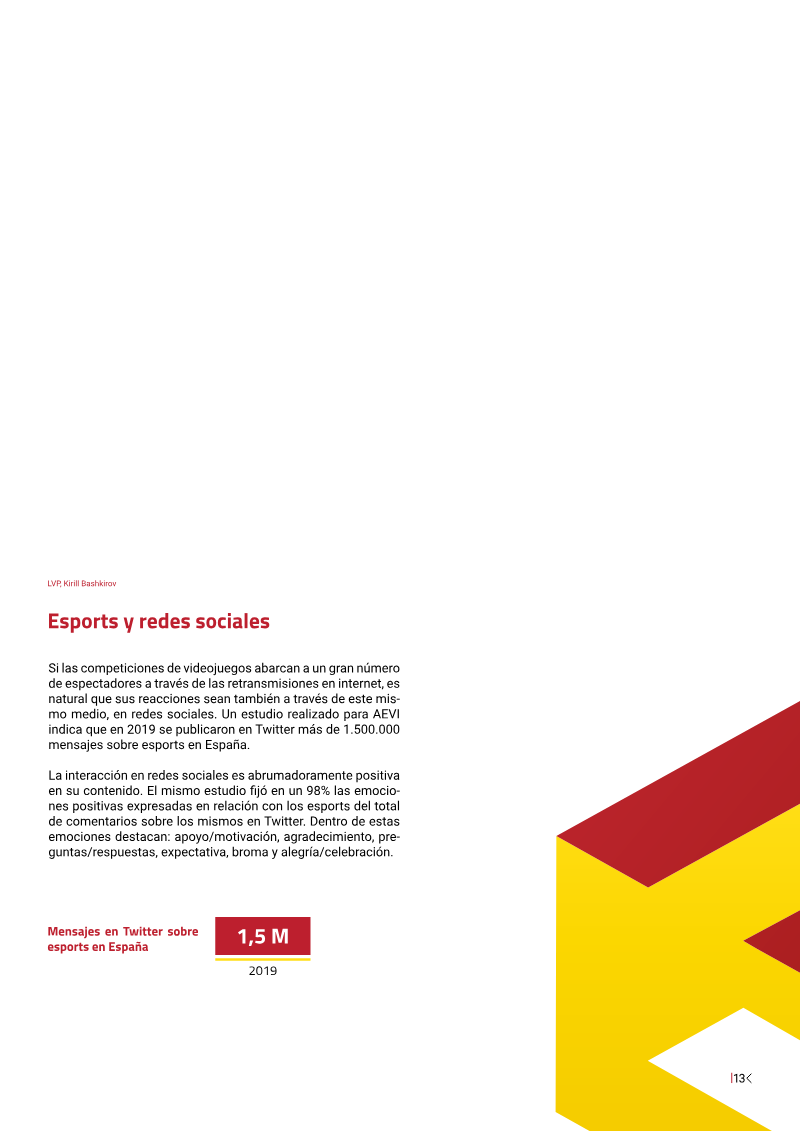
The analysis presents a comprehensive overview of Spain’s esports ecosystem, emphasizing its rapid expansion, market significance, and emerging challenges. Between 2016 and 2019 the sector more than doubled, rising from €14.5 million to €35 million in revenue, which now represents roughly four percent of global esports income. Employment grew to about 600 individuals, including 250 professional players, while advertising expenditure reached €22.5 million in 2019. Viewership figures place Spain twelfth worldwide, with 2.9 million regular spectators—over half of whom are older than 25—and a female audience share of 36 percent, the highest in Europe. Social engagement is strong, generating over 1.5 million positive mentions on Twitter.

Spain has consolidated its position as a European esports hub, attracting high‑level domestic talent, significant foreign participation, and flagship tournaments such as the League of Legends Championship, CS:GO, and Rocket League World Championships. Sponsorship is dominated by the three major telecom operators—Movistar, Orange and Vodafone—providing financial stability and visibility. The sector benefits from the involvement of leading publishers, platforms, and organizers like LVP, ESL and DreamHack.

Despite these advances, the industry faces structural obstacles, notably the need for improved broadband and 5G infrastructure and the absence of dedicated esports legislation, which contrasts with neighboring France. Regulatory uncertainty and the commercial nature of esports, coupled with complex intellectual‑property arrangements of game publishers, are identified as key factors that could influence future growth and investment.

  • Spain's esports revenue more than doubled between 2016 and 2019, growing from €14.5 million to €35 million and capturing approximately four percent of the global market.
  • The industry supports 600 jobs, including 250 professional players, and generated €22.5 million in advertising expenditure as of 2019.
  • Spain ranks twelfth globally in viewership with 2.9 million regular spectators, featuring the highest female audience share in Europe at 36 percent and a demographic where over half of viewers are older than 25.
  • Major telecom operators Movistar, Orange, and Vodafone provide the primary financial foundation for the sector, which hosts flagship events like the League of Legends, CS:GO, and Rocket League World Championships.
  • Growth is currently hindered by a lack of dedicated esports legislation and the need for improved 5G and broadband infrastructure.
AEVIJan 2020
Page 1
Report11 pages

Catálogo de Servicios – Desarrolladores: España

The catalogue presents AEVI’s strategy to strengthen Spain’s video‑game development sector through a suite of collaborative services and targeted initiatives. Central to the effort is the celebration of the second anniversary of the association’s development area, which underscores a commitment to expand support for local studios, from established references to emerging independents.

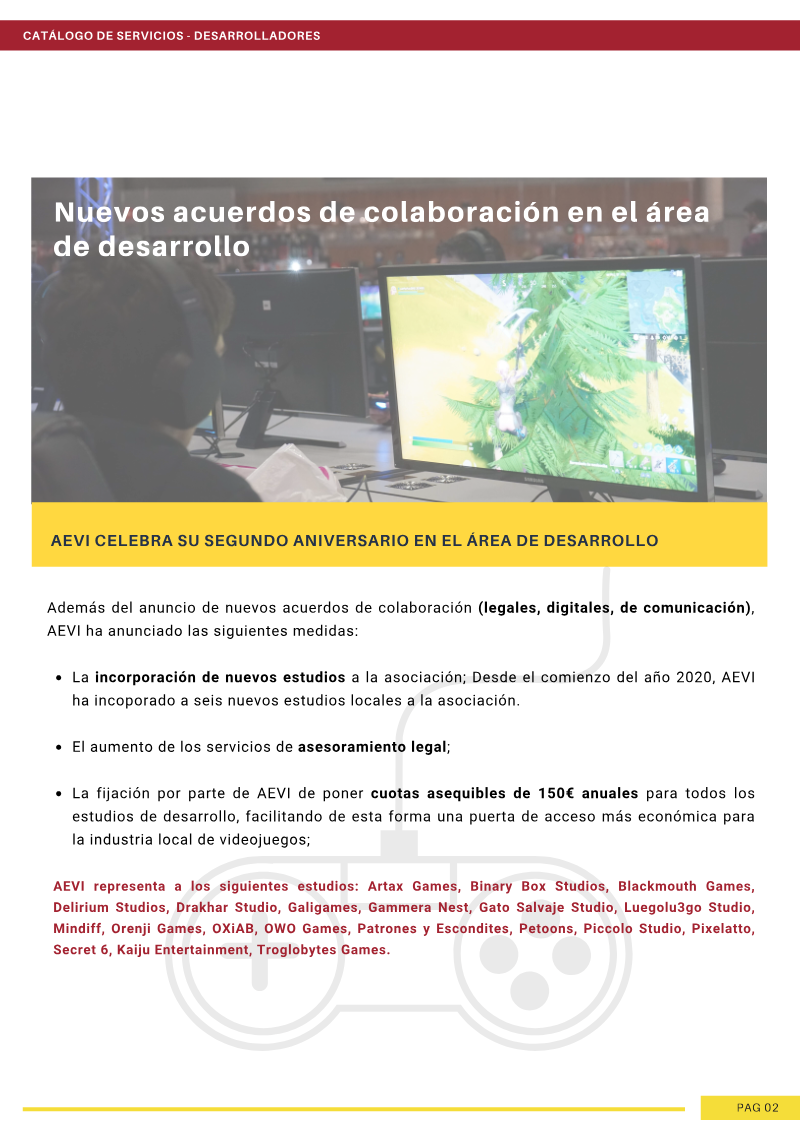
Since the start of 2020, six new development studios have joined AEVI, bringing the total roster to more than thirty members, including Artax Games, Binary Box Studios, Blackmouth Games and others. Financial assistance is offered through a €10,000 grant programme, while an affordable annual membership fee of €150 eases entry for smaller firms. AEVI also operates a mentor network, a job‑matching platform, and a €10,000 aid scheme, and has conducted outreach across 15,000 km, meeting over 300 developers in cities such as Madrid, Barcelona, Bilbao and Seville.

Key partnerships extend legal, technological and commercial expertise to members. Bird & Bird provides free initial legal consultations on intellectual‑property, labour and tax matters; Tutelio supplies blockchain‑based IP protection services; B2Boost grants access to weekly market‑intelligence reports covering PSN, Xbox Live, Steam and Nintendo e‑shop sales; Sorastream enables cost‑free integration of games into its cloud‑gaming platform with revenue‑share terms for AEVI affiliates. Additional collaborations with Enumbers, Screenglitch, Make Good Art Agency and Gamingates deliver accounting tools, marketing support, digital‑strategy advice and visibility in professional networks.

Collectively, these measures aim to create a sustainable ecosystem for Spanish developers, fostering talent, facilitating market entry and enhancing the international profile of locally produced games.

  • AEVI has expanded its development division to over 30 member studios since 2020, including firms like Artax Games, Binary Box Studios, and Blackmouth Games.
  • The association provides direct financial support through a €10,000 grant programme and maintains a low barrier to entry for small firms with an annual membership fee of €150.
  • Members receive specialized professional services, including free initial legal consultations from Bird & Bird and blockchain-based IP protection via Tutelio.

  • Market intelligence is provided through B2Boost, which supplies weekly sales data from major platforms including PSN, Xbox Live, Steam, and the Nintendo e-shop.
  • AEVI facilitates commercial growth and distribution through cloud-gaming integration via Sorastream and marketing support from partners like Make Good Art Agency and Gamingates.
+1
AEVIJan 2020
Page 1
Report35 pages

Impact of Cloud Gaming and Other Trends in the Indie Ecosystem: Spain

The analysis evaluates how cloud‑gaming and emerging distribution models are reshaping the Spanish indie game ecosystem, arguing that while the broader gaming audience is expanding across new platforms and financing structures, cloud‑gaming remains experimental and will not achieve mass‑market penetration for several years due to bandwidth constraints and uneven consumer readiness. Console users, especially those who are price‑sensitive and less tied to a single PC ecosystem, are identified as the most promising segment for indie titles delivered via cloud, with subscription‑or‑free‑to‑play (GaaS) approaches offering the strongest revenue potential.

Current platform data show PlayStation Now operating in 19 high‑speed‑Internet markets and reaching more than 79 million PS4 owners—approximately 0.6 % of the console base—yet its relatively high subscription fee and overlap with PS Plus dilute its attractiveness. Google Stadia leverages extensive data‑center and AI resources, providing a free tier alongside a €9.99‑per‑month option, illustrating divergent pricing strategies within the nascent market.

Strategic recommendations for indie studios emphasize hybrid monetisation that combines subscriptions with direct sales, targeting latency‑tolerant mid‑core audiences, including a growing female demographic. Development pipelines should prioritise engines with broad cross‑platform support, notably Unreal for versatility and Unity for seamless Stadia integration, while adopting low‑cost, high‑quality marketing to compensate for the reduced role of traditional publishers. Cloud‑gaming’s principal advantage lies in creating a more level playing field, granting indie developers visibility and access to users lacking high‑end hardware, thereby expanding market reach in Spain and comparable European territories over the coming three to five years.

  • Cloud gaming is currently an experimental niche that will not reach mass-market penetration for three to five years due to bandwidth limitations and consumer readiness.
  • Indie studios should adopt hybrid monetization models that combine direct sales with subscription or free-to-play (GaaS) approaches to maximize revenue potential.
  • The most viable target audience for cloud-based indie titles consists of price-sensitive console users and latency-tolerant mid-core players, including the growing female demographic.
  • PlayStation Now currently reaches approximately 0.6% of the 79 million PS4 console base, with its growth hindered by high subscription fees and service overlap.
  • Development pipelines should prioritize cross-platform engines, specifically Unity for its seamless Stadia integration and Unreal for overall versatility.
+1
AEVIOct 2019
Page 1
Whitepaper78 pages

Libro Blanco del Desarrollo Español de Videojuegos 2019

DESARROLLO ESPAÑOL<sub>DE</sub> PROMOVIDO POR: CON EL APOYO DE: CON LA COLABORACIÓN DE: FONDO EUROPEO DE DESARROLLO REGIONAL eGoGames mCR codice software GGCoM UNA MANERA DE HACER EUROPA INTRODUCCIÓN .......................................................................................................................................

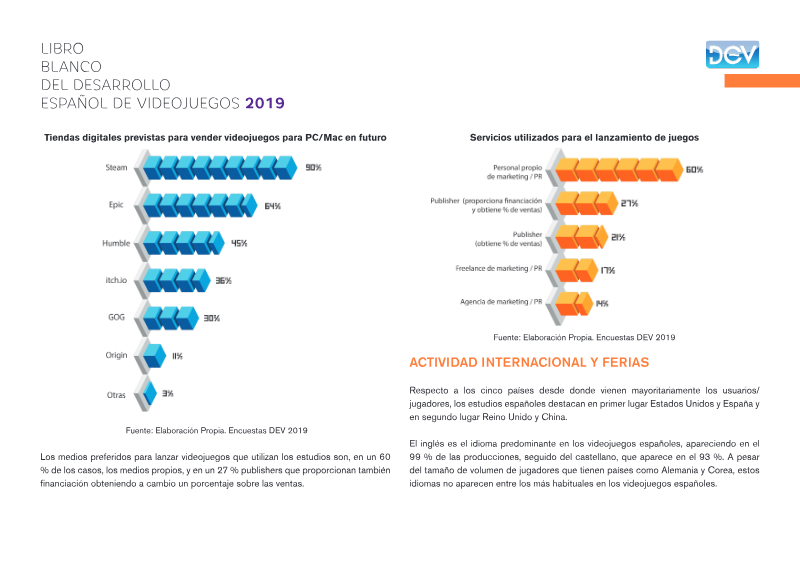
  • The Spanish video game industry is young, with 80% of companies less than 10 years old, and 61% of companies generating less than 200,000 euros annually. Only 3% of companies exceed 10 million euros per year, but they contribute 67% of the total annual revenue.
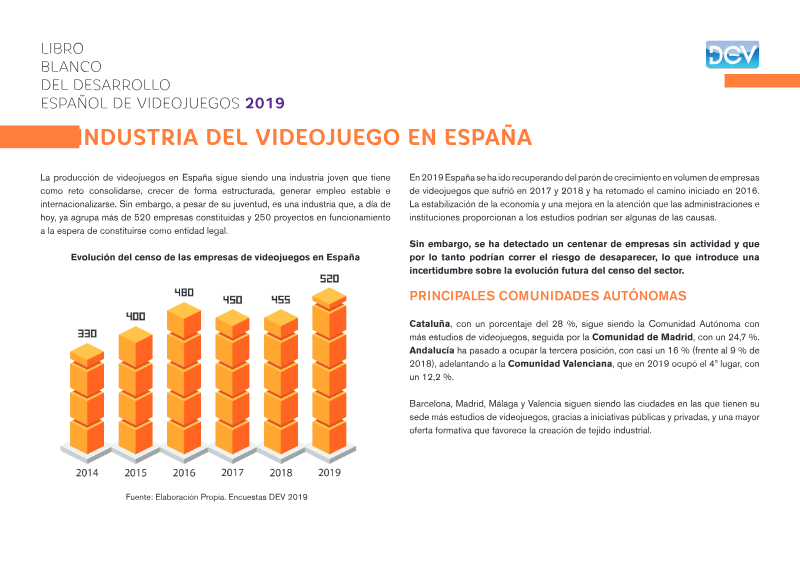
  • In 2019, Spain's video game industry recovered from a growth stagnation in 2017-2018, now boasting over 520 established companies and 250 projects in development. However, a hundred inactive companies introduce uncertainty about future growth.
  • Catalonia leads in the number of video game studios (28%), followed by Madrid (24.7%), and Andalusia (16%), which surpassed Valencia (12.2%) in 2019.
  • 42% of Spanish video game companies had not published any games in 2018, and 31% had published only one, often due to long development cycles and a focus on self-financed, single-IP projects.
  • Public aid for Spanish video game studios in 2018 primarily came from autonomous communities (47%), with 10% from the Ministry of Culture and Sport's Innovation in Cultural Industries program.
+1
DEV - Desarrollo Español de VideojuegosJan 2019

Publishers

Related Topics