Women went from 621 in 2022 to 685 in 2023
Source: Brazilian Gaming Industry Report 20232,600 member companies
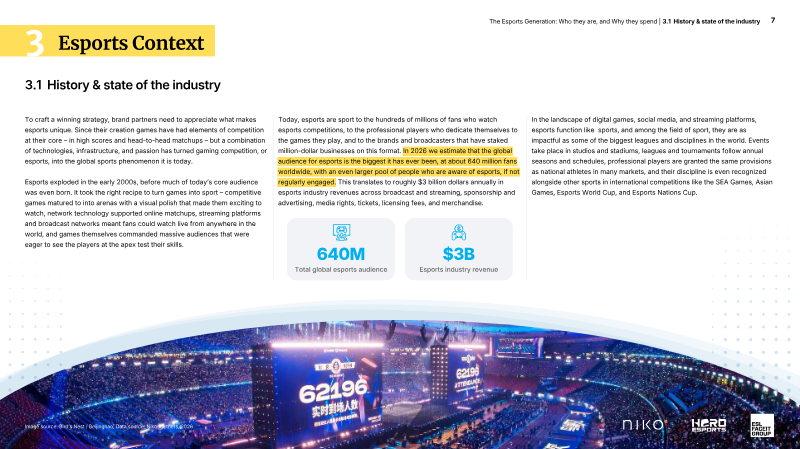
Source: Video Games – A Force for Good: Europe's Video Game IndustryEsports boast a total audience of 436 million, expected to reach 577 million in 2024.
Source: Video Games – A Force for Good: Europe's Video Game Industry31.3 is the average age of a video game player in Europe
Source: Video Games – A Force for Good: Europe's Video Game Industry48% of video game players are girls (6-15 years old)
Source: Video Games – A Force for Good: Europe's Video Game IndustryGirls who play video games are 3x more likely to pursue a STEM career than girls who don’t.*
63% play on smartphones or tablets
Source: Video Games – A Force for Good: Europe's Video Game IndustryThe largest proportion of men is in the area of Programming and Project Management at 30% (237 people), a lower proportion than in 2022 (35%), although the absolute number has risen.
Source: Brazilian Gaming Industry Report 2023The image displays a bar graph representing the total number of players in the mobile game, "Newzoo"
The image displays a bar graph representing the total number of players in different regions
The image displays a bar graph and pie chart
The image displays a bar graph representing the global market by region
The image displays a bar graph representing the global console revenue by genre in 2023
The image displays a bar graph with the title "How long should a game remain in Early Access before full release (v1
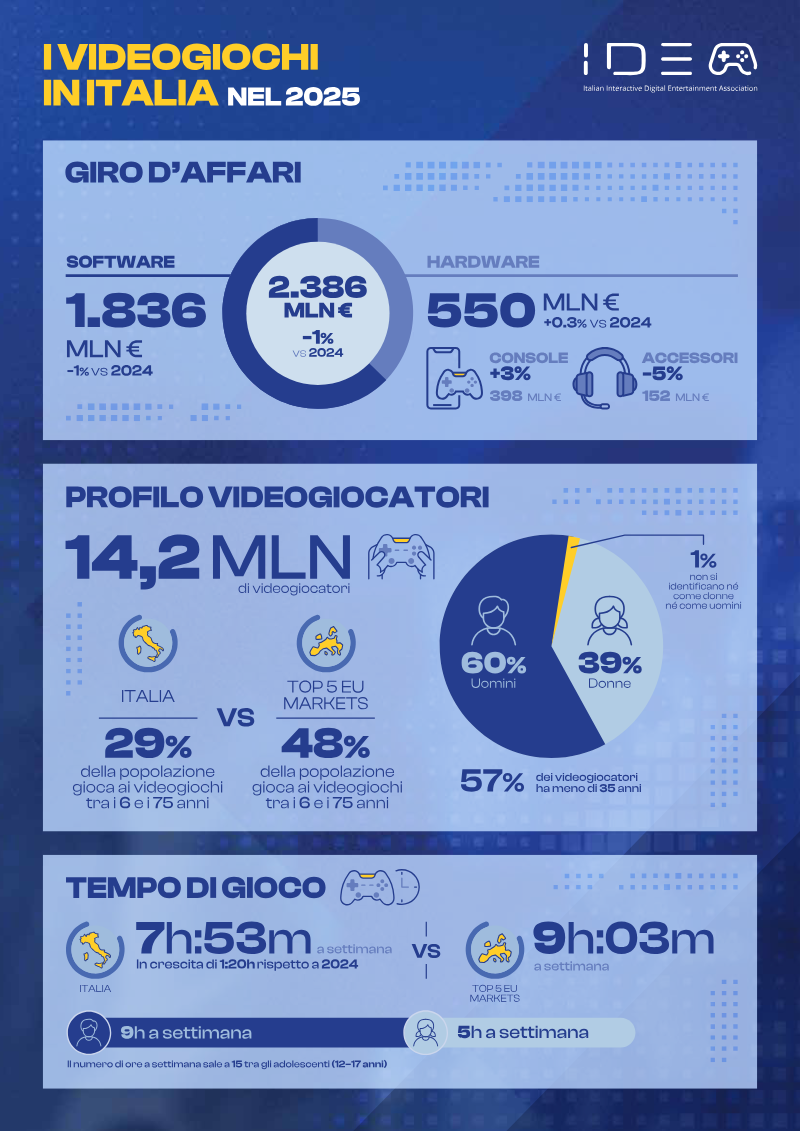
In 2025, roughly 14.2 million Italians—about a third of the population aged six to seventy‑five—engage in video gaming, with a pronounced male bias and a concentration of players under 35. The industry’s total revenue remains steady at €2.4 billion, of which game sales account for 77 percent (€1.8 bn). Gaming time has risen to nearly eight hours per week, driven primarily by smart‑device play (22 percent reach, €929 m revenue) and console gaming (13 percent reach, €643 m). App‑based games now represent more than half of the market, dominated by freemium monetisation; only one percent of app revenue comes from upfront purchases. Revenue distribution varies by platform. Smart‑device earnings are almost entirely from in‑app purchases (ARPU €84), while console sales lean heavily on digital downloads—65 percent of new game revenue comes from full‑game downloads (€502 m) and 21 percent from DLC (ARPU €99). PC revenue is largely driven by DLC (43 percent) and full‑game downloads (98 percent of console sales). Subscription services are pivotal: console ecosystem subscriptions contribute 59 percent of total gaming‑subscription revenue (€153 m), with mobile and single‑game franchises accounting for 6 percent and 35 percent respectively. Player demographics reveal that smart devices attract a younger, male‑skewed audience (31 percent of 6–17‑year-olds), whereas console and PC gaming remain niche but heavily male‑skewed, concentrated among teens. Casual and sports titles dominate sales across all platforms, with subscription services such as PlayStation Plus and Xbox Game Pass driving a significant share of paid play. Engagement patterns show males spending the most hours on consoles (average seven hours per week), while PC gaming remains steady across age groups. Approximately one‑quarter of players follow gaming news on YouTube or vlogs, and 20 percent rely on social media or family discussions for information. The data derive from a nationally representative online survey of 3,000 respondents, weighted against an offline omnibus sample and calibrated to industry sales figures.
Gaming is projected to reach 3.5 billion players and generate over US$225 billion in revenue by 2025, establishing the medium as a mass‑scale platform with extensive brand opportunities. Dentsu’s data‑fusion approach merges a 420,000‑respondent consumer panel with GWI gaming insights across 21 markets to create high‑fidelity gamer portraits that link lifestyle, media habits and in‑game behaviors. This methodology enables brands to segment audiences by motivation rather than device or genre, a strategy shown to produce the most authentic and attention‑driven brand experiences. Key demographic insights reveal that 57 % of gamers are female, with gaming serving as a tool for identity reinvention and social bonding. Shooters dominate play preferences (63 %), while sports and puzzle/strategy titles attract 16 %. Device usage is nearly evenly split among console, handheld, and a growing smartphone/tablet share. Community engagement is strong: 40 % of U.S. gamers play to belong, and 63 % rely on friends for game information, with platforms such as Discord, Reddit, and Twitch amplifying fandoms. Commercially, 71 % of gamers consume gaming content across multiple devices and 55 % of esports fans welcome sponsorships, underscoring high engagement. Brands that add genuine value—through exclusive rewards, immersive metaverse experiences, or AR scavenger hunts—achieve near‑perfect ad completion rates (96 %) and significant click‑throughs. Successful activations require clear brand rules, diversity inclusion, strategic partnerships with publishers or esports teams, and a focus on authentic integration rather than intrusive advertising. The analysis spans 22 global markets, including Australia, Brazil, Canada, China and the United States, offering a comprehensive framework for brands to identify entry points and growth opportunities within the evolving gaming ecosystem.
The survey, covering September 2024 to September 2025, examines India’s interactive media landscape across video, audio, social, gaming and emerging AI‑driven content. It finds that 46 % of consumers are women, with two‑thirds residing outside metro areas and 80 % using more than 1 GB of mobile data daily. Video consumption averages six hours weekly, driven by exclusivity and celebrity presence; OTT platforms dominate paid content, yet microdramas and anime are gaining wallet share. Audio listeners favor podcasts over music, with 60 % willing to pay for audio apps, especially during commuting and chores. Social media usage averages 10 hours weekly, skewing male and non‑metro, with participative platforms (astrology, dating) rising. Gaming remains mobile‑first but 30 % use PCs and 22 % consoles; casual and midcore titles command the most time (8 hours/week) and spend, with UPI accounting for 90 % of in‑app purchases. Monetization patterns show a preference for monthly subscriptions over annual plans, and a shift away from RMG/fantasy genres. Across price points, games capture 70 % of wallet share above INR 1,000, while video and social command 30 % each at INR 200‑500. AI adoption is higher in metros, with over half of users open to AI content but skeptical about AI companions. The study draws on a mixed‑method survey of 3,000+ respondents nationwide, integrating usage logs and payment data to map consumption, willingness to pay, and emerging trend trajectories.
Gaming in Africa 2024 reveals a market that is overwhelmingly mobile‑centric, with 92 % of respondents playing on phones and 81 % using smartphones. Android dominates, accounting for 92 % of downloads from Google Play, while iOS remains a minority. The region’s gamers are highly engaged: 78 % played in the previous day and a third spend three or more hours per session. Puzzle games lead at 40 %, followed by sports and football at 36 %; female players show a particular affinity for puzzles, twice the rate of male gamers. Motivations cluster around entertainment (73 %) and relaxation (64 %), with social interaction and competition also significant drivers. The market is poised for rapid expansion, fueled by a youthful population and high smartphone penetration. In Kenya, mobile‑first economics and widespread mobile money usage create a fertile environment for in‑game purchases. Across the four surveyed countries, 63 % of players have made microtransactions, using credit cards, mobile money, Google Pay or airtime; Kenya’s mobile‑money share exceeds 60 %. Spending patterns show that roughly one‑third of gamers spend $5–10 per month, while 26 % spend less than $2. Barriers include a preference for free titles (47 %) and limited disposable income (44 %). Demand for culturally relevant content is strong, yet 56 % of respondents report no awareness of African‑made games. Support for locally produced titles remains uneven. In Nigeria and South Africa, only 42 %–46 % of respondents care about a game’s origin, with enjoyment as the primary purchase driver for approximately 70 %. Interest in black protagonists is moderate at 38 % overall, dropping to 28 % in Egypt and 33 % in South Africa. These findings underscore a mobile‑driven, youth‑led market with growing appetite for local content but still constrained by payment preferences and awareness gaps.
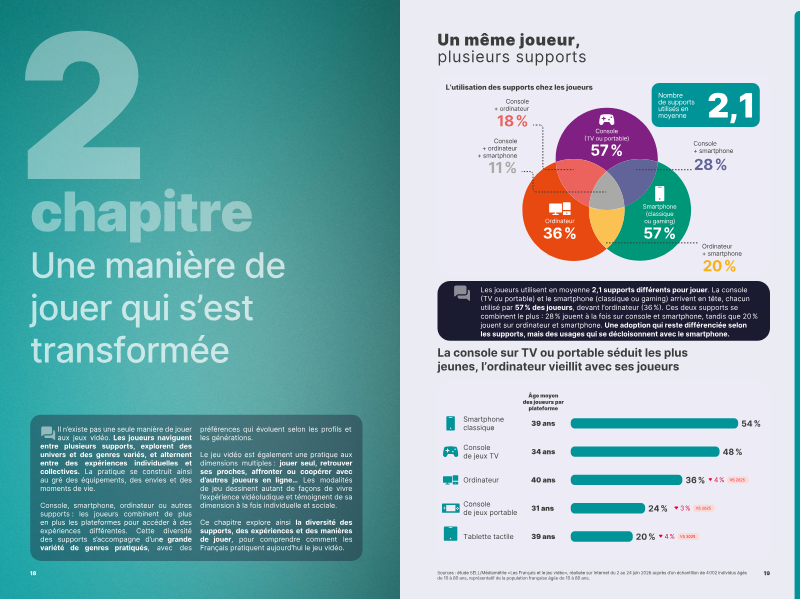
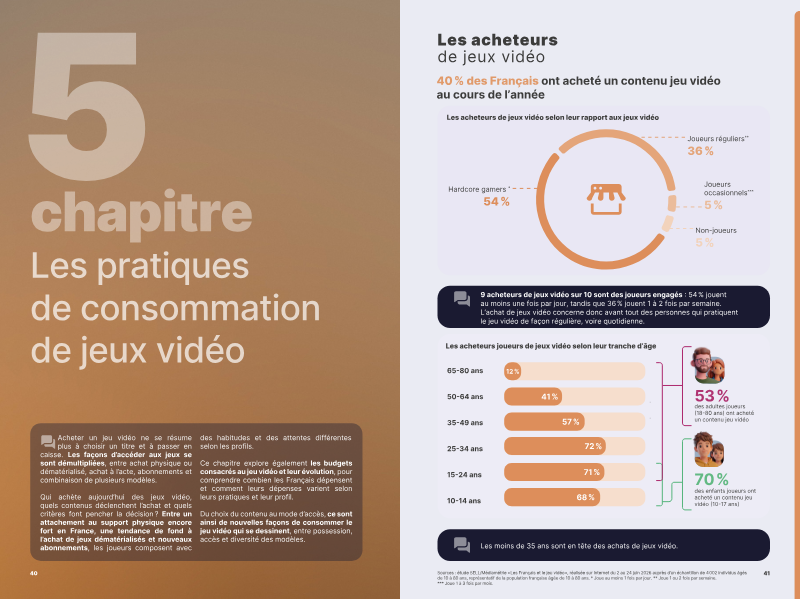
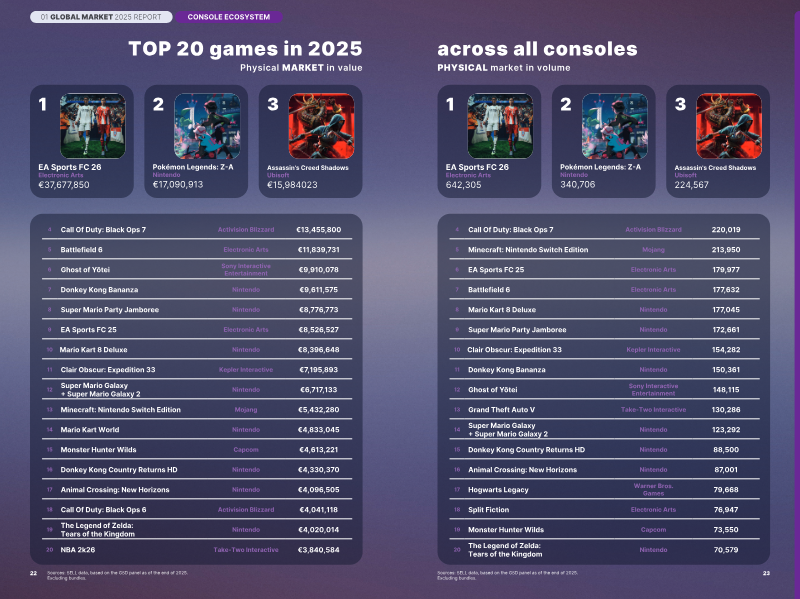
The French video game market demonstrated significant resilience in 2025, generating €5.856 billion in total revenue, a 2.9% increase over the previous year. This performance marks the second-highest in the industry’s history, solidifying its position as a cornerstone of the national cultural economy. Growth was primarily fueled by a rebound in console hardware sales and a record-breaking 11% surge in the mobile sector, which reached €1.792 billion. The market maintains a balanced ecosystem, with consoles commanding a 44% share, followed by mobile at 31% and PC gaming at 26%. Software remains the primary revenue driver, accounting for over two-thirds of the total market. While physical game sales faced a double-digit decline, this was effectively mitigated by the expansion of digital content, including microtransactions and downloadable content. Electronic Arts emerged as the leading publisher across console and PC platforms, while the mobile landscape remains almost entirely dominated by free-to-play models, which now represent 94% of mobile revenue. The industry’s reach expanded to 40.2 million players, characterized by a maturing demographic where adults comprise 88% of the base. High engagement levels persist, with 76% of players gaming on a weekly basis and a growing trend toward cross-platform usage. Alongside this growth, there is a heightened emphasis on responsible gaming. Parental involvement has reached new heights, with 67% of parents actively monitoring gaming habits through PEGI classifications and standardized parental control tools. This commitment to safety, supported by organizations like the SELL and events such as Paris Games Week, ensures that the industry continues to thrive as a mature, socially responsible, and culturally significant sector within France.
The Italian gaming landscape is characterized by a strong emphasis on the psychological and social benefits of interactive entertainment. Based on a survey of 1,012 Italian gamers, which forms part of a broader 12-country study involving 12,847 active weekly players, the research highlights that gaming serves as a vital tool for stress relief, cognitive stimulation, and social connection. A significant majority of respondents report that gaming alleviates stress and anxiety, fosters creativity, and enhances problem-solving skills, with 69% of participants noting that the medium stimulates the mind and improves teamwork capabilities. Social interaction remains a cornerstone of the Italian gaming experience. While solitary play is common on a daily basis, approximately half of the respondents prefer engaging with others through online platforms on a weekly basis. This social dimension is particularly prevalent among male gamers, who show a higher propensity for online multiplayer interaction. Furthermore, the data indicates that gaming acts as a bridge for building new relationships, with many users reporting that they have formed lasting friendships or met significant partners through in-game experiences. The demographic reach of gaming in Italy is broad, though usage patterns vary by age and gender. Engagement is most concentrated within the 19-34 age bracket, and there is a notable adoption of in-game communication tools, particularly among male players. Ultimately, the findings suggest that gaming is perceived not merely as a pastime, but as a constructive activity that supports mental well-being, facilitates personal development, and provides a reliable framework for community building in an increasingly digital society.
Video games serve as a significant mechanism for mental resilience and emotional regulation among the Italian population. A survey of 1,021 respondents aged 16 and older reveals that a substantial majority of Italian players utilize gaming to mitigate negative psychological states. Specifically, 71% of participants report that gaming helps reduce stress, while 60% use it to manage anxiety and 49% rely on it to combat feelings of isolation. These figures demonstrate that gaming functions as a vital outlet for navigating everyday challenges and difficult life transitions, with 50% of respondents explicitly noting that the medium helps them endure personal hardships. The demographic profile of the Italian gaming community is broad, with the largest segment of players falling into the 45-54 age bracket at 21%, followed closely by those aged 65 and older at 24%. Mobile devices remain the primary platform for 59% of users, significantly outpacing consoles and computers. Social connectivity is a core component of the experience, as 62% of players engage in online multiplayer sessions at least monthly. Beyond emotional support, gaming is perceived as a tool for cognitive development, with 71% of players reporting improvements in cognitive function, 70% in creativity, and 67% in problem-solving skills. The impact of gaming extends into familial and professional spheres, fostering positive interpersonal dynamics and skill acquisition. Approximately 39% of parents in Italy report that shared gaming experiences have strengthened their relationships with their children. While the influence on career paths remains lower in Italy at 28% compared to the global average of 43%, the medium continues to provide a unique space for pursuing hobbies and educational interests. Puzzle, action, and skill-based games represent the most popular genres, underscoring a preference for interactive experiences that challenge the mind while providing a structured environment for relaxation.
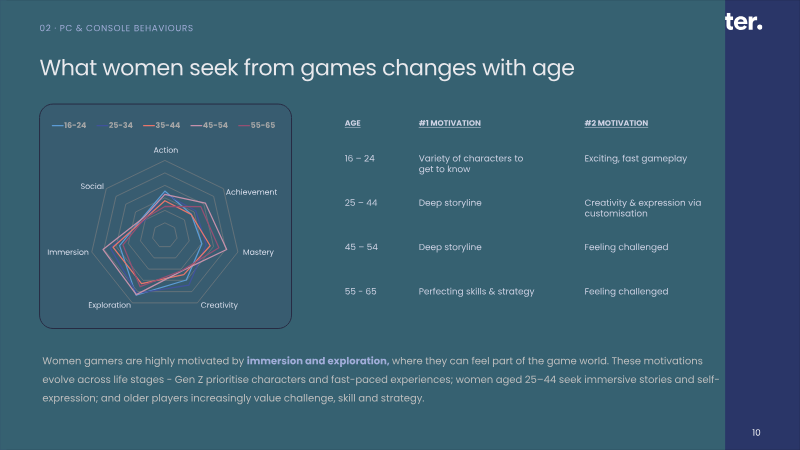
The Gamer Motivation Profile provides a comprehensive empirical framework for understanding player behavior through a psychometric model that categorizes gaming preferences into twelve distinct motivational drivers. These drivers—organized into six primary clusters including Action, Social, Mastery, Achievement, Immersion, and Creativity—allow developers and marketers to quantify why specific audiences engage with particular game titles. By linking psychometric data with demographic variables and specific game franchises, the model offers a data-driven approach to audience segmentation and product positioning. The research is built upon a robust dataset derived from over 1.75 million global participants who have completed the Gamer Motivation Profile survey. This large-scale, ongoing collection of data enables real-time analysis of player demographics, such as age, gender, and play frequency, alongside their psychological motivations. The methodology utilizes factor analysis to identify how various gaming preferences cluster together, providing a statistically sound basis for comparing individual titles against broader genre norms. The primary utility of this research lies in its ability to generate actionable insights for game development and player acquisition. Through a dynamic dashboard, users can perform side-by-side comparisons of different franchises, identify "game neighborhoods" based on shared motivational profiles, and filter titles by specific criteria to uncover underserved market segments. By mapping how individual games deviate from genre benchmarks, the model helps stakeholders prioritize development features, refine marketing messaging, and identify potential competitors even across disparate genres. This analytical toolset is designed to assist industry professionals in making evidence-based decisions regarding portfolio management and the strategic targeting of core and mid-core gaming audiences.
The Gamer Motivation Profile provides an empirical framework for understanding player behavior by categorizing gaming preferences into twelve distinct motivational factors. Developed through psychometric techniques and factor analysis, the model identifies how specific gaming desires—such as competition, immersion, or mastery—cluster together to drive player engagement. The primary thesis posits that gaming motivations exist on a spectrum, where both high and low scores serve as critical indicators of a player’s preferences, allowing for a nuanced analysis of why individuals gravitate toward specific titles or genres. The research is underpinned by a robust dataset of over 1.25 million unique gamers worldwide, with a demographic composition of 74% male, 22% female, and 3% non-binary, and a median age of 23. The geographic scope is global, with the largest concentrations of participants in North America (33%) and Western Europe (14%). Data collection relied on a five-minute online survey, which achieved high internal and test-retest reliability. By mapping these motivations against a 50th-percentile industry norm, the model allows analysts to visualize which factors are disproportionately important for specific game audiences, effectively linking demographic data with franchise-specific engagement. The twelve motivations are grouped into six thematic clusters: Action-Social (Destruction, Excitement, Community, Competition), Mastery-Achievement (Challenge, Strategy, Completion, Power), and Immersion-Creativity (Fantasy, Story, Discovery, Design). Each factor is defined by its behavioral anchors, providing a clear distinction between high-intensity, goal-oriented play and more relaxed, expressive, or exploratory experiences. By utilizing this standardized methodology, the research offers an actionable tool for developers and industry analysts to decode player behavior, predict engagement patterns, and better align game design with the psychological needs of diverse gaming audiences.
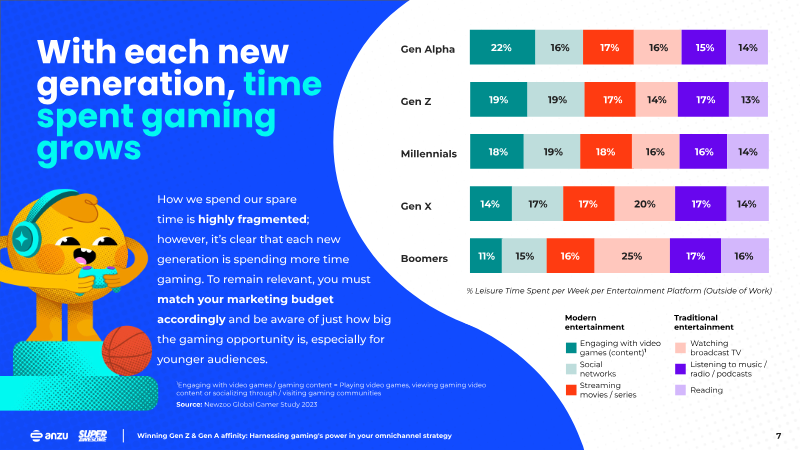
Gaming has become the dominant entertainment medium for younger generations, with 80 % of under‑18s actively gaming and Gen Z allocating up to 22 % of free time to play. The study, combining first‑party data from SuperAwesome and Anzu with social listening, qualitative research, quantitative surveys, syndicated data, brand lift studies and parent‑tracking panels, covers the UK, France, Germany, the United States and global markets from 2023‑24. A sample of 30 000 children, teens and young adults (ages 4‑24) plus parent responses informs the analysis. Key findings show that gaming captures more attention than social media for Gen Z, with 55 % of under‑18s reporting a strong affinity for branded in‑game experiences. Younger gamers are highly receptive to ads, with 75 % of Gen Z players in the UK and US saying in‑game ads improve their experience, compared to 34 % of older adults. In‑game advertising drives higher brand recall (+7 pts) and purchase intent (+9 pts) for audiences under 34, and generates a “halo effect” that boosts brand affinity by up to 86 % among under‑18s. Parents report that children influence household spending, with 86 % saying their child’s opinions matter in purchases and 82 % prioritising items for children. The report recommends a multi‑platform, contextual approach that respects emerging data‑protection regulations and Age Appropriate Design Codes. It emphasizes early engagement before brand loyalties lock at age 16, contextual targeting over behavioural profiling, and rigorous creative vetting to avoid manipulative design. The analysis underscores gaming’s strategic importance for reaching Gen Alpha and Gen Z, offering measurable lift across awareness, consideration and purchase stages.
The report establishes that Africa’s video‑game industry has entered a phase of rapid maturation, driven largely by mobile play in urban centres such as South Africa, Nigeria and Kenya. Mobile accounts for roughly 90 % of the $1.8 billion market in 2024, with a 10 % year‑over‑year rise in players to 349 million. PC and console remain niche but critical for studio visibility, with Steam dominating distribution (≈70 % of PC use) and local platforms like Gara and Jiwe capturing the remainder. Funding for studios is overwhelmingly sourced from international incubators and grants—Pro Helvetia, the French Agence Française de Développement, the British Council’s Ignite Culture and Digital Lab Africa—yet local infrastructure gaps (low internet penetration, limited payment systems, unreliable electricity) continue to constrain broader market development. Key findings show that the fastest‑growing economies—Eritrea, Niger, Egypt, Ethiopia, Nigeria and South Africa—host studios such as Maliyo Games, Kayfc and Legends of Orisha that are producing mobile‑first IP while experimenting with higher‑production PC/console titles. Female representation and gender inclusivity are addressed through programmes like Pro Helvetia’s “She Got Game”, yet overall skill development remains uneven, with many studios still operating at the indie level and lacking robust business training. The esports sector mirrors this mobile dominance, with titles like PUBG Mobile and Free Fire generating substantial prize pools and viewership across hubs such as Morocco, Egypt and Kenya. However, talent development is concentrated in a handful of urban centres, leaving Francophone and non‑English speaking regions underrepresented. The analysis concludes that sustainable growth hinges on three pillars: deeper, studio‑level talent development; reliable data infrastructure for market intelligence; and evolved payment systems that reduce friction. Strengthening African‑European partnerships, expanding local incubation pathways, and ensuring annual data updates are essential to unlock the continent’s commercial potential while preserving African leadership in game creation.
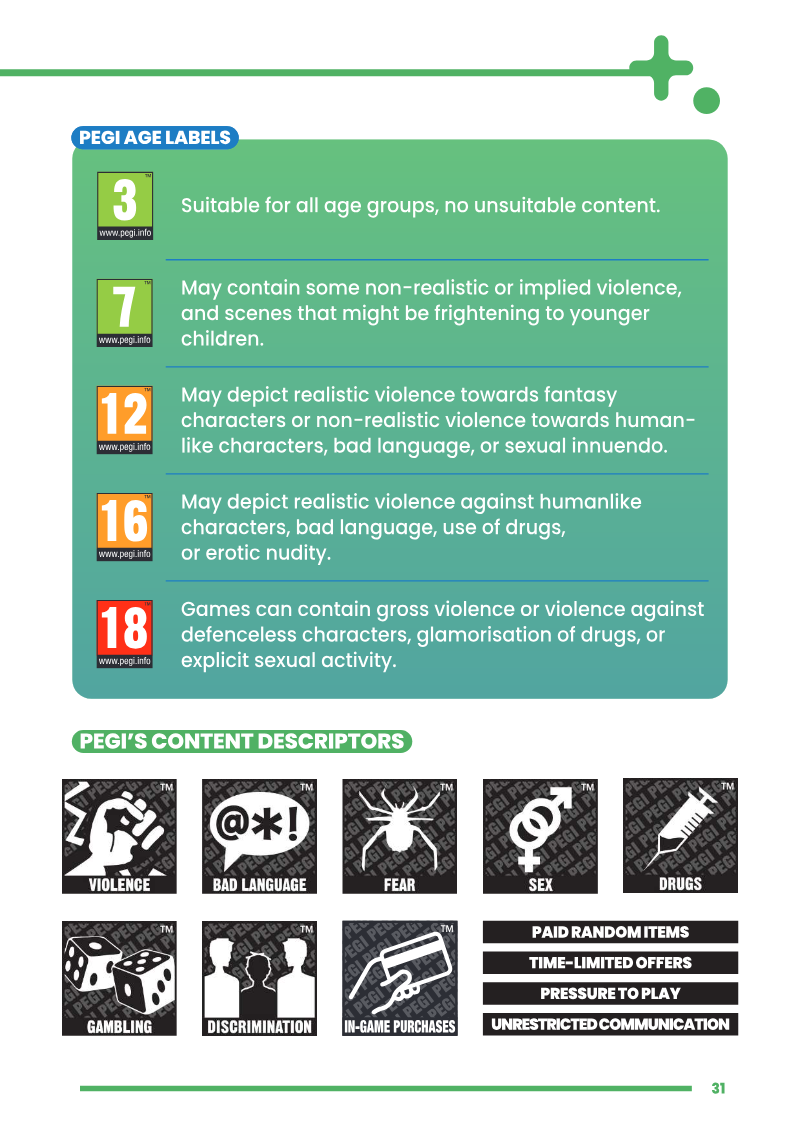
The text serves as an educational and promotional overview of the Pan‑European Game Information (PEGI) rating system, using a comic‑style narrative to capture the attention of younger gamers while delivering core information about age‑based content classification. Its central thesis is that PEGI provides the most comprehensive mechanism for informing consumers about video‑game suitability, thereby ensuring safe and informed purchasing decisions across Europe. Key points emphasize that PEGI operates in more than thirty countries and employs a traffic‑light colour scheme to convey age recommendations: green icons for games suitable for all audiences (ages 3 and 7), amber for intermediate levels, and red for titles restricted to adults (18+). The system also includes content descriptors that clarify specific elements that may affect suitability, reinforcing transparency for parents and players. The narrative illustrates the progression through various “worlds” representing age brackets—3, 7, 12, 16, and 18—highlighting that each tier is tailored to increasingly experienced gamers. The scope is continental, covering the European video‑game market and all major platforms, with references to the official website and downloadable applications for iPhone, Android, and Windows 7 Phone. No empirical methodology is presented; the piece relies on descriptive exposition and visual storytelling rather than survey data. Overall, the material positions PEGI as a reliable, universally adopted standard that guarantees 100 % informed choice for consumers.