DEV – Asociacion Espanola de Empresas Productoras y Desarrolladoras de Videojuegos
Association7 documents
Spanish game developers association. Publishes the annual 'Libro Blanco del Desarrollo Espanol de Videojuegos' (White Paper) with industry census data.
Documents
Report33 pages
White Paper Catalan Video Game Industry 2023
The 2023 white paper on Catalonia’s video‑game industry presents a detailed assessment of the sector’s economic performance and labour dynamics for the year 2022. It establishes that the regional market generated €709 million in revenue, reflecting a 7.5 percent decline compared with the previous year, while employment rose to 4 619 workers, an increase of 8.7 percent. This juxtaposition of falling turnover and rising headcount suggests a shift toward more labour‑intensive activities, such as development and ancillary services, even as overall sales pressures persist.
The analysis situates the sector within Catalonia’s broader creative economy, emphasizing its continued relevance as a source of high‑skill jobs and its capacity to attract talent despite modest revenue contraction. The data underline the resilience of the local ecosystem, which appears to be sustaining employment growth through diversification and possibly increased public or private investment in development capacities.
Overall, the findings portray a video‑game industry that, while facing short‑term market headwinds, maintains a solid employment base and remains a pivotal component of Catalonia’s digital and cultural output. The report implies that strategic support and continued innovation could reverse the revenue dip and further strengthen the region’s position in the European gaming landscape.
- Catalonia’s video game industry generated €709 million in revenue during 2022, representing a 7.5 percent decline from the previous year.
- Total employment in the sector grew by 8.7 percent in 2022, reaching a workforce of 4,619 people.
- The simultaneous decrease in revenue and increase in headcount indicates a strategic shift toward more labor-intensive development and ancillary service activities.
- The regional gaming ecosystem demonstrates resilience by sustaining job growth despite broader market headwinds and revenue contraction.
- The industry remains a critical component of the Catalan creative economy, serving as a primary driver for high-skill employment and digital innovation.
+3
DEVJan 2023
Report32 pages
Llibre Blanc de la Indústria Catalana del Videojoc 2022
The 2022 white paper evaluates the state of Catalonia’s video‑game sector, arguing that while the region has become an increasingly attractive hub for development, persistent structural constraints—particularly in talent supply and financing—limit its growth potential. By mapping the ecosystem’s performance against recent trends, the analysis highlights the urgent need for coordinated policy action to sustain the momentum generated by recent investment inflows.
A striking 59 % of Catalan studios report difficulty recruiting qualified personnel, a proportion that, although lower than in 2019‑2020, remains markedly high. Financing emerges as the foremost ongoing obstacle, closely followed by challenges in attracting and retaining skilled staff and the absence of competitive fiscal incentives. Despite these constraints, foreign direct investment surged, with five new projects injecting €39.5 million into the local economy and creating 377 jobs, representing a 32 % year‑on‑year increase in employment opportunities within the sector.
The findings suggest that reinforcing fiscal support mechanisms, expanding specialised training programmes, and fostering stronger links between academia and industry are essential to convert Catalonia’s investment appeal into durable, high‑value growth. Strengthening these levers would not only alleviate the talent bottleneck but also enhance the region’s capacity to attract further capital, positioning Catalonia as a leading European centre for video‑game development in the medium term.
- Catalonia's video-game sector faces a significant talent bottleneck, with 59% of studios reporting ongoing difficulties in recruiting qualified personnel.
- Foreign direct investment in the region saw a major surge, with five new projects injecting €39.5 million into the local economy.
- Employment opportunities within the Catalan video-game industry grew by 32% year-on-year, resulting in 377 new jobs.
- Financing remains the primary obstacle to industry growth, followed closely by the challenge of retaining skilled staff and a lack of competitive fiscal incentives.
- To sustain current momentum, the report identifies the expansion of specialized training and stronger academia-industry links as essential requirements for long-term growth.
+2
DEVJan 2022
Whitepaper8 pages
White Paper on Video Game Development Sector in Spain
The Spanish video game development sector has emerged as a vital component of the national digital economy, characterized by rapid growth, high innovation, and a strong global orientation. As of 2013, the industry comprised 330 companies, largely concentrated in Madrid and Catalonia, with a workforce that is notably young and highly qualified. The sector generated 313.7 million euros in turnover in 2013, with projections suggesting a compound annual growth rate of 23.7% through 2017. This expansion is driven primarily by online distribution models, which account for 78% of industry revenue, and a robust export market that represents 56% of total sales.
The industry is defined by its youth, with 68% of firms established within the last five years and 97% of capital originating domestically. Employment trends are equally positive; the sector supported 2,630 direct jobs in 2013, marking a 29% increase from the previous year, with a high proportion of permanent contracts. Despite this success, the industry faces significant challenges, particularly a talent gap, as 63.6% of businesses report difficulty finding qualified personnel. This highlights a misalignment between current educational curricula and the specialized technical demands of the video game market.
To sustain this momentum, the sector advocates for an integrated support plan that includes fiscal incentives for research and development, public funding for prototypes, and streamlined internationalization efforts. Recommendations emphasize the need for specialized technology clusters, improved tax treatment for intangible assets, and stronger synergies with transversal industries such as health and education through the development of serious games. By addressing these structural needs and fostering closer collaboration between public administration, private investors, and academic institutions, the industry aims to solidify its position as a competitive, high-productivity leader within the European digital landscape.
- The Spanish video game sector generated 313.7 million euros in 2013, with a projected compound annual growth rate of 23.7% through 2017.
- Online distribution models drive the industry's financial performance, accounting for 78% of total revenue, while exports represent 56% of sales.
- The industry is characterized by rapid expansion and youth, with 68% of the 330 existing companies established within the five years prior to 2013.
- Direct employment reached 2,630 jobs in 2013, a 29% increase from the previous year, though 63.6% of firms struggle to find qualified personnel due to a mismatch between education and industry needs.
- Capital investment in the sector is overwhelmingly domestic, with 97% of funding originating within Spain.
+1
Spanish Association for the Game and Entertainment Software Development and Publishing IndustryJan 2021
Whitepaper95 pages
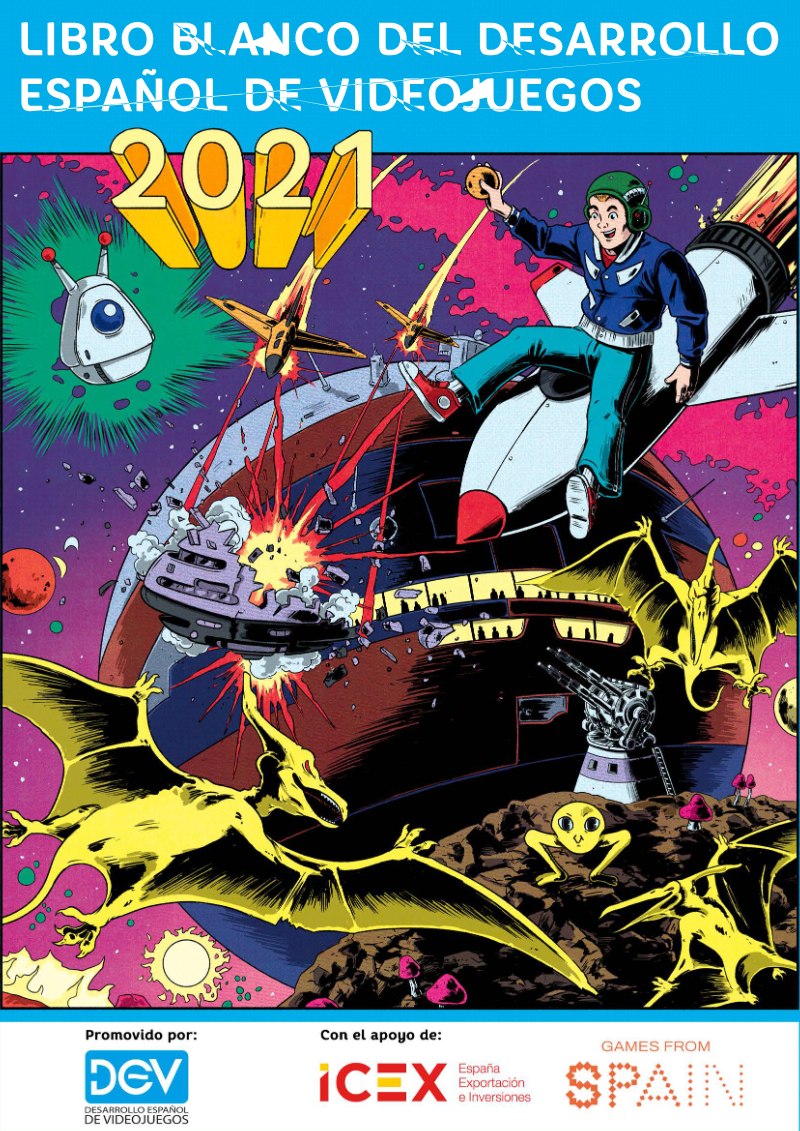
Libro Blanco del Desarrollo Español de Videojuegos 2021
Fondo Europeo de Desarrollo Regional Foto: Francesco Ungaro (Pexels) LIBRO BLANCO DEL DESARROLLO ESPAÑOL DE VIDEOJUEGOS 2021 1. Íntroduccion 6 2. Tribuna 8 3. Medidas para incentivar la economía de la industria española de desarrollo de videojuegos en 2022 10 4.
- The Spanish video game industry advocates for a tax incentive for video game production, similar to that for the audiovisual industry, to attract international projects and investment. This measure is common in other European countries like France, Italy, Belgium, and the UK.
- The primary funding sources for Spanish studios are their own resources (74%) and self-financing (71%). Funding from publishers increased from 18% to 28%, while bank financing decreased from 16% to 7%.
- Over half (52%) of the Spanish video game industry workforce is under 30 years old, with only 5% over 45. The majority of workers (43%) have 3-6 years of experience.
- 88% of Spanish studios develop their own intellectual properties. 54% self-publish, a decrease from the previous year, while 45% engage in development for third parties/outsourcing, and 22% develop serious games.
- Serious games are a significant niche, with 21% of published games falling into this category. They are primarily directed at the Education sector (85%), followed by Culture (37%) and Tourism (33%).
+1
Fondo Europeo de Desarrollo RegionalJan 2021
Whitepaper26 pages
White Paper on Spanish Video Game Development 2020
Promoted by: With support from: Promoted by: With support from: LÍNEA Covid-19<sub>CULTURA</sub> One more year, DEV, the Spanish Association of Video Games and Entertainment Software Producers and Development Companies, keeps its commitment to the sector it represents by publishing the White Paper on Spanish Video Game Development, the leading report that makes an in-depth analysis of the video game industry in our The White Paper, this year celebrating its seventh edition, is aimed at dev...
- The Spanish video game industry billed 920 million euros in 2019, a 13% increase from 2018, and is projected to exceed 1.7 billion euros by 2023 with an annual growth rate of 17%.
- Employment in the sector grew by 6.1% in 2019, reaching 7,320 professionals, and is estimated to reach 8,500 direct jobs by 2023.
- Despite being the fifth European and tenth global market, 86% of Spanish studios bill below 2 million euros annually, with 61% billing under 200,000 euros, indicating a prevalence of small companies.
- Catalonia leads in both billing (51%) and employment (46%) within the Spanish video game industry, followed by Madrid (28% billing, 26% employment).
- A significant 66% of the industry's revenue comes from international markets, highlighting its export-oriented nature.
+1
DEV - Spanish Association of Video Games and Entertainment Software Producers and Development CompaniesJan 2020
Whitepaper78 pages
Libro Blanco del Desarrollo Español de Videojuegos 2019
DESARROLLO ESPAÑOL<sub>DE</sub> PROMOVIDO POR: CON EL APOYO DE: CON LA COLABORACIÓN DE: FONDO EUROPEO DE DESARROLLO REGIONAL eGoGames mCR codice software GGCoM UNA MANERA DE HACER EUROPA INTRODUCCIÓN .......................................................................................................................................
- The Spanish video game industry is young, with 80% of companies less than 10 years old, and 61% of companies generating less than 200,000 euros annually. Only 3% of companies exceed 10 million euros per year, but they contribute 67% of the total annual revenue.
- In 2019, Spain's video game industry recovered from a growth stagnation in 2017-2018, now boasting over 520 established companies and 250 projects in development. However, a hundred inactive companies introduce uncertainty about future growth.
- Catalonia leads in the number of video game studios (28%), followed by Madrid (24.7%), and Andalusia (16%), which surpassed Valencia (12.2%) in 2019.
- 42% of Spanish video game companies had not published any games in 2018, and 31% had published only one, often due to long development cycles and a focus on self-financed, single-IP projects.
- Public aid for Spanish video game studios in 2018 primarily came from autonomous communities (47%), with 10% from the Ministry of Culture and Sport's Innovation in Cultural Industries program.
+1
DEV - Desarrollo Español de VideojuegosJan 2019
Whitepaper84 pages
Libro Blanco del Desarrollo Español de los Videojuegos
LIBRO CENTRO UNIVERSITARIO Fando Eurapeo de DE TECNOLOGIA Y ARTE DIGITAL Ung manere de hacer Eurapa Asociación Española de Empresas Productoras y Desarrolladoras de Videojuegos y Software de Entretenimiento 1 . INTRODUCCIÓN 05 2. CADENA DE VALOR DE LA INDUSTRIA DEL VIDEOJUEGO 07 2.1. Cadena de valor tradicional de la industria de videojuegos 08 2.2.
- The global gaming market had 1.231 billion active players by the end of 2013, representing over half of the world's internet-connected population and 17.5% of the total global population.
- The gamification business is projected for exponential growth, with Markets And Markets estimating a potential business of $5.5 trillion USD by 2018, growing at a 67.1% annual rate between 2013 and 2018.
- The Spanish video game sector increased employment by 29% in 2013, with 65% of contracts being permanent, making it a significant job creator for highly qualified young professionals.
- In 2012, the Russian video game industry generated $1.3 billion, a 30% increase from 2011, and its market is expected to double in the next three years to reach $1.5 billion.
- The UK offers R&D tax deductions for video game companies, with SMEs receiving a 225% enhanced deduction on their R&D investment.
+2
DEV – Asociacion Espanola de Empresas Productoras y Desarrolladoras de VideojuegosJan 2018