Retention reports and market data
Documents

Stop Believing Benchmark Metrics for Your Game
Standard industry benchmarks for mobile game performance—such as the widely cited 40/20/10 retention model for days 1, 7, and 28—are often misleading and should not be used as universal indicators of success.
- Generic industry benchmarks, such as the 40/20/10 retention model for days 1, 7, and 28, are misleading and should not be used as universal indicators of project viability.
- Developers should replace external averages with custom models that integrate daily installs, retention duration, and net ARPDAU to determine actual product sustainability.
- A game with lower retention can remain highly profitable if it maintains high organic install volumes or superior monetization efficiency compared to titles that meet standard benchmarks.
Firebase, Analytics, Google, and Understanding How They Work Together
Firebase provides a comprehensive suite of backend-as-a-service tools designed to assist game developers in building, managing, and optimizing mobile games.
- Firebase integrates backend infrastructure, quality assurance, and user engagement tools into a centralized console to support the full lifecycle of mobile game development.
- The platform utilizes an event-driven Google Analytics model instead of legacy session-based tracking to identify specific user segments, such as high-value players or those at risk of churning.
- Developers can use Remote Config to adjust game variables in real-time without requiring new app store updates, facilitating immediate optimization of the user experience.
Bringing a Desktop Subscription Model to Mobile
Jagex successfully expanded its desktop MMORPG, Old School RuneScape, to mobile platforms by prioritizing a seamless, cross-platform experience that allows players to maintain progress across PC and mobile devices.
- Jagex generated 25 million in gross revenue and 8.6 million installs by expanding Old School RuneScape to mobile, proving the viability of a cross-platform subscription model.
- To maintain a unified view of user value across PC and mobile, the company integrated internal data with mobile measurement partners, enabling more effective scaling of advertising spend.
- The mobile launch strategy utilized pre-order campaigns on the Apple App Store and Google Play, which drove the game to the top of free-to-play charts in the US and UK within 24 to 72 hours.
Superstar Session: New Ways to Optimise Your Instant Games Design
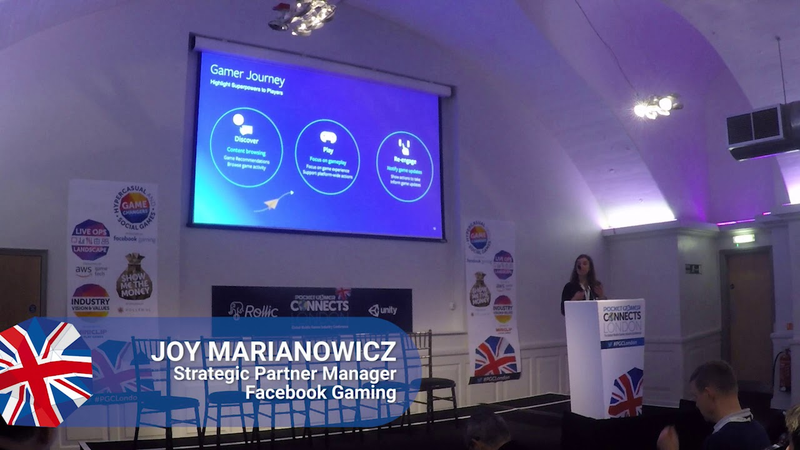
The Facebook Instant Games platform aims to foster a global gaming community by integrating social connectivity with accessible, high-quality gameplay.
- The Facebook Instant Games platform serves a massive audience of 700 million people who engage with gaming content, necessitating a strategic shift from simple turn-based mechanics to real-time, multi-player experiences.
- The platform's primary value propositions are the elimination of download requirements and the integration of social play, which drive user acquisition and engagement.
- User experience design must prioritize 'snackability' and low friction to capture players during short intervals, such as commuting or waiting.

Monetisation Trends & Tips for 2020
Mobile ad monetization serves as a critical revenue pillar for the modern gaming industry, particularly as global mobile ad spend continues to rise.
- Global mobile ad spend is projected to increase by 26% in 2020, with industry forecasts suggesting ad revenue may surpass in-app purchase (IAP) revenue for the first time.
- Approximately 94% of free-to-play mobile games now incorporate in-game advertising, with a growing year-over-year trend of developers generating between 40% and 100% of their total revenue from ads.
- Rewarded ad placements are a critical strategy for monetizing the non-paying user base ('the fish') while simultaneously boosting retention and IAP performance for 'whales'.

Privacy First! Mobile Engagement in the Fast Emerging New World
Mobile engagement strategies are currently undergoing a significant shift, moving away from traditional server-side push notifications toward on-device, edge-computing models.
- On-device edge computing solves data privacy compliance issues for GDPR, GDPR-K, and COPPA by keeping user data and unique identifiers on the device rather than transmitting them to the cloud.
- Push notifications should be treated as a core component of user experience, as 68% of user journeys for apps like Twitter begin with a notification.
- Moving notification logic to the device allows for real-time, context-aware delivery based on user behavior—such as device unlock patterns or charging status—rather than relying on server-side scheduling.
Creating and Retaining a Lifelong Playerbase
The primary objective of this analysis is to outline a strategic framework for developing and maintaining a lifelong mobile player base through high-quality product management.
- Long-term retention in mobile free-to-play games is built on the 'Golden Triangle' framework, which balances technical quality, consistent content, and player-aligned monetization.
- Technical stability, including high frame rates and consistent uptime, is the foundational requirement for building player trust and ensuring long-term engagement.
- Monetization strategies should prioritize time-saving or personalization-based offers over 'pay-to-win' mechanics, which are identified as detrimental to sustainable player retention.
Speedrunning Mobile Growth - Three Tricks to Hack Retention & Revenue
Mobile game developers face significant challenges in user retention, with a majority of players abandoning apps by the first day.
- Integrate mobile measurement platforms, CRM tools, and customer data platforms into a single source of truth to accurately map user journeys and identify specific drop-off points.
- Delay push notification permission requests until after the user has experienced the app’s core value to improve upon the baseline 42% iOS opt-in rate.
- Utilize A/B testing on specific user segments for product changes like onboarding or avatar creation to validate improvements before executing a full-scale rollout.

Building a Long-term Gaming App Business: Applying Lessons of the Past to Power Your Success
The mobile gaming industry has undergone a significant evolution since the inception of app stores, transitioning from a landscape defined by technical barriers and limited monetization options to a highly competitive, data-driven ecosystem.
- Success in modern mobile gaming relies on granular, impression-level revenue data, which enables real-time optimization of user acquisition and in-game economies at the individual user level.
- Hyper-casual developers maintain a competitive edge by testing hundreds of titles monthly to identify high-retention, low-cost acquisition opportunities.
- Operational efficiency is achieved through automated infrastructure, such as standardized waterfall setups and API-driven workflows, which minimize the human capital needed for daily tasks.
Superstar Session:Hitting Big Numbers:What Numbers Can & Cannot Tell You About Your Hypercasual Hits
Effective hypercasual game publishing relies on a disciplined approach to data analytics, moving beyond surface-level metrics to inform design and marketing decisions.
- Integrate tracking tools early in the development cycle to establish a robust historical dataset necessary for evaluating performance across diverse global regions.
- Use granular event tracking, such as tutorial drop-off rates, to identify specific friction points and refine game design rather than using data to justify pre-existing assumptions.
- Align monetization models with game structure by utilizing interstitial ads for level-based games and rewarded video integrations for endless titles with meta-game economies.

Superstar Session: Introducing Benchmarks+ Performance Insights for 1.2bn Monthly Players
This analysis of the mobile gaming industry, based on data from 87,000 games and 1.2 billion monthly players, identifies a significant shift in market dynamics between 2016 and 2019.
- High-spending players ('whales') have increased their spending by approximately 20% across the mobile gaming industry, with card and casino genres seeing growth as high as 50%.
- The average lifespan of a hit mobile game has plummeted from months to mere weeks, necessitating a shift toward 'games as a service' models to combat market oversaturation.
- Developers should pivot from purely ad-driven models toward incorporating in-app purchase (IAP) strategies and core-game mechanics to sustain revenue growth in a competitive landscape.

Monetization Design: The Dark Side of Gacha
Aggressive monetization strategies in mobile gaming often rely on high-pressure gacha mechanics, yet these systems frequently trigger long-term instability.
- Pixonic transitioned from a 'hype model' focused on immediate revenue spikes to a long-term growth strategy, prioritizing sustainable player trust and stable, predictable revenue over aggressive, short-term monetization.
- The implementation of gacha mechanics in War Robots served as an indirect sales system that obscured the true cost of items, leading to significant revenue spikes during events but causing severe community backlash and internal team morale issues.
- The 'wild offer' system, which uses algorithms to generate personalized, discounted bundles, requires robust cohort-based segmentation to avoid revenue cannibalization and excessive backend data load.