Live Ops reports and market data
455 game industry reports, presentations and talks about live ops from writers such as PocketGamer.biz, Game Developers Conference and Deconstructor of Fun, newest from 2026. Every document has a summary and key insights with the page they come from, and 596 charts and tables are extracted as data.
Key figures
The industry is heavily concentrated in the puzzle genre, which generates nearly 97% of local earnings, while studios increasingly pivot toward hybrid-casual titles and sophisticated LiveOps strategies.
AppMagic, 2026 · Türkiye's Mobile Gaming Landscape 2026, p. 14
95% of studios are now pursuing or planning live service strategies, creating a critical mismatch with traditional, non-iterative production pipelines.
Rendered VC, 2023 · Game Development Report 2023, p. 29
DeNA has significantly shifted its business portfolio since FY2021, reducing reliance on the volatile Game Business and growing Live Streaming to over 40.0 billion yen (more than 30% of total revenue) and Sports to 20% of total revenue.
DeNA Co. · 2024 Integrated Report: Value Creation Story, p. 33
New titles like Pixel Flow, which reached $35M in revenue within six months of its late 2025 launch, demonstrate that success in saturated genres now requires refined core gameplay and aggressive LiveOps.
AppMagic, 2026 · Casual Games Report 2025: Finding Growth in a Flat Market, p. 28
LiveOps has become an industry standard, with 82% of top-grossing titles running at least one event to drive retention through recurring mechanics like win streaks and resource-depletion challenges.
AppMagic, 2025 · Casual LiveOps Report: H1 2025, p. 57
Documents
Your Discord Is Lying to You. Watch What Players Do.
Game development strategy must shift from relying on passive community sentiment to prioritizing revealed demand, which is defined by the tangible actions players take to enhance their experience.
- Prioritize revealed demand—tangible player actions like modding and unofficial server hosting—over passive community sentiment found on platforms like Discord.
- Treat community-led initiatives and workarounds as a low-cost testing ground to validate potential features before committing significant engineering resources.
- Provide minimal infrastructure, such as APIs or server binaries, to observe how players interact with mechanics in real-world scenarios.

Mario Kart Tour, Minecraft Blast, Zynga + Supercell deal blocked, games on Instagram(...?), more
The mobile games industry is currently characterized by significant shifts in platform strategy, studio consolidation, and the sunsetting of long-running titles.
- Zynga founder Mark Pincus revealed that a 2012 deal to acquire Supercell for $400 million was blocked by the Zynga board, a decision he now cites as a major strategic regret.
- Nintendo has officially closed Mario Kart Tour after seven years, during which the game generated approximately $270 million in revenue from 276 million downloads, with 39% of revenue originating from the US.
- Supercell has returned its underperforming title 'Mo co' to beta development, placing it in 'low maintenance mode' with no new content planned until a major update arrives later this year.
Overwatch vs. Call of Duty: The Battle Pass War
The current landscape of Western first-person shooters is defined by a struggle to optimize monetization and player retention through evolving battle pass structures.
- Western AAA studios are struggling to balance battle pass monetization with player retention, as current models fail to generate the ARPU necessary to sustain high-quality live service teams.
- Major FPS titles are pivoting their progression mechanics: Call of Duty is implementing permanent boosts, Overwatch is adopting tiered unlock tracks, and Battlefield is introducing a three-month blackout period before rotating content into the store.
- The industry is currently stifled by a risk-averse culture where AAA developers prioritize avoiding negative community sentiment on platforms like Reddit over testing innovative monetization strategies.
Puzzle Monthly #6: Disney Solitaire's Big Win, Playtika's Earn-Out Trap and Solitaire vs Puzzle
Disney Solitaire has established itself as a significant market success by successfully adapting modern puzzle-game mechanics to the solitaire genre.
- Disney Solitaire has successfully modernized the solitaire genre by adopting high-frequency live-ops, gacha mechanics, and progression systems similar to top-tier match-three titles like Royal Match.
- Playtika is currently restricting user acquisition spending due to significant debt obligations and the financial pressure of a substantial earn-out agreement with developer SuperPlay.
- Solitaire games are shifting away from traditional, ad-reliant revenue models toward social casino economies and complex meta-layers to improve unit economics.
Rainbow Six: Siege boss: We'll treat our players like kings and queens when GTA 6 comes out
Rainbow Six: Siege maintains its long-term viability by prioritizing a service-oriented model that emphasizes technical stability and tactical depth over the development of a sequel.
- Ubisoft is prioritizing long-term player retention and service quality to mitigate potential market disruption caused by the upcoming release of GTA 6.
- The development team manages a workforce of over 600 people to maintain the game through a modular architecture that avoids the need for a full sequel rebuild.
- The studio is leveraging a strategic partnership with Tencent to improve communication, bolster regional expansion, and enhance security protocols following previous cyberattacks.
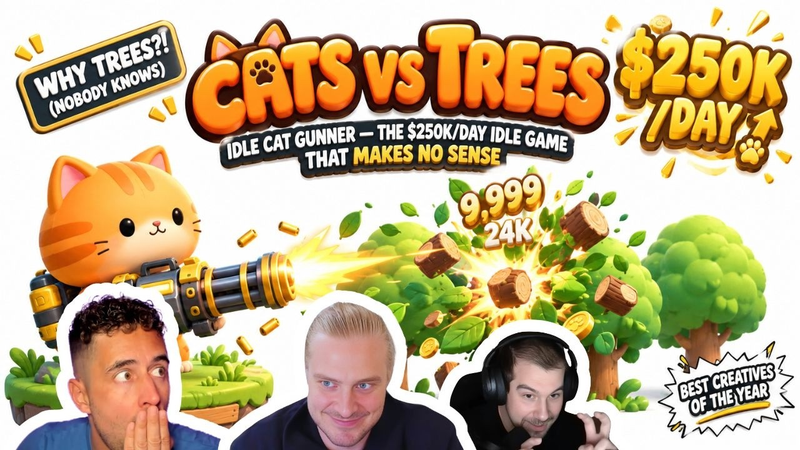
🐱 A Cat Shooting Trees: Idle Cat Gunner & the best creatives of the Year
Idle Cat Gunner has emerged as a dominant force in the mobile idle gaming sector, currently securing the number two position for in-app purchase revenue within its category.
- Idle Cat Gunner currently generates between $200,000 and $250,000 in daily revenue, securing the number two position for in-app purchase revenue in the mobile idle gaming category.
- The game utilizes a minimalist design that removes complex mechanics like enemy AI and defensive requirements, focusing instead on a simplified merge-weaponry progression loop.
- Monetization is driven by a multi-faceted architecture that includes battle passes, auto-upgrade packages, tiered offers, rewarded ads, and offer walls.
Shooter Monthly #9: Battlefield's Hot Streak, Gears Goes Helldiving, and the Battle Pass Plateau
The shooter genre is currently defined by a divergence in performance between established franchises, with Battlefield experiencing a resurgence by prioritizing focused seasonal updates and ranked play over the rapid, fragmented release cycles that have hampered Call of Duty.
- Western AAA studios are experiencing monetization stagnation due to a risk-averse reliance on battle passes that fail to adequately fund long-term live-service operations.
- Battlefield is seeing a resurgence by shifting away from rapid, fragmented release cycles in favor of focused seasonal updates and ranked play.
- Player preference is shifting toward sandbox-style battle royale and extraction modes, which offer lower-pressure environments and higher engagement than traditional zero-sum arena shooters.
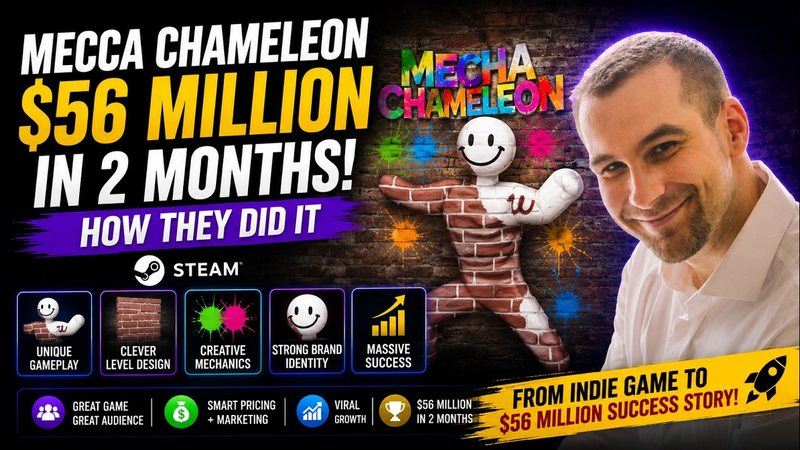
🦎Making $60 Mil in 2 months of development ? Meccha Chameleon playthrough 👀
Meccha Chameleon serves as a case study for the high-revenue potential of low-production, viral-driven games within the Steam ecosystem.
- Meccha Chameleon generated $56 million in revenue from a two-month development cycle, proving that low-production, viral-driven games can achieve massive financial returns.
- The game reached a peak of approximately 320,000 concurrent users in June, driven by a $5.99 price point and simple, highly social hide-and-seek mechanics.
- Community longevity is sustained by the Steam Workshop, which allows user-generated maps to refresh the gameplay meta and maintain engagement.

The 'Impossible' Evolution Of Toy Blast
The evolution of the mobile game Toon Blast serves as a case study in revitalizing aging titles through rapid feature adaptation and aggressive live operations.
- Toon Blast achieved a significant revenue surge in late 2023, successfully decoupling its financial performance from the broader, declining blast subgenre.
- The rapid integration of the 'Super Light Bulb' mechanic—adopted from Royal Match within three months of its industry emergence—was the primary catalyst for growth.
- The Super Light Bulb feature revitalized the game by adding strategic depth to the core loop, allowing players to clear entire colors or double special item effects.
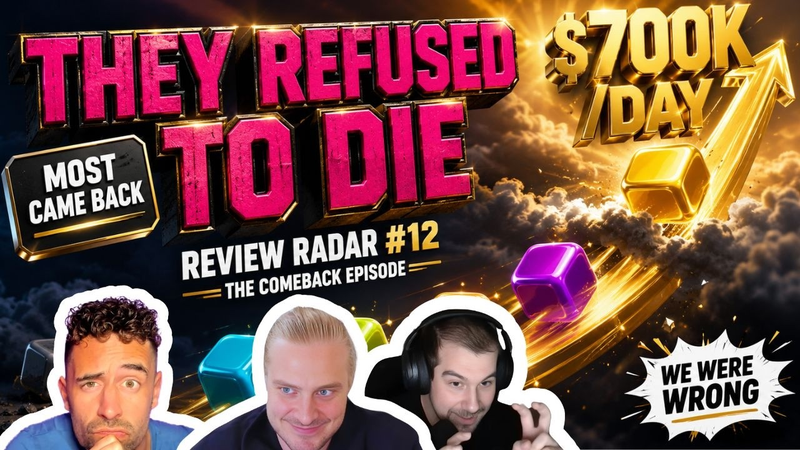
💀Review Radar #12: Which games survived & which are actually DEAD (Poke It With a Stick!!)
The mobile gaming landscape is characterized by high volatility, yet many titles previously perceived as failing demonstrate remarkable resilience and long-term sustainability.
- Strategic iteration on core mechanics—specifically pacing, inventory management, and content depth—can successfully revitalize stagnant titles, as demonstrated by the turnaround of Multiccast.
- The distinction between a failing game and a thriving one is frequently determined by a developer's willingness to refine monetization strategies, such as optimizing rewarded video advertising, in response to player behavior.
- Revenue charts for gacha-based games are often misleading due to monetization spikes, masking the underlying stability and long-term growth potential of titles that maintain consistent development updates.
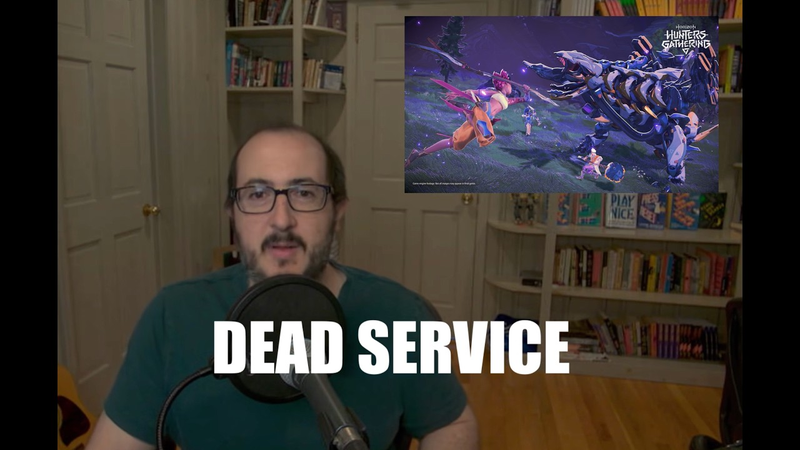
PlayStation's Live-Service Initiative Could Not Have Gone Worse
PlayStation’s strategic pivot toward live-service gaming, initiated around 2020–2021 with the goal of launching a dozen such titles by 2026, has largely failed to yield the intended results.
- Sony's live-service initiative, which aimed to launch a dozen live-service titles by 2025-2026, has largely failed, resulting in significant resource depletion and the cancellation of multiple high-profile projects.
- Guerrilla Games has rebooted 'Horizon Hunters: Gathering' following poor performance in playtests conducted throughout 2026, casting doubt on the project's future.
- Naughty Dog canceled its 'The Last of Us' online project in 2023 to avoid the long-term resource trap of becoming a dedicated live-service studio.
Is the Stop Killing Games Campaign destined to fail?
The Stop Killing Games campaign seeks to establish legal mandates for the preservation of online-only titles, aiming to protect consumers from losing access to purchased software when developers sunset servers.
- The 'Stop Killing Games' campaign faces significant legislative hurdles in the UK, EU, and California due to fundamental conflicts with existing intellectual property and consumer protection laws.
- Technical dependencies in live-service architectures, such as third-party assets, licensed music, and proprietary middleware, often prevent developers from legally releasing or preserving software even when they are willing to do so.
- Industry trade bodies oppose mandatory preservation initiatives, arguing that a one-size-fits-all legislative approach is incompatible with the diverse operational needs of studios ranging from independent developers to major publishers.