Player Demographics
Documents
Informe Mundial 2023: Comportamientos e Intereses de los Videojugadores
The 2023 Power of Play survey set out to map the motivations, social impacts and perceived wellbeing benefits of video gaming across a broad international sample. By combining responses from 12,847 active gamers who play at least once a week with findings from ten recent peer‑reviewed studies, the analysis argues that games deliver measurable social, emotional and cognitive value that extends far beyond pure entertainment.
Respondents from twelve markets—Australia, Brazil, Canada, France, Germany, Italy, Japan, Poland, South Korea, Spain, the United Kingdom and the United States—identified “having fun” as the top driver (69 % overall), followed by “entertainment” and “stress relief”. More than half of participants reported regular online play, while a third also engaged in face‑to‑face sessions. Nearly 45 % said they had met a close friend, partner or spouse through gaming, and 67 % believed games help them forge new relationships. Across the sample, 71 % felt games reduce stress, anxiety and isolation, 64 % described gaming as a healthy escape from daily problems, and 83 % reported increased happiness when playing.
Cognitive and creative gains were also prominent: 69 % linked gaming to improved problem‑solving, 65 % to greater adaptability, 60 % to enhanced communication, and 57 % to better linguistic skills. The report cites academic work that documents superior cognitive performance among gamers, reduced depressive symptoms during the COVID‑19 pandemic, and potential protective effects against age‑related memory decline and dementia. Studies of exergames and therapeutic titles further suggest benefits for pain management, motor coordination and social inclusion in clinical populations.
Methodologically, the survey employed an online, quota‑controlled panel designed to reflect each country’s demographic composition, with screening to ensure weekly gaming activity. Data were collected by AudienceNet, a market‑research firm accredited by the Market Research Society and compliant with GDPR standards. The integration of large‑scale consumer data with scholarly evidence provides a comprehensive picture of gaming’s evolving role in mental health, social connectivity and skill development worldwide.
- Gaming serves as a primary tool for emotional regulation, with 83% of players reporting increased happiness and 71% stating that games reduce stress, anxiety, and isolation.
- Social connectivity is a core outcome of gaming, as 67% of players believe games help them forge new relationships, and 45% have met a close friend, partner, or spouse through the medium.
- Players identify 'having fun' as the primary motivation for gaming (69%), followed by entertainment and stress relief as the leading drivers for engagement.
- Gaming is perceived as a driver of cognitive and professional skill development, with 69% of respondents citing improved problem-solving and 65% noting greater adaptability.
- Peer-reviewed academic research supports the survey findings, suggesting that gaming can provide protective effects against age-related memory decline and help manage depressive symptoms.
Global Report 2023
Power of Play: Global Report 2023 – Executive Summary
1. Scope & Methodology | Item | Detail | |------|--------| | Survey population | ≈ 12,847 active (weekly) gamers, ages 16 +, from 12 countries (Australia, Brazil, Canada, France, Germany, Italy, Japan, Poland, South Korea, Spain, United Kingdom, United States). | | Sampling | Quota‑based, nationally‑representative panels (AudienceNet). Each country ≈ 1,000 + respondents. | | Data collection | Online questionnaire covering motivations, mental‑health impacts, social behaviours, and skill development. | | Academic triangulation | Findings cross‑checked against ~10 peer‑reviewed studies (see References, p. 12). |
2. Why People Play (Top‑3 Reasons – Global)
| Rank | Reason | % of respondents (global) | |------|--------|----------------------------| | 1 | Fun / enjoyment | 69 % | | 2 | Pass the time | 63 % | | 3 | Stress relief / relaxation | 55 % |
Country‑level nuances: “Fun” dominates in every market (≥ 78 % in most). “Stress relief” is especially high in Australia (71 %) and Japan (73 %).
3. Self‑Reported Mental‑Health Benefits
| Benefit | Global agreement (average) | Range across countries | |---------|----------------------------|------------------------| | Reduces stress | 71 % | 55 % – 87 % | | Reduces anxiety | 61 % | 48 % – 78 % | | Reduces feelings of isolation/loneliness | 55 % | 45 % – 73 % | | Provides a healthy outlet for everyday challenges | 64 % | 52 % – 76 % | | Makes me feel happier | 63 % | 45 % – 83 % | | Helps me get through difficult times | 52 % | 33 % – 71 % |
> Interpretation: More than two‑thirds of gamers perceive video games as a stress‑relief tool, and roughly half feel less isolated because of gaming.
4. Social & Relational Outcomes
| Metric | Global % (approx.) | |--------|-------------------| | Play with others online (≥ weekly) | 51 % | | Play with others in‑person (≥ weekly) | 38 % | | Met a good friend, spouse, or significant other through games | 46 % | | Games helped develop deeper relationships | 43 % | | Games helped stay connected to friends/family | 46 % | | Games created lasting memories | 50 % | | Believe there is a game for everyone | 75 % |
> Key insight: Multiplayer and social features are central; almost half of respondents have formed meaningful offline relationships via gaming
- Video games function primarily as a mental health tool, with 71% of global gamers reporting that play reduces stress and 61% noting a reduction in anxiety.
- Fun and enjoyment remain the primary drivers for gaming, cited by 69% of the 12,847 respondents, followed by passing time (63%) and stress relief (55%).
- Social connectivity is a core component of the gaming experience, as 51% of players engage in online multiplayer weekly and 46% have formed meaningful personal relationships, including friendships and marriages, through games.
- Gaming serves as a significant social bridge, with 46% of respondents using games to stay connected with friends and family and 43% reporting that gaming helped them develop deeper relationships.
- The perception of gaming as an inclusive medium is high, with 75% of respondents agreeing that there is a game available for everyone.
I Videogiochi in Italia nel 2023
I Videogiochi in Italia nel 2023 – Sintesi
1. Dimensione del mercato
Fatturato: € 2,3 miliardi, con una crescita del 5 % rispetto al 2022 e del 28 % rispetto al 2019. Posizione europea: l’Italia si colloca tra i cinque maggiori mercati videoludici d’Europa. Pubblico: 13 milioni di persone tra i 6 e i 64 anni (circa il 31 % della popolazione), con un’età media di 30 anni.
Questi dati confermano che il settore è in forte espansione, sia in termini di valore economico sia di penetrazione culturale.
2. Il ruolo dell’IIDEA
L’Istituto per l’Innovazione Digitale e l’Economia dell’Arte (IIDEA) è il punto di riferimento istituzionale per lo sviluppo dell’industria videoludica italiana. Le sue attività principali sono:
| Area di intervento | Azioni chiave | |--------------------|----------------| | Sviluppo business & internazionalizzazione | - Programmi di accelerazione con partner nazionali e internazionali<br>- Campagna di branding “Games in Italy” per promuovere i titoli Made‑in‑Italy | | Educazione e gioco responsabile | - Portale “Tutto sui videogiochi” per genitori e insegnanti<br>- Informazione su rating PEGI e strumenti di parental‑control | | Eventi e riconoscimenti | - First Playable (fiera di riferimento)<br>- Italian Video Game Awards (dal 2013)<br>- Italian Esports Awards (dal 2020) | | Visibilità globale | - Missioni commerciali e matchmaking con investitori/partner esteri<br>- Supporto alla partecipazione a fiere internazionali (e.g., Gamescom, GDC) |
Obiettivi strategici dell’IIDEA
1. Elevare la visibilità internazionale dei prodotti italiani, facilitando partnership e accordi di distribuzione all’estero. 2. Collegare i developer locali con reti di finanziamento, expertise tecnica e canali di marketing globali. 3. Valorizzare il contributo culturale ed economico del settore, posizionandolo come driver di innovazione e creatività nel panorama digitale italiano.
Conclusioni
Il 2023 segna un anno di consolidamento per il mercato videoludico italiano: un fatturato in crescita, una base di utenti ampia e giovane, e un ecosistema supportato da un ente pubblico (IIDEA) che combina sviluppo commerciale, promozione internazionale e educazione responsabile. Queste dinamiche creano le condizioni per un futuro ancora più competitivo, con il potenziale di trasformare l’Italia in un hub di riferimento per la creatività digitale a livello europeo e mondiale.
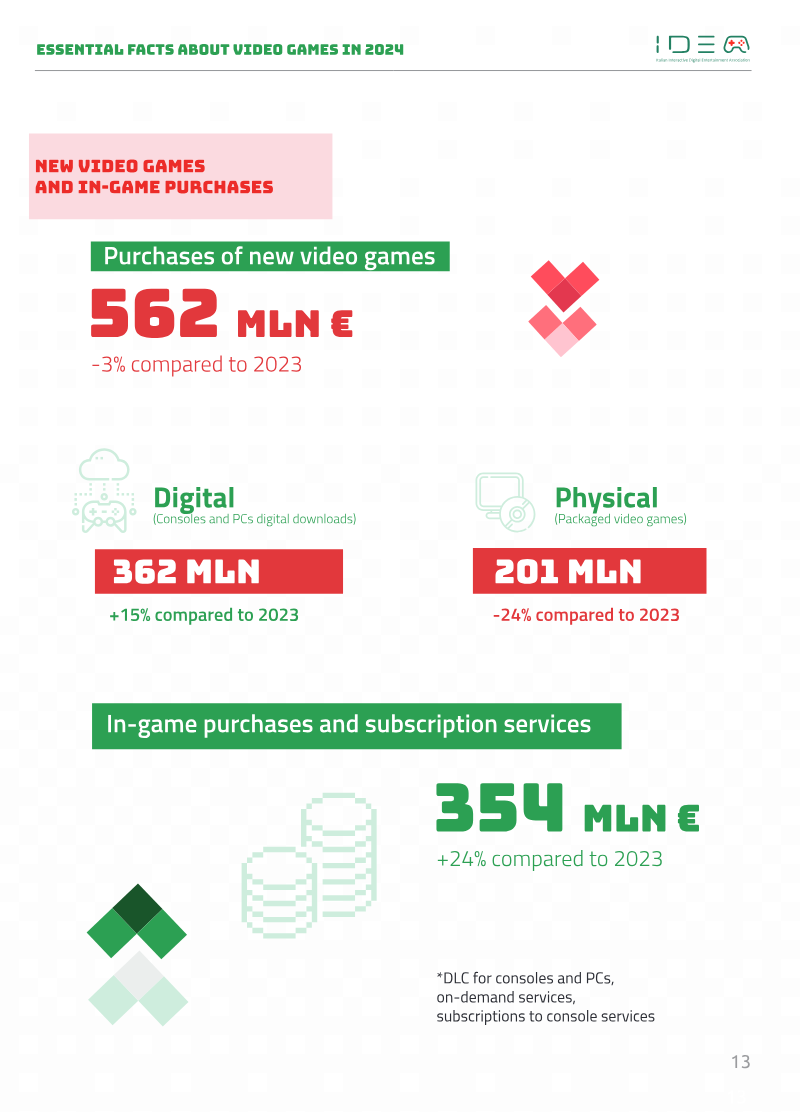
- The Italian video game market generated €2.3 billion in 2023, representing a 5% increase over 2022 and a 28% growth since 2019.
- Italy ranks among the top five largest video game markets in Europe, with 13 million players aged 6 to 64, representing 31% of the population.
- The average age of the Italian gamer is 30 years old, reflecting the sector's broad cultural and demographic penetration.
- IIDEA serves as the primary institutional body for the industry, focusing on business acceleration, international branding through 'Games in Italy,' and global networking at events like Gamescom and GDC.
- IIDEA manages key industry infrastructure, including the 'First Playable' trade fair, the Italian Video Game Awards, and the Italian Esports Awards.
Fashion & Beauty Trends: How Gen Z Express Themselves in Immersive Spaces
This analysis explores the evolving relationship between digital identity, fashion, and physical self-expression among Gen Z consumers. The primary thesis asserts that digital avatars have become a central medium for authentic self-expression, significantly influencing physical world style, brand affinity, and mental well-being. As immersive spaces transition from mere gaming environments to social hubs, the distinction between digital and physical identity continues to blur, with a majority of users now prioritizing their virtual appearance over their physical one.
The findings are based on a dual methodology: behavioral data from the Roblox platform collected between January and September 2023, and a representative survey of 1,545 Gen Z users aged 14 to 26 in the United States and the United Kingdom. Key data points reveal a significant upward trend in engagement; total avatar updates grew 38% year-over-year to 165 billion, while purchases of digital fashion items rose 15% to 1.6 billion. Notably, 56% of Gen Z respondents stated that styling their avatar is more important than styling their physical selves, an increase from 42% in the previous year.
The research highlights a symbiotic relationship between realms, with 84% of respondents noting that their physical style is inspired by their avatar’s look. This digital-to-physical pipeline extends to commerce, as 84% of users are likely to consider a brand in the physical world after trying its items virtually. The report also emphasizes the psychological benefits of these spaces, with 88% of users crediting immersive expression with helping them feel more comfortable in the physical world. Industry segments covered include digital fashion, beauty, and music, noting a growing demand for exclusivity through limited-edition digital goods and community-created content. Overall, the data suggests that the metaverse is functioning as a low-stakes laboratory for identity, driving broader trends in gender-fluid fashion and diverse representation.
- 56% of Gen Z users now prioritize styling their digital avatars over their physical appearance, a significant increase from 42% in the previous year.
- Engagement with digital identity is surging, with Roblox users performing 165 billion avatar updates (a 38% year-over-year increase) and purchasing 1.6 billion digital fashion items (a 15% increase) between January and September 2023.
- Digital-to-physical brand influence is high, as 84% of Gen Z respondents are more likely to consider a physical-world brand after interacting with its items in an immersive space.
- Virtual spaces serve as a primary style incubator, with 84% of users reporting that their physical-world fashion choices are directly inspired by their avatar's look.
- Immersive self-expression provides tangible psychological benefits, with 88% of users stating that their virtual experiences help them feel more comfortable in the physical world.
A New Era of Engagement in Media & Entertainment
The media and entertainment landscape is undergoing a fundamental generational shift toward active engagement, characterized by a seamless blend of physical and digital activities. Younger audiences, particularly Gen Z, are leading this transition by prioritizing interactive experiences over passive consumption. For the first time, Gen Z spends more time on video games and virtual worlds, averaging 12.2 hours per week, than on traditional broadcast or subscription television. This demographic also demonstrates a high level of creative participation, with 68% identifying as digital creators and spending three times more hours on user-generated content than Gen X.
Video games have emerged as the primary driver of this engagement, commanding a 72% active participation rate among US consumers. While movies and series still lead in total weekly volume at 17 hours, the gap is narrowing as gaming platforms like Fortnite and Roblox evolve into holistic entertainment hubs. These virtual spaces now serve as venues for socializing, attending concerts, and digital commerce, effectively functioning as early iterations of a persistent metaverse. This shift is further evidenced by the success of transmedia franchises and cross-media intellectual property strategies that bridge the gap between gaming, film, and music.
The future of the industry lies in the convergence of physical and digital worlds through interoperable 3D spaces that foster deeper fandom. Brands are increasingly integrating into these ecosystems through digital collectibles and in-game partnerships to capture the attention of younger consumers. High-profile investments in virtual fashion and NFTs underscore the growing economic value of digital assets within these environments. Ultimately, the industry is moving away from a model of passive viewership toward one defined by persistent, interactive, and creator-driven experiences that unify physical and virtual identities.
- Gen Z now spends an average of 12.2 hours per week on video games and virtual worlds, surpassing the time they dedicate to traditional broadcast or subscription television.
- Video games command a 72% active participation rate among US consumers, narrowing the volume gap with traditional media, which currently averages 17 hours of weekly consumption.
- 68% of Gen Z identify as digital creators, spending three times more hours on user-generated content than Gen X.
- Gaming platforms like Fortnite and Roblox are evolving into holistic entertainment hubs that facilitate socializing, live concerts, and digital commerce.
- Industry growth is increasingly driven by transmedia strategies and the integration of brands into virtual ecosystems through digital collectibles and in-game partnerships.
Newzoo’s Global Gamer Study 2023
Gaming engagement in 2023 has evolved into a multidimensional experience that extends far beyond active play to include viewing, socializing, and content creation. Data indicates that 79% of the total online population are game enthusiasts, with over half of all consumers engaging with games in more than one way. This trend is most pronounced among younger generations; 94% of Gen Alpha and 90% of Gen Z are classified as enthusiasts, frequently participating in "other" engagement activities like visiting online gaming communities or attending conventions.
The research highlights a significant shift toward multi-platform play, with 47% of gamers utilizing at least two platforms. A particularly high-value cohort, "tri-platform players" (15% of the player base), averages over 11 hours of play per week and shows a high propensity for spending, with 85% having made in-game purchases in the last six months. While mobile remains the most accessible entry point due to low hardware barriers, console gaming maintains the highest player-to-payer conversion rate, driven by subscriptions and pay-to-play models. Across all platforms, 57% of players are payers, motivated primarily by special offers and the desire to unlock exclusive content or customization options.
Gaming platforms have also emerged as powerful marketing channels. Approximately 50% of players and viewers report discovering new brands through gaming, and players generally hold more positive attitudes toward brands—particularly in the sports, beverage, and technology sectors—compared to non-players.
This analysis is based on Newzoo’s 2023 Global Gamer Study, which utilized Computer-Assisted Web Interviewing (CAWI) between February and May 2023. The methodology involved a representative sample of 74,295 respondents aged 10 to 65 across 36 global markets, covering North America, Europe, MEA, Latin America, and Asia-Pacific.
- Gaming is now a multidimensional ecosystem where 79% of the online population are enthusiasts, with over 50% of consumers engaging through a mix of playing, viewing, socializing, and content creation.
- Younger demographics show the highest engagement levels, with 94% of Gen Alpha and 90% of Gen Z participating in gaming activities beyond just active play.
- Multi-platform gaming is a significant trend, with 47% of gamers using at least two platforms and a high-value 'tri-platform' cohort (15% of players) averaging over 11 hours of play per week.
- Across all platforms, 57% of players are payers, with 85% of tri-platform players having made in-game purchases in the last six months to access exclusive content or customization.
- While mobile remains the most accessible entry point, console gaming maintains the highest player-to-payer conversion rate due to subscription and pay-to-play models.
Analyzing the Consumer and Market Impacts of Chinese Games Market Policies
China’s gaming market, the largest in the world by revenue and player count, is currently defined by a complex and increasingly restrictive regulatory environment. Primary governmental concerns center on minor protection and the mitigation of gaming addiction, which officials often characterize as a negative social influence. Key mandates include strict playtime limits for users under 18—restricted to one hour on weekend and holiday evenings—and the implementation of mandatory real-name verification systems. While minor spending accounts for less than 2% of revenue for major firms like Tencent and NetEase, these regulations threaten long-term market growth by reducing the future pipeline of engaged players and esports talent.
The administrative process for securing game licenses has become a significant barrier to entry. Following a nine-month freeze on approvals ending in early 2022, the government has adopted a rigorous scoring system that evaluates titles on societal values, cultural propagation, and original design. Foreign entities face additional hurdles, as they must partner with local publishers and navigate an approval process that is often slower than that for domestic titles. Consequently, many developers have shifted focus toward multi-platform releases, as a single license now covers mobile, PC, and console versions, streamlining the path to market.
Despite these restrictions, a robust grey market persists. Players frequently utilize virtual private networks (VPNs) and game accelerators to access international platforms like Steam, while console users often purchase hardware and software from overseas markets to bypass local content limitations. Additionally, some mobile developers utilize ad-based monetization models to operate without formal licenses, though regulators have recently begun cracking down on this practice.
In response to domestic pressures, Chinese gaming giants are aggressively expanding internationally. This strategy involves establishing overseas development studios, acquiring global talent, and launching international publishing labels. By leveraging their expertise in free-to-play mechanics and live operations, Chinese companies are successfully capturing market share in Western and other Asian markets, effectively diversifying their revenue streams away from the unpredictable regulatory landscape at home.
- Chinese gaming giants like Tencent and NetEase are aggressively expanding internationally through studio acquisitions and global publishing labels to mitigate domestic regulatory volatility.
- Government regulations restrict users under 18 to one hour of gaming on weekend and holiday evenings, a policy that threatens the long-term pipeline of players and esports talent despite minor spending accounting for less than 2% of major firms' revenue.
- The game licensing process now utilizes a rigorous scoring system evaluating societal values and cultural propagation, following a nine-month approval freeze that ended in early 2022.
- Foreign developers face significant barriers to entry, requiring local publishing partners and navigating a slower approval process compared to domestic titles.
- Developers are increasingly utilizing multi-platform releases to streamline market entry, as a single license now covers mobile, PC, and console versions.
Female Gamers in Asia: Version for Women in Games Asia Panel
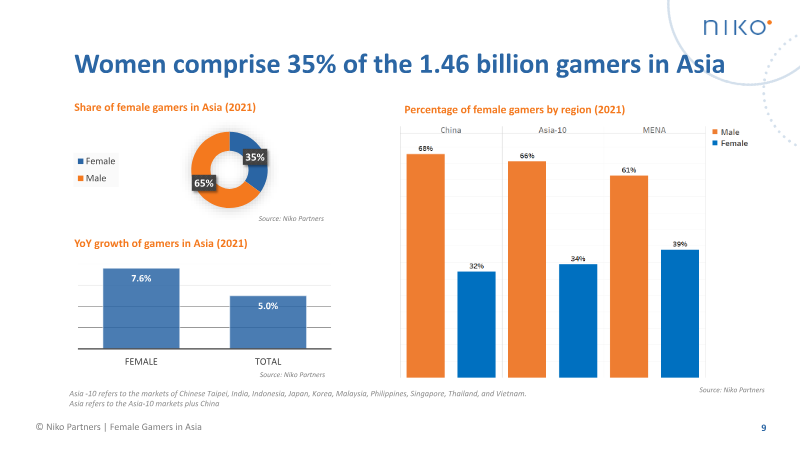
Female gamers represent a primary engine of growth within the Asian interactive entertainment market, accounting for 35% of the region's 1.46 billion total gamers as of 2021. This demographic is expanding at a faster rate than the general gaming population, with a year-over-year growth of 7.6% compared to the total market increase of 5.0%. The scope of this analysis covers China and the Asia-10 markets, which include Chinese Taipei, India, Indonesia, Japan, Korea, Malaysia, Philippines, Singapore, Thailand, and Vietnam. Data was derived from a 2021 survey of over 6,500 randomized respondents who identified as active gamers across mobile, PC, and console platforms.
Mobile gaming is the dominant platform for this demographic, utilized by 95% of female gamers, while 60% engage with PC games and 17% use consoles. In terms of genre, female players in Asia show a strong preference for role-playing, racing, and strategy games. Discovery of new titles is primarily driven by social recommendations from friends, followed by the visual quality of graphics and core gameplay mechanics.
Monetization trends indicate that female gamers are highly engaged with in-game economies, with 84% of those willing to spend making in-game purchases. They are particularly inclined toward purchasing cosmetic items and participating in gacha mechanics. In 2021, female gamer spending reached $13.07 billion in China and $5.52 billion across the Asia-10 for mobile titles, while PC game spending reached $9.70 billion and $3.93 billion in those respective regions. These findings suggest that gender inclusivity and targeted development for diverse interests are essential for capturing the full economic potential of the Asian games industry.
- Female gamers in Asia represent 35% of the region's 1.46 billion total gamers, with a year-over-year growth rate of 7.6% that outpaces the 5.0% growth of the general gaming population.
- In 2021, female gamer spending on mobile titles reached $13.07 billion in China and $5.52 billion across the Asia-10, while PC spending reached $9.70 billion and $3.93 billion respectively.
- Mobile is the primary platform for this demographic, with 95% of female gamers playing on mobile devices, compared to 60% on PC and 17% on consoles.
- Female players in Asia demonstrate high engagement with in-game economies, as 84% of those willing to spend make in-game purchases, specifically favoring cosmetic items and gacha mechanics.
- New title discovery for this demographic is driven primarily by social recommendations from friends, followed by visual graphics quality and core gameplay mechanics.
Market Outlook 2022: An Overview & Analysis of Industry Trends
The global mobile gaming market is currently undergoing a period of stabilization following unprecedented pandemic-era growth, characterized by a slight 6% year-over-year revenue decline to $21.2 billion in early 2022. Despite this correction, the industry maintains a high baseline of approximately 14 billion quarterly downloads and is projected to reach $117 billion in annual revenue by 2026. While casual titles account for 78% of total downloads, the financial core of the industry remains the mid-core segment, specifically RPG and strategy genres, which generate 60% of all player spending. Growth is increasingly concentrated in Asia-Pacific markets, though Western regions are showing significant engagement spikes driven by major intellectual property launches.
The RPG and MMORPG sectors remain the primary engines of monetization, particularly in Asian markets which contribute 80% of total genre revenue. However, the successful launch of titles like Diablo Immortal, which earned $28 million in its first six weeks in the United States, signals an expanding Western appetite for these complex mobile experiences. Simultaneously, the card battler sub-genre has emerged as a top-five growth category, benefiting from cross-media synergies and established franchises. This expansion is supported by a strategic shift in advertising, as developers increasingly leverage social platforms like YouTube and Instagram to capture a higher share of voice among target demographics.
Market leadership in the strategy and RTS segments is shifting, with China surpassing the United States in player spending for real-time strategy titles. While established leaders like Clash Royale maintain global dominance, the success of newer entries demonstrates that local market expertise and the integration of popular IPs are essential for sustained growth. As the industry moves toward a projected 73 billion annual downloads by 2026, the reliance on sophisticated advertising networks and the ability to monetize mid-core audiences will define the competitive landscape of the mobile gaming ecosystem.
- The global mobile gaming market is projected to reach $117 billion in annual revenue by 2026, despite a 6% year-over-year revenue decline to $21.2 billion in early 2022.
- Mid-core genres, specifically RPG and strategy, drive 60% of total player spending, while casual titles account for 78% of total downloads.
- Asian markets contribute 80% of total RPG and MMORPG revenue, though Western appetite for these complex titles is growing, evidenced by Diablo Immortal earning $28 million in the U.S. during its first six weeks.
- China has overtaken the United States in player spending for real-time strategy titles, highlighting the importance of local market expertise and intellectual property integration.
- Card battlers have emerged as a top-five growth category, supported by cross-media synergies and established franchises.
Essential Facts About the Video Game Industry 2022
The 2022 Essential Facts About the Video Game Industry provides a comprehensive analysis of the American gaming landscape, asserting that video games have become a vital tool for social connection, skill-building, and mental well-being. The central thesis posits that the high levels of engagement sparked during the pandemic have become permanent fixtures of American life, with 90% of players maintaining or increasing their playtime since the pandemic's peak.
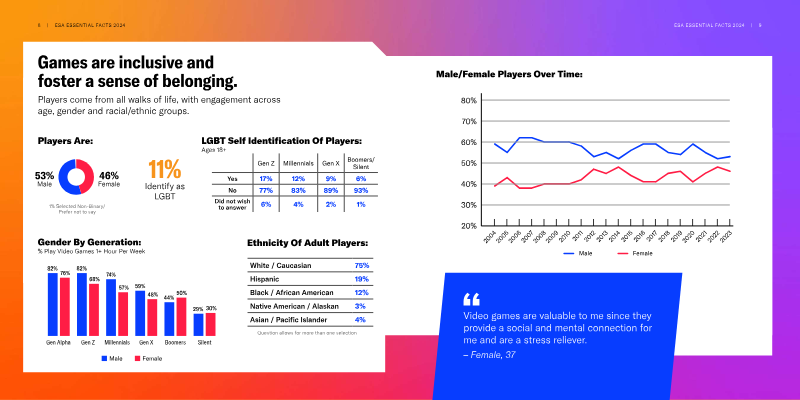
The findings are based on a February 2022 study conducted by The NPD Group, which surveyed approximately 4,000 Americans. The data reveals that 66% of Americans—roughly 215.5 million people—play video games at least weekly. The player base is diverse and aging, with an average age of 33; 48% of players identify as female and 52% as male. While smartphones remain the most popular device (70%), the majority of players utilize multiple platforms. Puzzle and arcade games lead in popularity, though preferences shift by generation, with older adults specifically valuing games for cognitive stimulation.
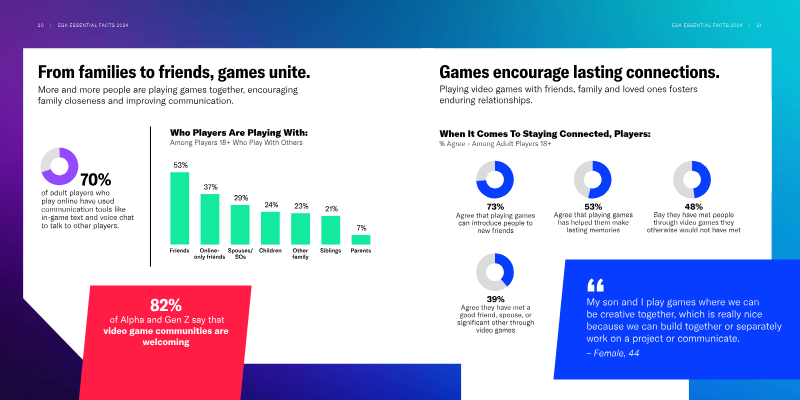
Social connectivity is a primary driver of modern gaming habits. The research shows that 83% of players engage with others, and 46% have met a significant other or close friend through gaming. Beyond entertainment, 97% of Americans see games as beneficial, citing stress relief and the development of cognitive and teamwork skills. Parents also view the medium favorably, with 77% playing games with their children weekly and 84% expressing awareness of ESRB ratings to manage household gaming habits.
Economically, the industry reached $60.4 billion in total U.S. sales in 2021, driven largely by content spending. Purchase decisions are primarily influenced by game quality and price, with 67% of players engaging in in-game purchases. The scope of the report covers the 2021-2022 period, focusing on U.S. demographics, market trends, and the evolving social role of interactive entertainment.
- The U.S. gaming industry generated $60.4 billion in total sales in 2021, with 67% of players participating in in-game purchases.
- Approximately 215.5 million Americans, or 66% of the population, play video games at least weekly.
- Pandemic-era engagement levels have stabilized, with 90% of players maintaining or increasing their playtime since the peak of the pandemic.
- The player base is gender-balanced at 48% female and 52% male, with an average age of 33 years old.
- Smartphones are the primary gaming device for 70% of players, though most users engage with multiple platforms.
Mobile Gaming Market Outlook 2022
The global mobile gaming landscape has entered a period of stabilization following pandemic-era surges, with quarterly downloads maintaining a steady baseline of 14 billion. Although total revenue experienced a 6% year-over-year decline to $21.2 billion in early 2022, the market remains significantly larger than its pre-pandemic state. Casual games continue to lead in volume, representing 80% of all downloads, yet Mid-Core titles remain the primary economic engine, generating 60% of total player spending. While the United States maintains its position as the leading consumer market, the Asia-Pacific region exerts increasing influence, evidenced by Taiwan’s rise to the fifth-largest global market and the region's dominance in high-monetization genres like MMORPGs and Card Battlers.
Strategic advertising and intellectual property integration have become essential for navigating this competitive environment. Strategy and RPG titles are increasingly prioritizing YouTube for share of voice, while the acquisition of MoPub by AppLovin has shifted the advertising landscape for strategy games. Success in the rapidly growing Card Battler sub-genre, which earns 62% of its revenue from the APAC region, is largely driven by high-performing titles like Yu-Gi-Oh! Master Duel and the effective use of Live Ops and Season Passes. Furthermore, cross-media synergies, such as the impact of the Netflix series Arcane on game downloads, demonstrate the power of multimedia IP in driving user acquisition.
The market outlook suggests a temporary correction phase with a projected return to growth by 2023. While Asian markets currently account for 80% of MMORPG revenue, Western interest is growing, as seen with the successful U.S. launch of Diablo Immortal. Similarly, the Real-Time Strategy sector is seeing a geographic shift, with China overtaking the U.S. as the top market for the sub-genre. Future expansion across these segments will likely depend on localized IP collaborations and sophisticated user acquisition strategies tailored to specific regional preferences.
- The mobile gaming market is in a stabilization phase, with quarterly downloads holding at 14 billion despite a 6% year-over-year revenue decline to $21.2 billion in early 2022.
- Casual games dominate volume at 80% of all downloads, while Mid-Core titles remain the primary revenue driver, accounting for 60% of total player spending.
- The Asia-Pacific region is a critical economic force, generating 80% of global MMORPG revenue and 62% of Card Battler revenue.
- Success in high-monetization genres like Card Battlers is increasingly driven by Live Ops, Season Passes, and high-performing titles such as Yu-Gi-Oh! Master Duel.
- Cross-media IP integration, exemplified by the impact of the Netflix series Arcane on user acquisition, has become a vital strategy for driving game downloads.
Motivations and Demographics Snapshot Report: The Motivations Driving Top Mobile Games, February 2022
The mobile gaming landscape in the United States is defined by a complex interplay between player demographics and a diverse set of motivational drivers. Analysis of the top 200 grossing titles as of early 2022 reveals that while certain motivations like excitement and thrill are universal, their execution is highly demographic-specific. Younger male audiences gravitate toward high-sensomotoric challenges such as Battle Royales, whereas players aged 45 and older seek similar thrills through low-sensomotoric experiences like Slots. A significant shift in the casual market is also evident, as every top-grossing casual game released between 2020 and 2022 has integrated renovation and customization elements to broaden appeal and foster player expression.
Gender and age remain primary indicators of genre preference and monetization behavior. Thinking and solving motivations, prevalent in Match3 and Hidden Object games, attract a 63% female audience that frequently monetizes through level retries. Conversely, strategic planning and mastery drivers are dominated by male players, who make up 76% to 84% of the audience in 4X strategy and synchronous PvP titles. However, these gender lines blur in specific sub-genres; for instance, while men dominate resource optimization in strategy games, women represent 61% of the audience for similar mechanics within the Tycoon and Crafting categories.
The integration of secondary motivational drivers has become a standard industry practice to enhance retention and engagement. Collection mechanics have permeated nearly all genres, with Slots and character-driven RPGs leading the trend. Social drivers are increasingly facilitated through non-competitive co-op and guild systems, particularly among men aged 25 to 44, while exploration is driven by live events and sandbox elements. Ultimately, the most successful mobile titles are those that layer multiple drivers—such as milestone completion, skill improvement, and social interaction—to appeal to the nuanced psychological profiles of their target demographics.
- Gender and age are primary indicators of genre preference, with women comprising 63% of the audience for Match3 and Hidden Object games, while men make up 76% to 84% of the audience in 4X strategy and synchronous PvP titles.
- Every top-grossing casual game released between 2020 and 2022 has integrated renovation and customization elements to increase player expression and broaden market appeal.
- Motivational drivers are demographic-specific; younger males prefer high-sensomotoric challenges like Battle Royales, while players aged 45 and older seek similar thrills through low-sensomotoric experiences like Slots.
- Gender-based genre preferences are not absolute, as evidenced by women representing 61% of the audience for resource optimization mechanics within Tycoon and Crafting categories.
- Secondary engagement drivers such as collection mechanics have become industry-standard, with Slots and character-driven RPGs leading the trend to improve retention.