1 free read left. Create a free account for unlimited reading + AI research.
Create free account
AI and Player Psychology
Key insights
6 takeaways- 01AI-driven data is increasingly being used to monitor player well-being and implement safety protocols, positioning games as tools for mental health and emotional exploration.
- 02Significant shifts in large-scale, AI-integrated game design are expected to materialize within the next three to five years.
- 03Widespread implementation of generative AI for asset creation is currently limited by high inference costs and the need for more robust infrastructure within existing game engines.
- 04Developers are moving beyond surface-level behavioral metrics to utilize adaptive psychometric assessments that identify enduring psychological profiles rather than transient player behaviors.
- 05The game industry is shifting from basic procedural generation toward AI-driven, personalized narrative experiences that leverage human psychology.
- 06The integration of cognitive layers into game design allows for the creation of more responsive non-player characters and gameplay environments tailored to specific player motivations.
Ask AI about this video
Transcript
foreign [Music] gaming podcast where it is our mission to explore the business and future of video games we bring together the industry's brightest Builders investors and thinkers to keep a full sun current events dissect emerging Trends and games share Lessons Learned and have a great time this podcast is also part of novik's growing ecosystem which ranges from free and premium research to Consulting and advisory services for more information visit www.navic.com [Music] this episode is brought to you by overwolf with over 1 500 games supported 165 000 creators and 38 million monthly active users overwolf is the guild for in-game creators whether you're a gamer Creator or game studio overwolf is the ultimate destination for integrating ugc in games for Game Studios overwolf
offers curse forged for Studios a white label solution that lets game makers and Publishers easily integrate mods safely and seamlessly into their games both existing and new at zero cost it's battle tested by AAA Studios and games including Maxis with the Sims 4 Studio wildcard with Arc Take 2 interactive and others for creators overwolf is the all-in-one platform that enables creators to build distribute and monetize in-game apps mods and Game servers in 2022 overwolf paid over 160 million dollars to in-game creators proving that they truly value the talents and contributions of The Gaming Community you can check out everything overwolf has to offer at overwolf.com or check out the details in the show notes and with that let's jump into the episode greetings everyone and welcome to the novik gaming podcast I'm your host Alex and this is the interview and insight segment it's our new Zeitgeist
in games keywords like generative Ai and diffusion models and an enormous imagination about how the onset of this technology might impact game creation what will be the first killer use case for the 2020 era of AI will it be optimization optimizing production marketing or a more transformative shift that fundamentally Alters what games are versus simply how they are made so today we're gonna have a really fun brainstorming session with two impressive folks first I'm super excited to have my friend kishan Patel on air keishin is a recent graduate of Harvard Business School and a games and consumer angel investor I had the pleasure of meeting him during my time at Big craft and he recently wrote a fantastic piece in collaboration with Lightspeed on gaming and the AI Market called the infinite power of play if anyone's looking for the link it'll be in the show notes below but I had such a good time reading it so I knew I had to have him come on and collab on the Pod so welcome kishan thanks for having me it's great to be here um and next I'm super psyched to have on
Joe shepi the CEO and co-founder of soulston soulston is a company that believes there's Limitless power in understanding your player direct quote from the website and there's some interesting uses of AI that the company um is doing and doing today and we'll explore that during our episode um so welcome to the Pod Joe I loved hearing um your episode on deconstructor of fun shout out to those guys and so I learned a little bit about from about soulston uh I don't know you did that episode like a year or two ago um something like that um from you guys so I'm really excited to see how the studios evolved and talk about AI um so as mentioned today's episode is slightly different than some of the others in our interview and inside segment I'm calling this like more of a brainstorming episode and we're learning at our guests but we're also talking about something that's rather unknown so before we Deep dive into the session with the use cases and the market of AI I just introd you guys pretty Loosely but could you guys tell me about yourselves and what you're up to now and
also your favorite sci-fi like episode of a TV or movie or book that deals with AI um Keisha and you go first sure sure so so yeah like like you mentioned at the intro uh I'm a consumer and gaming focused angel investor advisor startups um a lot of my focus lately obviously has been on generative Ai and AI broadly kind of how that's going to be impacting you know things like game development how games are played um who plays them uh really really excited time uh to kind of be in the space and excited to talk about it um favorite favorite movie so I know past life I used to be in entertainment so I have a lot of favorite movies that kind of touch on this topic probably though I'd say um and maybe odd choices probably Wally uh awesome awesome movie I think it touches on kind of something that they're going to be talking about today the kind of uh Human Side of AI a lot of emotions and and the aspects of AI we don't typically think of we think of like these hyper rational um almost cold cold robots ruling our
lives but love Wally kind of a kind of a different take positive take on AI stuff I'd say that that's not awesome um yeah I love the robot angle um it definitely contrasts with one of my favorites which is the love death and robots um episode with with the vacuum I don't know if anybody has has seen that show but there's a vacuum that basically has an AI it's like a Roomba but it like takes over the world um so there's a world with benevolent robots and a world with more uh malicious ones but uh Joe uh how about you uh sure so CEO and co-founder at solston um solson's journey is we're at the the Forefront and Edge of understanding what it means to be human uh we we firmly believe that AI can't function in a human world without unlocking theory of Mind understanding me understanding you that's what we do as human beings and so how do we help uh technology actually become regenerative for human beings and
what we mean by that is when we're on a podcast when we're using Tech when on our app how are we walking away from technology so that we actually it's better for us it it helped us in some way shape or form um biopsychosocial data so is it improving us biologically are we getting better sleep psychologically is it is it reducing anxiety is increasing resilience um socially are we actually meaningful connections and you can't improve something if you don't measure it so any game company out there that's like we're gonna make a healthier game for players are one of the first things we say is well what what does healthy mean to you and how do you measure that oh okay so you know let's let's start with that so soulston's at the really the Forefront of adapting these systems of measurement with actually one of the oldest forms of machine learning which is adaptive testing so that is what we've been doing and everyone forgets that when you took the act or the SAT if you're in the U.S that was machine learning it's it's as you're taking questions and I recently took the GMAT that thing again you know
we know all about the adapters that was the my favorite thing ML and you know what I'm sure we'll we'll dive into this in this episode talking about like what is like what do people think generative AI is and you know people will use terms like discriminatory Ai and there's like what are all these different sort of things and I have a very specific opinion on that which is probably not as popular but um we'll pause there so that's sort of sort of solsted and how we help game developers is where I mean we were rated the uh top AI by developers last year and we so we beat out chat GPT these different groups um for actually game development so we work with our developers for understanding Their audience and then being able to create better experiences for those players um so I'll pause there on that part and then favorite movie that has AI components to it you made me think on my feet a little bit here so I'm glad keishin had to go first there but one of my favorite movies of all time is hands down Prometheus and I I have a
background anthropology I used to be an adventure based psychotherapist and and what I love about Prometheus if you actually start to view it through the lens of all the different AI systems that are working there I love how like you know you make a lightsaber and everyone's like we're gonna go make lightsabers but Prometheus actually provides a really interesting road map for the future of like what I could do or couldn't do and the threats and ethical use cases too of of what it might become um and and why maybe it's important for it to understand Humanity which is part of what that movie is about of what happens when it doesn't understand us which is maybe just as much of a risk yeah well I'm super excited to ask some of those ethical questions which I think I've got some of those queued up later um but it is really interesting like how many movies touch on this topic and what we can and what we can learn from them um that talking about permits just reminded me of another Black Mirror episode that I was thinking about where there's like a they this woman like recreates her partner out of like text
messages and like video footage um in an AI um and then it's like kind of like this like the as any Black Mirror does there's like a double edge to this thing that seems immediately good but turns out to be kind of poisonous in a way um but yeah it's it's and then and this and this thing is so believably human um but you told us a little bit about like what you guys do at solstan and um from the episode that I listened to a long time ago at doff you guys were talking a lot about understanding player psychology's optimizing UI ux for quote a human-centered experience um I'm wondering how the new AI craze has changed or your original product if it has it all not yet so you know if you look at if you go to developers and you sit down with them and you ask them today how how much are you actually implementing this stuff in the day-to-day like talk to someone who works on Call of Duty at Activision and this is literal quote
unquote just to get an an art asset from one of our third party Studios into our you know Activision kind of headquarters Central the amount of work that needs to be done to get that in place to actually be able to put it in a game and be game ready um it is profound so it's not that we can't get there when it comes to ml and and different like deep learning neural networks it's just that we're still very infant in terms of actual practical use cases so when it comes to like how we interact with with developers in terms of um you know like uh mid-journey for example some of the areas where we're seeing already improvements is one of the things we do at Solstice called the resonance testing so when you're building a new game and you have your audience what we're actually able to do is when you test different themes art styles things like that you're able to look at does this actually resonate with the market that we're moving towards or not so one of the cool things about soulston is a lot of games that are going to develop right now like NFL Rivals is one that just came out recently that you use sulson it's top in
the mobiles type of things in terms of the game store they came to us and go can we get an audience of people that are into NFL into crypto and then all the testing and iterating they do they can actually see how it's resonating against Their audience so in that case we have clients using things like mid-journey for example to say hey can I get these five different art styles in these different look and feels based off of something that someone originally created and then we can resonance test those and that's part of our our resonance testing we have a part of that's ml because we're learning across all the different creators we work with so I do we do see things in terms of the creative process but in terms of like actual games um it's it's really limited to two things which this is what we say sulson's limited to with our we call it our traits product that's our product that works with live audiences we say it's limited to your Tech stack and your imagination so take for example game companies like Rovio Rovio had ml generative levels from way before ml was popular to talk about for Angry Birds
there's nothing new that's there you plug solston into something like that really interesting things that can happen however there's very few because of the history of game development if you talk to back-end professionals they'll tell you every single game company is going to look pretty different um at the end of the day and so game developers are developers so there's not really the systems in place yet to implement generative quote-unquote because it's not really generative it's more synthetic but that's a side but doing that at scale right now we're not there yet I think we'll start to move in that direction in maybe the next three to five years but so far in terms of how we work work here to provide that Human Side so if you want to plug that in it's a social and we're ready for that but in terms of the the top game companies out there it's just I think most people are trying to fight through um still uh Apple's changes and some of the stuff that has happened there on marketing and how the gaming industry levels out and gets into this new phase
and that's why maybe it's a good transition I really agree with the piece that you know you guys wrote and um what what Keisha and what you guys are talking about with the the stuff that we're doing today um the next three to five years it's there's going to be not step shifts there's gonna there's gonna be a couple Monumental shifts that that happen and I think that's going to be really interesting got it and yeah and and you use this word um we've talked about resonance that the testing but you use this word um uh generative and then you use synthetic and maybe Keisha and I'll Pawn this one off to use and see since you're the expert but like um what are the different techniques that you got that you use you know I've heard diffusion I've heard Gan I've heard now synthetic um maybe like walk through maybe well how that's a little bit like technically different and what can be accomplished using either different types of models um from my understanding I thought mid-journey was a diffusion based model if that's correct um but kitchen why don't you take that away yeah yeah
there's I think the diffusion there's a kind of diffusion based models like you said there's Gan models I think like the generally the idea is kind of before the way kind of games are made maybe in um kind of the typical procedural generation that we've seen before in like roguelike games um any kind of map based games uh you can kind of make levels make kind of maps that kind of generate based on certain rule sets I think here you know now in this kind of new world uh and kind of to Joe's Point kind of the step change that we're excited about and seeing is uh kind of this personalized aspect of that procedural generation so creating um creating levels or whatever their personal personalized to the user and then kind of expanding to uh categories that up until now you really couldn't do procedurally so you've seen a lot of narrative based games um you've seen kind of uh latitude has their AI dungeon um storycraft is doing kind of a narrative game hidden door so a lot of those are kind of marrying both the procedurally generated levels with kind
of language models to kind of create a really new kind of experience for for players um but yeah I think like the the most interesting thing for for me has been you know you can kind of create new maps and and kind of keep the game fresh but the game is even more fresh when it's personalized to the player and and getting to kind of send this up Joe has been focusing on how do you match that to someone's psychology um and kind of what they're looking for out of the game so maybe like mitigating some of like the like what we call like procedural like oatmeal where like mathematically the map is different but to the player it feels it's the same um which is really interesting and so you're saying that like this new era of AI like levels up procedural generation because I think oftentimes that's been a question that I even have I'm like well we've kind of already been generating Maps this way for a bit um is this just making it faster or better um so that's a really helpful um explanation and so actually this might be a good time to talk about like that number one use case that a lot of people are talking about which is kind of cost and and time reduction so your
piece um and we'll talk about it claims a couple of things the first is that AI is quote the fourth industrial revolution of video games and in this part you talk about the evolution from the publisher model which you call the Stone Age thanks um to modularization which to be honest from the word itself I had no idea what that meant but I think you basically make a claim that technology so like gaming engines and back-end resources is short-end game development Cycles two-third ugc player creation and then finally AI the dawn of the AI powered studio and then your second point is about AI powered games so basically AI following is into categories of use one do something faster cheaper smarter which is basically faster and cheaper and two do something new um so let's talk about number one first um and you have this great efficient Frontier Graphics so again like for those who haven't seen the article be linked to the show notes and as mbas we all love a nice Frontier graph two by twos graphs yeah that's that's my language um and you start putting forth some
ideas for what an AI powered studio actually means a joke and obviously complement this with what he's building at solstan but one it was innovation in art and asset creation two it was tools to design game environments three it was tools and developer on modding um and four was tools and quality assurance and testing and the overall thesis is time reduction um exactly and so I want to kind of get a sense of what's actually going down um and maybe Joe uh what's your take on this like who are actually using a lot of these tools and what has have there been like significantly successful Integrations with these so far are we still like are we still very much at the ideation phase where none of this is like actually making a daily production impact um maybe the resonance is actually happening right now but what about some of the other stuff yeah yeah totally so I'll kind of step back a little bit and and you kind of touched on some of uh the broader trends that we were kind of pointed out and how AI kind of jumps onto those Trends
um you know you had the in the monolith code bases that that big Publishers use and still use today uh and and the biggest example of kind of modularization kind of happening is you know the game engine right so like Publishers used to build their own and still do build their own engines and then you know first With It software but then you know most famously with unity you have people kind of taking that part of the stack out and then it gives kind of um game developers game designers more time to just focus on the actual gameplay they're not spending so much time you know recreating the physics whatever else it is um and then on top of that so if you think of that as kind of um closer to just the development side um you have ugc where where you have more personalization so just broadly even outside of gaming the idea of ugc is anyone can kind of make something and and by doing that they're able to find an audience for however small or larger might be you're able to kind of expand you know the the pool of people that I'd be interested in the the piece of content object um you know even the whole games you're talking about something like Roblox that you're creating
um and I think the way we thought about how AI fit into this was you know you have uh uh the more and more games kind of getting created and it creates this ability for um you know third-party software to plug in so you you I'm sure a lot of folks maybe have seen um you know 3D object creation kind of companies where they can speed up that development process so just the idea of bringing more people to make games means that you can have companies that just the same way that um engines took a piece of that you know difficult process out um you're able to have these kind of third-party companies come in and help you do that you know faster and more efficiently and then also AI you know is is increasing the personalization in games we're seeing you know people are able to create objects not just if you're if you're a you know high quality designer um you can you know eventually we think consumers can be able to kind of make their own objects use their own games the same way you know people have been doing for years now with modding but just making that barrier a lot lower um and in terms of kind of where where we are today I think you're right we're
still in very much in the ideation stage um there are people trying to figure out way is to use some of this technology I think the tough thing is matching the costs you know if you think about AI models you have their training so you train the model to be able to like you know create the either whether it's text output image output you know objects whatever it might be but then you also need like inference pass which means like you know once I've built the model I put the text in and then it runs through the model and creates the object I want that inference pass today is is still pretty expensive so people are still trying to figure out exactly how to bring that cost down so that you can you can use this in production environments so that you can have you know consumers able to use this at a cost that really makes sense so that's been kind of one of the biggest barriers I think in kind of expanding um kind of the usage of a lot of these tools but right now it's just really exciting to see how people are playing with it testing it out especially in Indie environments you know trying to figure out how they can bring them into their workflows and I think as we see
that I think that the spaces kind of kind of continue to grow yeah I think if you actually look at the the day-to-day though we're so far away from that so I think the the advantage soulston has is we're we're a category Creator we are at the frontier of ML and deep learning when it comes to human understanding and when it comes to actually like how we're implementing these different systems to do environment generation level generation these sort of things so we have the advantage of Danny Lang who was the the VP of ml at Unity early on uh Lloyd West was an individual who came to our team who he if he founded the game tune team at unity and one of their tasks was that like we're talking 2017 18. how do we allow developers to have these sort of more adaptive environments and there's some use cases with games where they made stuff but I remember Lloyd coming to me and saying I don't I'm a PhD mathematician from Cambridge because I don't think you can do this
without psychology and I'm like that's correct and so there's a huge overestimation that's happening right now in the ability for technology to generate things that are relevant and that's the important thing and that's why we talk about resonance versus relevance relevance is interesting it's like did I notice it is it relevant but that doesn't mean people are going to engage with it for a long period of time and one of the things if you talk to uh you know a well-seasoned game designer you know they're going to say I find the fun well how do you find the fun and then they have trouble articulating that um and a lot of that has to do with like theory of mind and hot cognition versus cold cognition and and AI is a cold cognition process it's it's very long robust there's not an emotional part to it but why is this so important and I'll go back to that so if you think of like let's talk about ml systems we've been training for a while like self-driving cars well on the cold cognition perspective we can get motion capture video capture we can understand when a self-driving car should possibly stop based on all previous data and this is
what I mean by AI is not generative it's synthetic we synthesize all this previous data we bring that data together and then we run a prediction on what that car should do well human beings we are not um just cold cognition beings we have hot cognition we have emotions you know when people say uh behavioral economics is is great and that people are predictably irrational false people are rational when you include cognition so when you include hey there's a kid running across the street for some random reason why well an ice cream person you know is on the other side and now the car doesn't know to stop because it didn't have that training use case historically well now maybe it can start to learn to identify ice cream trucks but in the future maybe there's different deliveries of ice cream trucks and they look different and you know there's this this Taco Bell that serves things you know out of you know shoots and things like that but we have new ways of deploying information Technologies Etc and that's one of the problems with with kind of this process so I think we like to think of it in a
couple different buckets there's there's the creative enablement aspect but I think is really cool is people that get good at a lot of these tools can come up with more inspirational facets quicker so that's if I see what is actually being done today that is improving the the game sort of the game development like sci-fi one it's you know what we do at solston it's we're able to use ml to better understand audiences than any one before so now as a game developer I know who I'm making this for and it's not just 45 year old women or 27 year old men you know Nielsen type data two if I look at where it's been applied and succeeding is with marketing at the moment it's let's go and generate a bunch of creatives or a bunch of text and then from there they'll plug into their solston data and say oh like our audience is really high on um on caring as a value and they're really high on family we got all these ideas hey um can you generate a bunch of images or text surrounded on the value around caring and family that all of a sudden what it
does is enable an artist like we've had companies go to us like you know I had a handgun now I have a machine gun or I have a little box of crayons and I have the full box of crayons and I actually know which colors to paint with so I think that accelerates a lot of that but then when it comes to implementation like solston doesn't work with sdks why when I was at Big Fish Games heading up ux there if we had third parties come to us and say we have an SDK we're like oh my gosh this is going to slow down our game this is going to do all these things so I actually think there's a lot of work that needs to be done on the engine end to really optimize how we actually actually sit down with game developers and and you know yes Unity helped with that but game developers are going to game develop they're going to want to customize things on the back end and there's some really interesting products that like we're partnered with Excel byte for example um we're looking to other groups like that where we can deploy things through the back end but I think there's there's going to be a nice play back and forth where we're going to need to be able to actually get to infrastructure level before the the generative stuff gets Mass so we're not
ready from an infrastructure perspective yet to support I think a lot of these cool companies that are getting started and this speaks to the cost point right where it's like okay this isn't actually cheaper we're talking about how it's going to be but as a matter of fact it might be slower or and way more expensive right yeah and you know and humans are great at like like we have a um an agency that works with a lot of game companies and he does their marketing creative and he's like the first thing I do when I build out creative as I ask if they have solston and he's like what that does for me is it bypasses all of the ABS testing that I know I'm going to have to do because then I can just see oh here's our main audience and here's their motivations and here's their personality and here's their cognition here's all these things that I know about them now and I can just start creating enough of that I think where things are gonna like the the groups that take off the the fastest are the ones that are going to be able to play Within the bounds that exist like that's one of the things that soulston crack that other companies didn't like I had one of the um founders of of playfab he's like how are you
working with the companies you're working with I'm like what do you mean it's like we were never able to integrate to the depth that you guys have in terms of just passing data back and forth and that was one of the things we did we recognized where they're at we're like we're not going to give you some SDK we'll just play with our rest API we'll make it super simple for you so I think it's like meeting a lot of development teams where they're at today and the technologies that I think you know are going to help bridge that are going to be huge enablers of the other end and I think that's one of the dichotomies we we see within the gaming industry like um June great guy he's the CEO of excel by we were talking and he's like we have all the back-end Engineers you guys have all the ml engineers and data scientists but very rarely do they all live in the same place so for us that's like a very natural partnership to come together and and work with each other and if you look in kind of across different game companies the same the same becomes pretty true like we've been looking for the top people that have
worked in ml and data science in the gaming industry for the past five years and that we gotta we gotta catch up when it comes to like universities and education programs and and training for this kind of stuff because it's almost like uh passed on wisdom body of of knowledge thing at this point where it's like ml is not just like plugging into chat GPT and saying you have an ml company like that's not really what that that is yeah what is it like the ml over like the M the chachibichi overlay or whatever it is like yeah but but um okay so you were talking a lot about um this the ice cream truck concept right where the kid runs across the street and the car doesn't know to stop because he didn't know that didn't have the cognition to know that the ice cream truck was there and that's what and and the kid might be wanting to run across the street um and my time that I wasn't taking accounting uh I took a class called simcis so symbolic systems 200 which talked about like how the cognition like
the Chinese room test um how babies learn and stuff like that and is actually really fascinating to like what kind of patterns humans can pick up and then copy even though there's like no actual like a machine would have such a hard time being able to identify like this apple this apple and this apple as an apple um or fruits or all that kind of binning category and processing um but when it comes to like defining caring right like you mentioned like oh this I've read this resonance test and now my audience knows that we're into where people are into caring or family or whatever what are you how are you building that um and sort of where does that where is the technology kind of coming from because that seems like a pretty hard thing to necessarily like psychograph about people um so like what about specific images indicate caring or family or anything else right and how are you doing that in a really efficient AI manner versus just having your consumer marketing team be like blue sky looks pretty like stuff like that exactly
um so you know one of the things I brought up early on is that soulston is at the edge we're at the frontier of human understanding so I think part of explaining this is also understanding where are we at just structurally when it comes to human understanding so in a former life I was a psychotherapist I did a lot of neuropsych evals and neuropsych assessments that in the medical world is the Forefront of human understanding what does that look like in 2023 well maybe you're like hey I might have ADHD or you know what I'm a pilot Pilots have to do neuropsyche valves every two years um I need to get my neuropsyche valve done well I'm going to sit down probably for about seven hours I'm going to go through a series of of questions um these questions are are psychometric items that have been developed to measure certain things so there's things called like construct validity which means am I measuring what I intend to measure and there's ways to verify that reliability if I ask you the question today or in a year from now will you answer the same or not so we need to
have that level of consistency and we're standing on the shoulders of giants in the sense that you know if you take for example the mmpi that's probably one of the most popular ones that a psychologist would give you it's like around 500 questions and we can understand things like depression anxiety some personality things about you um these these assessments were broadly built for Western populations U.S populations and so the item the question that is the best one for measuring let's say um from a personality perspective perspective your level of extroversion that question that is the most accurate and valid for you might Alexander might be a little bit different than the one for uh question and so you're asked several of these questions and then from that a trait is deduced and traits are interesting because if you look at your personality uh about 40 of it from what we know you can thank mom and dad for just like we can thank them for our noses and all these other phenotypical
traits the other 60 of us we get to choose how we express those things so there's that nature versus nurture piece what we don't know a lot of this right now so in terms of how soulston deploys this what we do is we have an Adaptive psychometric assessment with a huge library of valid psychometric items and we're measuring over 300 different traits so you can kind of think of it as like if you're a bartender and you're making cocktails you might have base ingredients like I got whiskey I got gin I know those are my base ingredients but then there's some garnishes there's some liqueurs well we're able to do through adaptive testing and I brought up ACT SAT so David Weiss came from the University of Minnesota he's the Godfather of computerized adaptive testing he he built it he created it so the system is oh that's part of why we're in Minneapolis I know we asked about where we are but really it came from this part of the world adaptive adaptive testing did so what we're able to do is learn about you as your answering the questions at solston so in live games we deploy an Adaptive
assessment that has had the cool Fortune of learning for the past three we have the we implemented I think first about three years ago so before that we were based off clinical assessments now we're based we have our own adaptive assistant assessment that's constantly learning and because we get to work with games it's been learning across almost every single culture country and language you can imagine so there will be a future where that adaptive assessment could literally maybe provide you one question if you're multilingual in one language and then the next question would be in a different language if it knew those things about you so we get this sample from what we know is really good foundational science in terms of measuring all these different traits those are anonymously so we never collect personal identity that's one of the advantages of working with sulson especially from a legal perspective you're able to separate sensitive data which is psychological data from personally identifiable data so it de-risks your company as well so now that we have an encrypted version of the user ID we have a psychological profile
attached to that based on pop-up in the game hey we want to improve your players player experience what's cool is the assessment also updates itself based on engagement and so it's it's wild in terms of we'll get 10 of daus basically take this within the first day so massive like solson by far is the largest psychological database in the world like all the alien talk that's going on in governments uh if an alien came to Earth and was like I want to know who human beings are we could tell you like we got a big enough sample for it it's bigger than a university so and that's why we're able to attract a lot of these people are curious about this too um but so that being said those people end up getting captured and then what we're all we're now in an environment so let's say well I use NFL Rivals as an example so the next thing we do is we take the play behavior in the game from all the people that did not take the questionnaire um because now we're only representative of you know maybe 10 of the population which you can extrapolate is is representative at like a 99 accuracy of
your most engaged audience engaged people don't take questionnaires so you have a representation of your engaged players but now what about all the people that didn't take the questionnaire so what we do is we we structure that data on the back end we kind of do two things if you want to read our patent Library you can kind of learn about what we do because we have patents on all these things so like we have like the literal Harry Pot Harry Potter hat patent so we're able to identify broad systems of behavior and say we already knew that there was a group of really courageous people that were altruistic hey based on these broad systems of behavior okay it looks like you're one of them so you're in Hufflepuff or you're in you know Gryffindor these are not pre-established they're they're they generate based off of the game that we're in so that's kind of first step is kind of sorting everyone in a game into their house but then the second step that we're learning and this is like the Wild Frontier the wild wild west of what it means to be human um what we do is we understand play data and we take that and start to predict psychological traits from play and one
of the reasons why Facebook doesn't really actually know anything about you much like credit card companies they know what you bought they know maybe your interests but your interests change your purchase Behavior changes when I'm in Berlin I think I said this to Kesha in our last conversation like I'll go eat a kebab kebabs are amazing in Berlin like I'm in Minneapolis that behavior is never going to exist for me in Minneapolis and then you're in the near future like you know I just I just don't see that happening like maybe and we have great Somalian food and Ethiopian food in Minneapolis could go for some of that but so very very very different thing behaviors change but what is cool about play so I specifically and I'll stop here and I've been talking for a bit I was an adventure based psychotherapist and there's this beautiful saying that I love which is show me how you play and I'll tell you who you are when we play it's play as fundamental to what it means to be human I know Kesha This was literally in your piece some of these aspects it's fundamental to who we are it's how we learn and it's where we express our most authentic versions of self so then
Sultan uses this play Behavior to predict traits and in the same way that Google indexed the internet and made it searchable soulston's using gameplay and we're building the cognitive layer of the Internet by using this this beautiful training environment which is play I I kind of want to just jump in I think one of the one of the things that gets me really excited about kind of what Joe's talking about um relates to just how how I you know AI like you know I mentioned kind of the personalization aspects being able to um create games that are specific to players and I know a lot of um kind of listeners might be familiar with like bottle types you have like you know ways of people approaching games what they're looking for in a game and I think like adjusting you know and being able to shape what a game is to the what the person is trying to get out of the game is really exciting to me so you know like trying to be able to to build games that like if you're let's say an achiever you the game is kind of catered to you trying to do that uh if you're you know a socializer you really want to meet a lot of people and do a certain
you know have a certain way of interacting with the game trying to do that and I think like you know from the game is games industry that's obviously great because you know if the num your player base is just gonna be so much larger for the same game um but just in terms of like like people being able to play games and get what they want out of them kind of what Joe was touching on earlier is is really exciting to me yeah if I add one more thing on that because one of the big misunderstandings when we when we started working with game companies is because people 4 used to bottle types oh these are socializers these are killers these are or you know some of the early research that was done was all Behavior based so right one of the things that was problematic is we were saying we have psychographics on our customers and then they would tell us I'm like well what are you measuring what's the psychographics you're measuring well these are completionists and these are not completionists and I said well how are you measuring it I'm like oh you're not measuring it as a personality trait you're measuring it as a behavior these people completed things in the game and then they go well these same user IDs are not completing things in this other game this is an actual solston case we had but they're completionists and I
said no you measured the behaviors let's measure their traits the traits is the parts of their personality that are enduring so we measured their traits and we saw that that specific audience there is nothing from a trait perspective that indicated that they were really into productivity or or completion type psychology what we saw actually was they were really high on status orientation as a trait so what we said another game was like if you want them to complete stuff completion behaviors and off gas off of cognition it's an off gas of our personality it's an off gas of our emotions and so if you want them to complete things give them status for it put them on leaderboards give them vanity items do all this stuff they come back to us they're like that was a little too simple and I'm like what do you mean well they're they're completing stuff again they're completionists again I'm like no they're not completionists again you know you think about like um Ai and training models I went over this actually with unity we were talking about this early on they said we're training our bots off of curiosity I said well that's interesting you know
what do you mean so well all human beings are are curious but we're curious based on who we are that's the theory of mind that I know understanding me understanding you and I said well some people are curious more about the color blue than about the color green some people are more curious about cars and some people are more curious about boats so if we just train you know purely based off curiosity if humans were purely curious we'd all be dead you know you need things like like what is your you know perception of risk taking um how high are you on openness people were higher on openness are more curious about a lot of different things so all these different parts that I think what we don't realize is human beings a lot of who we are are 4.5 billion years of pre-installed packages that have served they're incredibly brilliant pre-installed packages we're not do like yes we have mirror neurons we do work we do imitation learning but those mirror neurons it's not just we're not a blank slate and if you watch really young young children there's all these cool processes that we run and one of the
things that I love about I said Prometheus um anthropology is you actually look at some of the close of our some of our close ancestors like chimpanzees for example you know seven million years ago we we had a descendant that's there and if you look at some of their behaviors like when they're out in the field and they do something good they'll give each other high fives you can see like hey these are these are part of our lineage for at least seven billion years these are pre-packaged install things that have meaning and we can see a chimpanzee give a high five we don't need a training model to emotionally know what that what that probably meant this it's and it's it happens instantaneous so you know there's all this cool stuff that's there in terms of of that being said but that whole piece of uh what is behavior versus what is psychology that's so important in terms of I think the next generation of of how we build experiences yeah and I think that that's definitely that shifted really heavily from the cost and time reduction category of AI to the well people are really also excited about which is this new genre of AI powered game which could
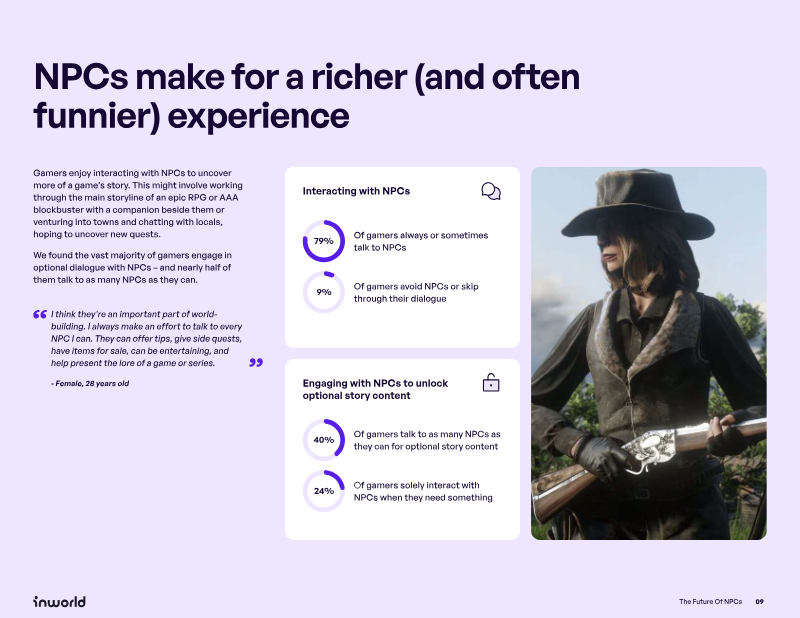
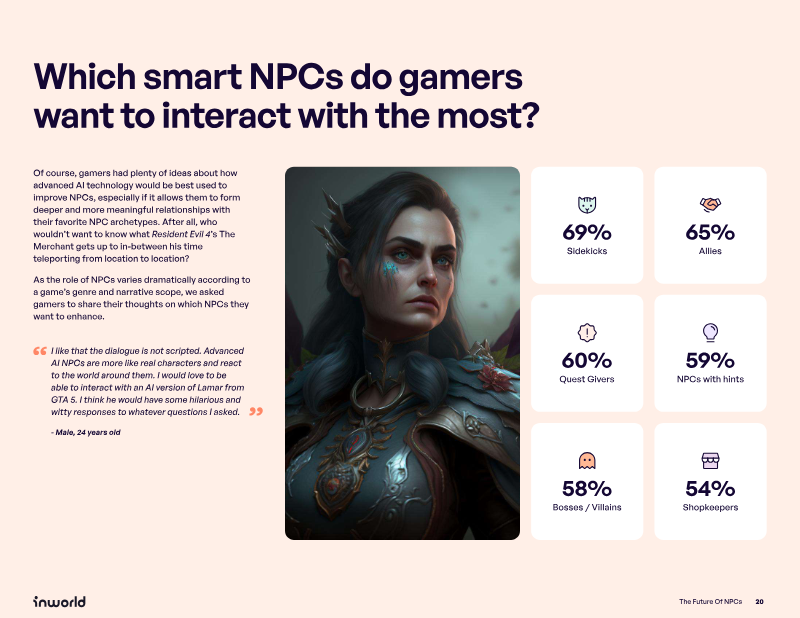
be discerned from by designing plant designing games for people with specific psychologies who may or may not express that through their behavior or not and trying to kind of navigate what kind of um game you could design for that kind of person but I think there's another part of the new genre of AI games besides doing psychographic testing on the players themselves but creating and breathing new life into the games through the form of like NPCs which I think is another big sector of this AI powered Market um and you know we've in world just had their big round um and their whole thing is to create these inner dialogue and PCs um that you could just drop into your game and have breathe life into it um and so I just I have a question that's a little bit um maybe like I I think I would it's more From perspective of understanding but there are plenty of games with incredibly complex NPC systems like the Nemesis system and Shadow of Mordor right and those are incredibly complicated um the dialogue and story trees and
games like Hades are like require like a PhD in math to understand and so the player experience is amazing you're like oh my gosh this orc remembers that I killed his brother like and I did this horrible bad thing and behind the scenes there's all this design logic that's running that took years and was incredibly costly to run so I'm wondering whether or not a company that's creating these NPCs with AI models is actually cutting out the labor or is it actually like a new tectonic genre of game right because I think basically it's just making it it seems like it's just making it easier to create really complicated and deep NPCs but complicated and deep NPCs have been in like The Witcher 3 is an incredibly complex like NPC system right so I guess maybe like kishan like what's your perspective on that about it being like something actually new or is it that or is that a tooling thing yeah I know that that's a really great question I think um you know what someone once said to me I think it's a it's a good way of thinking about this space is that a lot of the Innovation
that happens um in gaming uh happens already within a lot of game studios people build games they've created like you said really complex uh and and interesting AI systems um and they're not done as a service so I think the one like just business model wise that a lot of these companies do just the same way we talked about um you know engines being built within games and then someone does it kind of as a service that modular aspect you're talking about before that's like an innovation there and being able to do as a service um I know Joe mentioned before things like latency being able to do it in a way that that you can easily plug in integrate really well like those aren't trivial by any means but then on a technological basis like uh you know shout out in world love kylan uh Ilia Michael great team there and I think what they're doing and what people in that space are kind of focused on is you know you can have the intelligent and NPC the AI and PC that um you know leverages kind of llms to be able to kind of interact with people but it's a combination of of the llm what what
they're actually saying with the emotions the way the kind of sound comes out uh with you know facial expressions like coordinating all those systems um you know that that's the complexity and I think that's where you have a lot of value where you know you're right someone at another Studio kind of building a single game could do that um but that's super time intensive it's extremely hard there are highly you know in world they're highly technical team that's able to deliver something that um kind of as a service that's really really high quality out of the box and so I think that's really um that's the big difference is you know there are technological leaps obviously with generative AI people could build this themselves and I think what what companies like in world are doing is making us at the highest quality can be achieved by anyone from from the AAA Studio to the Indie developer and they can create really cool experiences with it yeah I totally forgot about the um like the voice uh and the emotion empathy because like yes you designed the whole system but then you'd be like all right voice actors to the studio like read every line that's possibly
possible and then you'd and and localization exactly expensive part yeah yeah exactly really interesting um and then I think like the emotion part is something that I would love to dig a little bit into and this is like I know that we like you know 35 minutes ago we were talking about ethical questions and stuff like that maybe Joe bounced this to you but like on the website for salsa you make a point about like well about well-being right about understanding someone's behavior in someone's psychographics and to make sure that they are doing well or they're happy with this game Etc um and so like let's just bear with me for a second it's like a very hypothetical example but let's just say like there's like an NPC AI That's like installed in your game that's actually supposed to be there to ensure that your well-being is good right and then it somehow figures out that um yeah maybe you actually actually have a mental health disorder or that you do truly need help based on the way that okay maybe not the way that you behave because you just told me there's a big difference between behavior and
psychographics but Loosely the base on the way that you behave um and then uh you know on the moral level I guess like let's just say like you're and you're a game company and you kind of find out through your NPCs that this this player actually needs help or mental support like what do you think should happen next in that context you know because we're building these games to tailor that experience for those players but you know is it in our right best interest to have an NPC recommend for example that you go see somebody um yeah so the the first thing that's important is knowing so like if you if you zoom out and we let's just talk about the population that is Gamers it's three billion people globally we looked at that data and we said what are the traits that show up most frequently when it comes to just flat out who these people are and I think what's interesting is like the the trait that actually appears most frequently across all games drumroll like kind of kind of interesting it's actually high achievement so about 22 percent of people that play
games as a trait are high Achievers um what's interesting about people see this I should just tell this to my mom see she didn't believe me um like my entire entire life like I would just try to convince the whole world let's see I love this keep going I like where you're going I got I got you Alexandra so high Achievers well what else is interesting about this group of people low levels of neuroticism statistically low levels of depression low levels of anxiety so we have a very like um actually high levels of physical activity are associated with this group too so when we look at it's right you just describe it Alexander in a sentence I achieve her physical activity gamer so you know what this is really interesting but then when we look at um let's talk about the next largest sort of group that that appears across this kind of like three billion group of people we're talking about 19 of the population the opposite end of achievement low achievement high levels of neuroticism
not well adjusted so Gaming's is fascinating and the thing about play you know if if you do something over and over and over again you want to learn something new it takes about 400 times for you to develop that that new synapse that that new connection in the brain when you do it in a state of play on average it takes 20 times that's why as an adventure-based psychotherapist I could work through stuff with people who have depression much faster than than I could if I was just sitting in a couch so you know if we look at the responsibility of play also we know that passive systems if you look at the body all the bodies of research on health and digital use and Screen Time passive system so TV social media things that you passively engage with um if we look at that compared to two-way digital systems interactive digital systems um just flat out people like shouldn't my kid be playing a first person shooter game Joe or watching TV first person shooter game the data is very very clear that there's not like likely to be violent outcomes related to that yes the
kids learn hand-eye coordination there's a study showing that FPS kids outshot police officers in terms of target practice so yes it teaches hand-eye coordination but the violent stuff there's nothing to support that that I've seen anyway in the research so far so interactive media tends to be much better than us so I think what we have is we have this thing where High Achievers go to gaming because like this is a way for me to improve different aspects of who I am in my career and what I'm trying to achieve and then people who are on the other uh end of the spectrum go to gaming because they're looking for a way out like I used to work with a lot of patients who were suicidal and it's a really scary thing like my very first patient that I ever had came to me and within the first minute this was when I'm in like my practicum I'm very early on I have a supervisor but it's me and this personal loan room and they said I want to kill myself and that's like your your biggest as a student you know and being in grad school that's your biggest like oh man like what do I but you're trained you know what to do um there's training there you know
what's your plan you kind of go through all those things you understand that I had multiple therapy sessions with this kid and one of the cool I remember he came two years later and I didn't even recognize him because he looked so good um he's like you say in my life can I can I give you a hug and I I went and reflected on that Journey it's part of soulston's Journey and I'll address the question now here too one of the questions I'd ask these people when we're going through this process when was the last time you felt Joy and I'd say about a good 50 60 of them would tell me about a video game they were playing and and with him he's like you know it's Ocarina of Time I was playing this game and it's just so awesome and I said well here's the process you know we're gonna have to admit you to the hospital that's gonna happen we need to make sure you're safe we're gonna go through that but then after that I want to talk about that more I want to I want to get back to you experience that we'll work through the the medical aspects of this but let's start there and so play is you know I think play humans have a responsibility to play it's not that play as a responsibility
to us if you look at um brain data in terms of um Crystal memory versus fluid memory and if you look at adults a lot of adults um Crystal memory goes up past 30 and fluid memory goes down well when we look at studies of people that still play games post 30 years old their fluid memory keeps going up it's so cool to see so I think you know when we look at play and the power of play and what play means it's it's how can we play and what's so cool about games is games are the easiest access to play it's just we can open them up pick them up so when we talk about games if you just turn the other other you know you look the other way and you go well we don't want to know about depression we don't want to know about anxiety okay well then you know you're not going to be able to nurture your player to Optimal outcomes you're not going to be able to nurture your audience the game companies that are the first companies to say let's let's look at that and Google has policies and procedures for all of this by the way if you trigger certain Search terms boom there's a suicide hotline here's what to do so it's not the first
time businesses have actually had to go through if this then that's for all and there's best practices for all this so I think you know as game developers given the population data we just laid out and what it's like I actually think you know going that direction we have Casino companies that reach out to us hey we're starting to get regulated for addiction can you guys help us measure addiction we're like great we'll do just that we're not going to help you with creating addiction but we'll help you with measuring it because even gambling companies know that if you reduce addiction you make more money because addictions people burn out of them and blow out of that they don't keep engaging over time you know you want predictable Revenue over time and so you know Community when we think about Healthy Communities some of the game companies that said we're focused on mental health and healthy communities have some of the most unhealthy communities and then if you ask them if they measure it they'll tell you no because they don't know how and that's where solstum can can be a partner so I think it's creating that and and starting to go down that path and I'm excited for I think this all plays into Ai and NPCs and communication and what's
there where do Flags happen and it's not the responsibility of the game company to to do anything about it but I think it's the response to the bill of of that's a therapist shop that's a doctor's job that's not your job what your job is just like Google does a pretty good job of is helping get them to hey here's here's the suicide number um you know you call this if you need it it's the first thing that that shows up for people who are suicidal if they start going down that path in Google and if and if you're Googling for a friend and it comes up like so what that's good to know Google thinks about things like this we only have a couple minutes left but I had I have a little bit of like a can of worms question but maybe this is a uh do you guys do you think people play when they play as who they really are or do you think people are playing as someone that they want to be or some sort of other persona I mean like I think I was talking with someone the other day about like using gameplay to like help decide what your credit score
should be based on like if you're a good person or not basically and I was like well I'm not sure like I would want somebody to go through my League of Legends chat and like figure out whether or not I should have a good credit score because like sometimes people behave online and the way that they aren't in the real world and so I think that's something that makes me slightly nervous about like the idea of like having um these kinds of like well-being monitors or AI things that like might assess that because that might not be who you truly are but I would wonder what your take is on that and again we're coming up on the the end of the episode probably but this could probably be an entire other Episode by itself but um what do you guys think maybe question you should because I was talking but we know I have the answer no okay I'm with you where I I use I play games as a way of experimenting like like being different parts of Me Maybe not like the whole me like I play when I play Civ I'm I will play domination only I don't do Wonder Mysteries
so like the most toxic kind of player I like to think I'm a nice guy in person so no I think um I think we're different parts of ourselves where we explore different parts of ourselves maybe when we play it but I don't think it's that our our whole self or or only who we are that comes across we should do psychographic tests what what when condition uh what your when condition and civilization tells you about you mine is culture um okay but I think in life I'd be more probably more domination um but the it's uh the the culture one is just so nice just peacefully off to your own hopefully no one bombs you they do you're always raising every city raising every city give me everything yeah so so what word so all I got the answer for it so we'll we'll jump in from this so and this is again some of the confusion between Behavior versus traits so traits are enduring they don't change on a day-to-day basis they're they're enduring parts of of who you are
and some of us have more psychological traits than others and some of our traits are more enduring than other peoples um and that's all that's a whole scientific topic we can go down but the reality is so in life we have this thing called histrionics they're all the masks that we wear and when you're on a podcast you're socially regulated um if you're a second culture kid you know how to culturally work through your primary culture versus your secondary culture as an example and your personality might change differently based on that why games and play are so powerful is it's who we are when no one is looking and so given that what we're actually doing we're measuring traits and then we're learning for one person how you play Civilization here's the thing and in one game and so we we see this data for one person that might have nothing to do with with who you are you know it
might be not really indicative but for other people it very well could be I think I just added myself you know it's you did a little bit but it's but it's a part it's a part of you and the thing about games because games are not you know we know that games are structured play with rules so because it's not an open world environment it also doesn't allow you for the full expression of yourself either so games can bring out who we are within a specific context and that's part of why we measure things across different different systems so the reality is you know show me how you play and tell me who you are like you can get a very very good idea of why is that person super dominant and aggressive in that type of game I'm sorry but that's a part of who they are there's two things when you look at at play um in in therapy there's been research on um you know like doing doing drunk assessment for example because you get that you get parts of the brain to shut down and you get a more accurate view like my uncles he's he's an angry drunk when he drinks whiskey now your uncle's got anger
issues that are repressed societally and when uninhibited we get to see parts of who he who he is and so a humans are poor observers of our own cognition we're not very good at it we're poor observers of each other's cognition therefore we need ways to assess who we are and then if we're talking about machines interact with machines appropriately um based on that and so the answer is you can learn so much about yourself through how you play and play in different environments all right well Keisha I think you have a lot to think about um yeah my therapy appointments can be great tomorrow um guys I absolutely love brainstorming with you but we're gonna call it um thanks for coming on and sharing all of your thoughts on the potential uh use cases for AI and games that being either on the cost of production side or this new generation of AI powered games that we have yet to see um to our friends in the audience that might be interested in getting in touch with y'all for any reason how can they reach you um Joe how about we start with you
solston dot IO uh s-o-l-s-t-e-n so we have a form on there feel free to reach out um you can connect with me on LinkedIn too if that's that's interesting yeah linkedin's great with me um Twitter too I'm kishan.patel kishan like akish like the food um and same with threads if people are still using that awesome okay so on that note we'll be concluding big thank you Joe and kishan for coming on thank you to our listeners and I'll be back in two weeks um feel free to hit me up at Alexandra navic dot Co if you ever have any questions comments or concerns would love to hear your feedback and with that we're out bye gang if you enjoyed today's episode whether on YouTube or your favorite podcast app make sure to like subscribe comment or give a five star review and if you want to reach out or provide feedback shoot us a note at podcast navic dot Co or find us on Twitter and Linkedin plus if you want to learn more about what novik has to offer make sure to check out our
website www.navik.com there you can sign up for the number one games industry newsletter navic digest or contact us to learn about our wide-ranging Consulting and advisory Services again that is www.navic.com thanks for listening and we'll catch you in the next episode
Summary
The integration of artificial intelligence into game development is currently transitioning from basic procedural generation toward the creation of personalized, narrative-driven experiences rooted in human psychology. While the industry is presently focused on optimizing existing workflows and utilizing machine learning for audience analysis and resonance testing, the next three to five years are expected to yield significant shifts in large-scale, AI-driven game design. Despite the potential for generative AI to accelerate asset creation, widespread implementation remains in an early stage, constrained by high inference costs and the need for more robust infrastructure within current game engines.
True innovation in this space involves moving beyond surface-level behavioral metrics toward a deeper understanding of human cognition and emotional resonance. By employing adaptive psychometric assessments, developers can now measure hundreds of personality traits to distinguish between transient player behaviors and enduring psychological profiles. This cognitive layer allows for the development of more responsive non-player characters and highly personalized gameplay environments. These systems enable developers to move past cold data synthesis, instead fostering experiences that align with the specific motivations and emotional needs of the player base.
Beyond technical and creative applications, gaming environments are increasingly recognized as powerful tools for self-discovery and mental health. Because interactive play can reveal repressed cognitive patterns, there is a growing emphasis on using AI-driven data to monitor player well-being and implement safety protocols. By leveraging these insights, the industry aims to create safer, more supportive digital spaces that provide opportunities for emotional exploration. Ultimately, the synthesis of AI and psychology is positioning games not merely as entertainment, but as sophisticated platforms for understanding human behavior and supporting user health on a global scale.