Player Demographics

177 documents·72 publishers

Documents

Page 1
Report31 pages

Motivations and Demographics Snapshot Report

The mobile gaming landscape in the United States is defined by a complex interplay between game mechanics and player psychology, categorized through a framework of twelve distinct motivational drivers. Analysis of the top 200 grossing titles reveals that while broad categories like Excitement and Thrill account for nearly a quarter of the market, the specific implementation of these drivers varies significantly across demographic lines. Younger male audiences typically engage with high-action PvP environments to satisfy mastery and competition, whereas players aged 45 and older gravitate toward progressive jackpots in social slots.

A significant shift in the casual gaming sector demonstrates the universal appeal of renovation and customization mechanics. Every top-100 grossing casual title released within the last two years has integrated renovation elements, signaling that Expression—the desire to customize and decorate—has become a fundamental requirement for modern engagement. This trend is particularly pronounced among female players, who show a strong preference for tycoon games and creative customization, while male players remain more focused on role-playing elements and reaction-based skill mastery.

Strategic drivers such as Management and Exploration show varying levels of market penetration. While Exploration is widely utilized through gacha mechanics and sandbox discovery, Management remains a specialized niche dominated by 4X strategy titles, which account for 70% of that segment. These findings underscore the necessity for developers to align specific gameplay features with the nuanced motivational profiles of their target age and gender groups to achieve commercial success in the competitive US mobile market.

  • Renovation and customization mechanics are now a fundamental requirement for casual gaming, appearing in 100% of the top-100 grossing casual titles released in the last two years.
  • Motivational drivers for US mobile gaming are highly demographic-specific, with younger males prioritizing mastery and competition in PvP, while players aged 45 and older favor social slots.
  • The 'Expression' driver, centered on customization and decoration, is a primary engagement factor particularly among female players who show a strong preference for tycoon and creative titles.
  • Excitement and Thrill-based mechanics account for nearly 25% of the market across the top 200 grossing titles.
  • The Management genre is a specialized niche in the US market, with 4X strategy titles currently controlling 70% of that segment.
+1
GameRefineryFeb 2022
Page 1
Report18 pages

Consumer Insights: Games and Esports 2022

The Consumer Insights: Games and Esports 2022 report provides a comprehensive analysis of global gaming behaviors, motivations, and market engagement. The primary purpose of the research is to equip game developers, publishers, and industry stakeholders with actionable data to benchmark titles, understand player demographics, and identify growth opportunities across 36 diverse international markets. By examining over 100 key performance indicators, the analysis offers a granular view of how players interact with PC, console, and mobile platforms.

The research is underpinned by a robust methodology, drawing on survey data from over 75,000 consumers worldwide. The findings highlight distinct engagement patterns, such as the prevalence of specific gaming personas—notably Time Fillers and Mainstream Gamers—and the interplay between playing and viewing habits. For instance, data from the German market indicates that while playing remains the dominant activity, a significant portion of the population also engages with gaming video content and esports. Furthermore, the report identifies key drivers for consumer spending, noting that price sensitivity, the desire for exclusive content, and social connectivity are primary motivators for financial investment in games.

Covering a broad geographic scope that includes North America, Europe, Latin America, the Middle East, and the Asia-Pacific region, the report serves as a strategic tool for navigating the complex global gaming landscape. By synthesizing metrics such as monthly active users, daily active users, and lifetime player value, the analysis facilitates a deeper understanding of the motivations driving player behavior. Ultimately, the findings emphasize that a nuanced approach to audience segmentation and platform-specific engagement is essential for companies seeking to reach and retain diverse gaming populations in an increasingly competitive entertainment market.
  • The research is based on a global dataset of over 75,000 consumers across 36 international markets, covering North America, Europe, Latin America, the Middle East, and the Asia-Pacific region.
  • Consumer spending is primarily driven by three factors: price sensitivity, the desire for exclusive content, and the need for social connectivity.
  • Gaming engagement is categorized into distinct personas, with 'Time Fillers' and 'Mainstream Gamers' identified as the most prevalent segments.
  • Player behavior analysis utilizes over 100 key performance indicators, including monthly active users (MAU), daily active users (DAU), and lifetime player value (LPV).
  • Engagement patterns in markets like Germany demonstrate that gaming video content and esports are significant activities that complement traditional gameplay.
+5
NewzooJan 2022
Page 1
Report48 pages

Market Outlook 2022

The analysis outlines a 2022 outlook for the global mobile‑gaming market, emphasizing that quarterly installs have plateaued at roughly 14 billion after a pandemic‑driven surge, with casual titles still accounting for about 80 % of downloads. Revenue dynamics have shifted: mid‑core games now generate 60 % of total earnings, while overall mobile‑game revenue fell 7 % year‑over‑year in Q1 2022, marking the first decline since the industry’s rapid expansion. The United States remains the largest spend market, yet Asia‑Pacific regions—especially Taiwan and Brazil—exhibit the fastest growth rates.

Advertising spend analysis reveals that role‑playing games dominate iOS channels, with YouTube capturing an 8.2 % share of voice and exceeding 10 % in Q2 2022; Android spend lags across all networks. Card‑battler titles emerge as the fastest‑growing sub‑genre, driven largely by Japan and China, which together account for 62 % of player spending. Yu‑Gi‑Oh! Master Duel leads launch revenue, reaching $80 million in five months and achieving a worldwide revenue per day of $20—twice that of its nearest competitor. MMORPGs hold the second‑largest spending position globally, with Diablo Immortal topping U.S. spend at $22 million in H1 2022 and maintaining a modest 10 % share of U.S. MMORPG installs.

In the United States, Diablo Immortal generated over $30 million in its first six weeks and captured 3.2 % of mid‑core revenue, yet U.S. players still lag behind Asian markets where Lineage M and Odin: Valhalla Rising amassed $225–$350 million in the same period. The report underscores that U.S. MMORPG revenue represents only about 4 % of the global total, highlighting the critical need for localized market strategies in future mobile RPG releases.

  • Global mobile-game revenue declined 7% year-over-year in Q1 2022, marking the first such contraction after a period of rapid expansion.
  • Quarterly mobile-game installs have plateaued at approximately 14 billion, with casual titles continuing to represent 80% of total downloads.
  • Mid-core games now drive 60% of total mobile-game earnings, despite the U.S. market accounting for only 4% of global MMORPG revenue.
  • Card-battler titles are the fastest-growing sub-genre, with Japan and China accounting for 62% of global player spending in this category.
  • Yu-Gi-Oh! Master Duel achieved $80 million in revenue within five months, maintaining a daily revenue of $20 per player—double that of its nearest competitor.
+1
Sensor TowerJan 2022
Page 1
Report29 pages

Analyzing the Consumer and Market Impacts of Chinese Games Market Policies: China

China continues to dominate the global gaming market, yet a series of regulatory tightening measures—particularly anti‑addiction rules for minors and an expanded licensing framework—have introduced significant uncertainty and higher operational costs for both domestic and foreign developers. The new minor‑protection law caps playtime, limits in‑game spending, and restricts live‑streaming access for users under 18, while the licensing system now demands detailed content reviews and real‑name verification. These requirements are projected to dampen player engagement and increase investment risk over the long term.

Regulators enforce licensing through a complex approval process, yet many unlicensed titles persist on platforms such as Steam, VR services, cloud gaming, and mobile ad‑only games. Enforcement remains uneven; fines are issued but monitoring is inconsistent. Console and live‑streaming services often circumvent restrictions via overseas purchases, backdoors, or content renaming, creating a regulatory environment that is difficult to monitor and enforce uniformly.

The revised licensing regime now permits a single license for multiplatform releases, encouraging developers to produce cross‑platform titles and streamlining the approval process. The market remains dominated by free‑to‑play mobile games, with LiveOps and regular content updates sustaining high retention. In 2021, half of the top 50 grossing mobile games were launched before 2019. Chinese studios are increasingly exporting their expertise, establishing international studios and publishing arms to tap global markets while leveraging IP‑based mobile games to penetrate China’s competitive scene.

  • China’s regulatory environment has tightened through strict anti-addiction laws for minors, which now cap playtime, limit in-game spending, and restrict live-streaming access for users under 18.
  • The licensing framework now requires detailed content reviews and real-name verification, increasing operational costs and long-term investment risks for both domestic and foreign developers.
  • While the licensing process is complex, a new policy allowing a single license for multiplatform releases is incentivizing developers to prioritize cross-platform title development.
  • Regulatory enforcement remains inconsistent, with many unlicensed titles continuing to operate on platforms like Steam, VR services, and cloud gaming despite the official approval requirements.
  • The Chinese mobile market is characterized by high maturity and retention, evidenced by the fact that 50% of the top 50 grossing mobile games in 2021 were released prior to 2019.
NewzooJan 2022
Page 1
Report31 pages

Annual Report of the German Games Industry 2022

01 Players in Germany 8 02 German market for computer 14 03 The games industry in Germany 26 .1 Employment figures and companies .3 The ten demands of the games industry 04 Esports 40 05 esports player foundation 42 06 gamescom and devcom 44 07 German Computer Games Awards 48 08 Entertainment Software 50 09 Foundation for Digital Games 52 10 About game –...

  • The German games market grew by 19% in 2021, reaching €5.448 billion, following strong growth in 2020. In-game and in-app purchases were major growth drivers, increasing by 30% to €4.239 billion.
  • 59% of Germans play computer and video games, a 6% increase since 2019, with 48% of players being women and 52% men. This indicates sustained engagement even after the pandemic-related surge in 2020.
  • The German games industry is experiencing an upward trend, with increases in both companies and employees in 2021 and 2022. This growth is partly attributed to increased games-related study programs at universities.
  • Germany has introduced a games funding scheme and its first federal games strategy, which aims to make Germany a globally competitive location for the games industry. Regional funding has also increased, with new schemes launched in Rhineland-Palatinate and plans in Mecklenburg-Vorpommern and Schleswig-Holstein.
  • Esports has become a mass movement in Germany, with a growing number of hobby players, clubs, and professional esports players. The esports player foundation provides comprehensive support for aspiring professionals, including sports psychology, nutrition, and financial coaching.
Game – Verband der deutschen Games-Branche e.V.Jan 2022
Page 1
Report4 pages

Southeast Asia’s Games Market

Southeast Asia represents one of the world’s fastest-growing video game markets, characterized by a young population, improving infrastructure, and a rapidly expanding digital economy. Data indicates that the six major countries in the region—Indonesia, Malaysia, the Philippines, Singapore, Thailand, and Vietnam—account for approximately $5 billion in market size and 270 million gamers. While this represents 6% of total Asian games revenue, the region is projected to maintain a compound annual growth rate of 8.6% through 2025.

Esports serves as a primary driver for this growth, with over 200 million viewers and gamers in the region. Approximately 60% of Southeast Asian gamers are strongly drawn to esports, and 42% are classified as competitive arena gamers. This interest has led to the integration of esports into major regional athletic events like the SEA Games. Furthermore, the audience is becoming increasingly diverse; female gamers now make up 40% of the total gaming population, with growth rates in this demographic outpacing the general market average. In specific markets like Indonesia and Singapore, women comprise nearly half of the gaming audience.

The region has also emerged as a pioneer in blockchain and play-to-earn gaming, exemplified by the success of titles like Axie Infinity, which reached over one million daily active users. However, the market faces unique challenges, including parental skepticism, fluctuating government regulations regarding game approvals and bans, and complex cultural sensitivities. Successful expansion requires navigating diverse religious and social landscapes, as localized content can significantly boost revenue while cultural oversights can lead to public backlash or censorship. Ultimately, Southeast Asia offers significant opportunities for global stakeholders, provided they adopt localized strategies rather than a one-size-fits-all approach.

  • The Southeast Asian games market across six major countries generates approximately $5 billion in revenue from 270 million gamers and is projected to grow at a compound annual rate of 8.6% through 2025.
  • Esports is a primary market driver, with over 200 million viewers and 60% of the regional gaming population expressing a strong interest in competitive play.
  • Female gamers represent 40% of the total gaming population, with growth in this demographic outpacing the general market and reaching nearly 50% in Indonesia and Singapore.
  • The region has pioneered blockchain and play-to-earn gaming, evidenced by titles like Axie Infinity achieving over one million daily active users.
  • Market expansion requires localized strategies to navigate complex religious and social landscapes, as cultural oversights frequently lead to censorship or public backlash.
Niko PartnersJan 2022
Page 1
Report18 pages

Key Insights Into German Gamers

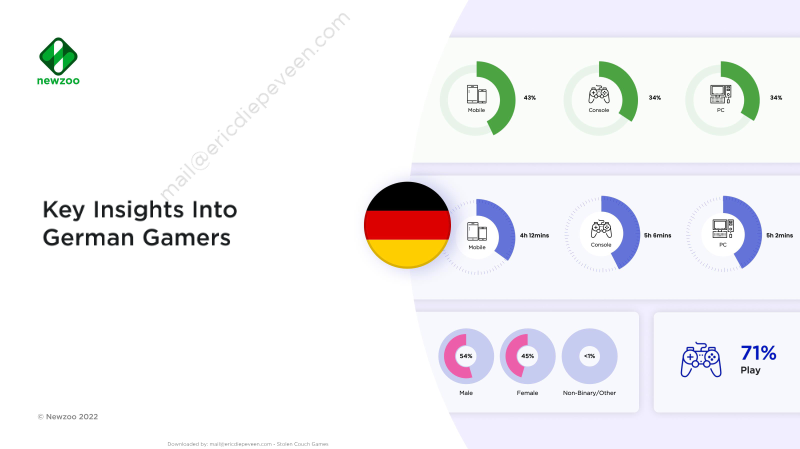
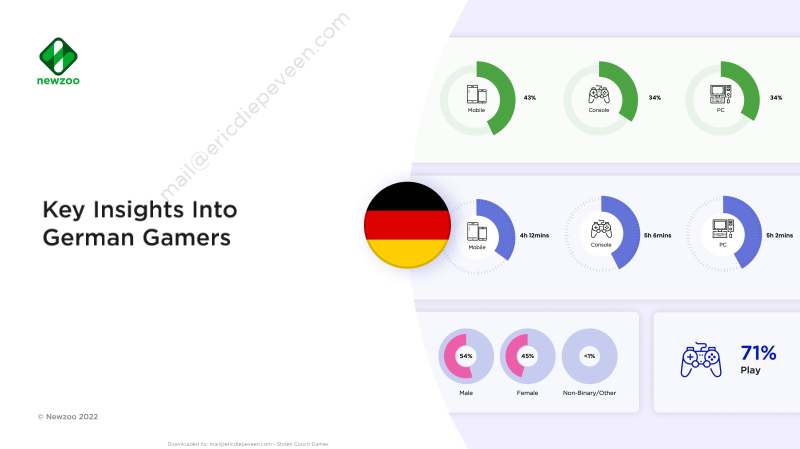
Germany represents a significant pillar of the global gaming industry, ranking as the largest games market in the European Union and the fifth largest worldwide by revenue. As of 2022, the German gaming landscape is characterized by a high level of engagement, with 71% of the online population aged 10 to 65 identifying as game enthusiasts. This engagement extends beyond active play to include viewing gaming video content, social interaction, and community participation.

The demographic profile of German players is nearly balanced by gender, consisting of 52% males and 48% females. While gaming is popular across all age groups, the 21-35 age bracket represents the largest segment at 31%. Motivation for play is primarily driven by the desire to relax and unwind, followed by the pursuit of achievement and social connection. Among the various gamer personas, Time Fillers and Mainstream Gamers are the most prevalent, reflecting a mix of casual mobile play and more dedicated multi-platform engagement.

Platform preferences show that mobile gaming has the highest reach, utilized by 43% of the online population, followed by console and PC at 34% each. Despite the higher reach of mobile, PC and console players demonstrate higher average weekly play times, exceeding five hours. Popular titles in the market include Minecraft, Roblox, and Grand Theft Auto V, with Adventure and Action genres leading in popularity.

Monetization remains strong, with 63% of players spending money on games. The primary driver for spending is the availability of sales or special offers, though a significant portion of consumers also pays to unlock exclusive content or to personalize their in-game experience. These findings are based on a 2022 survey of 2,057 online consumers in Germany, forming part of a broader global research initiative covering 36 markets.

  • Germany is the largest gaming market in the EU and the fifth largest globally, with 71% of the online population aged 10 to 65 identifying as game enthusiasts as of 2022.
  • Mobile gaming has the highest market reach at 43%, though PC and console players demonstrate higher engagement with average weekly play times exceeding five hours.
  • The German gaming demographic is nearly gender-balanced at 52% male and 48% female, with the 21-35 age bracket serving as the largest segment at 31%.
  • Monetization is robust, as 63% of players spend money on games, primarily driven by sales, special offers, and the desire to unlock exclusive content or personalization options.
  • Adventure and Action are the leading genres in the market, with Minecraft, Roblox, and Grand Theft Auto V identified as popular titles.
+1
NewzooJan 2022
Page 1
Report22 pages

Newzoo Gamer Insights: The Future of Gaming

The Gamer Generations Report 2022 examines the evolving relationship between younger consumers and the video game industry, asserting that gaming has become an integral, multi-dimensional pillar of daily life for Gen Alpha and Gen Z. The analysis highlights a shift where gaming serves not just as entertainment, but as a primary venue for socialization, self-expression, and immersion. This trend is positioning these generations as the primary drivers of future virtual worlds and the emerging metaverse.

Data for this study was collected between February and April 2022 via Computer Assisted Web Interviewing, surveying 75,930 respondents across 36 global markets. The scope covers Gen Alpha (ages 10-12) and Gen Z (ages 13-27), comparing their behaviors against the total online population. Key findings indicate that 90% of Gen Alpha and Gen Z are "game enthusiasts" who engage through playing, viewing, or social interaction, compared to 79% of the general population. Furthermore, these groups spend significantly more leisure time on gaming than older cohorts; it is the top entertainment source for Gen Alpha and a top-three source for Gen Z, rivaling social networks and video streaming.

Economic engagement is also high, with 52% of Gen Alpha and 48% of Gen Z spending money on games, primarily on mobile platforms. The top spending motivators include unlocking exclusive content and personalizing in-game experiences through currencies and gear. Socially, 70% of Gen Z expresses interest in using game worlds for non-gaming gatherings, such as concerts or virtual hangouts. The report concludes that as gaming becomes a ubiquitous social platform, brands and developers must adapt to these generations' preferences for multiplayer connectivity, character customization, and diverse content consumption.

  • 90% of Gen Alpha and Gen Z are active game enthusiasts, significantly higher than the 79% engagement rate seen in the general online population.
  • Gaming is the primary entertainment source for Gen Alpha and a top-three source for Gen Z, competing directly with social media and video streaming platforms.
  • Economic engagement is high, with 52% of Gen Alpha and 48% of Gen Z spending money on games, primarily driven by mobile platform purchases for exclusive content and personalization.
  • 70% of Gen Z respondents express interest in utilizing virtual game worlds for non-gaming social activities, including concerts and virtual hangouts.
  • The shift toward gaming as a multi-dimensional social platform requires developers to prioritize multiplayer connectivity, deep character customization, and diverse content consumption to remain relevant to younger cohorts.
+1
NewzooJan 2022
Page 1
Report21 pages

Newzoo’s Global Gamer Study 2022

Gaming has evolved into a multi-dimensional entertainment ecosystem that extends far beyond traditional play, encompassing viewing, socializing, and content creation. Research conducted between February and April 2022 across 36 global markets reveals that 79% of the online population are game enthusiasts. This engagement is most profound among younger generations; for Gen Alpha, gaming has surpassed social media and streaming as the primary source of entertainment. The study utilized a representative sample of 75,930 respondents aged 10 to 65 to analyze behaviors across five distinct generational cohorts.

Data indicates that gaming is increasingly a platform for social connection, with 75% of players engaging in game worlds for social purposes without playing the primary game. This trend is a significant driver of the emerging metaverse. Financial engagement is also high, with approximately half of Gen Alpha, Gen Z, and Millennials spending money on games. Total consumer spending in the sector was projected to exceed $200 billion in 2023. Furthermore, the rise of blockchain gaming and play-to-earn models shows significant future potential, with 34% of players in the United States expressing interest in these technologies.

The findings emphasize that gamers are a highly attractive demographic for brands, as players generally hold 36% more positive attitudes toward brands compared to non-players. However, the diversity of the audience necessitates a nuanced approach to engagement. Using a proprietary segmentation model, the research identifies various personas ranging from Ultimate Gamers to Time Fillers. For instance, while both Apex Legends and Fortnite are battle royale titles, their player bases differ significantly in age, gender, and brand preferences, illustrating that effective marketing requires deep insights into specific game communities and generational motivations.

  • Gaming has become a primary entertainment ecosystem for 79% of the global online population, with Gen Alpha prioritizing gaming over social media and streaming.
  • The gaming sector reached a projected consumer spend exceeding $200 billion in 2023, with approximately 50% of Millennials, Gen Z, and Gen Alpha actively spending money on games.
  • Gaming is increasingly used as a social platform, as 75% of players engage in game worlds for social interaction rather than playing the primary game mechanics.
  • Gamers represent a high-value demographic for advertisers, holding 36% more positive attitudes toward brands than non-players.
  • Interest in blockchain and play-to-earn gaming models is significant, with 34% of U.S. players expressing interest in these technologies.
+1
NewzooJan 2022
Page 1
Report146 pages

Construyendo un Sector del Videojuego en Igualdad

The Spanish video‑game market now serves more than 18 million players, with women representing 48 % of the audience, yet women occupy only about 20 % of development roles across Europe’s roughly 90 000‑person sector. This persistent gender gap, amplified by the COVID‑19 pandemic and Brexit‑related uncertainties, motivates a coordinated push for equality that links industry associations, NGOs such as Women in Games, and policy makers. The central thesis is that genuine gender parity requires systemic change across recruitment, workplace culture, product design, and community moderation, supported by transparent data and legally anchored standards.

Key findings show that inclusive branding, gender‑neutral job ads, transparent salary bands and multi‑reviewer hiring processes can increase women’s entry and retention, while mentorship programmes, employee‑representative groups, regular engagement surveys and equitable parental‑leave schemes produce measurable improvements in pay‑gap closure and promotion rates. Companies that have instituted unconscious‑bias training, “inclusion nudges,” and data‑driven KPIs—such as Wooga—report higher retention and greater representation of women in senior positions. Community‑level interventions, including robust codes of conduct, verified‑identity requirements and AI‑enhanced chat filters, have already cut toxic messages by 5 % in pilot environments, demonstrating the effectiveness of proactive moderation.

The analysis covers the European context, drawing on data up to 2022 from Spain,

  • Women comprise 48% of the 18 million players in the Spanish market, yet they hold only 20% of development roles within the 90,000-person European industry.
  • Systemic hiring reforms—including gender-neutral job advertisements, transparent salary bands, and multi-reviewer processes—are essential to increasing the entry and retention of women in development roles.
  • Companies such as Wooga have achieved higher retention and increased female representation in senior leadership by utilizing unconscious-bias training, inclusion nudges, and data-driven KPIs.
  • Proactive community moderation, including verified-identity requirements and AI-enhanced chat filters, has successfully reduced toxic messaging by 5% in pilot environments.
  • Internal workplace initiatives like mentorship programs, employee-representative groups, and equitable parental-leave schemes are proven to improve pay-gap closure and promotion rates for women.
+2
AEVIJan 2022
Page 1
Report32 pages

Gaming in Europe: Key Facts 2022

The European video game industry demonstrated significant economic resilience and social expansion in 2022, generating €24.5 billion in revenue and achieving a 5% year-on-year growth rate. This sector now engages approximately 126.5 million people, representing 53% of the population aged 6 to 64. Demographic shifts indicate a maturing and diversifying market, as women now comprise nearly 47% of the player base and the 45-64 age group has emerged as the largest playing demographic. While engagement has stabilized at an average of 8.8 hours of weekly playtime, the industry’s economic footprint is bolstered by a workforce of over 110,000 employees, which saw a 12% increase in staffing levels.

Despite this robust growth, the industry faces a critical talent shortage that threatens future expansion. Projections suggest a widening digital skills gap, exemplified by Sweden’s anticipated deficit of 25,000 developers by 2031. To sustain its trajectory, the sector is increasingly focusing on workforce diversity—where women currently hold 23.7% of roles—and the implementation of comprehensive social responsibility frameworks. These include the expansion of the PEGI rating system and the deployment of advanced parental control tools to ensure a safe environment for the evolving player base.

Environmental sustainability has also become a central pillar of the European gaming landscape. Through collaborative efforts like the Games Consoles Voluntary Agreement, the industry achieved a reduction of 54TWh in energy consumption across previous console generations. Major publishers and trade associations across 18 countries are now prioritizing carbon neutrality, with sector-wide initiatives successfully offsetting significant carbon footprints. These combined economic, social, and environmental strategies reflect a maturing industry that is balancing rapid commercial growth with long-term ecological and demographic responsibilities.

  • The European gaming industry generated €24.5 billion in revenue in 2022, marking a 5% year-on-year growth rate and supporting a workforce of over 110,000 employees.
  • The player base has reached 126.5 million people, with the 45-64 age group now representing the largest demographic and women accounting for 47% of all players.
  • A critical talent shortage threatens future expansion, highlighted by a projected deficit of 25,000 developers in Sweden alone by 2031.
  • Industry staffing levels grew by 12% in 2022, though women remain underrepresented in the workforce, currently holding only 23.7% of roles.
  • Environmental initiatives, such as the Games Consoles Voluntary Agreement, have successfully reduced energy consumption by 54TWh across previous console generations.
+2
European Games Developer FederationJan 2022
Page 1
Report149 pages

Brazil Games Industry Report 2022

Brazil has established itself as the preeminent games market in Latin America and the 12th largest globally, generating approximately USD 2.3 billion in 2021. The ecosystem is defined by rapid professionalization and internationalization, evidenced by a 102% increase in active studios since 2018. With over 1,000 companies and a workforce exceeding 12,000 professionals, the industry has transitioned from a historical period of informality to a sophisticated hub for original intellectual property and high-quality external development services. While the Southeast and South regions remain the primary geographic hubs, the sector’s reach is global, with over half of local companies serving international markets, particularly in the United States and Europe.

The industry demonstrates increasing maturity through longer studio lifespans and a shift toward diverse platforms. While mobile and PC development remain dominant, console production grew significantly to 17% of the market by 2021. Beyond entertainment, Brazilian studios maintain a strong presence in educational and corporate gamification. Despite this growth, structural challenges persist, including a lack of formal inclusion policies for underrepresented groups and a "wage war" for senior talent driven by the rise of remote work for foreign firms. Furthermore, the workforce is navigating a transition where 93% of companies now focus on proprietary IP, moving away from a pure service-provider model.

Economic and regulatory hurdles continue to shape the landscape. Federal funding has reached historic lows, forcing a reliance on founder capital and state-level initiatives. Developers face significant "legal insecurity" due to the absence of a specific regulatory category for games and a tax system that treats development hardware as luxury entertainment rather than capital goods. Nevertheless, the resilience of the sector is underscored by a 336% revenue increase in USD since 2015 and the emergence of "unicorns" like Wildlife. The industry remains a vital component of the global value chain, increasingly recognized for its technical proficiency in engines like Unity and its expanding role in emerging technologies such as blockchain and the metaverse.

  • Brazil is the 12th largest games market globally and the leader in Latin America, generating approximately USD 2.3 billion in 2021.
  • The industry has experienced rapid expansion, with a 102% increase in active studios since 2018 and a 336% revenue increase in USD since 2015.
  • The sector is shifting toward original intellectual property, with 93% of companies now focusing on proprietary IP rather than a pure service-provider model.
  • The ecosystem comprises over 1,000 companies and 12,000 professionals, with more than half of these businesses exporting services to international markets, primarily in the U.S. and Europe.
  • Console production has grown to represent 17% of the market, diversifying a landscape previously dominated by mobile and PC development.
+1
AbragamesJan 2022

Publishers

Related Topics