IIDEA – Italian Interactive Digital Entertainment Association
Association9 documents
Documents
Report49 pages
Essential Facts about Video Games in Italy: 2025
In 2025, roughly 14.2 million Italians—about a third of the population aged six to seventy‑five—engage in video gaming, with a pronounced male bias and a concentration of players under 35. The industry’s total revenue remains steady at €2.4 billion, of which game sales account for 77 percent (€1.8 bn). Gaming time has risen to nearly eight hours per week, driven primarily by smart‑device play (22 percent reach, €929 m revenue) and console gaming (13 percent reach, €643 m). App‑based games now represent more than half of the market, dominated by freemium monetisation; only one percent of app revenue comes from upfront purchases.
Revenue distribution varies by platform. Smart‑device earnings are almost entirely from in‑app purchases (ARPU €84), while console sales lean heavily on digital downloads—65 percent of new game revenue comes from full‑game downloads (€502 m) and 21 percent from DLC (ARPU €99). PC revenue is largely driven by DLC (43 percent) and full‑game downloads (98 percent of console sales). Subscription services are pivotal: console ecosystem subscriptions contribute 59 percent of total gaming‑subscription revenue (€153 m), with mobile and single‑game franchises accounting for 6 percent and 35 percent respectively.
Player demographics reveal that smart devices attract a younger, male‑skewed audience (31 percent of 6–17‑year-olds), whereas console and PC gaming remain niche but heavily male‑skewed, concentrated among teens. Casual and sports titles dominate sales across all platforms, with subscription services such as PlayStation Plus and Xbox Game Pass driving a significant share of paid play. Engagement patterns show males spending the most hours on consoles (average seven hours per week), while PC gaming remains steady across age groups. Approximately one‑quarter of players follow gaming news on YouTube or vlogs, and 20 percent rely on social media or family discussions for information. The data derive from a nationally representative online survey of 3,000 respondents, weighted against an offline omnibus sample and calibrated to industry sales figures.
- The Italian video game market generated €2.4 billion in 2025, with game sales accounting for 77 percent (€1.8 billion) of total revenue.
- App-based gaming dominates the market, representing over half of total revenue with a freemium model where only one percent of earnings come from upfront purchases.
- Smart devices are the primary revenue driver at €929 million, while console gaming accounts for €643 million, supported by an average of eight hours of gameplay per week across the population.
- Console revenue is heavily reliant on digital distribution, with 65 percent of new game sales coming from full-game downloads and 21 percent from DLC.
- Console ecosystem subscriptions are the primary driver of the subscription market, contributing 59 percent (€153 million) of total subscription revenue.
+4
IIDEA – Italian Interactive Digital Entertainment Association
Report1 pages
Video Games as a Tool for Mental Resilience: Italy
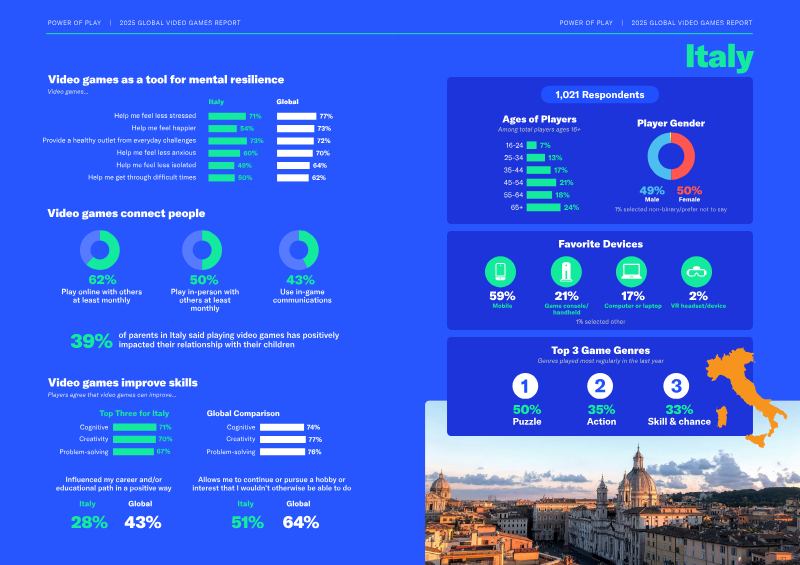
Video games serve as a significant mechanism for mental resilience and emotional regulation among the Italian population. A survey of 1,021 respondents aged 16 and older reveals that a substantial majority of Italian players utilize gaming to mitigate negative psychological states. Specifically, 71% of participants report that gaming helps reduce stress, while 60% use it to manage anxiety and 49% rely on it to combat feelings of isolation. These figures demonstrate that gaming functions as a vital outlet for navigating everyday challenges and difficult life transitions, with 50% of respondents explicitly noting that the medium helps them endure personal hardships.
The demographic profile of the Italian gaming community is broad, with the largest segment of players falling into the 45-54 age bracket at 21%, followed closely by those aged 65 and older at 24%. Mobile devices remain the primary platform for 59% of users, significantly outpacing consoles and computers. Social connectivity is a core component of the experience, as 62% of players engage in online multiplayer sessions at least monthly. Beyond emotional support, gaming is perceived as a tool for cognitive development, with 71% of players reporting improvements in cognitive function, 70% in creativity, and 67% in problem-solving skills.
The impact of gaming extends into familial and professional spheres, fostering positive interpersonal dynamics and skill acquisition. Approximately 39% of parents in Italy report that shared gaming experiences have strengthened their relationships with their children. While the influence on career paths remains lower in Italy at 28% compared to the global average of 43%, the medium continues to provide a unique space for pursuing hobbies and educational interests. Puzzle, action, and skill-based games represent the most popular genres, underscoring a preference for interactive experiences that challenge the mind while providing a structured environment for relaxation.
- Gaming is a primary tool for mental health in Italy, with 71% of players using it to reduce stress, 60% to manage anxiety, and 49% to combat isolation.
- The Italian gaming demographic is older than often assumed, with the 65+ age group representing 24% of players and the 45-54 bracket accounting for 21%.
- Mobile devices are the dominant gaming platform in Italy, utilized by 59% of the population compared to consoles and computers.
- Beyond emotional regulation, 71% of Italian players report improvements in cognitive function, 70% in creativity, and 67% in problem-solving skills.
- Social connectivity is a key driver of engagement, with 62% of players participating in online multiplayer sessions at least once a month.
IIDEA – Italian Interactive Digital Entertainment Association
Report33 pages
Power of Play: 2025 Global Video Games Report
Across more than twenty national markets, the majority of gamers report that playing video games reduces stress and enhances happiness, with 70‑90 % indicating lower stress levels and 57‑91 % feeling happier. Respondents also cite diminished anxiety and isolation, while parents observe a positive shift in relationships with their children, ranging from roughly one‑third in Sweden to nearly four‑fifths in Nigeria. Mobile devices dominate the landscape, accounting for 60‑96 % of play sessions, and online multiplayer emerges as the most prevalent social mode.
In the United Arab Emirates, United Kingdom and United States, surveys of roughly three thousand gamers reveal consistent benefits: about 70‑80 % experience reduced stress and increased well‑being, and roughly two‑thirds of parents note improved parent‑child interaction. Genre preferences diverge, with UAE players favoring teamwork, collaboration and creativity, whereas UK and US gamers gravitate toward problem‑solving, critical‑thinking and cognitive‑skill development. Approximately half to sixty percent of participants perceive gaming as supportive of career‑related or hobby pursuits, and a similar share report enhancements in professional competencies.
Research spanning multiple sectors demonstrates that video‑game‑based training yields measurable gains in cognition, decision‑making speed and technical performance. Gamers outperform non‑gamers in robotic‑surgery simulations, emergency‑response drills and retail‑seasonal‑sales scenarios, with meta‑analyses confirming statistically significant improvements in perception, attentional control and procedural accuracy. These outcomes translate into higher job performance, reduced error rates and stronger return on investment, prompting organizations such as NASA, the U.S. Air Force and elite sports teams to integrate game‑based platforms into their training pipelines.
- Video games provide measurable professional benefits, with gamers outperforming non-gamers in robotic surgery, emergency response, and retail simulations due to improved cognition, decision-making speed, and attentional control.
- Organizations including NASA, the U.S. Air Force, and elite sports teams have integrated game-based platforms into their training pipelines to reduce error rates and improve return on investment.
- Mobile devices are the primary gaming platform globally, accounting for 60–96% of all play sessions.
- A majority of gamers across more than twenty national markets report significant mental health benefits, with 70–90% experiencing reduced stress and 57–91% reporting increased happiness.
- Approximately 50–60% of gamers report that gaming supports their career or hobby pursuits and enhances professional competencies.
+1
Video Games EuropeJan 2025
Report33 pages
Italian Esports Report 2024: Market & Streaming Trends
The analysis evaluates Italy’s esports ecosystem in 2024, aiming to map its audience composition, revenue structure, and strategic priorities for industry participants. Findings reveal a core fan base of 7.3 million individuals, of whom 3.3 million regularly watch esports content. This audience skews younger, resides in urban centres, is predominantly male, and is more likely to hold full‑time employment than the broader gaming population, indicating a segment with disposable income and commercial appeal.
Revenue streams are heavily weighted toward advertising and sponsorship, with 80 % of organisations citing these as primary income sources and accounting for roughly one‑third of total market revenue. This concentration underscores the sector’s dependence on brand partnerships and suggests that monetisation beyond traditional media rights remains limited.
The study draws on a balanced consumer survey of approximately 1,000 Italian internet users aged 16‑65, conducted in September‑October 2024, and a complementary questionnaire administered to an equal number of esports‑industry stakeholders in partnership with IIDEA. All quantitative data are rounded, sourced from publicly available information, and have not undergone independent verification.
Overall, the Italian esports market emerges as a youthful, urban‑centric niche with significant advertising potential, yet its financial model remains narrowly focused. Stakeholders are likely to continue prioritising sponsorship acquisition and related promotional activities to capitalise on the identified demographic strengths.
- Italy’s esports ecosystem comprises 7.3 million fans, with 3.3 million identified as regular viewers of esports content.
- The Italian esports audience is characterized by a younger, urban-centric demographic that is predominantly male and more likely to be employed full-time than the general gaming population.
- Revenue generation is heavily concentrated, with 80% of organizations relying on advertising and sponsorship as their primary income source.
- Advertising and sponsorships account for approximately one-third of the total Italian esports market revenue.
- Monetization strategies in the Italian market remain limited, showing a significant reliance on brand partnerships rather than diversified income streams like media rights.
+1
IIDEA – Italian Interactive Digital Entertainment AssociationJan 2024
Report41 pages
Essential Facts About Video Games in Italy 2024
1. Italian Video Games Market...............................10 2. Italian Players ..................................................16 3. Italian Video Games Industry ............................23 4. Responsible Gameplay ......................................32 5. IIDEA ...............................................................38 • Total turnover of the sector.
- There are 14 million video gamers in Italy, an 8% increase from 2023, representing 1 in 3 Italians aged 6-64.
- The growth in Italian video gamers is primarily driven by women, with a 14% increase compared to a 3% increase among men in 2023.
- Mobile devices are the most popular gaming platform, used by 74% of gamers, followed by consoles (44%) and PC (34%).
- Purchases of new video games generated €562 million in 2023 (a 3% decrease from 2023), while in-game purchases and subscription services generated €354 million (a 24% increase from 2023).
- Digital downloads for consoles and PCs saw a 15% increase in sales, reaching €362 million, while physical packaged video games decreased by 24% to €201 million.
+1
IIDEA – Italian Interactive Digital Entertainment AssociationJan 2024
Report12 pages
Global Report 2023
Power of Play: Global Report 2023 – Executive Summary
1. Scope & Methodology | Item | Detail | |------|--------| | Survey population | ≈ 12,847 active (weekly) gamers, ages 16 +, from 12 countries (Australia, Brazil, Canada, France, Germany, Italy, Japan, Poland, South Korea, Spain, United Kingdom, United States). | | Sampling | Quota‑based, nationally‑representative panels (AudienceNet). Each country ≈ 1,000 + respondents. | | Data collection | Online questionnaire covering motivations, mental‑health impacts, social behaviours, and skill development. | | Academic triangulation | Findings cross‑checked against ~10 peer‑reviewed studies (see References, p. 12). |
2. Why People Play (Top‑3 Reasons – Global)
| Rank | Reason | % of respondents (global) | |------|--------|----------------------------| | 1 | Fun / enjoyment | 69 % | | 2 | Pass the time | 63 % | | 3 | Stress relief / relaxation | 55 % |
Country‑level nuances: “Fun” dominates in every market (≥ 78 % in most). “Stress relief” is especially high in Australia (71 %) and Japan (73 %).
3. Self‑Reported Mental‑Health Benefits
| Benefit | Global agreement (average) | Range across countries | |---------|----------------------------|------------------------| | Reduces stress | 71 % | 55 % – 87 % | | Reduces anxiety | 61 % | 48 % – 78 % | | Reduces feelings of isolation/loneliness | 55 % | 45 % – 73 % | | Provides a healthy outlet for everyday challenges | 64 % | 52 % – 76 % | | Makes me feel happier | 63 % | 45 % – 83 % | | Helps me get through difficult times | 52 % | 33 % – 71 % |
> Interpretation: More than two‑thirds of gamers perceive video games as a stress‑relief tool, and roughly half feel less isolated because of gaming.
4. Social & Relational Outcomes
| Metric | Global % (approx.) | |--------|-------------------| | Play with others online (≥ weekly) | 51 % | | Play with others in‑person (≥ weekly) | 38 % | | Met a good friend, spouse, or significant other through games | 46 % | | Games helped develop deeper relationships | 43 % | | Games helped stay connected to friends/family | 46 % | | Games created lasting memories | 50 % | | Believe there is a game for everyone | 75 % |
> Key insight: Multiplayer and social features are central; almost half of respondents have formed meaningful offline relationships via gaming
- Video games function primarily as a mental health tool, with 71% of global gamers reporting that play reduces stress and 61% noting a reduction in anxiety.
- Fun and enjoyment remain the primary drivers for gaming, cited by 69% of the 12,847 respondents, followed by passing time (63%) and stress relief (55%).
- Social connectivity is a core component of the gaming experience, as 51% of players engage in online multiplayer weekly and 46% have formed meaningful personal relationships, including friendships and marriages, through games.
- Gaming serves as a significant social bridge, with 46% of respondents using games to stay connected with friends and family and 43% reporting that gaming helped them develop deeper relationships.
- The perception of gaming as an inclusive medium is high, with 75% of respondents agreeing that there is a game available for everyone.
+1
IIDEA – Italian Interactive Digital Entertainment AssociationJan 2023
Report32 pages
I Videogiochi in Italia nel 2023
I Videogiochi in Italia nel 2023 – Sintesi
1. Dimensione del mercato
Fatturato: € 2,3 miliardi, con una crescita del 5 % rispetto al 2022 e del 28 % rispetto al 2019. Posizione europea: l’Italia si colloca tra i cinque maggiori mercati videoludici d’Europa. Pubblico: 13 milioni di persone tra i 6 e i 64 anni (circa il 31 % della popolazione), con un’età media di 30 anni.
Questi dati confermano che il settore è in forte espansione, sia in termini di valore economico sia di penetrazione culturale.
2. Il ruolo dell’IIDEA
L’Istituto per l’Innovazione Digitale e l’Economia dell’Arte (IIDEA) è il punto di riferimento istituzionale per lo sviluppo dell’industria videoludica italiana. Le sue attività principali sono:
| Area di intervento | Azioni chiave | |--------------------|----------------| | Sviluppo business & internazionalizzazione | - Programmi di accelerazione con partner nazionali e internazionali<br>- Campagna di branding “Games in Italy” per promuovere i titoli Made‑in‑Italy | | Educazione e gioco responsabile | - Portale “Tutto sui videogiochi” per genitori e insegnanti<br>- Informazione su rating PEGI e strumenti di parental‑control | | Eventi e riconoscimenti | - First Playable (fiera di riferimento)<br>- Italian Video Game Awards (dal 2013)<br>- Italian Esports Awards (dal 2020) | | Visibilità globale | - Missioni commerciali e matchmaking con investitori/partner esteri<br>- Supporto alla partecipazione a fiere internazionali (e.g., Gamescom, GDC) |
Obiettivi strategici dell’IIDEA
1. Elevare la visibilità internazionale dei prodotti italiani, facilitando partnership e accordi di distribuzione all’estero. 2. Collegare i developer locali con reti di finanziamento, expertise tecnica e canali di marketing globali. 3. Valorizzare il contributo culturale ed economico del settore, posizionandolo come driver di innovazione e creatività nel panorama digitale italiano.
Conclusioni
Il 2023 segna un anno di consolidamento per il mercato videoludico italiano: un fatturato in crescita, una base di utenti ampia e giovane, e un ecosistema supportato da un ente pubblico (IIDEA) che combina sviluppo commerciale, promozione internazionale e educazione responsabile. Queste dinamiche creano le condizioni per un futuro ancora più competitivo, con il potenziale di trasformare l’Italia in un hub di riferimento per la creatività digitale a livello europeo e mondiale.
- The Italian video game market generated €2.3 billion in 2023, representing a 5% increase over 2022 and a 28% growth since 2019.
- Italy ranks among the top five largest video game markets in Europe, with 13 million players aged 6 to 64, representing 31% of the population.
- The average age of the Italian gamer is 30 years old, reflecting the sector's broad cultural and demographic penetration.
- IIDEA serves as the primary institutional body for the industry, focusing on business acceleration, international branding through 'Games in Italy,' and global networking at events like Gamescom and GDC.
- IIDEA manages key industry infrastructure, including the 'First Playable' trade fair, the Italian Video Game Awards, and the Italian Esports Awards.
IIDEA – Italian Interactive Digital Entertainment AssociationJan 2023
Report148 pages
Campo da Gioco Equo
The guide argues that gender equity is both a commercial necessity and a social responsibility for the European video‑game sector, which employs roughly 90 000 people while women constitute only about 20 % of developers despite half of Europe’s population being gamers. It frames equitable hiring, compensation, and workplace culture as strategic imperatives that can unlock talent, improve product relevance, and enhance profitability across development, publishing, and community‑management functions.
Key findings reveal a persistent 14.1 % gender‑pay gap within the EU and a pronounced promotion disparity linked to biased “potential” assessments. Transparent salary bands, gender‑bias‑checked job descriptions, and data‑driven monitoring are shown to narrow these gaps, as illustrated by Outplay’s partnership with InGAME, which produced a policy kit aligning compensation, career growth, and flexible work with equity goals. Hybrid‑flexible work models, mental‑health support, and targeted health initiatives—such as menopause pledges—further sustain inclusion, with Wooga’s five‑year parity programme cited as a successful example.
The document outlines concrete actions for building inclusive cultures: senior‑leadership commitment, merit‑based hiring, regular employee surveys, and zero‑tolerance harassment policies. Effective employee‑resource groups, exemplified by Take‑Two’s “Women in Gaming” ERG, amplify under‑represented voices and drive mentorship, innovation, and retention. Community‑safety measures, including AI‑enhanced moderation and diversified moderator teams, reduced toxic chat by 5 % in a pilot, demonstrating the impact of proactive, data‑driven interventions.
Education and pipeline initiatives span Europe, from the AWS GetIT programme that has reached over 23 000 students to national diversity pledges in France, Germany, Spain, Sweden, and the UK. These efforts aim to address the projected need for 500 000 software engineers and double girls’ interest in technical careers through early exposure and role‑model visibility. The guide stresses that measurable KPIs, positive‑action hiring practices, and compliance with EU legal frameworks are essential for tracking progress and ensuring lasting gender‑parity across the games industry.
- Women currently represent only 20% of the 90,000-person European video-game workforce, despite comprising half of the continent's gaming population.
- A persistent 14.1% gender-pay gap exists within the EU gaming sector, exacerbated by promotion disparities rooted in biased assessments of employee potential.
- Proactive, data-driven interventions—such as AI-enhanced moderation and diversified teams—successfully reduced toxic in-game chat by 5% in pilot programs.
- Industry-wide pipeline initiatives, such as the AWS GetIT programme, have reached over 23,000 students to address a projected demand for 500,000 software engineers.
- Companies like Outplay and Wooga have demonstrated that formalizing salary transparency, flexible work models, and long-term parity programmes effectively narrows gender gaps and improves retention.
+1
IIDEA – Italian Interactive Digital Entertainment AssociationJan 2022

Report35 pages
Guida agli Esports: Italia
The analysis positions esports as a rapidly expanding digital sport that, in 2021, generated $947.1 million in revenue and attracted more than 215 million fans worldwide, with total direct earnings approaching $1.1 billion. Growth is concentrated in regions with advanced broadband infrastructure—East Asia, Northern Europe and North America—where titles that balance accessibility, competitive depth and spectator‑friendly design dominate the market. The ecosystem is defined by five interdependent actors: game publishers, tournament organizers, professional and amateur teams, players, and fan communities, each relying on robust licensing agreements and strong intellectual‑property protection to sustain competitive formats and monetisation pathways.
Publishers invest heavily, often exceeding $100 million per title, and retain exclusive control over game updates, balance changes and the creation of official competitive modes, making their cooperation essential for event staging and broadcast rights. Organisers must secure these rights before launching tournaments, while fan‑generated content such as streaming, casting and influencer activity drives viewership and ancillary revenue streams. The sector’s economic impact extends beyond digital earnings; flagship events have delivered measurable short‑term gains—Rotterdam recorded €2.36 million in visitor revenue and Katowice generated $12.8 million—while also enhancing city branding, attracting young talent and prompting infrastructure investment.
Education and social inclusion are emerging pillars, with universities offering scholarships and curricula that leverage esports to develop digital, problem‑solving and teamwork skills. Initiatives targeting gender balance, including Women in Games and dedicated incubators, aim to broaden participation and address persistent representation gaps. The overarching conclusion stresses that sustained, coordinated action among industry bodies, policymakers and diversity‑focused programs is vital to cement esports’ legitimacy, protect minors, and unlock its full economic and societal potential.
- The global esports market reached $947.1 million in revenue in 2021, with total direct earnings approaching $1.1 billion and a fan base exceeding 215 million.
- Market growth is primarily concentrated in regions with advanced broadband infrastructure, specifically East Asia, Northern Europe, and North America.
- Game publishers hold exclusive control over competitive ecosystems, often investing over $100 million per title to manage updates, balance changes, and essential broadcast rights.
- Flagship esports events provide significant local economic impact, evidenced by $12.8 million generated in Katowice and €2.36 million in visitor revenue in Rotterdam.
- The esports value chain relies on five interdependent actors—publishers, organizers, teams, players, and fan communities—underpinned by strict intellectual property protection and licensing agreements.
+1
IIDEA – Italian Interactive Digital Entertainment AssociationJan 2021