2024 Professional Gamer Workforce and Career Structure in Korea
20246 pages~5 min full read
Key insights
6 takeaways · ~2 min read- 01South Korea’s professional e-sports workforce consists of 361 domestic players and 372 athletes competing in overseas leagues.See it on page 2
- 02League of Legends is the dominant title for Korean professionals, accounting for 58 domestic players and 169 athletes competing internationally.See it on page 2
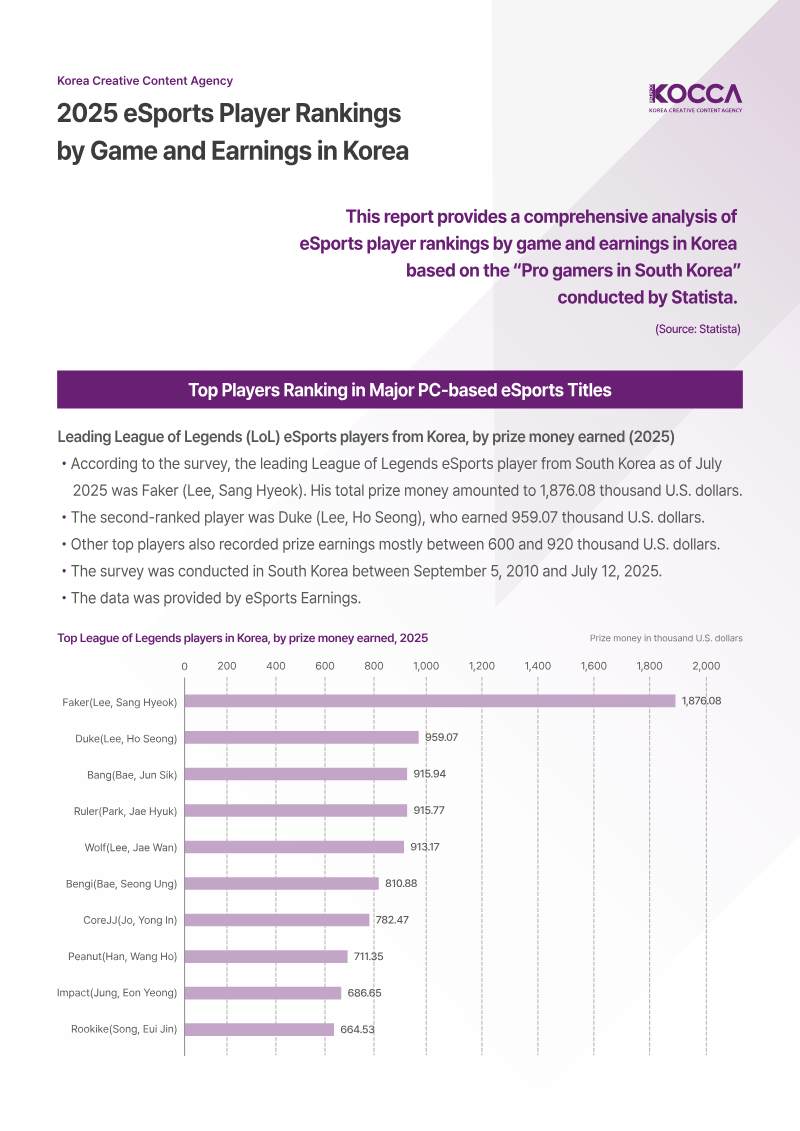
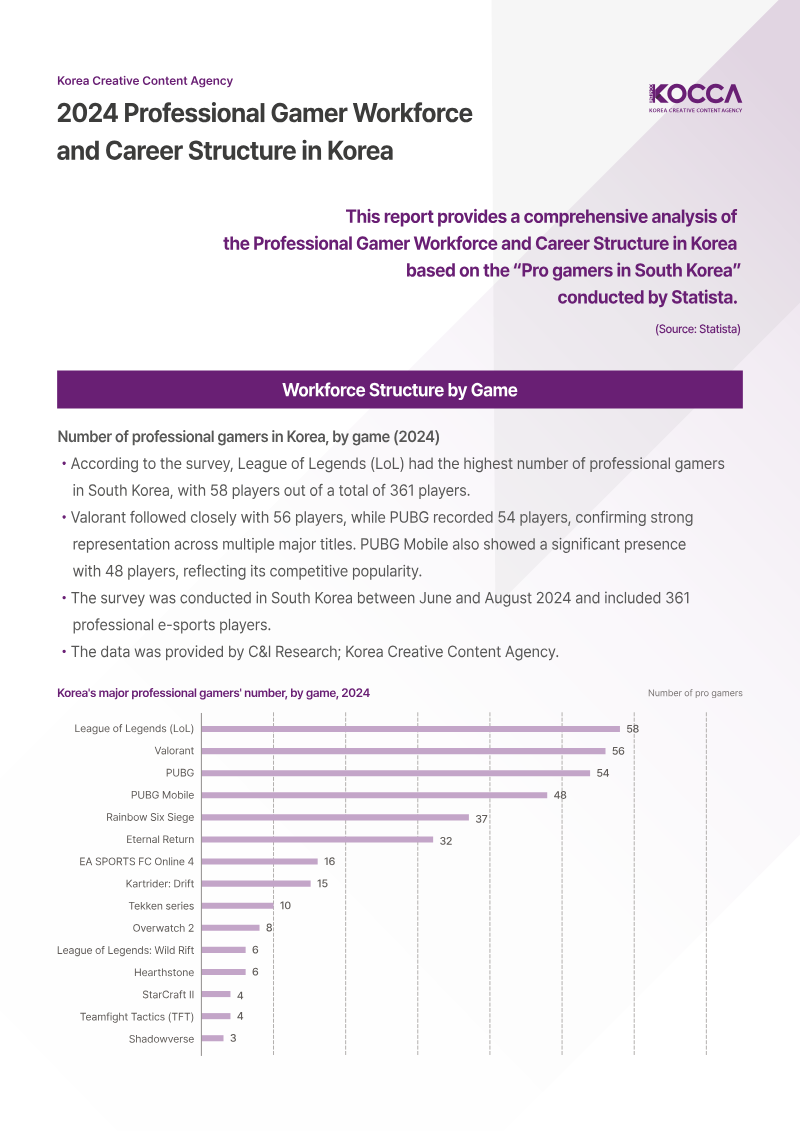
- 03The professional player base is heavily concentrated in four domestic titles: League of Legends (58), Valorant (56), PUBG (54), and PUBG Mobile (48).See it on page 1
- 04Overwatch 2 serves as the second-largest destination for Korean talent abroad, with 108 players currently competing in international leagues.See it on page 2
- 05The workforce is primarily composed of young adults, with 61.6% of professionals aged 20 to 24 and only 8.7% under the age of 19.See it on page 3
- 06Career longevity is polarized, with 29.7% of surveyed professionals possessing six or more years of competitive experience.See it on page 4
Summary
The analysis aims to map the composition, demographics, career trajectories, and income streams of South Korea’s professional e‑sports workforce, drawing on Statista surveys conducted between June and November 2024. It covers domestic players across major titles, Korean competitors active in overseas leagues, and the age, tenure, and earnings profiles of a sample of 138 active professionals, providing a snapshot of the industry’s structure during the current competitive season.
Domestic data identify 361 professional gamers, heavily clustered around four titles: League of Legends (58 players), Valorant (56), PUBG (54) and PUBG Mobile (48). Smaller but notable presences include Rainbow Six Siege (37) and Eternal Return (32). Internationally, 372 Korean e‑sports athletes were reported competing abroad, with League of Legends accounting for 169 participants and Overwatch 2 for 108, while StarCraft II, Valorant and other games each contributed fewer than 30 players.
Age distribution reveals a predominance of young adults, as 37.7 % fall within the 22‑24 year bracket, followed by 29.7 % aged 25 and older, 23.9 % aged 20‑21, and 8.7 % under 19. Career length shows a polarized pattern: 29.7 % have six or more years of experience, while the
Cite this report
Citation
Generating citation…