Player Behavior reports and market data
Documents

Design by the Numbers: Using Data for Good
This analysis explores the integration of data analytics into mobile game design, using the development of the RPG battler Looney Tunes: World of Mayhem as a primary case study.
- Designers should treat data as a core creative tool to identify friction points and optimize engagement loops, rather than delegating analytics exclusively to product managers.
- Comprehensive data logging of every player interaction—including taps, navigation, and resource spending—is essential to move beyond intuition and inform game balance decisions.
- Tracking store impressions allowed the developers of Looney Tunes: World of Mayhem to implement a three-hour free prize, which directly resulted in increased conversion rates.
Skill Transference - Extra Credits - Game Design
Video games serve as more than a source of entertainment; they function as effective training grounds for developing a variety of practical, real-life skills.
- Video games function as low-stakes, iterative environments that allow individuals to cultivate complex professional competencies like goal setting, resource management, and strategic planning.
- Research from Nottingham Trent University and University College London indicates that game mechanics, specifically feedback loops and goal-oriented tasks, directly foster increased perseverance and independence in players.
- Strategy games improve self-regulation and impulse control by requiring players to consistently balance immediate short-term gains against long-term objectives.

Stop Living on 1HP: Health and Wellness in Esports
Esports functions as a high-stakes static endurance activity, necessitating a shift from reactive injury treatment to proactive, performance-based conditioning.
- Esports is classified as a static endurance activity that challenges executive function, involving prolonged seated positions with repetitive micro-movements of the hands, wrists, and shoulders that increase injury risk.
- Health and wellness initiatives should be integrated into gaming communities by linking in-game character growth with out-of-game physical development to foster player retention and community engagement.
- Developers can implement non-disruptive health interventions through 'toast' text pop-ups or time-gated codex entries that provide specific stretching and strengthening exercises based on playtime milestones.
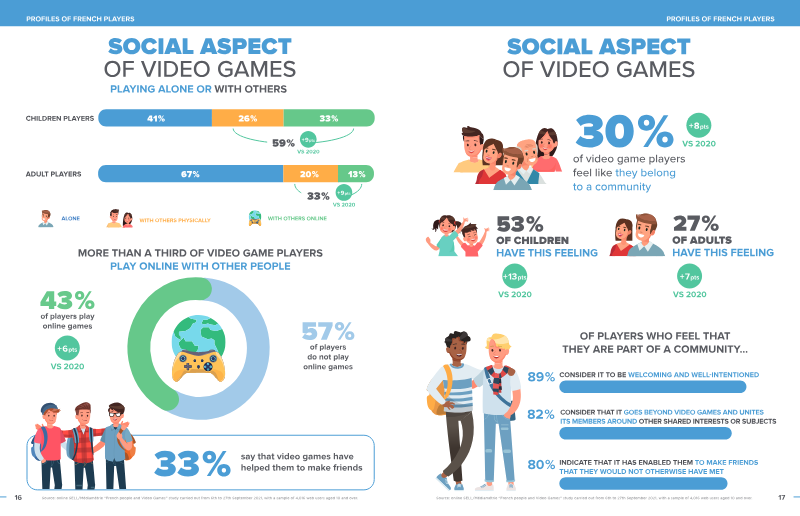
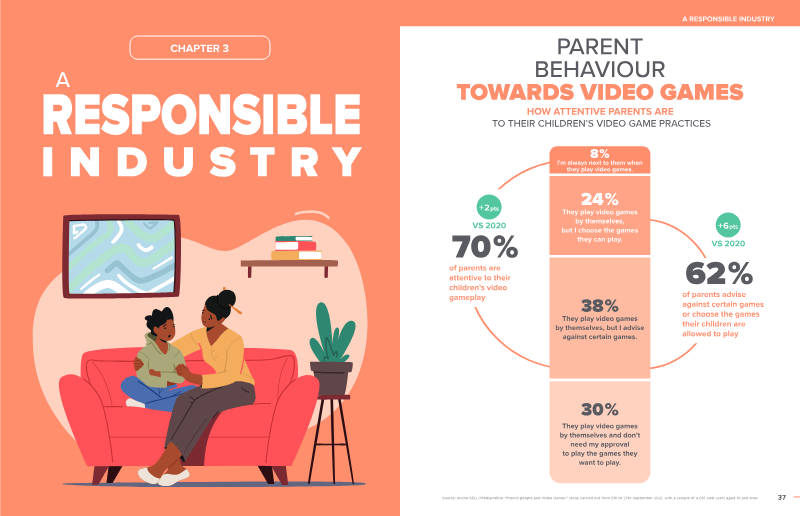
Essential Video Game News: France (November 2021)
Video games have firmly established themselves as the primary digital leisure activity in France, with 73% of the population engaging in gaming as of 2021.
- As of 2021, 73% of the French population engages in video games, with 58% of the population playing on a weekly basis.
- Gaming has become a core family activity in France, evidenced by 77% of parents participating in gaming sessions with their children.
- The adoption of parental control tools in France increased by 50% over the two-year period leading up to November 2021.

Applying Methods from Other Domains to Identify Gamer Behaviors
Addressing disruptive conduct in digital environments requires a sophisticated, dual-modeling approach that synthesizes top-down hypothesis testing with bottom-up data mining.
- Games with low toxicity levels demonstrate over 16% higher player retention compared to high-toxicity games, while medium-toxicity titles see approximately 10% higher retention.
- Analysis of player behavior shows that 35% of players make potentially offensive statements, and in nearly 20% of reported toxicity cases, the offender was provoked by another player.
- Contextual gameplay data reveals that friendly fire rates increase significantly when a team is losing by a large margin, suggesting that environmental triggers like score deficits influence disruptive behavior.
Children's In-Game Spending: 2020 GameTrack Report
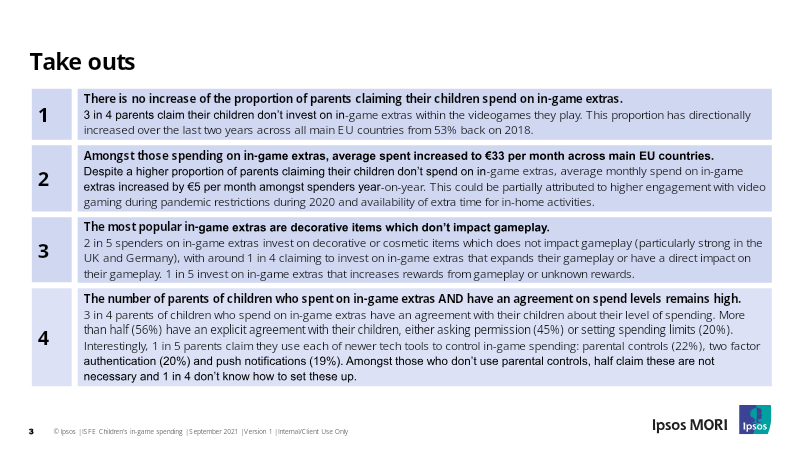
The 2020 GameTrack report, conducted by Ipsos for the Interactive Software Federation of Europe, examines trends in children’s in-game spending across major European markets, including the UK, France, Germany, Spain, and Italy.
- The vast majority of children do not engage in in-game purchases, with 74% of parents reporting zero spending on extras in 2020.
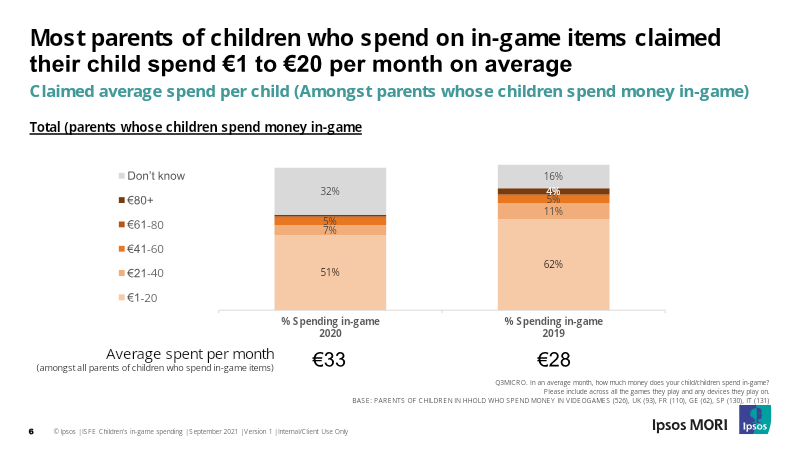
- Among the minority of children who do make in-game purchases, the average monthly expenditure rose to €33 in 2020, a €5 increase from the previous year.
- Cosmetic or decorative items that do not impact gameplay are the most popular purchases, favored by 39% of children who spend money in games.
How the Industry Can Change the "Games Are Bad" Narrative
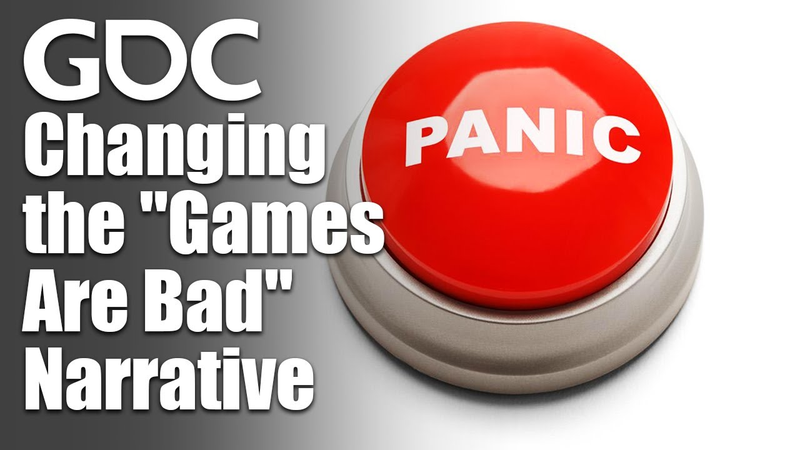
The gaming industry faces a persistent, fifty-year-old narrative of moral panic that characterizes video games as inherently harmful.
- The gaming industry must shift from internal research to collaborative partnerships with independent academics to replace long-standing moral panics with evidence-based findings.
- Research relying on self-reported play time is fundamentally flawed, as players frequently overestimate their actual usage by nearly twenty hours per week.
- Studies utilizing objective server-side log data, such as the 2020 research involving Electronic Arts and Nintendo, consistently demonstrate a positive correlation between gameplay and mental health.
How Games Control You - Compulsive Design in Games - Extra Credits
The primary purpose of this analysis is to examine how specific game design decisions inadvertently foster compulsive player behaviors that can detract from the intended gaming experience.
- Game design often inadvertently triggers compulsive player behaviors, such as item hoarding or repetitive movement, which prioritize mechanical efficiency over genuine narrative engagement.
- Players frequently fall into 'autopilot' habits, like searching empty corridors or using movement exploits, because game architecture signals potential rewards or optimization advantages that the player feels compelled to pursue.
- Compulsive play often stems from a loss of player agency, where individuals perform monotonous tasks to avoid missing content or to maximize character stats at the expense of personal aesthetic preference.

Panel: What Makes a Social Game Truly 'Social'?
Social gaming has evolved from simple platform integration into a fundamental paradigm where games function as primary virtual spaces for human connection.
- Sociality is now a core design paradigm rather than a genre, where embedding cooperative mechanics and guild structures directly improves long-term player retention.
- The COVID-19 pandemic accelerated digital-first social interaction, driving consumer spending in the sector to $1.7 billion per week by early 2021.
- Success in modern social gaming is measured by social graph metrics, specifically the frequency of friend invitations and the formation of persistent player groups.

Uma Musume Pretty Derby - What is this game? ft. Junde Yu from App Annie
Uma Musume Pretty Derby represents a significant case study in the Japanese mobile gaming market, blending the traditionally male-dominated genre of horse racing simulation with the idol-training mechanics typically favored by female audiences.
- Japan accounts for over 70 percent of global downloads and more than 85 percent of global revenue for the idol-training subgenre, highlighting extreme regional concentration.
- Uma Musume Pretty Derby successfully hybridizes male-dominated horse racing simulation mechanics with female-oriented idol-training systems to broaden its demographic reach.
- The game utilizes high-production-value assets and established anime intellectual property to justify premium pricing within its gacha-based monetization model.

Tackling Audience Experiences in Games
Modern game development increasingly prioritizes the creation of watchable experiences, recognizing that the spectator’s role is as vital to a title's success as that of the active player.
- Game development must treat spectators as a primary audience, utilizing a three-phase engagement strategy focused on attracting viewers, educating them on mechanics, and fostering long-term community retention.
- Developers should implement spectator-specific user interfaces and integrate tools that allow audiences to directly influence gameplay to transform passive viewing into a participatory experience.
- Designers can heighten narrative tension and visual clarity by leveraging information asymmetry and rebalancing mechanics to sustain competitive intensity.

The Schema is (Still) Mightier than the Sword: How Cognition Predicts Player Spatial Coding Systems
Cognitive schemas serve as the foundational mental structures that dictate how players interpret, navigate, and interact with virtual environments.
- Cognitive schemas act as the primary mental frameworks that dictate how players navigate and process virtual environments, directly influencing the speed and accuracy of their decision-making.
- Aligning game design with established mental models promotes conceptual fluency, allowing players to navigate environments through automatic, low-effort processing.
- Deviating from expected spatial patterns triggers conceptual disfluency, which forces players to shift from intuitive navigation to taxing, deliberate cognitive effort.