1 free read left. Create a free account for unlimited reading + AI research.
Create free account
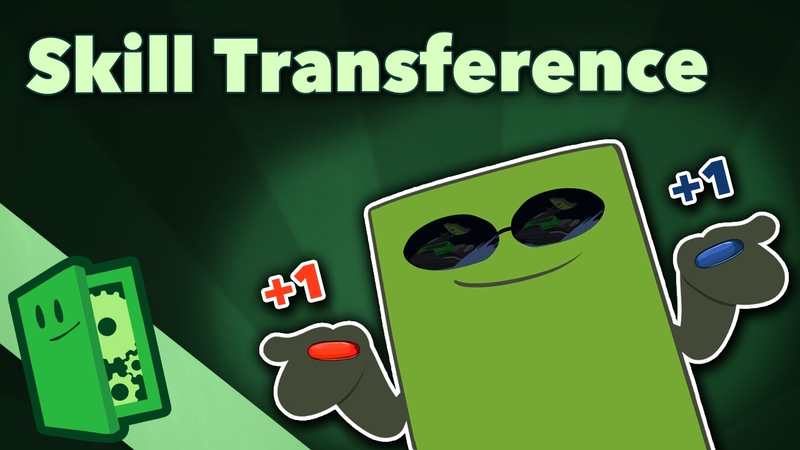
Skill Transference - Extra Credits - Game Design
Key insights
6 takeaways- 01Simulation-heavy games provide functional knowledge that can translate to physical tasks, such as the operation of real-world machinery, by mirroring actual physics and control schemes.
- 02Video games function as low-stakes, iterative environments that allow individuals to cultivate complex professional competencies like goal setting, resource management, and strategic planning.
- 03Research from Nottingham Trent University and University College London indicates that game mechanics, specifically feedback loops and goal-oriented tasks, directly foster increased perseverance and independence in players.
- 04Strategy games improve self-regulation and impulse control by requiring players to consistently balance immediate short-term gains against long-term objectives.
- 05Real-time strategy titles enhance cognitive flexibility, enabling individuals to effectively manage multiple, shifting priorities while operating under high-pressure conditions.
- 06The medium serves as a behavioral simulation platform where users can experiment, fail, and iterate to improve performance, mirroring the professional development process.
Ask AI about this video
Transcript
As you've probably guessed by now, a lot of us have been playing video games since our early childhood, interacting with our favorite medium for years. But outside the joy that games can bring, does our dedication to them bring us any real-life benefits? Or to put it more bluntly, can the virtual skills we develop in video games materialize into real-life skills? And can we answer that question with some research and a jet ski? Thanks so much to CuriosityStream for helping support today's discussion. Real quick up top, please welcome today's guest writer Mariana from the super helpful channel Mariana's Corner, which focuses on productivity, time management, and organization. Thanks so much. Recently, Mariana wondered how all of the video games she's played since childhood impacted her life, habits, and productivity. And after doing a bunch of research, she was not surprised to find that her love for video games had indeed influenced her real-life skills. Now, it's pretty normal for anyone who plays video games to assume that they can provide some sort of a learning experience. After all, the right games
can teach you about history, mythology, science, sports, music, or farming. Heck, even games that aren't focused on learning might end up teaching you something new. Like how the game Coffee Talk teaches you a lot of cool coffee recipes, or even how Minecraft is sometimes used to help teach engineering and coding. And it's incredible how specific these games can get. For instance, Mariana learned a lot about winemaking playing a game called Hundred Days, where she managed a winery and got a crash course on subzones, grape varieties, and the process of fermentation. Cheers to that. So, let's talk about some of these implicit teachings that your games might be delivering to you unnoticed. To start, a study from Nottingham Trent University, among others, shows that video games are really good at helping you set and accomplish goals. In most games, you're given a set of tasks to accomplish, and then the game provides you with feedback, reinforcement, and keeps a record of your progress. And while this may happen in real life as well, it doesn't happen in exactly the same way because video games provide a safe environment to play, experiment, and learn. And when you experience failure, you're usually alone instead of at school or at work with the feedback
provided by the game specific to your individual actions. This gives you opportunities to try again and again and again and again without having to meet other people's expectations and has been shown to increase perseverance, independence, and your ability to set and accomplish your own goals. In fact, most games use feedback loops that teach you that as long as you keep trying and improving your technique, you'll eventually be able to succeed. And some games, such as most RPGs and MMOs, even allow you to choose the goals you want to accomplish without having to follow a defined script. You can opt for a side quest, follow the main story line, explore the world with no clear goal in mind, or even just spend a few hours farming resources. This mirrors self-improvement in real life jobs. You read books, go to conferences, and earn work experience by getting involved in different projects, all to help you better prepare for your next challenge. Sort of like how it works in a video game, doing a hard side quest to get a great weapon before you face the final boss. And you know, doubling back to resources for a second, video games can also teach you a lot about resource management, which falls under a wider set of skills called self-regulation.
And strategy games in particular are well known for helping you with it. Many strategy games limit your ability to upgrade, purchase, build, and deploy, requiring the player to plan how to best achieve their goals. Civilization, for instance, requires you to strategically manage resources, units, technology, diplomacy, exploration, and expansion to achieve victory. Planning for purchases and builds, knowing when it's the right time to develop different parts of your empire, and learning how to control the impulse to deplete resources for short-term benefits that might hinder long-term strategy. Actually, Mariana's pretty sure that most of her personal finance principles that she knows by heart were all acquired by playing management games like RollerCoaster Tycoon and Theme Hospital when she was young. This control of impulses, self-regulation, is something that requires daily work and practice, which again is something that can be strengthened by video games. Also, video games improve your decision-making ability. This was concluded in research from a team-up between University College London Queen Mary and Texas University. Real-time strategy games, for instance, force you to make
decisions on the go, helping to develop fast thinking and stress management, particularly under conditions which you must switch rapidly between contexts, like when you battle at the same time that you're managing resources. Plus, a lot of games teach you how to plan efficiently. Once again, strategy games are well known for this, but there are other great examples. For instance, the game 60 Seconds forces you to plan your entire strategy on the objects you pick up during the aforementioned 1 minute. You plan which objects you should take with you, and your odds of surviving are improved depending on the amount of food, water, and other supplies you were able to pick up during that limited time. Another example is Stardew Valley, which encourages you to plan your layout and crops in advance, way in advance sometimes, because poor planning makes the game harder and more tedious, as you'll miss out on a bunch of events, fail to collect enough money to make progress, and most importantly, get a terrible score from your grandpa. And finally, to add some anecdotal evidence to all of Mariana's playtime and research, I've found games can sneakily teach you other skills as well. Okay, it's story time. A while back, I was
with a friend of mine riding some jet skis on a lake, and when it was my turn to drive, they asked me if I had ever driven one before, to which I answered honestly that I had. Then, before you could shout Wave Race 64, I was off. But after a few minutes of having a blast without incident, something shocking occurred to me. My memory of previously piloting a jet ski wasn't from my IRL life. Rather, it was from a bunch of time riding jet skis in Grand Theft Auto V. Yeah, the game had taught me the basic physics and throttling skills needed to pilot the machine so well, it tricked my brain into thinking I'd actually done it before. Oh, PS, I never told my friend about this whole story, so if we could just keep this between us, that would be that'd be great. So, all in all, in In to telling compelling stories, testing our abilities, and providing enjoyment, video games can also teach planning, resource management, decision-making, goal-setting, and possibly piloting personal watercraft. All transferable skills that can be used in real life that usually aren't taught in
traditional school environments, as it's hard to provide opportunities to actively and repeatedly engage in this type of training in a classroom setting the way that playing a video game does. I mean, in a lot of ways, video games are the perfect platform to create situations that help people simulate different behaviors, responses, and choices, all in a safe environment, teaching us to make better decisions, learn how to manage our time and money better, set life goals, and even on occasion tear up some waves. Until next time, everybody. Let's ride. Speaking of making waves, have you seen all of the awesome stuff recently over on Nebula? What's Nebula, you ask? Well, for those of you who have never made it this far into this part of the video, first of all, hi. You're awesome. And second, let me tell you all about it. Nebula is our by creators for creators streaming service, featuring original content from some of our favorite educational entertainers on the internet, such as Joe Scott, Real Science, and Wendover Productions. Plus, it's home to not only a ton of our shows, all ad-free, plus a few of our exclusive Nebula originals, but I'm also
super psyched to announce that my erroneously titled podcast, The Only Podcast About Movies, is now on Nebula as well, where every week you can listen to me and my co-host Shahir Daud investigate the conversation cinema can start and totally not yell at each other a bunch along the way. No. Seriously, it gets heated. It's pretty fun. And because Curiosity Stream loves us independent educational creators, they've teamed up with us over at Nebula, so we can offer you a pretty amazing two-for-one deal. When you sign up for Curiosity Stream using our link in the description, you'll get a matching Nebula subscription for free. Now, for the uninitiated, Curiosity Stream is an online learning platform where you can watch thousands of amazing documentaries and award-winning original series. And you know one doc that I wasn't expecting to like as much as I actually did is called Beyond the Spotlight, which takes a deep dive look into the life of Jimmy Donaldson, aka the YouTube juggernaut Mr. Beast. It follows his journey from YouTube enthusiast to pioneering digital philanthropist, and it really was a fascinating look at a person who's now
so ubiquitous with the platform. Plus, I mean the kid's basically the everlasting Gobstopper of good deeds at this point, so that's pretty cool, too. So, head on over to curiositystream.com/ extracredits right now to get both of these phenomenal streaming services for only $14.97 for an entire year. Not only is that 26% off the regular price, but again, that's under 15 bucks for an entire year, which still totally just blows my mind. And when you do, not only will you get to watch some of the best content the internet has to offer, but you'll also be helping out our channel in the process, and we are so thankful for your support. A huge thanks to our legendary patrons, Oreels1, Kyle Murgatroyd, Joseph Blain, Dominic Valenciana, Casey Musgraves, Alicia Bramble, and Ahmed Ziad Turk.
Summary
Video games serve as more than a source of entertainment; they function as effective training grounds for developing a variety of practical, real-life skills. The central thesis posits that the interactive nature of gaming creates a safe, iterative environment where players can cultivate competencies that are often difficult to replicate in traditional academic or professional settings. By engaging with complex systems, players naturally acquire and refine abilities related to goal setting, resource management, strategic planning, and rapid decision-making.
Research from institutions such as Nottingham Trent University and University College London highlights how gaming mechanics—specifically feedback loops and goal-oriented tasks—foster perseverance and independence. Strategy games, in particular, are identified as instrumental in teaching self-regulation and impulse control, as players must balance short-term gains against long-term objectives. Furthermore, real-time strategy titles are shown to enhance cognitive flexibility, enabling players to manage multiple, shifting priorities under pressure. These virtual experiences mirror real-world professional development, where individuals must experiment, fail, and iterate to improve their performance.
Beyond abstract cognitive skills, games can provide functional knowledge that translates directly to physical tasks. Anecdotal evidence suggests that the physics and control schemes within simulation-heavy games can prepare individuals for real-world activities, such as operating machinery. Ultimately, the medium acts as a unique platform for behavioral simulation, allowing users to practice complex decision-making and organizational habits in a low-stakes environment. By bridging the gap between virtual play and real-world application, video games offer a supplementary form of education that equips players with transferable tools for personal and professional success.