Monetization reports and market data
Documents

Double Dodgers (Mobile App) - Jonas Plays Your Game #007
The analysis of the mobile game Double Dodgers highlights the critical balance between minimalist design and effective monetization strategies in the casual gaming sector.
- Aggressive ad frequency early in the user journey acts as a primary deterrent to player retention and long-term revenue potential.
- Inconsistent control responsiveness in a minimalist, two-button game creates unfair gameplay failures that lead to player frustration.
- Monetization strategies should be delayed until players reach a specific threshold of engagement rather than being implemented immediately upon installation.
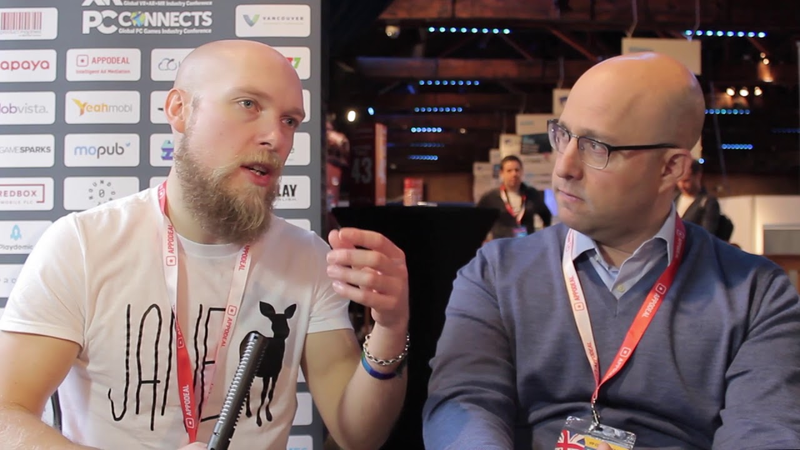
MoPub on how advanced bidding services can 'revolutionise' mobile advertising
MoPub’s primary objective in the mobile advertising sector is to transition the industry toward advanced bidding, a technology designed to optimize monetization for app developers.
- MoPub is transitioning mobile advertising from fragmented ad networks to advanced bidding, a model that creates a unified, real-time competitive environment to increase publisher yield.
- Advanced bidding allows programmatic demand to compete directly against traditional ad networks, capturing larger brand advertising budgets while improving transparency.
- Since 2010, the mobile market has shifted from premium paid-to-download apps to a free-to-play model where advertising is a core revenue stream rather than an intrusive element.

7 Game Development Facts - Let's Face It!
Independent game development is a demanding discipline characterized by significant market saturation and high barriers to commercial success.
- Market saturation in the independent game sector is high, meaning developers cannot rely on organic discovery and must implement deliberate, strategic marketing to achieve visibility.
- Consumers are indifferent to the technical methodology or personal struggles behind a game's production, prioritizing only the final product's quality and playability.
- Success requires transitioning from a romanticized view of development to a pragmatic business approach that treats the game as a commercial product rather than a personal project.
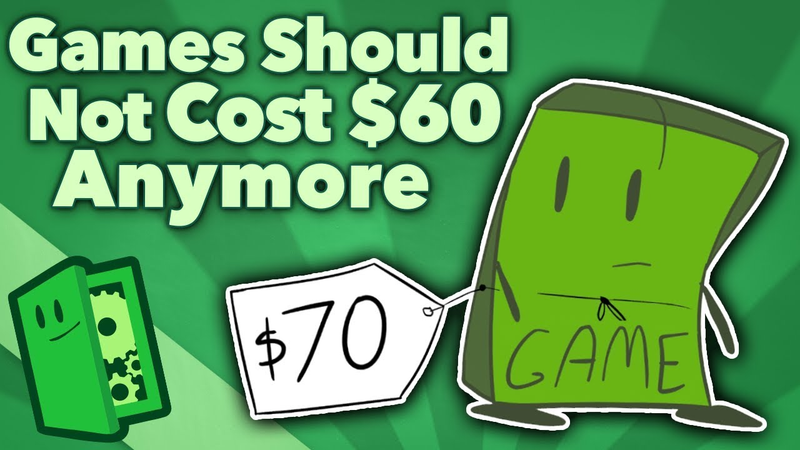
Games Should Not Cost $60 Anymore - Inflation, Microtransactions, and Publishing - Extra Credits
The standard $60 retail price for AAA video games has become economically unsustainable, driving the industry toward aggressive monetization strategies like microtransactions, loot boxes, and day-one DLC.
- The $60 AAA price point, established in 2005 with the Xbox 360 and PlayStation 3, has failed to keep pace with inflation, which alone would necessitate a $75 base price today.
- Escalating development costs driven by a graphical arms race have tripled or quadrupled since 2005, suggesting a required retail price of $85 to $90 for standalone products.
- Publishers have adopted aggressive monetization strategies like microtransactions, loot boxes, and day-one DLC as a direct response to the widening gap between static retail pricing and rising production costs.
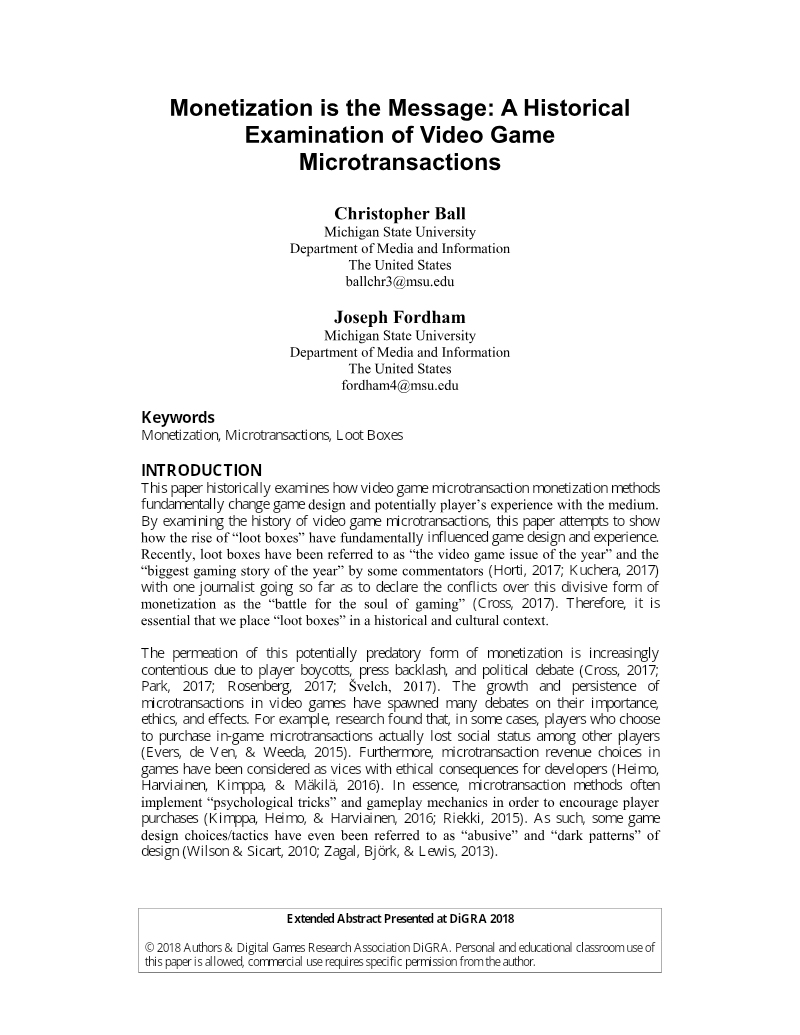
Monetization is the Message: A Historical Examination of Video Game Microtransactions
This extended abstract, presented at DiGRA 2018, historically examines how microtransaction monetization, particularly loot boxes, has reshaped video game design and players' experience of the medium.
- The paper's central thesis, framed through McLuhan's 'the medium is the message,' is that monetization is itself a formative force: microtransactions change what games deliver, so content can become a delivery mechanism for purchases rather than an end in itself.
- The lineage of microtransaction practices is traced to the early 2000s, when publishers such as EA and Square Enix embraced 'games as a service' with continual multiplayer content and downloadable additions sold via microtransactions.
- The paper credits the free-to-play Chinese MMO ZT Online with pioneering randomized 'virtual treasure boxes,' which later spread to mobile free-to-play titles, major franchises like Call of Duty and Destiny, and eventually primarily single-player games.
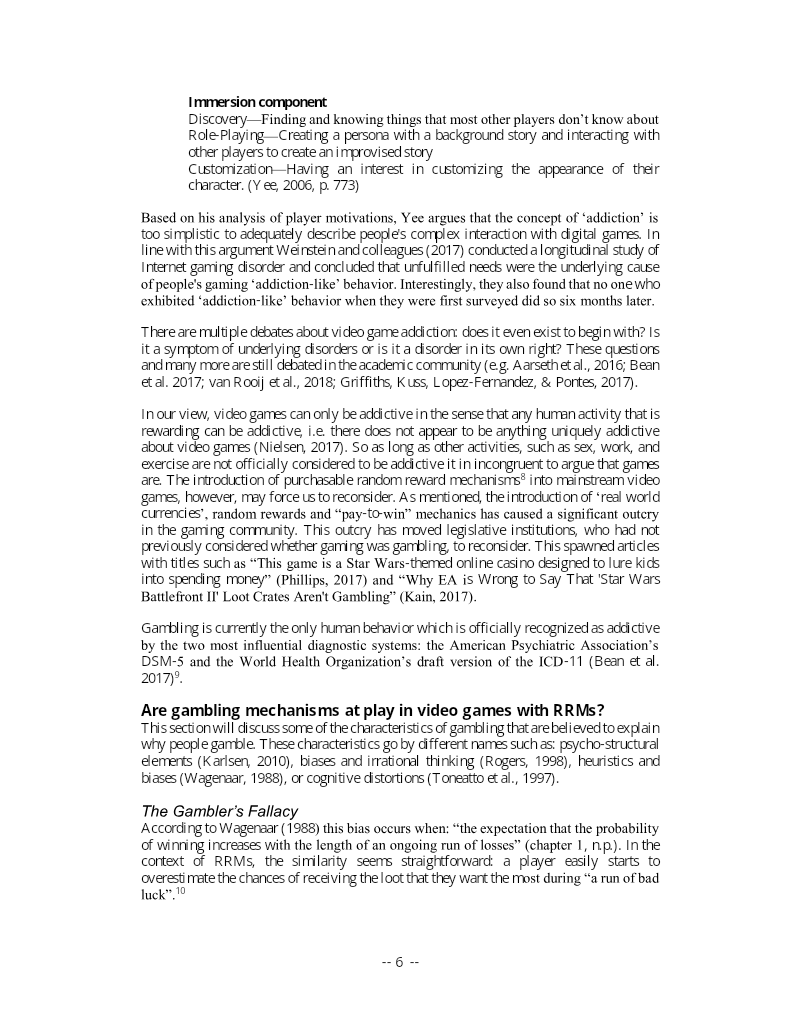
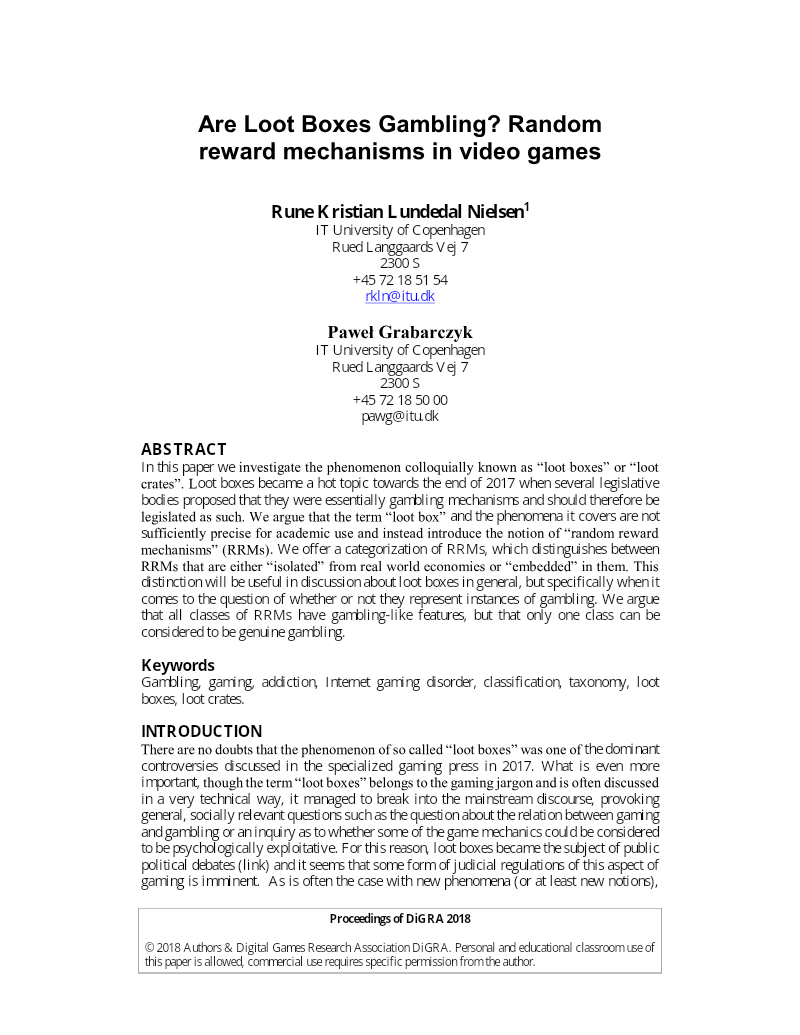
Are Loot Boxes Gambling? Random Reward Mechanisms in Video Games
The paper argues that the popular term "loot box" is too imprecise for academic and regulatory purposes, and proposes "random reward mechanisms" (RRMs) as a neutral alternative, defined as an eligibility condition that triggers a random procedure delivering a reward.
- The paper argues "loot box" is too imprecise for academic and regulatory use and proposes "random reward mechanisms" (RRMs), defined as an eligibility condition that triggers a random procedure delivering a reward.
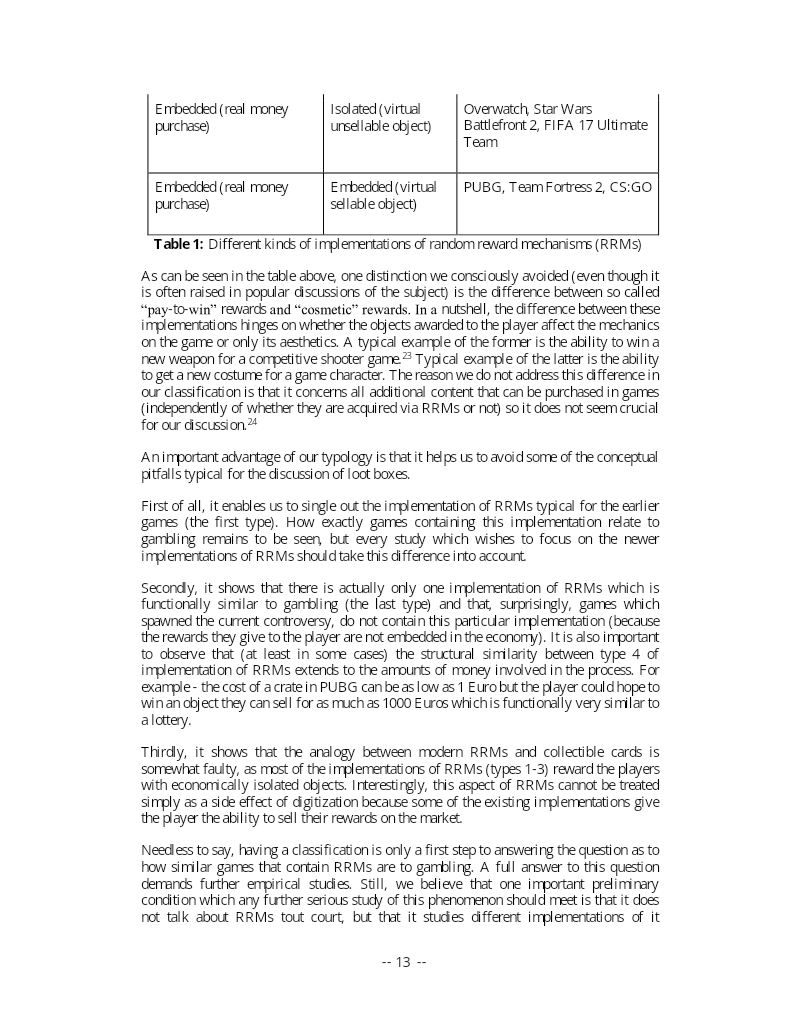
- The authors' central finding is that RRMs resemble gambling only when both the purchase and the reward are embedded in the real-world economy, i.e., they can be bought with and exchanged for real money.
- Regulators diverged on this point: Denmark's Gambling Authority treated CS:GO skin-betting as gambling because skins could be sold for cash, but did not classify Star Wars Battlefront 2 loot boxes, whose contents could not be converted to currency.
Aesthetics and Cosmetic Microtransactions in Path of Exile
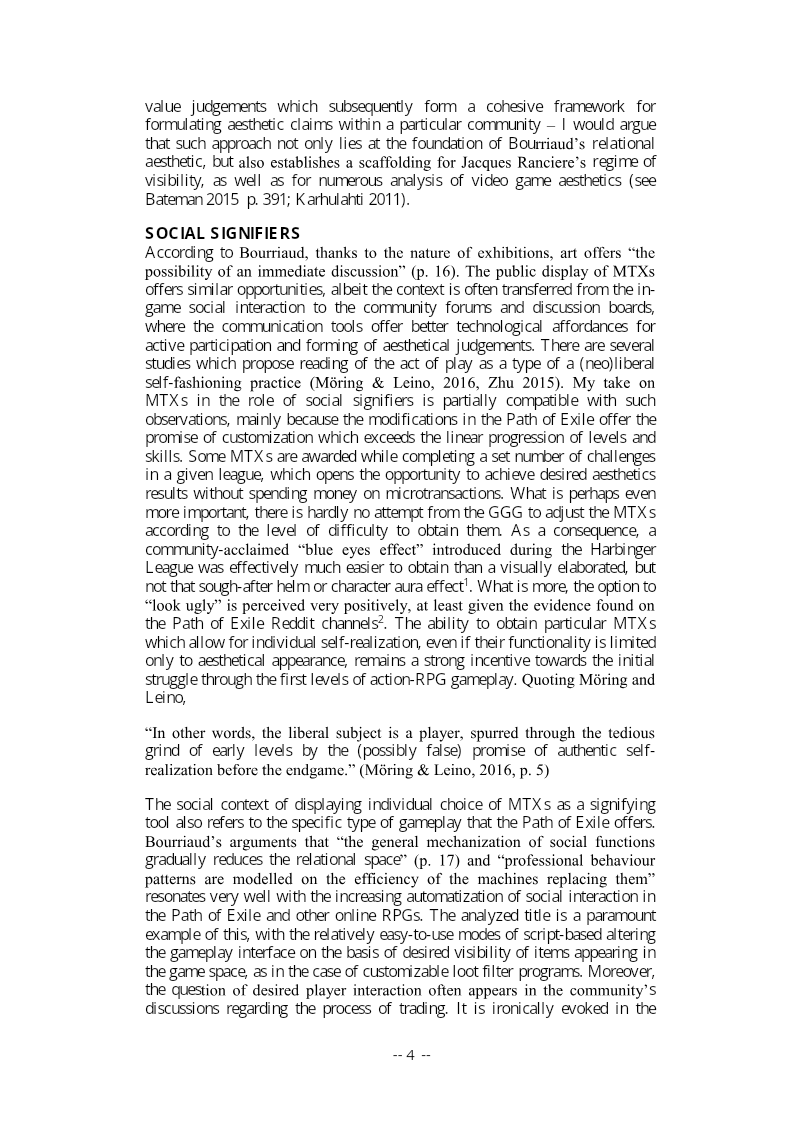
Felczak's paper examines cosmetic microtransactions (MTXs) in Path of Exile through the lenses of Jacques Rancière's aesthetic regime of art and Nicholas Bourriaud's relational aesthetics.
- Cosmetic microtransactions in Path of Exile are formally disconnected from game mechanics yet meaningfully shape play practices and sustain the game's post-release lifecycle, according to six months of participatory observation of in-game data, forums, and Reddit.
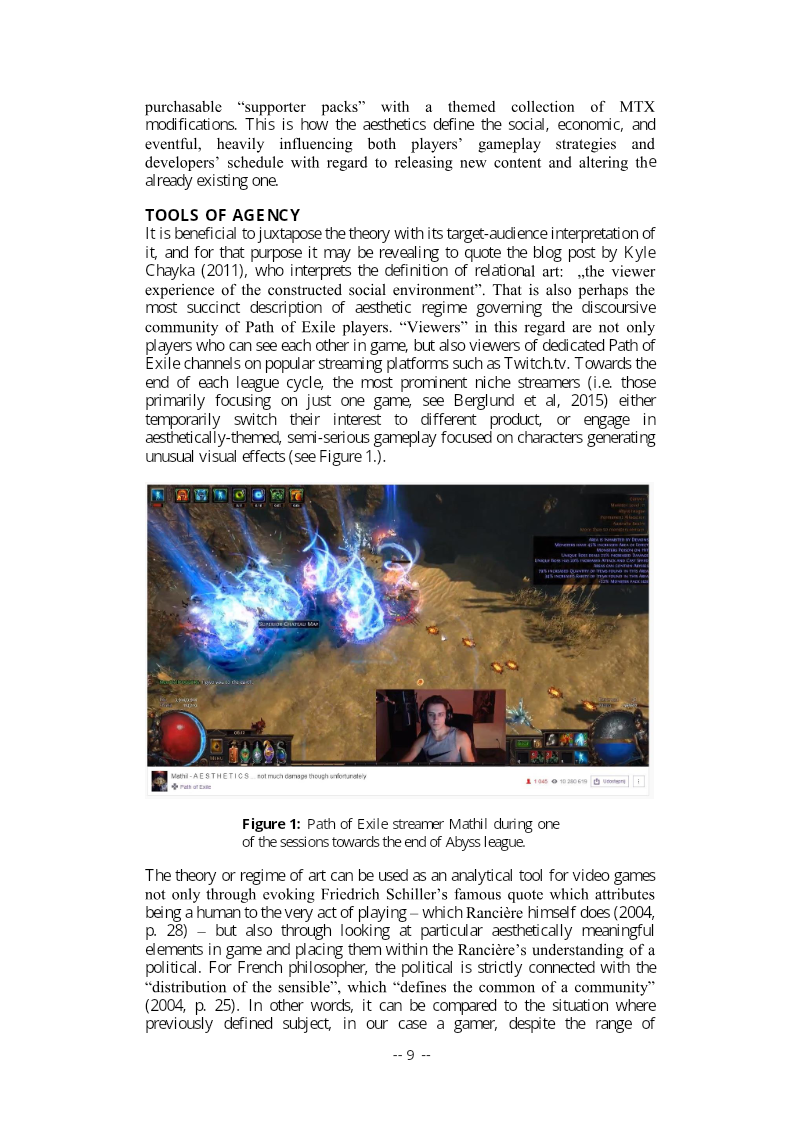
- The paper identifies three roles for cosmetics: social signifiers, incentives that motivate continued play, and tools of agency outside the core gameplay frame.
- Rare cosmetics serve as the principal tangible incentive in the late-game reward structure around reaching level 100, and acquiring different cosmetics is unevenly difficult.

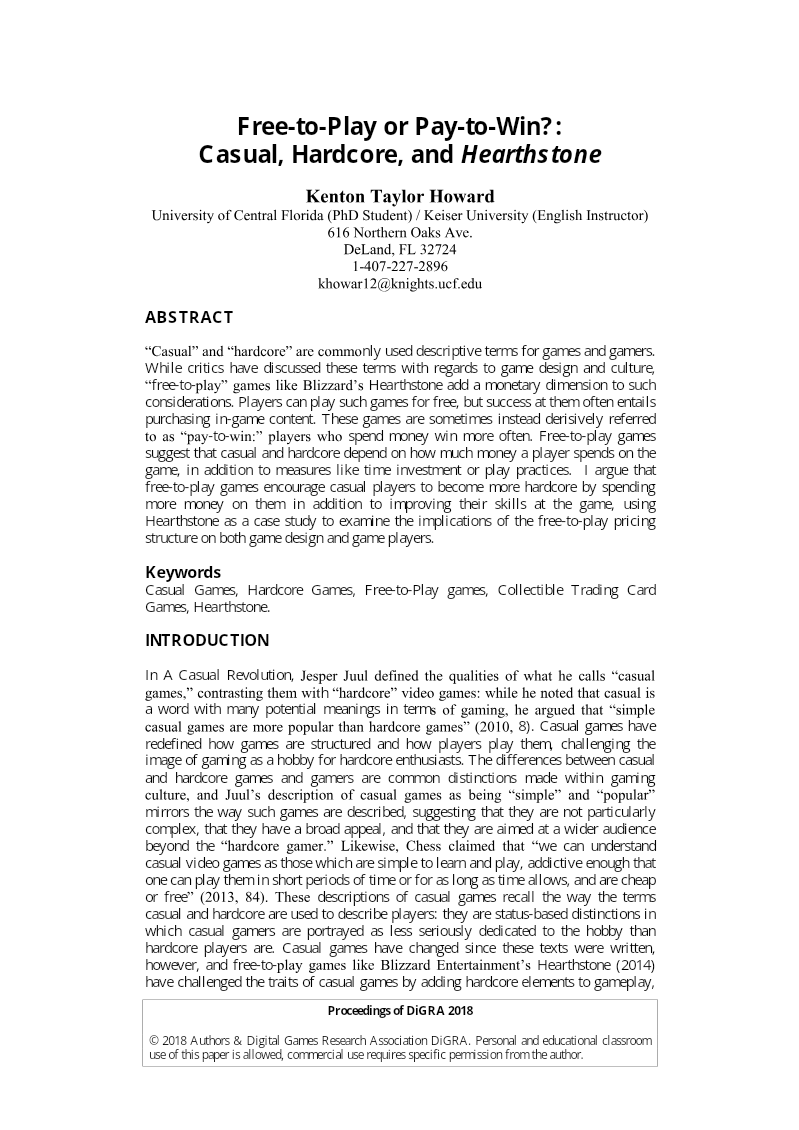
Free-to-Play or Pay-to-Win?: Casual, Hardcore, and Hearthstone
Free-to-play games such as Blizzard's Hearthstone, the author argues, blur the traditional boundary between casual and hardcore play by tying a player's status to how much they spend as well as how much time and skill they invest.
- The central thesis is that free-to-play models with microtransactions for randomized card packs create a "pay-to-win" dynamic, in which spending money tends to move players from casual toward hardcore engagement, using Blizzard's Hearthstone as the primary case study.
- Hearthstone had over 70 million registered accounts as of Blizzard's 2017 report, and an analyst estimated its monthly revenue at over $25 million.
- Randomization mitigates the most extreme pay-to-win effects, but expansions, metagame shifts, and a daily quest system still pressure casual players to either spend money or devote substantial daily time to stay competitive.
Understanding Media Rights in Esports
The esports media rights landscape is undergoing rapid expansion, positioning itself as the fastest-growing revenue stream within the global esports economy.
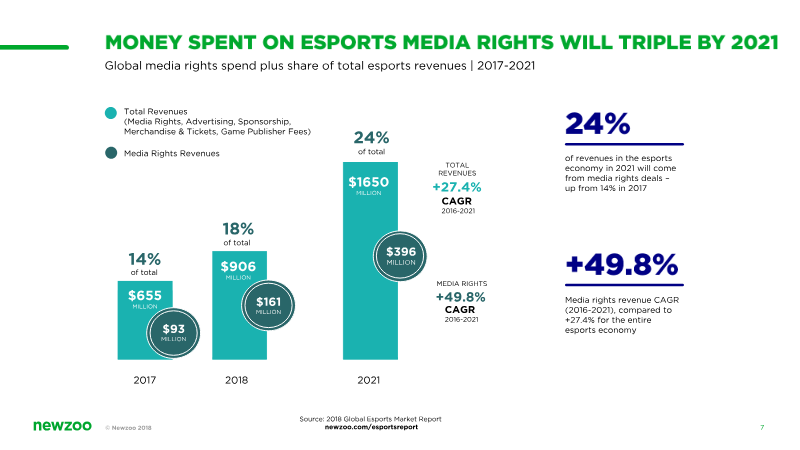
- Esports media rights revenue is projected to grow from 14% of total industry revenue in 2017 to 24% by 2021, with market value expected to rise from nearly $100 million to $400 million in the same period.
- North America dominates the global market with a 44% share of media rights revenues, bolstered by an established sports culture and the influence of major media conglomerates.
- The industry is increasingly adopting traditional sports business models, such as those used by the UFC, to maximize the value of esports properties.

Global Mobile Market Report 2018
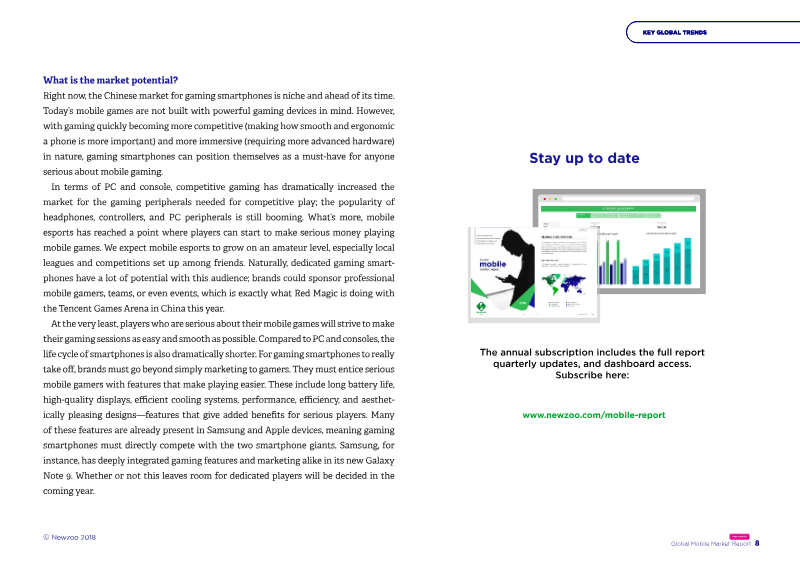
The global mobile market is undergoing a significant transformation characterized by a shift toward immersive, competitive gaming experiences and the integration of high-engagement subscription services.
- Mobile gaming generated $70 billion in 2018, representing 76 percent of the $92.1 billion total global app store revenue.
- Global smartphone adoption is projected to reach 3.8 billion users by 2021, with the Asia-Pacific region serving as the primary driver of market penetration.
- The mobile market is shifting toward immersive, competitive gaming experiences and subscription-based service models.

Libro Blanco del Desarrollo Español de los Videojuegos
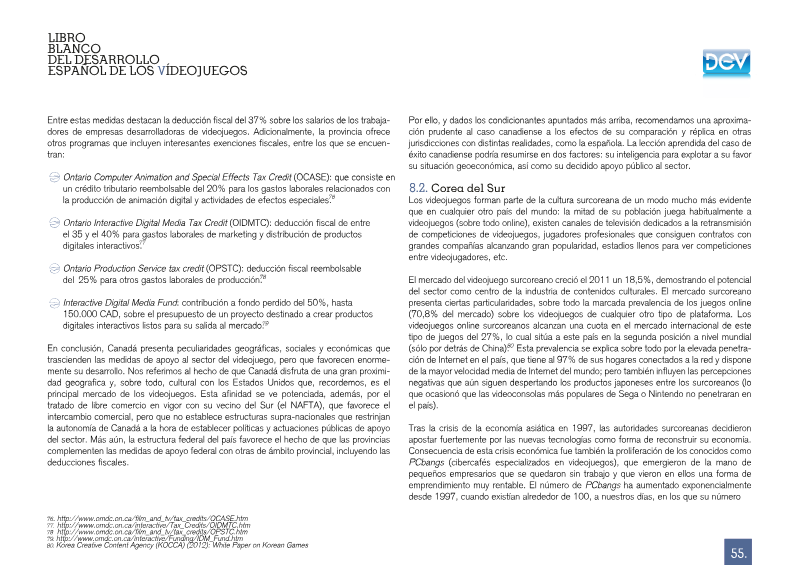
The Spanish video game industry represents a high-growth, export-oriented sector that serves as a critical engine for innovation and professional employment.
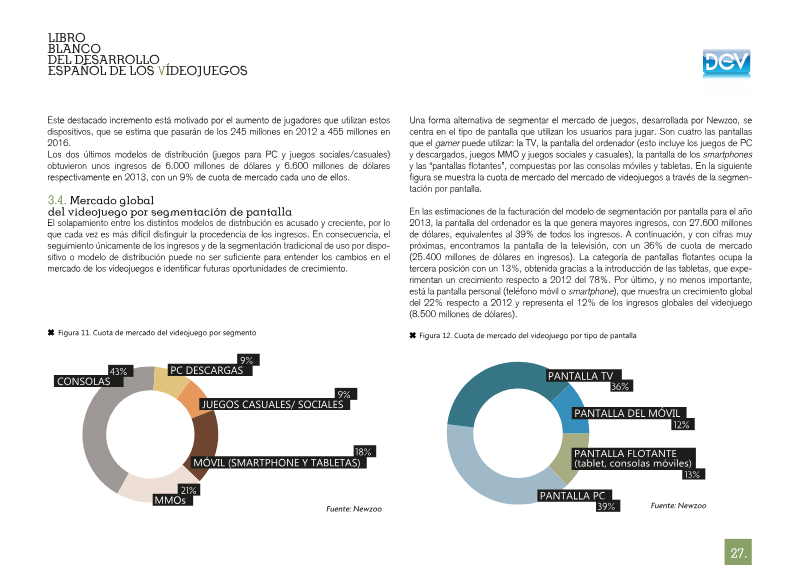
- The global gaming market had 1.231 billion active players by the end of 2013, representing over half of the world's internet-connected population and 17.5% of the total global population.
- The gamification business is projected for exponential growth, with Markets And Markets estimating a potential business of $5.5 trillion USD by 2018, growing at a 67.1% annual rate between 2013 and 2018.
- The Spanish video game sector increased employment by 29% in 2013, with 65% of contracts being permanent, making it a significant job creator for highly qualified young professionals.

The Data Behind 10 Years of the iOS App Store – 2018
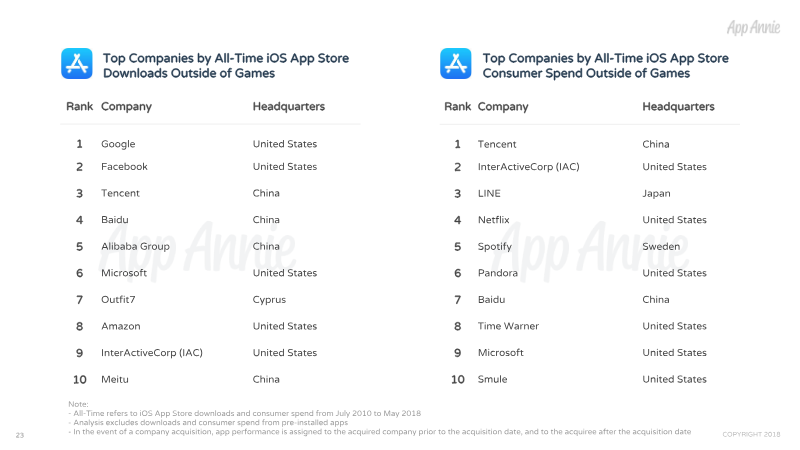
The iOS App Store underwent a profound transformation between 2010 and 2018, evolving from a nascent marketplace into a mature global economy characterized by massive revenue growth and a shift in monetization strategies.
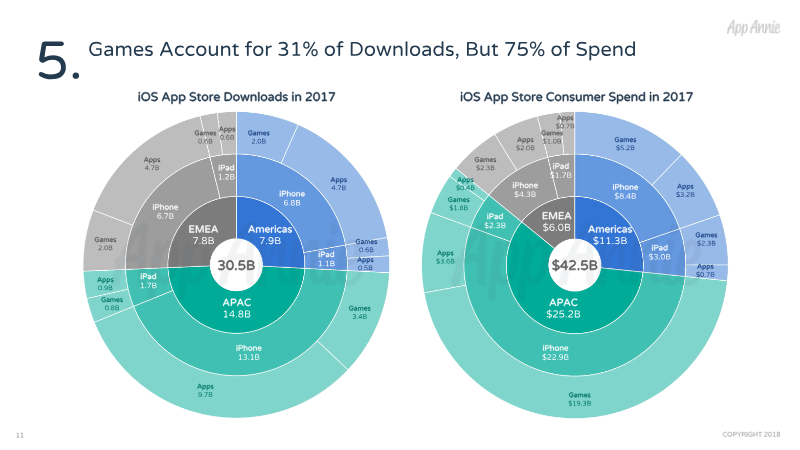
- The gaming sector is the primary economic driver of the iOS App Store, accounting for 75% of total consumer spend despite representing only 31% of total downloads.
- Between 2010 and 2018, the platform generated $130 billion in consumer spend, with revenue growing at a 52% compound annual growth rate compared to a 15% growth rate for downloads.
- The Asia-Pacific region now accounts for nearly 60% of global iOS revenue, with China overtaking the United States in 2016 to become the largest market for both downloads and spending.