Marketing reports and market data
Documents

AdTruth's James Lamberti on the challenges of privacy while tracking mobile users
The digital advertising industry faces a significant challenge in balancing the need for effective audience identification with the growing demand for consumer privacy.
- The digital advertising industry is shifting from persistent device identifiers like UDIDs and Android IDs to probabilistic identification to better balance marketing intelligence with consumer privacy.
- Probabilistic identification maintains ad functionality by aggregating anonymous data points such as language settings, time zones, and operating system versions to identify user segments without tracking specific individuals.
- This approach enables essential advertising functions like reach and frequency management, which prevents the negative user experience of repetitive ad exposure.

Appsfire CEO Ouriel Ohayon tells us about why he's focused on iOS
Appsfire functions as an application discovery and promotion service designed to accelerate growth for mobile developers through daily curated recommendations.
- Appsfire prioritizes the iOS ecosystem over Android because of significantly higher monetization potential, which enables developers to reinvest more aggressively in user acquisition.
- The platform has surpassed 10 million downloads and functions as a marketing channel that drives distribution by highlighting one curated application per day.
- The company maintains a lean team of 20 employees, necessitating a strategic focus on the most profitable market segments to ensure sustainable growth.

AppGratis CEO Simon Dawlat on building the best app distribution channel
AppGratis functions as a global app discovery and distribution channel, connecting mobile users with curated daily promotions for free or discounted applications.
- AppGratis operates a discovery platform that generates up to 1.5 million app installs per day for developers.
- The company maintains a user base of 10 million total members, including 3 million daily active users.
- The business model focuses exclusively on non-incentivized downloads to ensure long-term sustainability and avoid artificial inflation of metrics.

Demo Daze - Why Don't Creators Make Game Demos Anymore? - Extra Credits
The decline of game demos is primarily driven by unfavorable economic outcomes for developers, rooted in shifting consumer purchasing habits.
- Industry data indicates that releasing a game demo frequently results in decreased total sales, as demos often satisfy player curiosity enough to discourage a full-price purchase.
- Developing a demo is a poor business investment for most studios because it requires significant time, money, and certification resources that could otherwise be used to improve the core game.
- An analysis of nine potential outcomes for demo releases shows that only two scenarios result in a net positive for developers, highlighting the high risk of negative financial impact.

Cross-Media Worlds - Connecting Across Games, Film, Books, and More - Extra Credits
The evolution of gaming is increasingly defined by the development of transmedia worlds, where interconnected experiences span across various platforms, media, and genres.
- Transmedia design fosters social cohesion by allowing players with varying skill levels and genre preferences to contribute to a shared narrative or goal through different gameplay styles.
- Linking disparate gaming experiences increases player retention and enhances the perceived value of microtransactions by creating functional, symbiotic relationships between platforms.
- Modern cross-platform ecosystems, such as the integration between Dust 514 and Eve Online, allow actions in one environment to directly influence the state of another, maintaining world continuity.

SOPA & PIPA - 2011 Legislation that Threatens Digital Freedoms - Extra Credits
The Stop Online Piracy Act (SOPA) and the PROTECT IP Act (PIPA) represent significant legislative threats to digital freedom and internet infrastructure.
- SOPA and PIPA threaten the integrity of the Domain Name System (DNS) by proposing government-mandated interference that experts from the Department of Homeland Security and Sandia National Laboratories warn would undermine global cybersecurity.
- The legislation grants internet service providers (ISPs) blanket immunity for voluntary content blocking, creating a conflict of interest for ISPs that simultaneously own large copyrighted media portfolios.
- The bills utilize overly broad language that risks suppressing legitimate online activity and eroding net neutrality standards.

Our Oscars - Why Games Deserve Better than the Spike Video Game Awards - Extra Credits
The gaming industry lacks a prestigious, culturally significant awards ceremony comparable to the Academy Awards, which hinders the medium’s artistic growth and public legitimacy.
- The gaming industry lacks a prestigious, culturally significant awards ceremony, which prevents the medium from gaining the same public legitimacy and artistic recognition as film.
- Current mainstream awards, such as the Spike Video Game Awards, prioritize marketing, trailers, and celebrity appearances over the actual craft and merit of game development.
- Industry-led events like the Game Developers’ Choice Awards and the Interactive Achievement Awards successfully focus on peer-reviewed technical excellence but lack the mainstream visibility required to influence consumer trends.

An Open Letter to EA Marketing - Why EA's Controversial Ads Harm the Industry - Extra Credits
Electronic Arts (EA) faces significant criticism for its marketing strategies, which are characterized as tasteless, juvenile, and detrimental to the broader gaming industry.
- EA’s reliance on inflammatory and exclusionary marketing tactics undermines the gaming industry’s efforts to be recognized as a legitimate, serious medium for art and communication.
- Controversial campaigns, such as the 'Sin to Win' contest for Dante’s Inferno and the use of fake protesters, prioritize short-term sensationalist buzz over long-term brand loyalty and product quality.
- Marketing strategies that utilize sexist or offensive content reinforce negative stereotypes about gamers, ultimately alienating potential audiences and complicating relationships with external institutions.



MTG Corporate Responsibility Report 2011
The 2011 Modern Responsibility Report demonstrates how Modern Times Group (MTG) has integrated a comprehensive sustainability framework across its operations in 39 countries, targeting employee welfare, anti-corruption, climate action and community engagement.
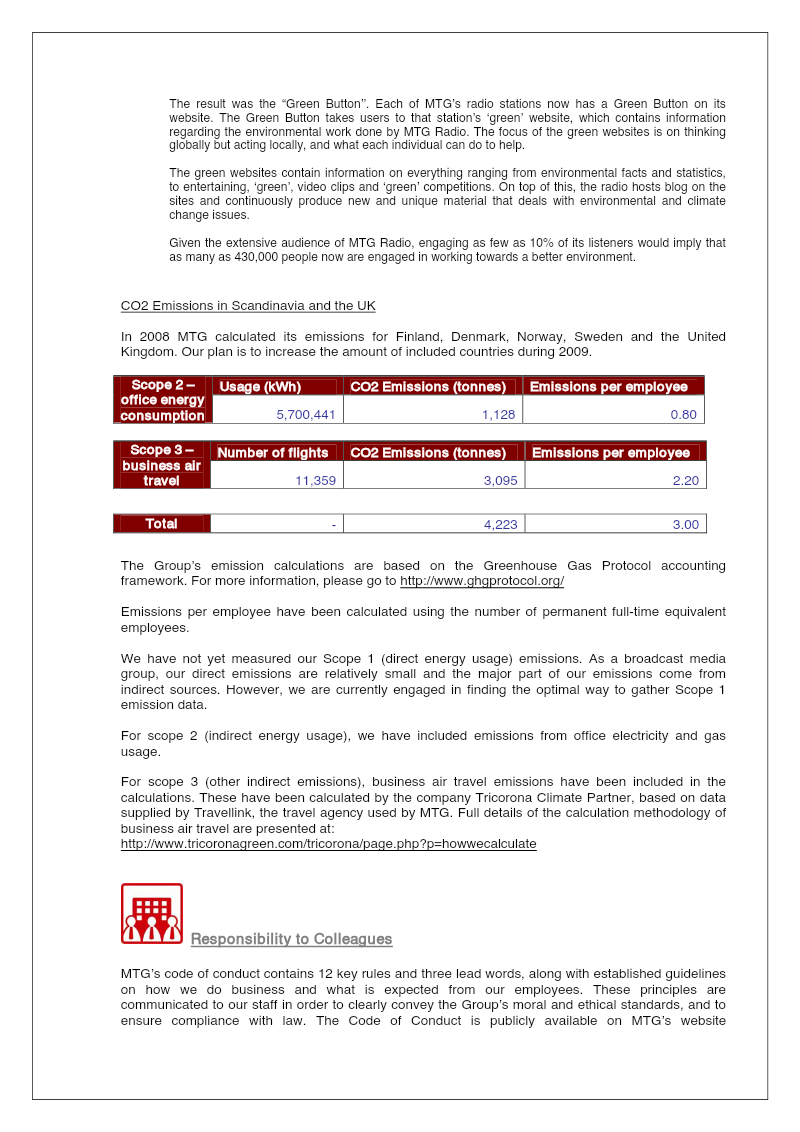
- MTG achieved a 16% total reduction in carbon emissions and office energy use by the end of 2011, resulting in a 6% decline in CO2 per employee compared to the 2009 baseline.
- The company expanded its geographic footprint in 2011 by entering four African nations—Ghana, Uganda, Tanzania, and Kenya—and acquiring stakes in TV Prima, Darial TV, and Balkan Media Group.
- MTG maintained a strong safety record with zero work-related accidents and an absenteeism rate of approximately 1% among its 3,031 employees.
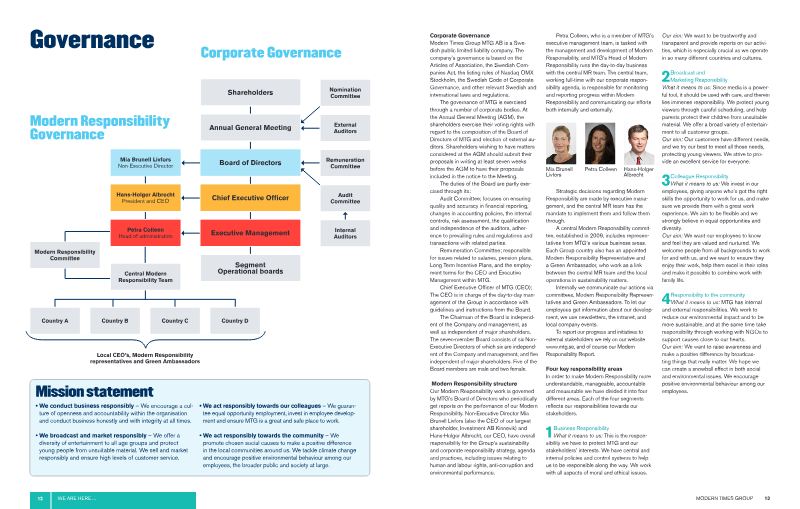


MTG Corporate Responsibility Report 2010
The 2010 Modern Responsibility report presents Modern Times Group’s first GRI-aligned disclosure, expanding the reporting perimeter to encompass all subsidiaries and leased assets that employ staff.
- MTG launched its first GRI-aligned corporate responsibility report in 2010, establishing a formal materiality analysis and crisis-support framework across all subsidiaries.
- Philanthropic efforts leveraged media assets to donate 111 million SEK in airtime and raise over €58 million for global health and disaster relief campaigns.
- Total greenhouse gas emissions rose 7% to 15,032 tonnes of CO2e in 2010, with business travel and facility energy as the primary drivers, leading to a new target of a 5% per-employee reduction by February 2012.
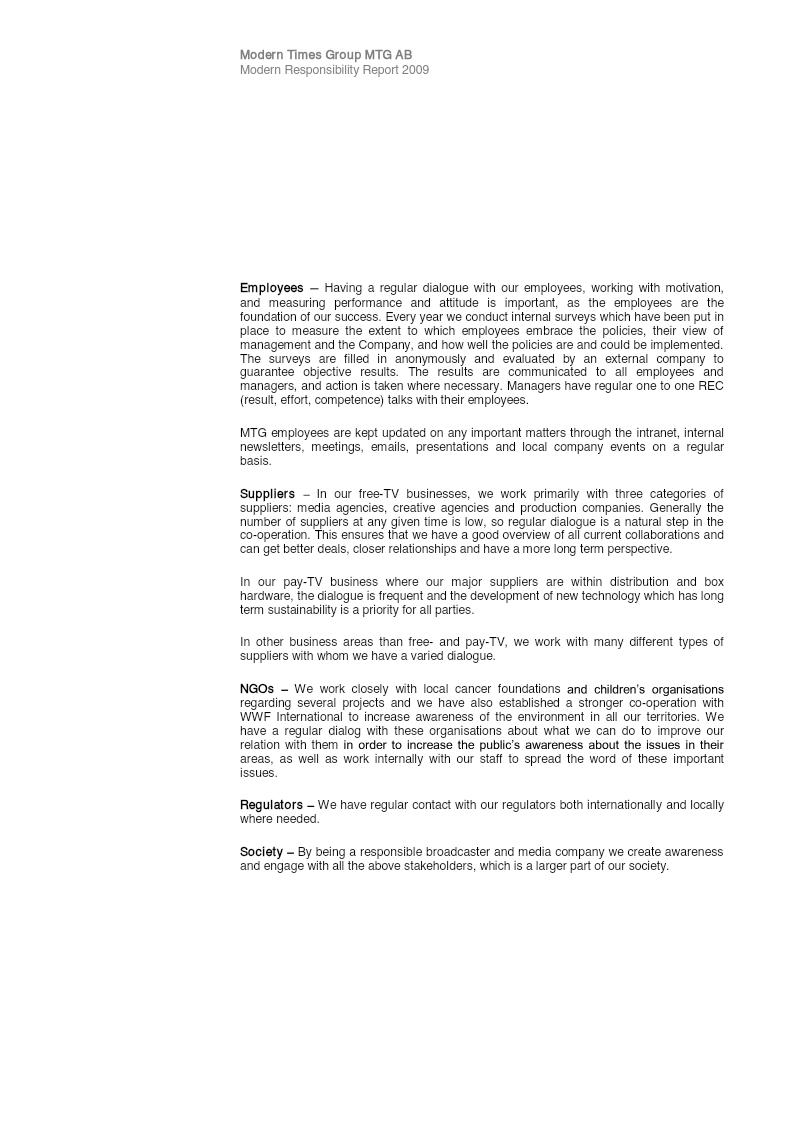
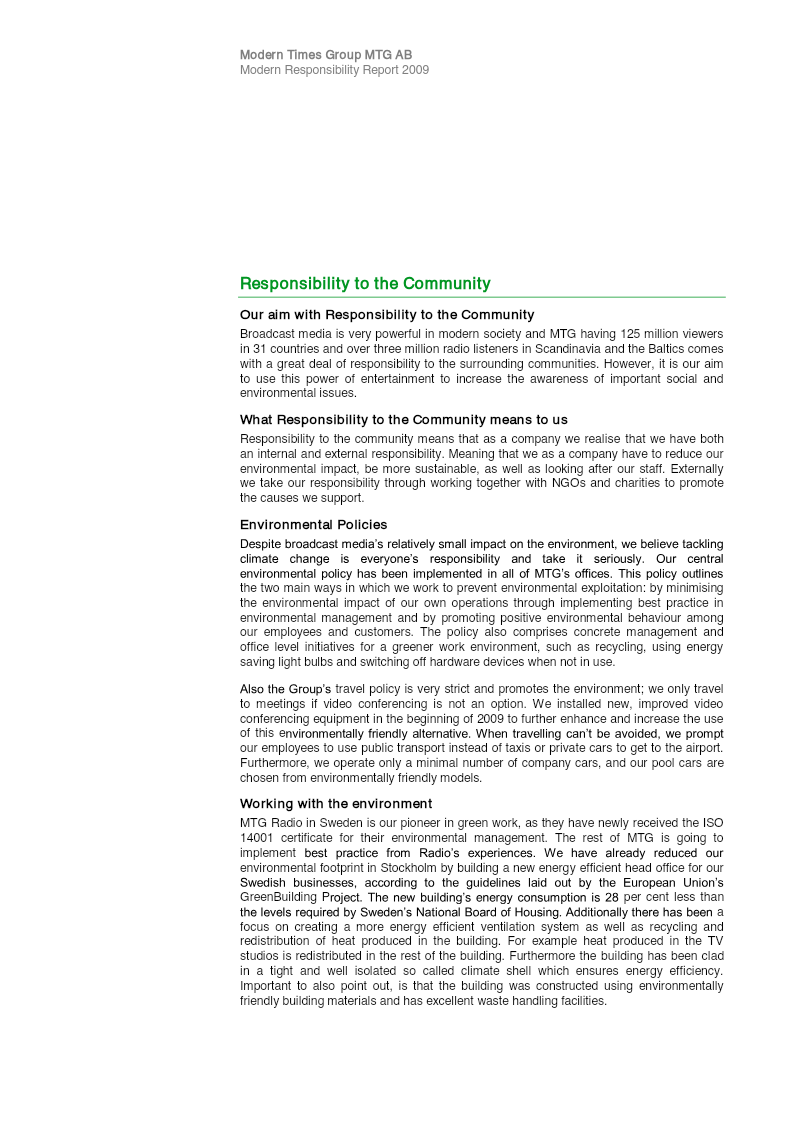
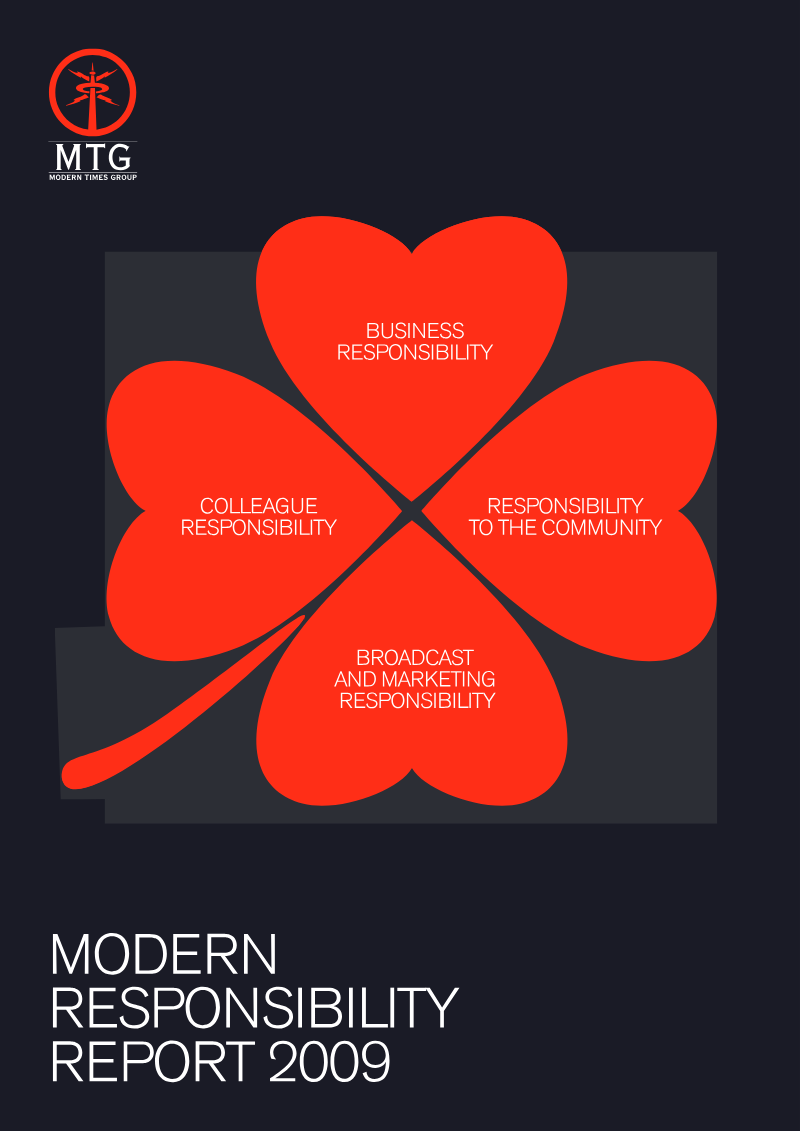
MTG Corporate Responsibility Report 2009
The 2009 Modern Responsibility Report presents Modern Times Group’s (MTG) effort to embed corporate responsibility across its broadcasting and media operations while navigating the aftermath of the 2008-09 financial crisis.
- MTG reported 2009 net sales of SEK 14.2 billion, though operating income resulted in a loss of SEK 1.4 billion and earnings per share fell to -30.86 SEK.
- The company expanded its portfolio during the 2008-09 financial crisis by launching TV3 Puls, Prima COOL, and Viasat Hockey, alongside a major restructuring of Bulgarian assets.
- Employee engagement remained high, with 86% of the 2,906-person workforce participating in the annual survey and 88% reporting enthusiasm for their work.
MTG Corporate Responsibility Report 2008
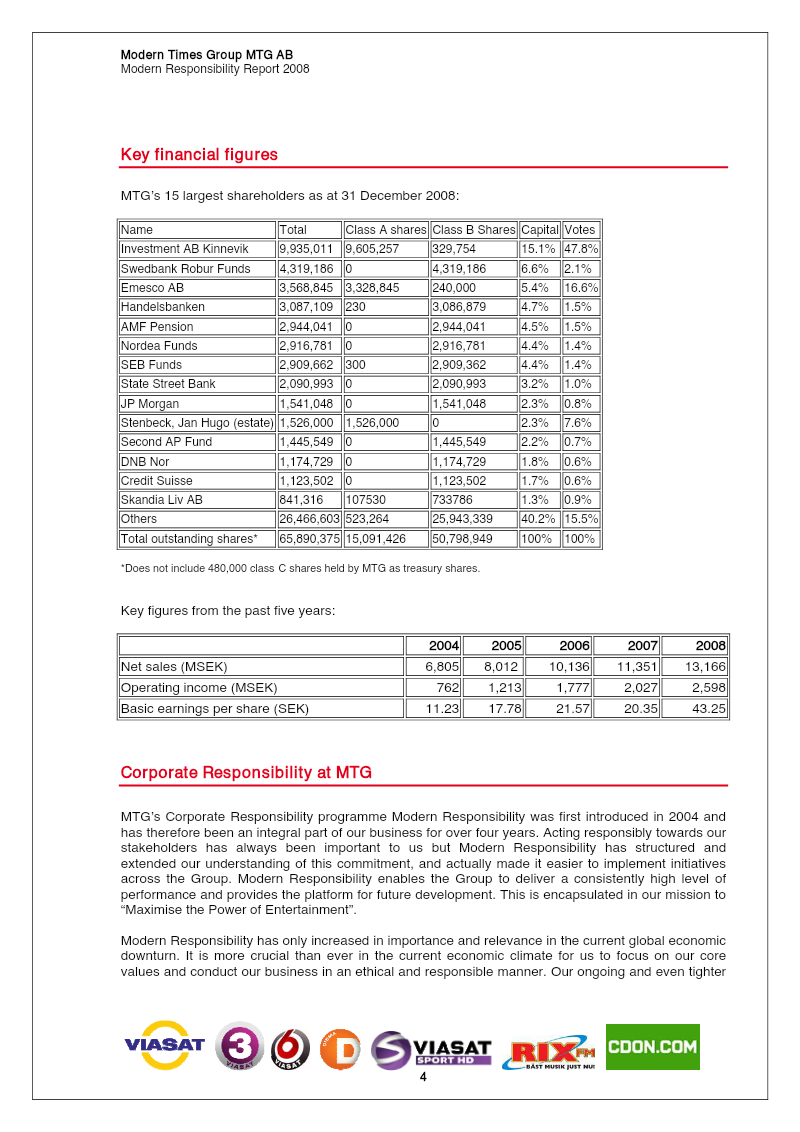
Modern Times Group’s Modern Responsibility programme, launched in 2004, is presented as a strategic framework for leveraging entertainment to create social and environmental value across the company’s global operations.
- In 2008, MTG achieved strong financial growth with net sales of SEK 13.2 billion, an operating income of SEK 2.6 billion, and basic earnings per share of SEK 43.25.
- MTG’s community engagement efforts in 2008 resulted in SEK 78 million worth of donated airtime and SEK 56 million raised for charitable causes.
- The company maintained a workforce of 2,810 employees across 30 countries, with 35% female representation and a 22% staff turnover rate.