Market Forecast reports and market data
Documents

Four Realistic Predictions - What the Future Holds for Games - Extra Credits
The gaming industry is currently undergoing several subtle yet significant structural shifts that are reshaping development and distribution.
- The gaming industry is shifting toward the widespread adoption of third-party licensed engines like Unreal and Unity to reduce the high costs and training burdens associated with maintaining proprietary, in-house technology.
- Studios are increasingly maximizing return on investment by aggressively reusing digital assets, such as models, textures, and audio, across spin-offs, mobile titles, and back-catalog projects.
- AAA developers are redesigning game structures to accommodate shorter, more satisfying play sessions, reflecting a strategic response to modern players who have less time for long, uninterrupted gaming blocks.

Capcom Integrated Report 2015
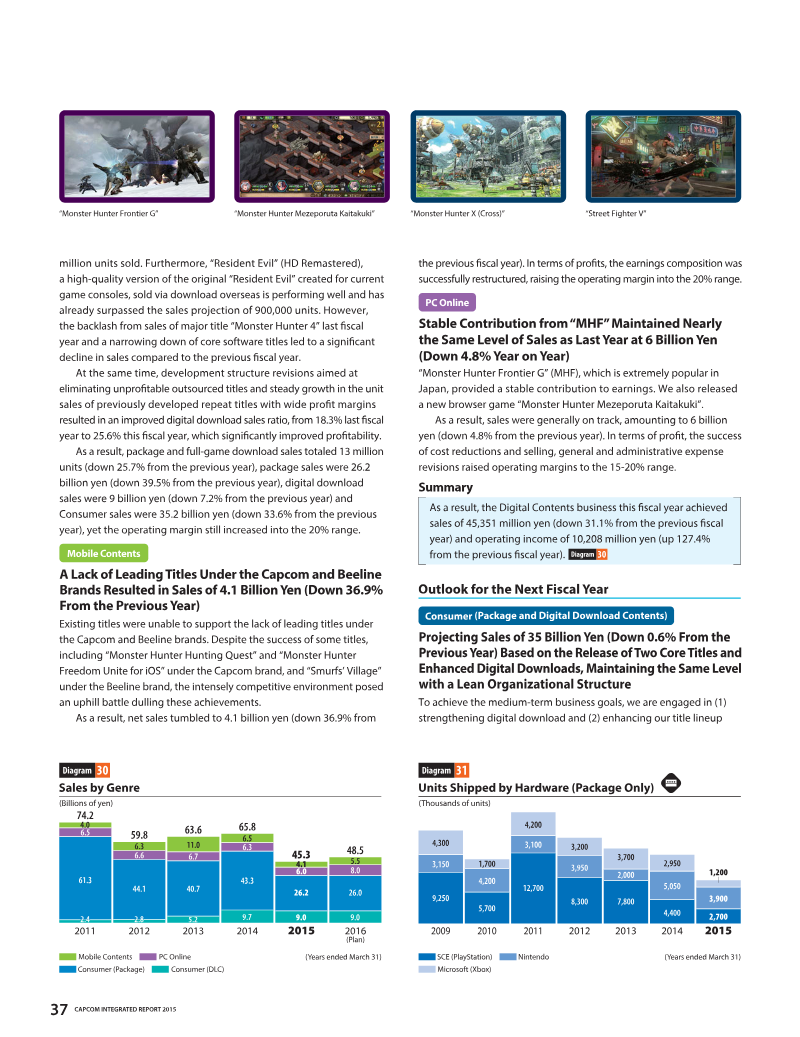
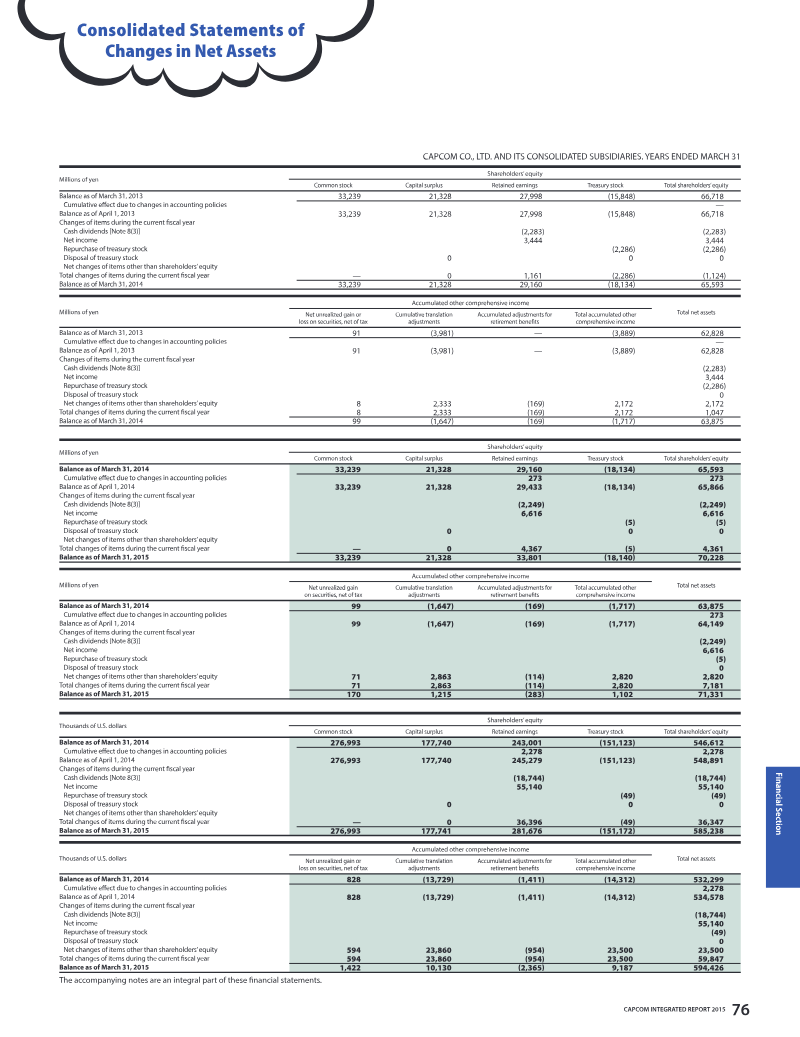
The 2015 Capcom Integrated Report details a strategic pivot toward long-term sustainability and profitability through the "Single Content Multiple Usage" model.
- Capcom targeted a 20% operating margin by 2018 by shifting toward a 'Single Content Multiple Usage' strategy that leverages in-house IP across console, mobile, and PC platforms.
- Despite a 37.1% decline in net sales to 64,277 million yen in fiscal 2015, net income nearly doubled to 6,616 million yen due to organizational restructuring and reduced R&D costs.
- The company achieved a 16.5% operating margin in 2015 by prioritizing high-margin digital downloads and improving overall cost management.

Casual Games Sector Report: Southeast Asia 2015
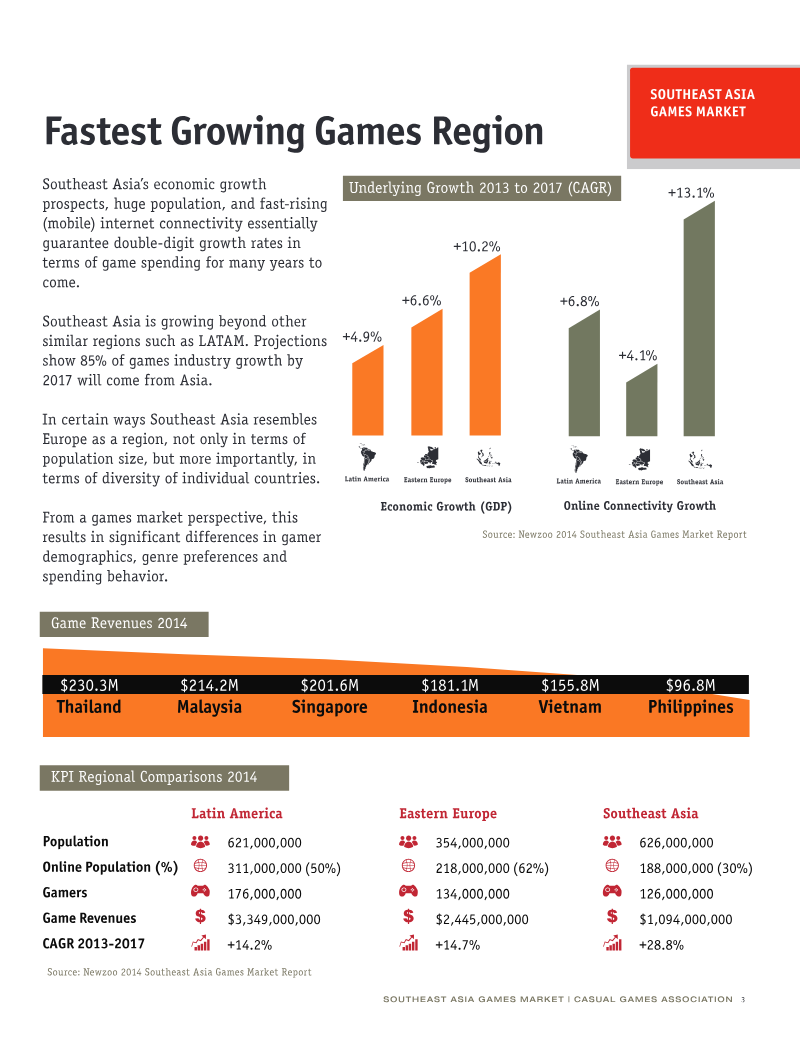
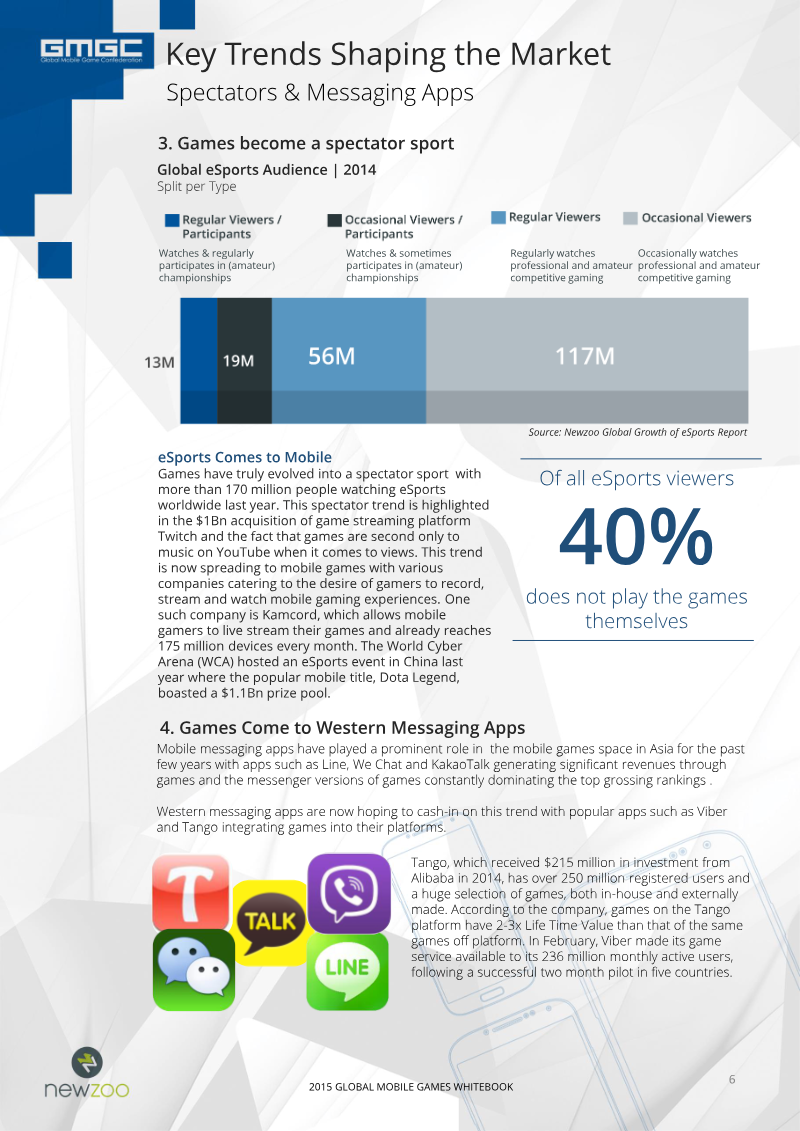
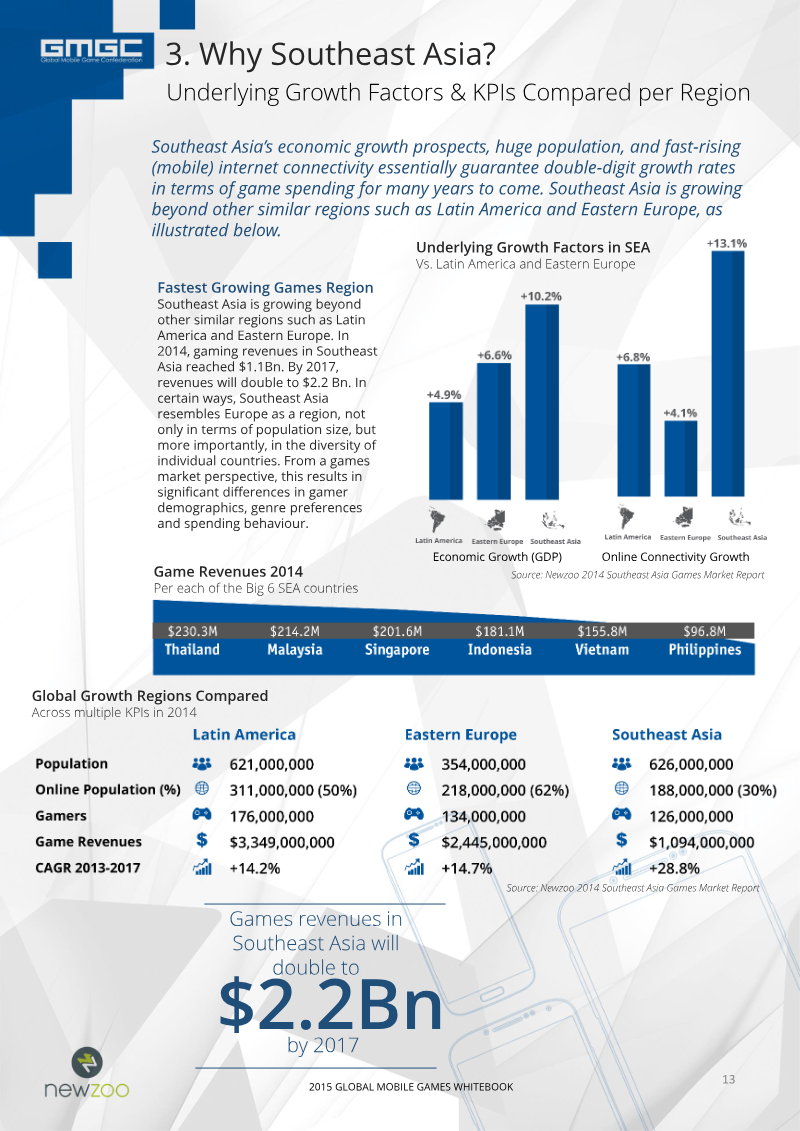
The Southeast Asia games market is positioned as a primary growth engine for the global industry, with total regional revenues projected to double to $2.2 billion by 2017.
- The Southeast Asia games market is projected to reach $2.2 billion in revenue by 2017, growing at a compound annual rate of 28.8%.
- Mobile gaming is the dominant sector across the region, with Western titles from publishers like King and Supercell consistently ranking among the top-grossing applications.
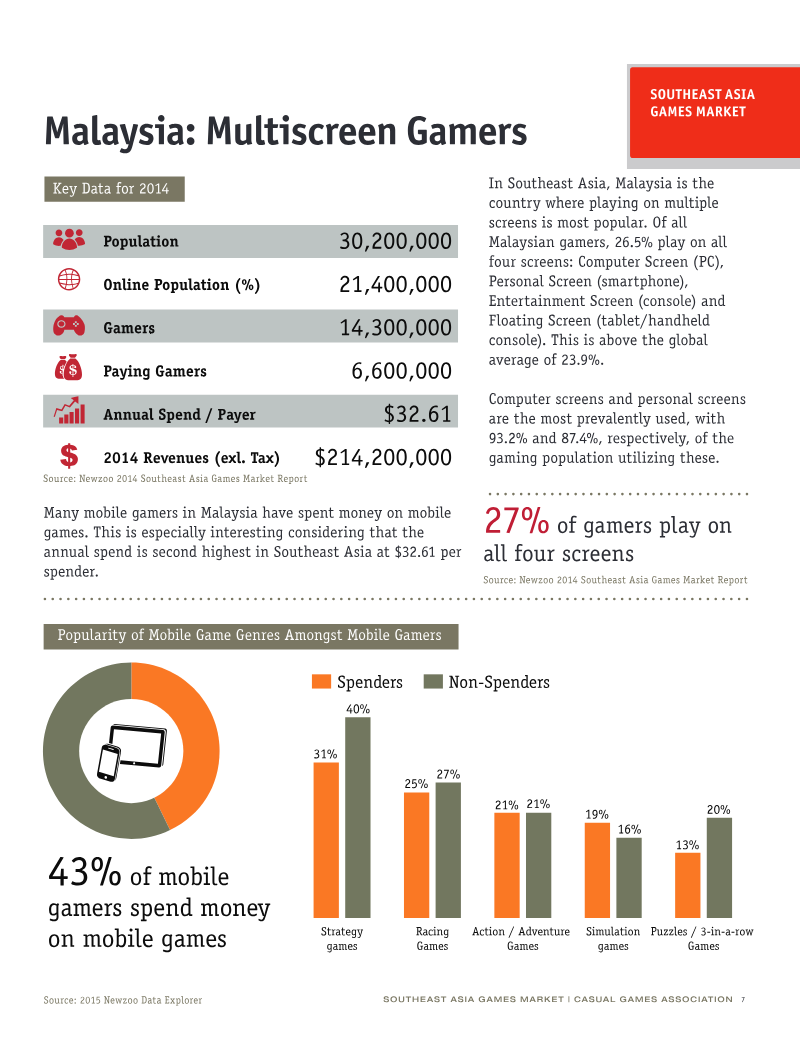
- Thailand currently generates the highest total game revenue in the region, while Singapore leads in monetization with an average annual spend of $189.30 per payer.

Global Mobile Game Industry White Book: 2015
The global mobile gaming industry is undergoing a transformative shift, positioning itself as the dominant force within the broader interactive entertainment sector.
- The global mobile gaming market is projected to reach $30.1 billion in revenue in 2015, establishing itself as the dominant sector in interactive entertainment.
- China serves as a high-engagement market where users spend an average of 35 minutes daily on mobile games, primarily favoring card and role-playing genres.
- Southeast Asia is a rapidly maturing market expected to double its revenue by 2017, providing a strategic entry point for Western publishers due to standardized app store infrastructure.


Casual Games Sector Report 2015: World's Top Games Markets
The 2015 Casual Games Sector Report provides a comprehensive analysis of the global games market, focusing on the shifting dominance between the United States and China.
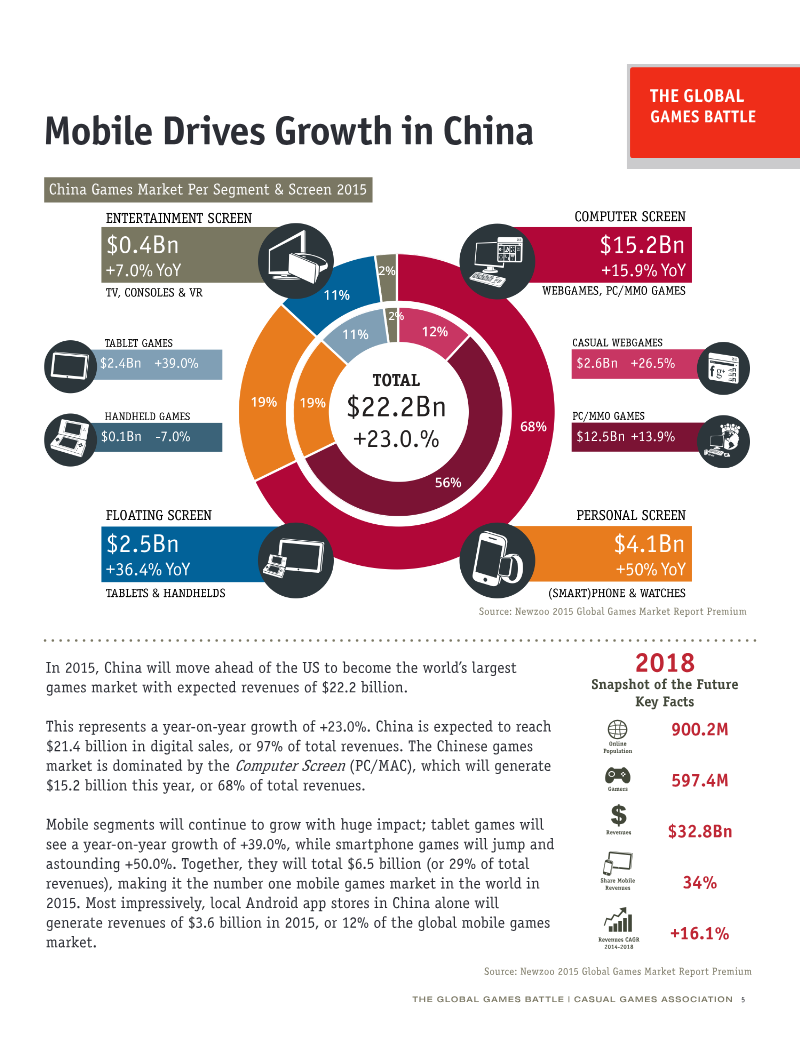
- As of 2015, China surpassed the United States as the world's largest games market, with the two nations projected to account for 50% of global revenue by 2018.
- China’s games market reached $22.2 billion in 2015, marking a 23% year-on-year increase driven by a 50% growth rate in the smartphone gaming segment.
- The US market generated $22.0 billion in 2015, with 45% of its total revenue derived from TV, console, and VR platforms.

Unity, the Riccitiello riddle, and mobile gaming's $40B future
The mobile gaming industry is experiencing rapid, sustained expansion, with market projections indicating a significant shift in the global gaming landscape.
- Mobile gaming is projected to reach $41 billion in revenue by 2017, positioning it to surpass both the console and PC sectors as the largest segment of the global games market.
- Newzoo increased its 2014 mobile gaming revenue forecast from $21.7 billion to $25 billion, reflecting faster-than-anticipated industry expansion.
- Growth is fueled by steady performance in mature markets like North America and Western Europe, alongside rapid expansion in China, which is experiencing growth rates of 85 to 90 percent.
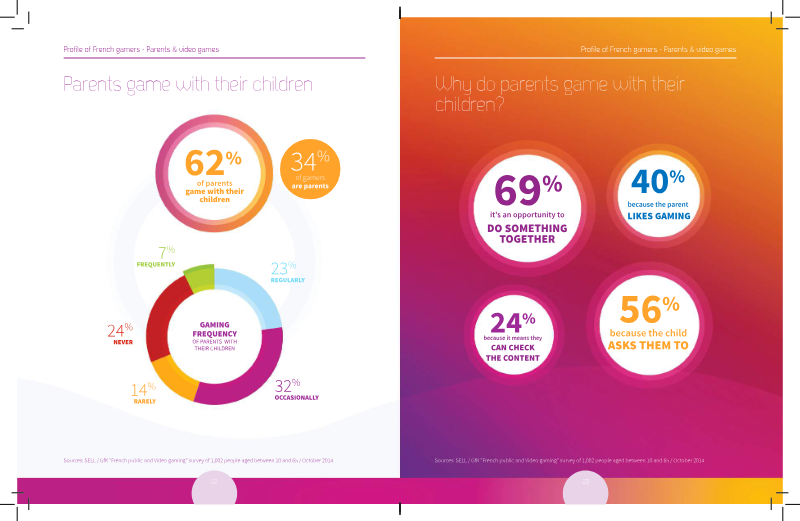

Essential Video Game News: Market Data and Consumption – France (October 2014)
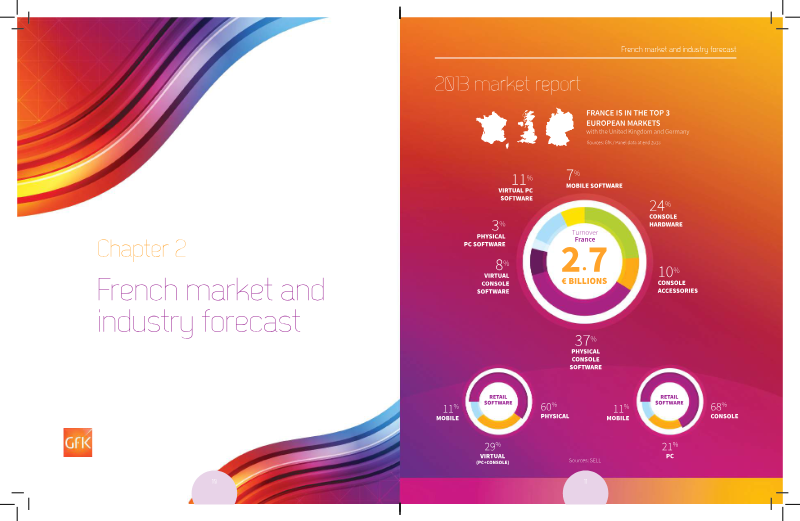
The French video game industry experienced a significant transition in 2013 and 2014, driven by the successful launch of the eighth generation of home consoles.
- The French video game industry is the country's second-largest leisure sector, with 75% of the population aged 10 to 65 playing games at least occasionally.
- Market forecasts for 2014 projected a 7% increase in total industry turnover and a 42% surge in hardware sales, driven by the eighth generation of consoles.
- By the end of 2013, over 17 million French households were equipped with home or handheld gaming consoles.

Ben Cousins on what next's for gaming hardware
The evolution of computing hardware follows a predictable, logarithmic trajectory characterized by three primary trends: decreasing physical size, increasing interface simplicity, and growing user intimacy.
- Computing hardware follows a consistent trajectory toward smaller physical footprints, increased interface simplicity, and greater user intimacy.
- Future gaming platforms will likely be smaller than current smartphones, utilizing intuitive inputs like voice activation and eye-tracking to remove layers of abstraction.
- Historical precedents for wearable technology, such as spectacles and wristwatches, suggest that devices currently viewed as niche will eventually become essential, ubiquitous tools.

Using statistical analysis to predict the success of F2P games
The mobile gaming industry faces a significant challenge in balancing creative development with commercial viability, particularly as the market shifts toward free-to-play (F2P) models.
- Predictive modeling using a 'Game Power Score' shows a strong correlation with market success, as over 80% of titles scoring 85 or higher have reached the top 100 U.S. top-grossing charts.
- Statistical analysis allows developers to evaluate commercial viability during the concept and development phases, reducing reliance on subjective team reputation and soft-launch performance metrics.
- The scoring methodology identifies specific design weaknesses, such as ineffective progression or re-engagement loops, and enables scenario simulations to test how adjustments impact projected performance.

How Minecraft Changes the Future of Games - Minecraft Generation - Extra Credits
The long-term influence of Minecraft on the video game industry extends far beyond its immediate commercial success, representing a fundamental shift in the developmental experiences of a new generation of players.
- Minecraft is shifting the gaming industry away from reflex-based, instant-gratification design toward a paradigm centered on patience, construction, and creative labor.
- The maturation of the 'Minecraft generation' into the primary consumer base is expected to reshape industry standards over the next decade.
- Future AAA game development will likely move away from strictly action-focused mechanics to accommodate more methodical genres like deep simulations and tactical shooters.

How mobile will boost the games market to over $100 billion
The global games industry is projected to exceed $100 billion in revenue by 2017, a milestone driven primarily by the rapid expansion of the mobile sector and significant growth within Asian markets.
- The global games industry is projected to surpass $100 billion in revenue by 2017, fueled primarily by the mobile sector and rapid growth in Asian markets.
- Mobile games generate over 70% of total global application revenue, outperforming traditional console and subscription models in profitability and development efficiency.
- Multiplayer and player-versus-player mobile games generate up to 13 times the revenue of single-player titles due to superior engagement and retention metrics.

Mobile is the dominant driver for the game's industry say Applifier's CEO
Mobile gaming is rapidly emerging as the primary growth engine for the global interactive entertainment sector, with projections indicating the market will expand from $13 billion in 2013 to $22 billion by 2015.
- The mobile gaming market is projected to grow from $13 billion in 2013 to $22 billion by 2015, establishing it as the primary growth engine for the interactive entertainment sector.
- The influx of console-quality development talent into the mobile space is shifting the industry focus from casual titles toward more complex, mid-core, and core gaming experiences.
- Mobile platforms are increasingly characterized by a winner-take-all environment, where app store saturation makes content discoverability a critical structural challenge for developers.